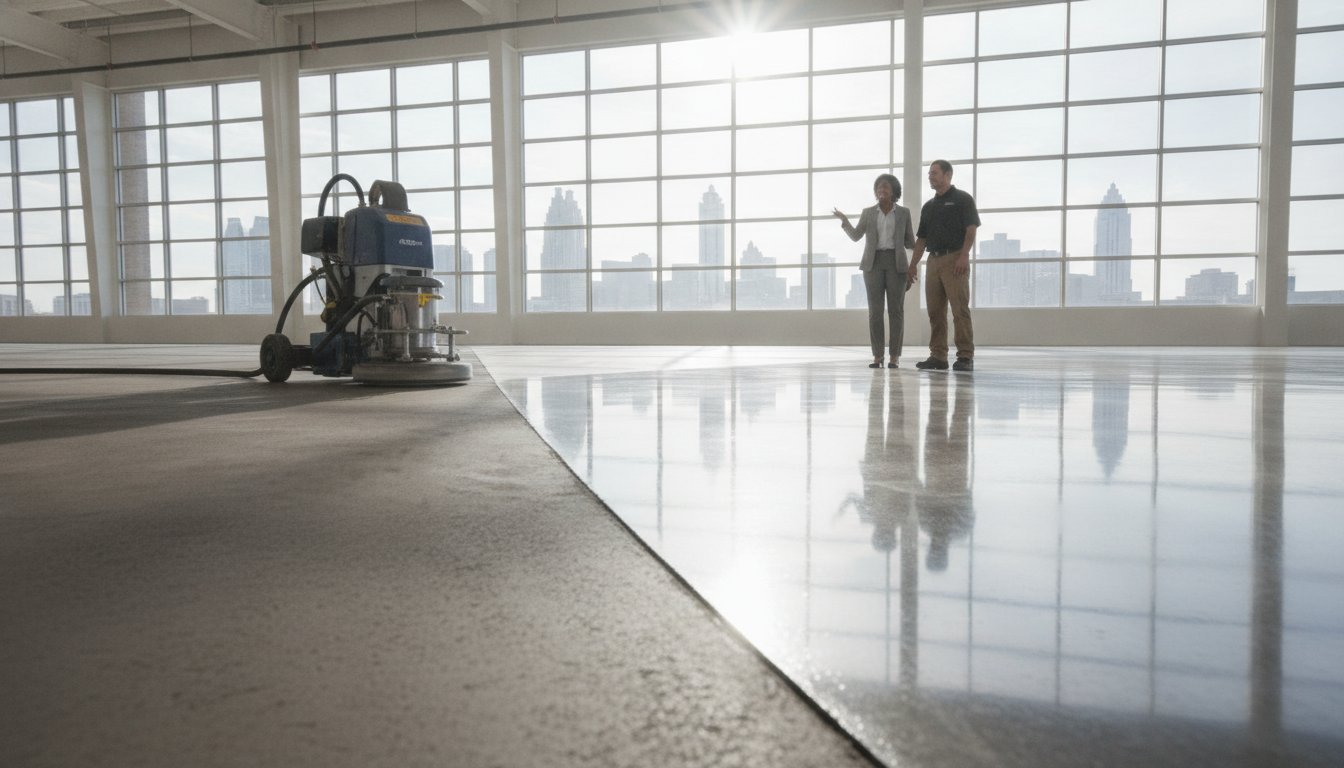
A floor that fails isn't just an eyesore. It's a liability that drains your bottom line. Most facility managers live with the looming threat of delamination or the hidden costs of a poorly executed finish. It's a valid concern. Professional concrete polishing systems are not merely a series of grinding steps. They are a scientifically engineered sequence of mechanical refinement and chemical transformation. You deserve a surface that stands up to the heavy traffic of a busy Atlanta warehouse while maintaining a high-performance profile. Precision is the only standard that matters.
You likely feel the pressure to choose a finish that balances aesthetic appeal with industrial-grade resilience. We'll show you how. This guide helps you master the technical components and selection criteria of professional systems to ensure your facility achieves maximum durability. We'll provide a clear understanding of the ROI for different polishing grades and how to slash lifetime maintenance costs. It's time to replace uncertainty with technical precision. We're moving from the abstract concept of quality to the concrete reality of a superior floor.
Key Takeaways
- Understand why professional concrete polishing systems must integrate mechanical refinement with chemical densification to achieve lasting durability.
- Identify the essential roles of high-mass planetary grinders and precision diamond tooling in creating a perfectly flat, high-performance surface.
- Learn how to select the optimal performance grade by matching your facility's traffic patterns and spill risks to specific industrial or architectural finishes.
- Recognize that surface preparation is the non-negotiable foundation of every project, requiring expert floor glue removal and substrate remediation.
- Gain a strategic understanding of the ROI associated with different polishing grades to minimize long-term maintenance expenses.
Beyond the Surface: What Defines a Professional Concrete Polishing System?
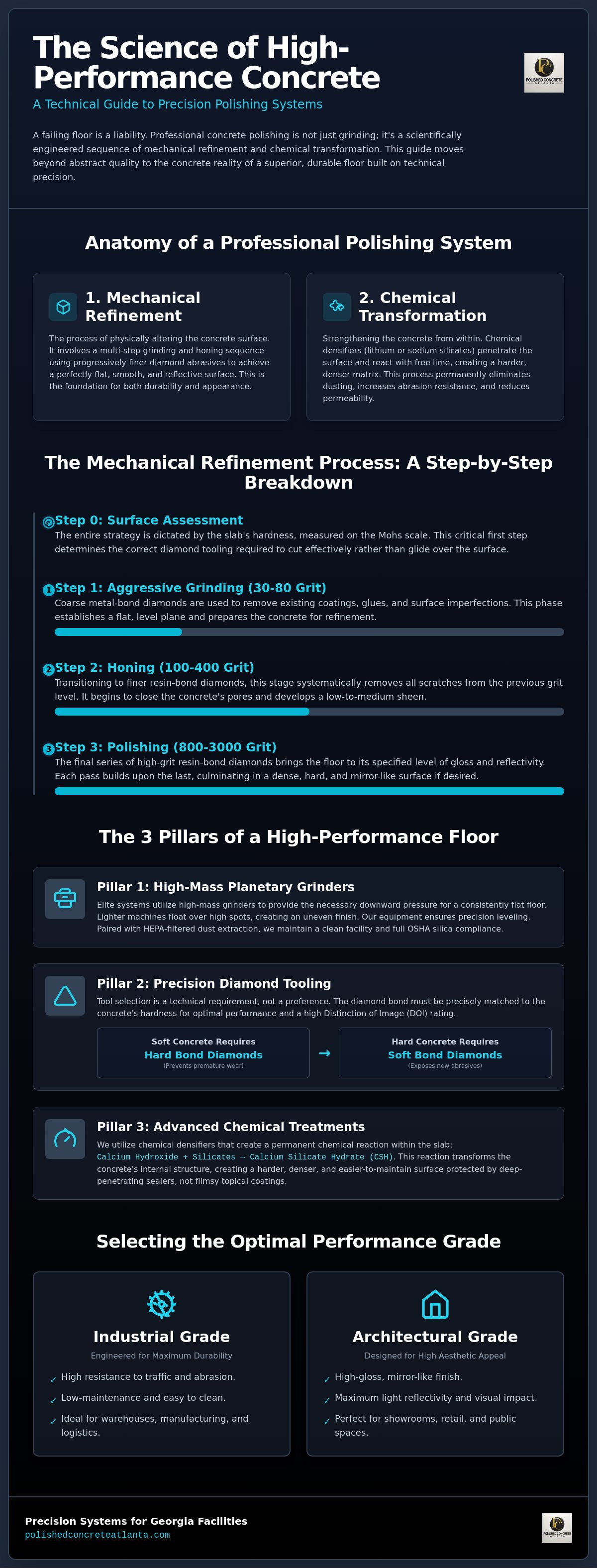
A floor is only as strong as the logic behind its creation. Professional concrete polishing systems are not merely a collection of tools; they are a scientifically engineered sequence of mechanical grinding, chemical densification, and resinous refinement. Choosing an ad-hoc grinding method is a gamble that rarely pays off. A true system approach ensures long-term durability and a finish that won't delaminate under pressure. We rely on standardized protocols to achieve repeatable, high-luster results every time. To truly understand what is polished concrete, one must look at the synergy between these steps. Before any work begins, we assess the slab's hardness using the Mohs scale. This data point dictates our entire strategy. Hard concrete requires a specific diamond bond to ensure the tools actually cut rather than glide. Soft concrete needs the opposite. Precision starts with the first scratch.
The Science of Mechanical Refinement
The process begins with aggressive metal-bond diamond tooling to level the surface and remove existing coatings. As the floor becomes smoother, we transition to resin-bond diamonds. These tools are designed to close the surface and build the sheen. Grit levels typically range from a coarse 30-grit to a mirror-like 3000-grit finish. Refinement is the total removal of scratches from the previous grit level. If a contractor rushes this stage, the final product will look hazy. Quality cannot be faked. Each step must be completed with meticulous attention to detail to ensure the next grit can do its job effectively.
Chemical Transformation: The Role of Densifiers
Mechanical work alone is insufficient for high-traffic environments. We use chemical densifiers, specifically lithium or sodium silicates, to transform the concrete's internal structure. These chemicals react with the calcium hydroxide naturally present in the slab to create calcium silicate hydrate. This reaction hardens the surface from within and permanently eliminates the problem of "dusting." While standard densifiers provide the foundation, we often utilize high-performance penetrating sealers for added resistance. These are not topical coatings that peel; they are deep-penetrating agents that protect the integrity of the concrete polishing systems we install. This chemical fusion creates a floor that is harder, denser, and easier to maintain.
The Core Components: Grinding, Densification, and Diamond Tooling
A high-performance floor isn't an accident. It's the calculated result of three pillars working in perfect harmony: machinery, tooling, and chemicals. You can't compromise on one and expect the others to compensate. Elite concrete polishing systems rely on high-mass planetary grinders. These machines provide the necessary downward pressure to achieve consistent floor flatness. Without this mass, a grinder simply floats over high spots rather than leveling them. We don't settle for "good enough" profiles. We demand precision.
Operational safety is just as critical as the final finish. We utilize industrial-grade, HEPA-filtered dust extraction systems on every project. This keeps your facility clean and ensures we remain fully compliant with OSHA silica standards. It's a non-negotiable part of our professional process. Beyond the machinery, we integrate proven systems like the Ashford Formula into our mechanical steps. This isn't a topical layer. It's a chemical hardening process that becomes a permanent part of the slab's matrix, ensuring the floor can handle the rigors of industrial use.
High-Performance Diamond Tooling
Tooling choice is where most contractors fail. You must select the correct bond (hard, medium, or soft) for the specific concrete slab. It's a technical requirement. Soft concrete requires a hard bond tool to prevent premature wear. Hard concrete needs a soft bond to expose new diamonds constantly. This alignment is what separates a mediocre floor from one with a high Distinction of Image (DOI) rating. We follow ASCC technical standards to ensure every diamond pass is executed with mathematical accuracy. Quality tooling produces quality results. Period.
Advanced Chemical Treatments
The refinement process involves more than just grinding. We apply specialized grout coats to fill micro-cracks and pinholes. This creates a truly monolithic surface. After the final polish, we use stain protectors and guard products to provide a critical layer of chemical resistance against oils and spills. To protect your long-term investment, you must use pH-neutral cleaners for daily maintenance. Anything else risks etching the surface and dulling the shine. If you're ready to upgrade your facility, our team specializes in industrial floors that stand the test of time. We deliver durability without excuses.
Industrial vs. Architectural Systems: Selecting the Right Performance Grade
Selection is a strategic decision. You don't choose a floor based on a whim; you choose it based on the specific mission of your facility. Industrial environments demand a different caliber of resilience than a high-end retail showroom. Professional concrete polishing systems are versatile, but they must be tuned to the specific stressors they'll encounter. Traffic volume, chemical exposure, and aesthetic expectations are the variables that define your performance grade. We don't guess. We engineer the solution to match the environment.
Balancing gloss with safety is a technical requirement. While a high-gloss finish looks impressive, you must ensure the Static Coefficient of Friction (SCOF) meets safety standards. A properly executed system achieves a .50 SCOF, which is the required OSHA standard for slip resistance, even with a high shine. Facility managers can justify the cost of higher refinement by calculating the reduction in long-term maintenance. High-refinement floors are significantly easier to clean and require less frequent resealing than lower-grade alternatives. You're trading upfront precision for decades of worry-free performance.
Heavy-Duty Industrial Systems
Warehouses and manufacturing plants need a workhorse, not a showpiece. For these high-impact zones, we typically recommend a satin finish achieved through 400 to 800 grit refinement. This specific range is intentional. It provides a dense, durable surface that hides forklift tire marks and resists abrasion from heavy machinery. These systems prioritize load-bearing capacity and impact resistance over a mirror-like shine. It's about maintaining operational efficiency without constant floor repairs. A properly maintained industrial floor can last 20 years or more, making it a superior long-term investment compared to temporary coatings.
High-End Architectural Systems
Retail spaces and corporate lobbies require a different level of sophistication. These architectural finishes often involve "Class A" aggregate exposure and high-gloss refinement reaching 1500 to 3000 grit. The result is a mirror-like surface that significantly enhances natural light. This reflectivity doesn't just look elite; it can actually reduce artificial lighting needs and lower energy costs. We also integrate decorative elements like stained concrete or custom brand logos directly into the concrete polishing systems we install. It's a premium investment that pays dividends in both brand perception and reduced utility expenses.
A flawless finish is an illusion if the substrate is failing. It's the hard truth of the flooring industry. No concrete polishing systems, regardless of the diamond quality or chemical grade, can overcome a compromised foundation. For older industrial facilities in the Atlanta region, surface preparation can account for 30% to 40% of the total project investment. We view this as a necessary insurance policy. We treat the substrate with the same technical rigor as the final polish. If the base isn't right, the system will fail. Delamination and premature wear are the inevitable results of a rushed start. Precision begins before the first polishing diamond ever touches the floor.Moisture Mitigation and Sweating Slab Syndrome
Atlanta's notorious humidity creates a specific, dangerous challenge: Sweating Slab Syndrome (SSS). This phenomenon occurs when warm, moist air condenses on the cooler concrete slab or when vapor drives upward from the earth through the porous concrete. It's a disaster for floor longevity. SSS turns a high-performance surface into a slip hazard and can cause the internal chemistry of the finish to degrade. We don't guess about moisture levels. We conduct rigorous testing. Our protocols involve installing moisture barriers before the final polishing steps to neutralize osmotic pressure. These strategies align with the updated 2026 Georgia building codes to ensure full compliance and structural integrity. Peace of mind comes from a dry, stable slab.
Glue Removal and Surface Leveling
Most commercial floors carry the residues of previous installations. We specialize in the mechanical removal of mastic, carpet glue, thin-set, and failed epoxy coatings. This is a labor-intensive process that requires heavy-duty machinery and a focused attention to detail. As expert concrete surface preparation contractors, we know that a level floor is a non-negotiable requirement for a uniform shine. We use aggressive grinding to eliminate high spots and remediate uneven transitions. This ensures that the subsequent polishing diamonds make consistent contact with the surface. Without professional leveling, your floor will suffer from inconsistent aggregate exposure and a patchy, unprofessional appearance. We deliver a monolithic, perfectly refined surface every time. If you need a partner who understands that the foundation dictates the finish, we provide the floor preparation services required for total success. Quality is built from the bottom up. No excuses.
The Polished Concrete Atlanta Advantage: Precision Systems for Georgia Facilities
Authority is earned through decades of technical execution and an uncompromising commitment to quality. We don't just install floors; we engineer assets that enhance your operational efficiency. Our approach to concrete polishing systems is rooted in a no-nonsense pragmatism that prioritizes tangible results over flowery descriptions. We understand that a facility manager’s greatest fear is floor failure. We eliminate that uncertainty. By combining seasoned industry leadership with the latest technical innovations, we ensure your investment is a worry-free, long-term success. We've mastered the craft so you don't have to worry about the details.
Choosing a local partner means choosing someone who understands the specific environmental stressors of the Southeast. We don't apply a one-size-fits-all solution. Instead, we consult with you to develop custom system specifications tailored to your specific traffic volume and load requirements. Whether you're managing a massive distribution center or a high-end retail space, we provide the strategic alliance necessary to achieve elite results. We move from the abstract concept of quality to the concrete reality of a high-performance floor. Precision is our only standard.
Local Expertise in Atlanta Commercial Environments
Georgia's environment presents unique challenges that out-of-state contractors often overlook. The high iron oxide content in Georgia red clay makes it incredibly abrasive when tracked into a facility. Without a properly densified and refined surface, this clay can act like sandpaper, dulling your finish and increasing maintenance costs. We've been setting the standard for polished concrete floors in Atlanta since 2004. Our deep understanding of local logistical needs and the 2026 Georgia building codes ensures your project remains compliant and durable. We are a reliable partner who knows exactly how the local climate impacts your slab’s behavior over time.
Total Project Accountability
We believe in total accountability. This means we manage every phase of the project lifecycle, from initial floor glue removal and moisture mitigation to the final high-luster seal. You won't have to coordinate between multiple subcontractors or deal with the finger-pointing that occurs when a "cheap" quick-fix fails. We prioritize transparency and long-term value because we know that the cheapest bid is often the most expensive floor in the long run. Our concrete polishing systems are designed for those who refuse to settle for mediocrity. If you're ready to secure a floor that reflects the integrity of your business, contact Polished Concrete Atlanta today for a technical consultation. We deliver the elite craftsmanship your facility deserves.
Secure Your Facility's Future with Technical Precision
Your floor is a long-term investment that dictates the safety and efficiency of your entire operation. It's an asset that requires strategic management. We've demonstrated that elite concrete polishing systems are the result of technical synergy, not just generic grinding. From rigorous moisture mitigation to precision diamond refinement, every step must be executed with unwavering discipline. We don't believe in shortcuts. We believe in results.
We've been serving the Atlanta region since 2004. Our team specializes in heavy-duty industrial and commercial environments where floor failure isn't an option. As experts in moisture mitigation and comprehensive floor preparation, we ensure your facility stands on a foundation of absolute reliability. Don't settle for mediocrity when you can have a high-performance surface engineered for decades of durability. It's time to eliminate uncertainty and invest in craftsmanship that lasts. Get a Professional Quote for Your Atlanta Facility Floor and experience the advantage of working with a dedicated partner. We're ready to elevate your facility to the highest standard of excellence.
Frequently Asked Questions
What are the main components of a concrete polishing system?
A professional system integrates high-mass planetary grinders, precision diamond tooling, and chemical densifiers like lithium silicates. These elements work in a specific sequence to refine the slab's surface and harden its internal matrix. It isn't just about the tools; it's about the methodology. Using standardized protocols ensures that the mechanical refinement and chemical transformation result in a monolithic, high-performance floor. Precision is the only way to guarantee a result that lasts.
How long does a professional concrete polishing system typically last?
A properly maintained system can last 20 years or more in a commercial environment. Its longevity stems from the fact that the finish is part of the slab itself rather than a topical coating. While the surface may need a light reseal every 3 to 5 years in high-traffic zones, the structural integrity remains intact. This makes it a superior long-term investment for any industrial facility that prioritizes durability over temporary fixes.
Is polished concrete more durable than epoxy for industrial warehouses?
Polished concrete often outperforms epoxy in industrial settings because it doesn't peel, flake, or delaminate under heavy traffic. Unlike epoxy, which acts as a plastic-like skin, concrete polishing systems densify the existing slab to increase its natural strength. It won't yellow or scratch as easily. This reduces the total cost of ownership by eliminating the need for periodic coating removals and re-applications. You get a harder, more resilient surface that stands up to forklift traffic.
Can any concrete floor be polished using these systems?
Most structurally sound slabs can be polished, though the final result depends heavily on the initial concrete quality. Slabs with excessive cracking or severe oil contamination require extensive remediation before the process begins. We evaluate the Mohs hardness and surface integrity of every floor to determine the best approach. If the substrate is too soft or damaged, we recommend specific floor preparation steps to stabilize the base first. Quality starts with the substrate.
How much maintenance do polished concrete systems require in high-traffic areas?
Maintenance is minimal but must be disciplined to preserve the floor's luster. Daily sweeping and occasional damp mopping with pH-neutral cleaners are usually sufficient to remove abrasive debris. You don't need waxes or strippers. In high-traffic Atlanta warehouses, using an auto-scrubber with clean water ensures the surface remains slip-resistant and visually sharp. It's a low-effort, high-impact maintenance routine that saves significant labor costs over the life of the floor.
What is the difference between a grind-and-seal and a true polished concrete system?
A grind-and-seal uses a topical sealer to create shine, whereas a true polished system achieves its sheen through mechanical refinement. Grind-and-seal projects are faster but prone to scratching and wear as the topical layer degrades. True concrete polishing systems involve multiple diamond-grinding steps and chemical densification to close the pores of the concrete. This creates a permanent, reflective surface that doesn't rely on a temporary film. We don't settle for superficial results.
Does the system include moisture mitigation for older concrete slabs?
Moisture mitigation is a critical component of our professional flooring protocols. Older slabs often lack a vapor barrier, leading to issues like Sweating Slab Syndrome. We conduct rigorous moisture testing and install specialized barriers to block vapor drive before finishing the floor. Addressing these subsurface issues prevents osmotic pressure from compromising the finish. It's an essential step for ensuring the long-term stability of the system in Georgia's humid climate.
How do concrete polishing systems improve facility safety and slip resistance?
These systems improve safety by creating a high-traction surface that meets or exceeds OSHA standards for slip resistance. Even with a high-gloss finish, a properly polished floor maintains a static coefficient of friction of .50 or higher. The increased reflectivity also enhances ambient lighting. This improves visibility in large warehouses and manufacturing plants, reducing the risk of accidents while simultaneously lowering artificial lighting costs. Safety and performance go hand in hand.


