
Did you know that roughly 70% of DIY floor coatings in professional environments fail within the first twenty-four months? It's a staggering figure that points to a hard truth. A shop floor is a piece of industrial equipment, not a weekend painting project. You need an auto shop epoxy floor coating Atlanta GA solution that doesn't just look good on day one, but survives the relentless grind of a high-volume service center. We know the frustration of seeing a new finish peel under hot tires or dissolve when a technician spills DOT 4 brake fluid. It's an expensive setback that stalls your operations and erodes customer trust.
This article provides the blueprint to engineer a high-performance, chemical-resistant floor designed to last a decade or more. You'll discover how to navigate the specific challenges of Georgia's humid climate and impermeable red clay through advanced moisture mitigation. We will preview the 2026 professional standard, including hybrid layered systems and mechanical preparation techniques that ensure an unbreakable bond. From achieving the perfect slip-resistance to selecting topcoats that repel oil and grease, this is your guide to building a world-class facility that commands respect.
Key Takeaways
- Identify why industrial resinous systems are mandatory for handling the extreme point loads of floor jacks and heavy tool chests.
- Explore the 2026 hybrid architecture that uses high-solid epoxy for bonding and polyaspartic topcoats for rapid return-to-service.
- Understand the necessity of mechanical diamond grinding to ensure an auto shop epoxy floor coating Atlanta GA achieves a permanent chemical bond.
- Learn to vet contractors based on their moisture mitigation protocols and adherence to international concrete repair standards.
Beyond Aesthetics: Why Auto Shops Require Industrial-Grade Epoxy Coatings
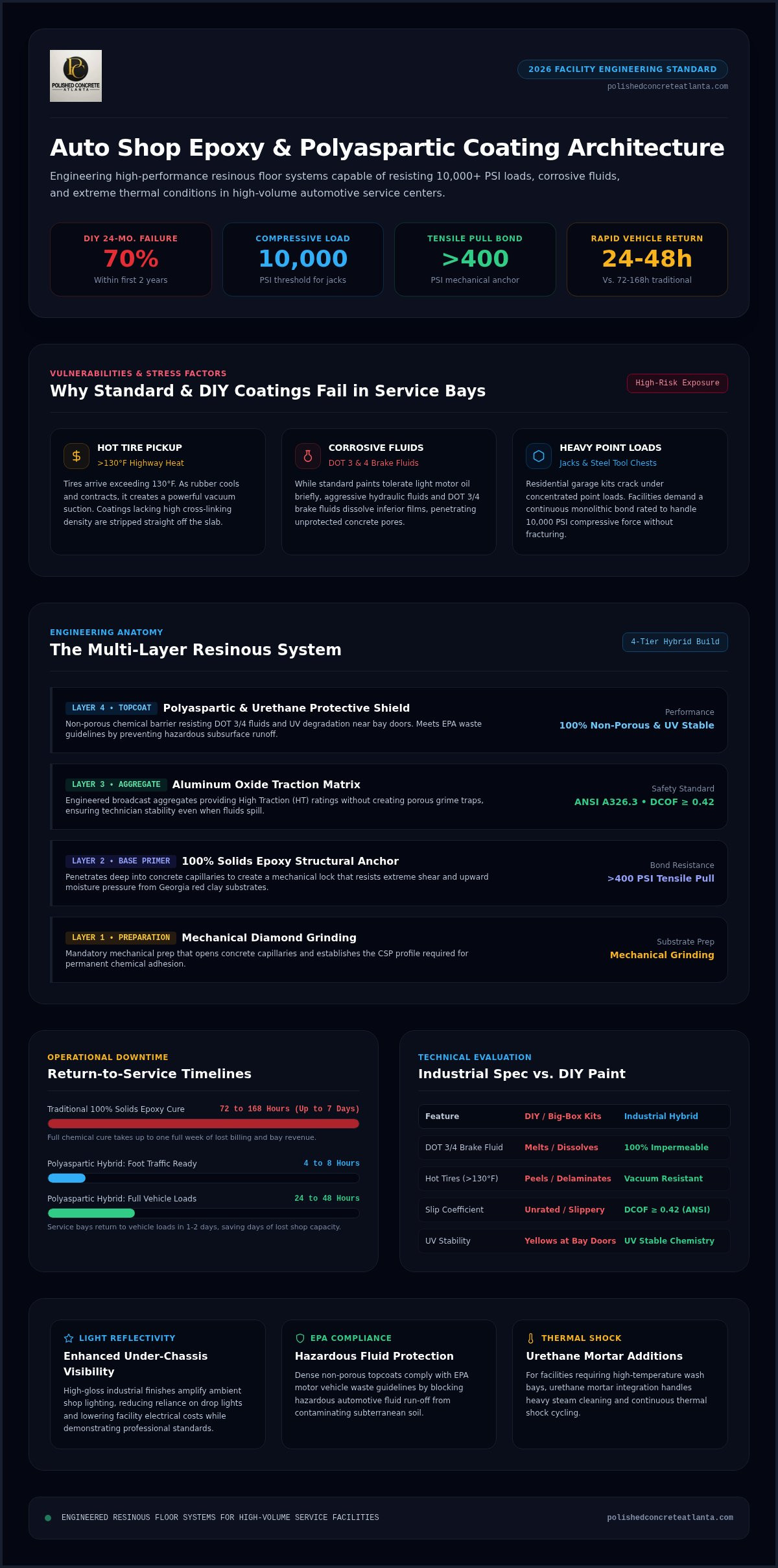
A professional service bay isn't a showroom; it's a high-impact work zone. Choosing an auto shop epoxy floor coating Atlanta GA requires looking past the glossy surface to the engineering beneath. Big-box store "garage kits" are designed for light foot traffic and occasional parking. They lack the high-solids chemistry needed to withstand the 10,000 psi compressive strength required in a mechanical environment. When a technician drops a heavy tool chest or positions a jack stand, a thin residential coating will crack and flake. Professional grade industrial epoxy resin systems create a monolithic bond with the concrete, turning the floor into a durable asset. It's about resilience, not just appearance.
Chemical exposure is another point of failure for inferior products. While standard paints might resist motor oil for a short window, they often melt when exposed to DOT 3 or DOT 4 brake fluid. A true industrial system provides a non-porous shield that prevents these corrosive fluids from reaching the slab. Safety is also paramount. By integrating broadcast aggregates, we ensure your facility meets ANSI A326.3 standards with a Dynamic Coefficient of Friction (DCOF) of 0.42 or higher. This keeps your team on their feet even when fluids hit the floor.
The Threat of Hot Tire Pickup
Hot tire pickup is the silent killer of cheap coatings. When vehicles arrive after highway driving, their tires can exceed 130 degrees Fahrenheit. As those tires cool while parked, the rubber contracts and creates a vacuum effect. If your coating lacks high cross-linking density, the tire will literally pull the film off the concrete. Our high-build systems are engineered to resist this mechanical suction, ensuring your bays remain intact year after year. We don't settle for "good enough" when it comes to adhesion.
Light Reflectivity and Shop Productivity
Visibility is a safety and efficiency metric. A high-gloss finish significantly increases ambient light distribution, making it easier for technicians to see under chassis without constant reliance on drop lights. This professional aesthetic doesn't just lower energy costs. It validates your premium labor rates. When customers see a pristine, well-lit facility maintained to industrial floor coatings Atlanta standards, they trust your expertise. It's a visual period at the end of your claim of quality.
The Chemistry of Performance: Epoxy vs. Polyaspartic Systems
High-performance flooring is a multi-layered system. It isn't a single product poured from a bucket. For a resilient auto shop epoxy floor coating Atlanta GA, we utilize a hybrid architecture that leverages the strengths of different resins. It starts with 100% solids epoxy primers. These resins penetrate deep into the concrete capillaries to create a mechanical bond that resists over 400 psi of tensile pull. This is the foundation. Without this structural anchor, even the most expensive topcoat will eventually delaminate under pressure.
Traction additives are the final component of this chemical equation. We balance technician safety with ease of maintenance by using broadcast aggregates like aluminum oxide. This ensures your facility meets High Traction (HT) ratings without turning the surface into a porous trap for grease and grime. If you're ready to upgrade your facility's durability, exploring our industrial floor services provides the technical path forward.
Choosing the Right Topcoat for Automotive Fluids
Standard epoxies are vulnerable to specialized chemicals. They soften when exposed to DOT 3 or DOT 4 brake fluids and can yellow under UV light near open bay doors. Polyaspartic topcoats are the definitive solution for these environments. They offer superior scratch resistance and remain completely non-porous. This density ensures compliance with EPA motor vehicle waste management guidelines by preventing hazardous fluid run-off from reaching the subsurface. For shops requiring extreme thermal shock resistance, we integrate urethane mortars to handle high-temperature pressure washing and heavy steam cleaning.
Return-to-Service: Minimizing Shop Downtime
Revenue stops when your bays are closed. Traditional 100% solids epoxy systems often require 72 to 168 hours to reach a full chemical cure. That's a week of lost billing. Polyaspartic chemistries change the math. These systems allow for foot traffic in as little as 4 to 8 hours. Most facilities can return to full vehicle loads within 24 to 48 hours. We coordinate these installations in phases. This allows you to keep the majority of your service stalls active while we secure the long-term integrity of your floor. We don't believe you should have to choose between a quality finish and your operational schedule.
The Non-Negotiable Standard: Professional Surface Prep in Atlanta
Adhesion is the heartbeat of a successful auto shop epoxy floor coating Atlanta GA project. Most failures happen because of what wasn't done before the first drop of resin hit the concrete. We prioritize mechanical preparation to achieve a Concrete Surface Profile (CSP) of 2 to 3. This creates a "tooth" that the coating can bite into. While some contractors rely on acid etching, we know it's a shortcut that leads to disaster. Acid cannot remove the deep petroleum saturation found in busy service bays. It merely moves the oil around.
We utilize planetary diamond grinding to strip away the top layer of contaminated concrete. This process opens the pores and exposes clean, sound aggregate. For shops with deep grease penetration, we follow an industrial degreasing protocol to emulsify trapped oils. This is where the expertise of concrete surface preparation contractors becomes your greatest asset. It's about eliminating uncertainty before the installation begins. If you're tired of seeing your current floor peel and crack, it's time to get a professional floor evaluation.
Moisture Mitigation and Georgia Humidity
Atlanta's climate is notoriously humid. Slabs poured on Georgia's dense red clay are prone to high Moisture Vapor Emission Rates (MVER). If you ignore this, you're inviting osmotic blistering. This is where moisture pressure forces the coating to bubble and pop. We conduct ASTM F2170 testing to measure internal slab humidity. If levels exceed 75% to 80%, we apply an ASTM F3010-compliant moisture vapor barrier. It's a non-negotiable step for long-term survival in the Southeast.
Repairing Cracks and Spalls Before Coating
A seamless floor requires a perfect substrate. We treat expansion joints and repair spalls using high-strength epoxy fillers. This is critical for shops with precision alignment racks where a fraction of an inch matters. We don't just cover the cracks; we stabilize them. This ensures your final surface is flat, level, and ready for the rigors of heavy vehicle traffic. We build floors that last ten years, not two.
Investing in Longevity: Evaluating Your Atlanta Epoxy Partner
Selecting a partner for your auto shop epoxy floor coating Atlanta GA project is a decision that impacts your balance sheet for the next decade. Many contractors lead with a low price point, but "cheap" quotes are often built on compromises. They skip the ASTM F2170 moisture testing or swap industrial-grade planetary grinders for ineffective chemical washes. These shortcuts lead to delamination and operational downtime that far exceeds any initial savings. You aren't just buying a floor; you're investing in a surface that must adhere to rigorous industrial floor coatings Atlanta standards. We believe in getting it right the first time.
A 20-year veteran of the Atlanta market brings more than just tools to the job site. They bring an understanding of how Georgia's red clay and humidity affect concrete slabs over time. This experience allows for the elimination of uncertainty. When you evaluate a contractor, ask about their specific moisture mitigation protocols and their approach to high-traffic impact zones. If they can't explain the chemistry behind their bond, they shouldn't be on your floor. Reliability is the only metric that matters in a professional shop.
Defining the Scope of Your Project
Precision begins with an accurate assessment of your facility's needs. We don't use a one-size-fits-all approach. We calculate square footage while identifying high-impact zones, such as tire changing stations and heavy diagnostic bays, that require increased mil thickness. A standard 10-mil system might work for a storage area, but a heavy-duty service bay often demands 20 to 30 mils of high-build resin to survive tool drops and jack stands. If preparing your bays requires clearing out disabled project cars or parts vehicles taking up valuable square footage, services like Windward Auto Removal Service can remove them quickly. We coordinate with your team to ensure the installation happens without disrupting your essential workflows.
We've built our reputation on a "no-nonsense" pragmatism since 2004. Our commitment to definitive industrial results means we don't settle for mediocrity in our prep or our products. Our specialized floor preparation ensures a lifetime of adhesion, turning your concrete into a high-performance asset that builds customer trust. Don't leave your facility's foundation to chance. Consult with our industrial flooring experts today to engineer a floor that stands the test of time.
Engineer a Floor That Outperforms the Competition
Building a world-class service facility requires a shift in perspective. Your floor isn't a cosmetic detail; it's a critical piece of industrial equipment. You now understand that a high-performance auto shop epoxy floor coating Atlanta GA relies on the synergy of 100% solids chemistry and rigorous mechanical preparation. We've established that moisture mitigation and proper CSP standards are the only ways to eliminate the risk of delamination in Georgia's humid environment. Shortcuts lead to failure. Precision leads to longevity.
Since 2004, Polished Concrete Atlanta has operated as industrial-grade moisture mitigation specialists with deep expertise in heavy-duty automotive environments. We don't settle for mediocrity. We deliver results that withstand the daily grind of jacks, tool chests, and corrosive fluids. It's time to stop managing floor failures and start focusing on your shop's productivity. Get a Professional Quote for Your Atlanta Auto Shop Floor and secure the long-term value of your facility today. Your team deserves a workspace that works as hard as they do.
Frequently Asked Questions
How long does a professional auto shop epoxy floor installation take?
Most professional installations require between three and five days to complete properly. This timeline accounts for rigorous mechanical preparation, primer application, and the necessary cure cycles for the base and topcoats. While traditional 100% solids epoxy requires several days to reach full chemical resistance, we often utilize rapid-cure polyaspartic topcoats. This allows us to return your bays to service within 24 to 48 hours after the final application without compromising the structural bond.
Can industrial epoxy withstand heavy floor jacks and point loading?
High-build industrial systems are specifically engineered to handle extreme point loading from floor jacks, jack stands, and heavy tool chests. Unlike residential kits that crack under pressure, our professional systems provide a compressive strength of 10,000 psi or higher. This durability depends entirely on the mechanical bond created during the grinding phase. When the coating becomes a monolithic part of the slab, it resists the shearing forces common in high-volume automotive service environments.
How do you handle concrete that has been saturated with oil for years?
Remediating oil-saturated slabs requires a multi-stage industrial degreasing process. We don't just wash the surface; we use specialized emulsifiers to pull petroleum and synthetic fluids out of the concrete capillaries. Following deep cleaning, we utilize planetary diamond grinding to remove the contaminated upper layer and expose clean, porous concrete. This ensures your auto shop epoxy floor coating Atlanta GA achieves the necessary chemical cross-linking for a permanent, non-peeling bond that lasts.
Is a glossy epoxy floor too slippery for a working mechanic shop?
Glossy finishes are not inherently dangerous if they are installed with the correct broadcast aggregates. We integrate aluminum oxide or quartz into the topcoat to achieve a Dynamic Coefficient of Friction (DCOF) of 0.42 or higher, meeting ANSI A326.3 safety standards. This creates a high-traction surface that remains easy to clean while protecting your technicians from slips and falls. You get the benefits of high light reflectivity without the liability of a slick work zone.
Why is moisture mitigation so critical for Atlanta-based facilities?
Atlanta's subsoil consists primarily of dense red clay which traps moisture beneath the slab. This leads to high vapor drive and hydrostatic pressure, especially during our humid summers. Without professional moisture mitigation, this vapor pressure causes osmotic blistering, forcing the coating to delaminate from the concrete. We perform ASTM F2170 testing on every project to determine if a moisture vapor barrier is required to safeguard your investment against these inevitable environmental forces.
What is the difference between a DIY kit and a professional high-build system?
The primary difference lies in the resin's solids content and the preparation method. DIY kits are often water-based or solvent-borne, leaving behind a thin, brittle film after the liquids evaporate. Professional systems use 100% solids chemistry, resulting in a coating that is three to four times thicker and significantly more impact-resistant. Furthermore, professionals use diamond grinding rather than acid etching. This ensures a mechanical bond that a home-center kit simply cannot replicate.


