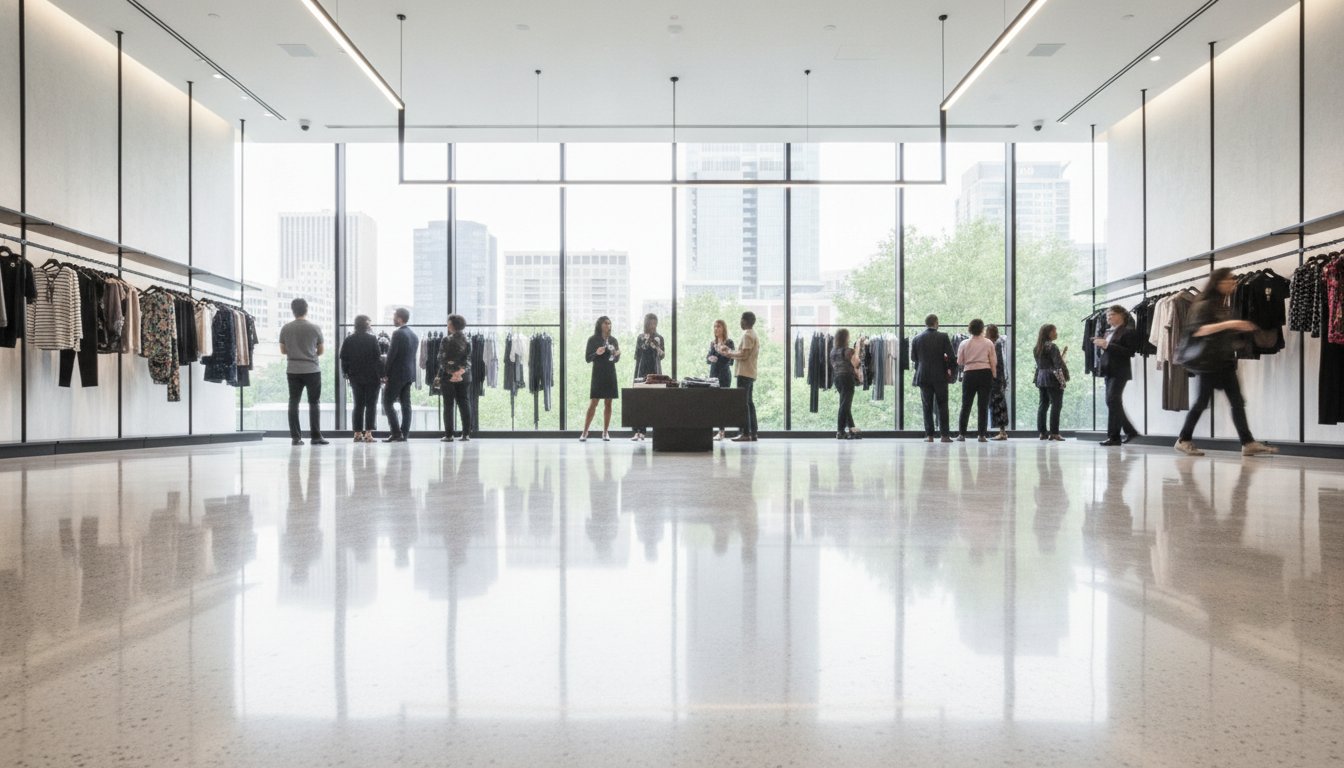
Is your flooring a strategic asset or a recurring liability on your balance sheet? For most retail operators, it's a constant drain on resources. You're likely tired of the relentless cycle of waxing, the high cost of maintenance, and the constant fear of moisture-related floor failure. Choosing commercial polished concrete Atlanta is the definitive move to end this cycle of uncertainty. We understand the frustration of seeing a high-end brand image compromised by inconsistent, deteriorating surfaces. It's time to stop settling for mediocrity and start demanding a foundation that reflects your professional standards.
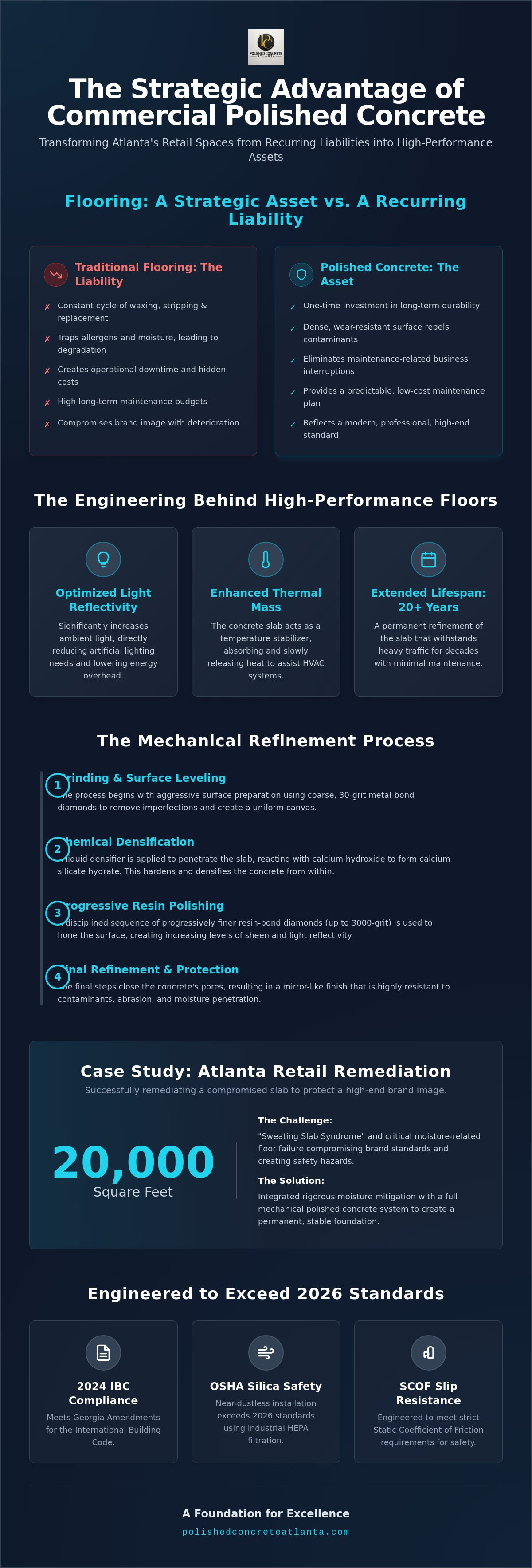
This isn't just a cosmetic upgrade; it's a rigorous engineering decision. In this case study, we examine how high-performance mechanical polishing transforms retail spaces into durable, low-maintenance environments that exceed 2026 standards. You'll discover the technical precision required to meet the 2024 International Building Code (IBC) with Georgia Amendments. We also analyze how a near-dustless installation, exceeding 2026 OSHA silica standards, protects your investment and your reputation from the start. We're moving beyond flowery descriptions to show you the tangible ROI of a floor that works as hard as you do.
Key Takeaways
- Master the distinction between superficial coatings and the multi-step mechanical refinement required for true industrial-grade durability.
- Discover how optimizing light reflectivity and thermal mass directly reduces HVAC and lighting overhead in high-traffic retail environments.
- Review a technical case study detailing how commercial polished concrete Atlanta systems successfully remediated 20,000 square feet of compromised slab.
- Identify the critical indicators of "Sweating Slab Syndrome" to prevent moisture-related floor failure before it compromises your brand image.
- Establish a foundation for 2026 standards by integrating rigorous moisture mitigation and professional-grade floor preparation into your facility strategy.
The High-Traffic Challenge for Atlanta Commercial Spaces
Atlanta's commercial corridors demand more from a floor than simple aesthetics. Between the abrasive red clay grit tracked in from the street and the relentless humidity of the Southeast, traditional flooring systems often fail within months. For facility managers, the choice of commercial polished concrete Atlanta isn't just about a modern look. It's about survival in a high-traffic environment. This process is a rigorous, multi-step mechanical refinement of the existing slab. To understand the technical depth of this process, one should ask: What is Polished Concrete? It's not a topical sealer or a quick coat of epoxy. It's the literal transformation of the concrete matrix into a dense, wear-resistant surface.
By 2026, the industry has shifted away from temporary fixes. We're seeing a definitive move toward permanent refinement. When you analyze a 10-year facility budget, the economic impact is undeniable. While VCT or carpet might seem cheaper on day one, the cumulative cost of stripping, waxing, and eventual replacement creates a massive financial drain. Polished concrete eliminates this uncertainty. It provides a foundation that stands up to the stressors of Metro Atlanta retail and office hubs without the need for constant intervention. It's a strategic investment in long-term durability.
The Problem with Traditional Commercial Floor Coverings
Traditional materials like VCT and carpet are essentially a maintenance trap. In high-traffic Atlanta corridors, carpet traps allergens and moisture, leading to premature degradation. VCT requires a constant cycle of chemical stripping and re-waxing to maintain its appearance. This doesn't just cost money; it creates operational downtime. Every hour your floor is being serviced is an hour your business isn't at full capacity. For a high-achieving brand, this level of mediocrity is unacceptable. We focus on eliminating these hidden costs through superior floor preparation and refinement. Results matter.
Defining the 2026 Standard for Polished Concrete
A true polished floor requires a disciplined approach that a simple grind-and-seal cannot match. The 2026 standard involves progressively finer diamond abrasives and the strategic application of chemical densifiers. These densifiers react with the calcium hydroxide in the concrete to create calcium silicate hydrate, hardening the surface from within. Safety is non-negotiable. Our systems are engineered to meet strict Static Coefficient of Friction (SCOF) requirements, ensuring slip resistance even in demanding commercial settings. We also adhere to 2026 OSHA silica standards, utilizing industrial HEPA-filtered vacuums to maintain a clean, professional workspace during the entire project. This is the new benchmark for excellence.
The Technical Blueprint: Why Polishing Outperforms Other Coatings
Engineering a high-performance floor starts with understanding the physics of the slab. For any facility investing in commercial polished concrete Atlanta, the primary technical advantage is the Light Reflectance Value (LRV). A properly refined surface can significantly increase ambient light levels, directly reducing the need for artificial lighting and lowering energy overhead. Beyond optics, the thermal mass of a concrete slab acts as a temperature stabilizer. In the volatile Atlanta climate, this mass absorbs and slowly releases heat, assisting your HVAC system in maintaining a consistent environment. This isn't a superficial coating; it's a strategic enhancement of the building's existing structure.
The transition from a raw slab to a mirror-like finish is a disciplined sequence of mechanical refinement. We utilize a precise progression of diamond tooling, starting with 30-grit metal bonds for aggressive surface leveling and moving through to 3000-grit resin-bonded diamonds for peak clarity. This process follows strict technical specifications for polished concrete to ensure the surface is densified and hardened at a molecular level. By closing the pores of the concrete, we create a surface that resists contaminants and stands up to heavy foot traffic for 20 years or more when properly maintained. If you're looking to optimize your facility's long-term performance, consult with our project managers to identify the right technical specification for your space.
Gloss Levels and Aesthetic Customization
Brand identity is often dictated by the floor's finish. We offer four distinct gloss levels to meet specific aesthetic and functional requirements. Level 1 provides a matte finish ideal for industrial environments, while Level 4 delivers a high-gloss, mirror-like reflection for luxury retail. Customization doesn't stop at shine. We can control aggregate exposure, ranging from a "salt and pepper" fine-grain look to large aggregate exposure that mimics high-end terrazzo. For brands requiring specific color palettes, decorative stains can be chemically bonded into the concrete during the polishing process, ensuring the color never peels or fades.
Polished Concrete vs. Epoxy: The Professional Verdict
Choosing between systems requires a clear understanding of your facility's specific stressors. Epoxy is the correct choice for environments facing heavy chemical spills or where the existing slab has significant structural defects that require a high-build coating. However, for the majority of retail and office applications, polishing is the superior investment. It offers a lower total cost of ownership because it eliminates the cycle of flaking and re-coating associated with topical resins. For a detailed breakdown of these two systems, see our guide on Polished Concrete vs Epoxy Flooring: The Professional Verdict. Polishing remains the most sustainable choice for LEED-certified projects, as it maximizes the use of existing materials and eliminates the need for VOC-heavy adhesives.
Case Study: Retail Excellence in an Atlanta Commercial Facility
Theory only goes so far in the field. To demonstrate the impact of a high-performance floor, we look at a recent 20,000 square foot retail project in Metro Atlanta. The facility manager faced a failing floor that was both an aesthetic eyesore and a safety liability. The existing slab was buried under layers of degraded VCT and stubborn adhesive residue. Even worse, initial moisture testing revealed high relative humidity (RH) levels that would have caused any topical coating to delaminate within months. This project required more than a simple cleaning. It demanded a full-scale execution of commercial polished concrete Atlanta systems designed for extreme retail traffic.
Our approach was methodical. We didn't just cover the problem; we engineered a solution from the slab up. By adhering to the rigorous benchmarks set by the International Standards and Training Alliance, our team transformed a compromised substrate into a high-end brand asset. The final results were definitive. The client achieved a 40% reduction in artificial lighting costs due to the increased reflectivity of the floor. More importantly, they eliminated maintenance downtime entirely, moving from a weekly waxing schedule to a simple pH-neutral cleaning protocol. This is how we define retail excellence.
Phase 1: Floor Preparation and Glue Removal
The success of any polished floor is decided during the preparation phase. For this 20,000 square foot space, we utilized specialized Polycrystalline Diamond (PCD) tooling to strip away years of VCT adhesive. This isn't a task for standard grinders. PCDs are aggressive enough to shear off thick glue without gumming up the equipment or damaging the underlying slab. Once the adhesive was removed, we addressed structural cracks and surface imperfections with high-strength polyurea fillers. We also performed precision floor leveling in key transition areas. A level floor isn't just about looks; it's about ensuring a uniform grind across the entire massive footprint. Precision is a requirement, not a suggestion.
Phase 2: The Polishing and Staining Sequence
With a clean, level canvas, we began the progressive mechanical refinement. We moved through metal-bond and transition diamonds to open the concrete's pores for chemical treatment. We applied a high-grade densifier, specifically the Ashford Formula, to chemically harden the concrete matrix. This step is critical for retail environments where heavy pallet jacks and thousands of daily shoppers would otherwise wear down the surface. To align with the client's corporate identity, we integrated a custom gray-tone stain. Unlike paint, this stain penetrates the concrete, becoming a permanent part of the floor. We finished the sequence at an 800-grit level, striking the perfect balance between high-end gloss and practical slip resistance. The floor doesn't just look elite; it's built to last for decades.
Critical Success Factors: Moisture Mitigation and Preparation
Moisture is the silent killer of commercial flooring. In the humid environment of Metro Atlanta, atmospheric moisture isn't the only threat. You must also account for moisture vapor transmission (MVT) rising from beneath the slab. For any project involving commercial polished concrete Atlanta, ignoring the internal environment of the concrete is a recipe for structural failure. This isn't just about aesthetics; it's about engineering a surface that won't delaminate or compromise your brand image within 24 months. We don't guess. We test.
One of the most pervasive issues in Georgia is "Sweating Slab Syndrome". This occurs when warm, humid air hits a cool concrete slab, causing condensation to form on the surface. If your floor hasn't been properly prepared with deep-penetrating moisture barriers, this condensation can lead to significant slip hazards and a breakdown of the concrete matrix. Topical sealers are a temporary band-aid. True protection requires a holistic approach to Moisture Mitigation for Concrete Floors in Georgia. We focus on locking out vapor at the source to ensure long-term stability.
Testing and Remediation Standards
We utilize the most rigorous testing protocols in the industry. While some contractors still rely on outdated Calcium Chloride tests, we prioritize Relative Humidity (RH) testing. This involves drilling probes into the slab to measure moisture at the core, providing a definitive reading of the slab's internal state. This data allows us to establish a baseline for safe application. If moisture levels exceed 2026 standards, we implement pro-active remediation for slabs on grade. This technical precision eliminates the uncertainty that plagues low-bid projects. Results require data, not assumptions.
Avoiding Floor Failure: A Warning to Facility Managers
The #1 cause of commercial floor delamination in Atlanta is insufficient preparation. "Cheap" grinding often skips the critical diamond-tooling steps and moisture testing phases to save on labor costs. This is a false economy. These shortcuts lead to expensive long-term failures, including ghosting, peeling, and structural cracking. Why risk your facility's reputation on a contractor who settles for mediocrity? The pride of high-end craftsmanship comes from doing the work that isn't seen. Hiring specialized industrial flooring contractors is the only way to guarantee a maintenance-free result that stands the test of time. Secure your investment by scheduling a technical moisture assessment with our expert team today.
The Polished Concrete Atlanta Standard: Your Strategic Partner
We don't just finish floors; we manage project outcomes. Decades of experience in the Atlanta commercial corridor have taught us that reliability is the only currency that matters in high-stakes development. When you choose us for commercial polished concrete Atlanta, you're gaining a partner committed to unwavering honesty and technical transparency. We don't settle for mediocrity, and we don't expect you to either. Our "no-nonsense" pragmatism ensures your project stays on schedule and meets every 2026 regulatory benchmark. We've seen every possible slab scenario. We've mastered the craft of remediation. This veteran perspective allows us to eliminate uncertainty from your facility's future.
Our approach is holistic and disciplined. It starts with a rigorous assessment of your substrate and ends with a long-term maintenance strategy designed to preserve your investment. We prioritize tangible results over flowery descriptions. We understand that a retail floor isn't just a surface; it's a critical component of your brand's physical identity. By combining elite technical skill with a blue-collar work ethic, we deliver a final product that stands as a testament to high-end craftsmanship. Your peace of mind is our primary metric for success. We deliver floors that work as hard as you do.
Comprehensive Industrial Floor Services
Our capability extends far beyond mechanical polishing. We provide a full spectrum of high-performance surfaces, including industrial epoxy flooring, decorative stained concrete, and architectural micro-cement options. This versatility allows us to serve as a single-source solution for complex, large-scale projects. We are recognized as the definitive Industrial Flooring Contractors in Atlanta because we build strategic alliances with developers and facility managers. Whether you're managing a 50,000 square foot warehouse or a boutique retail storefront, our team provides the technical depth and professional register required for excellence.
Next Steps for Your Atlanta Facility
Planning for your 2026 commercial flooring project requires more than a simple quote. It requires a professional surface evaluation. We'll analyze your slab's structural integrity, perform Relative Humidity (RH) testing, and identify any existing bond-breakers or contaminants. This data-driven approach allows you to budget with precision and avoid the "maintenance trap" of inferior flooring systems. Don't leave your brand image to chance. Investing in your floor is a direct investment in your facility's long-term ROI. Contact our project management team today to schedule an on-site consultation and secure a foundation that reflects your commitment to quality.
Secure Your Facility's Future with Engineering Excellence
Your floor is the foundation of your brand's physical presence. It shouldn't be a source of constant maintenance anxiety or a recurring drain on your capital. Choosing commercial polished concrete Atlanta means opting for a system that prioritizes long-term durability and measurable ROI. We've demonstrated how technical precision in floor preparation and moisture mitigation transforms compromised slabs into high-performance assets. The data is clear. True mechanical refinement reduces energy overhead, eliminates the maintenance trap, and exceeds 2026 industrial standards.
We've been serving the Atlanta commercial corridor since 2004. As specialists in heavy-duty industrial and retail floors, we bring a level of expertise in floor glue removal and moisture mitigation that low-bid contractors simply can't match. We eliminate the uncertainty of "Sweating Slab Syndrome" and premature delamination through rigorous testing and seasoned craftsmanship. It's time to demand a floor that reflects your professional standards. Request an Expert Floor Evaluation for Your Atlanta Facility today. Let's build a foundation that supports your vision for decades to come.
Frequently Asked Questions
Is commercial polished concrete slippery for retail customers?
Polished concrete is not inherently slippery and often exceeds ADA and OSHA standards for slip resistance. We engineer these surfaces to meet a high Static Coefficient of Friction (SCOF), ensuring safety for high-traffic retail environments. Even with a high-gloss finish, the mechanical refinement provides a stable surface. Proper maintenance with pH-neutral cleaners is mandatory to preserve this slip resistance over the floor's lifespan.
How long does the commercial concrete polishing process take?
Project timelines depend on the slab's condition and total square footage. A typical 10,000 square foot retail space generally requires five to seven business days for a full mechanical refinement. This schedule includes initial floor preparation, grinding, densifying, and final polishing. We operate with a disciplined workflow to minimize your facility's downtime. Efficiency is a byproduct of our veteran experience and professional equipment.
Can you polish old concrete floors with existing glue or coatings?
Old slabs are prime candidates for refinement once the existing surface is cleared. We utilize specialized PCD tooling for efficient floor glue removal and the stripping of old epoxy or VCT adhesives. This process exposes the raw concrete matrix, allowing us to begin the polishing sequence. We've successfully transformed decades-old industrial slabs into high-end retail environments. A compromised surface is simply a starting point for our team.
What is the maintenance schedule for a commercial polished floor in Atlanta?
A disciplined maintenance protocol is essential for preserving peak reflectivity and durability. Daily dust mopping removes abrasive grit that can dull the surface under foot traffic. Weekly wet mopping should only involve pH-neutral cleaners to avoid chemical etching. For high-traffic retail environments, we recommend a professional re-guarding and high-speed burnish every 18 to 24 months. This ensures your commercial polished concrete Atlanta investment maintains its elite aesthetic.
How does polished concrete contribute to LEED certification?
Polished concrete is a cornerstone of sustainable design because it utilizes the existing building envelope. This eliminates the need for new material manufacturing and reduces waste. The process uses no VOC-heavy adhesives or coatings, which significantly improves indoor air quality. Additionally, the high light reflectivity (LRV) reduces the demand for artificial lighting. These factors contribute directly to several LEED credit categories, including Energy and Atmosphere and Indoor Environmental Quality.
What is the cost difference between polished concrete and epoxy flooring?
Polishing typically offers a significantly lower total cost of ownership compared to epoxy systems. While epoxy provides a high-build barrier for specific chemical resistance, it eventually requires full removal and replacement. Polishing is a permanent refinement of the slab itself. You save on long-term maintenance and the recurring capital expenditures associated with re-coating. For retail and office facilities, the life-cycle value of polished concrete is the definitive choice.
Do you provide moisture mitigation for commercial slabs in Georgia?
Moisture mitigation is a non-negotiable component of our project management approach. Given Georgia's high humidity, we perform Relative Humidity (RH) testing on every commercial slab before work begins. We provide deep-penetrating moisture barriers that remediate vapor transmission at the source. This prevents "Sweating Slab Syndrome" and ensures the structural integrity of the floor. We don't settle for superficial fixes; we solve the underlying moisture issues.
Can corporate logos or specific colors be added to polished concrete?
Brand identity can be permanently integrated into your floor through staining and precision stenciling. We utilize high-grade concrete stains that chemically bond with the matrix to match your specific corporate palette. Precision stenciling allows us to incorporate logos directly into the floor during the polishing sequence. Unlike topical paints, these graphics won't peel or wear away under heavy foot traffic. Your floor becomes a permanent, high-end brand asset.


