

The most expensive floor you'll ever buy is the one that fails six months after the ribbon cutting. In the high stakes environment of Atlanta commercial real estate, mediocre aesthetics and cracking overlays are no longer acceptable risks. You recognize that a surface should be an asset, not a liability. Investing in micro cement floors Atlanta provides that elusive, monolithic look without the structural vulnerabilities of traditional concrete pours. It's about more than just a finish. It's about architectural integrity.
You want a space that reflects a premium standard while demanding minimal maintenance. We agree that your flooring should be as resilient as it is beautiful. This guide outlines why micro cement has become the 2026 benchmark for high-end commercial environments and the technical precision required to get it right. We'll detail the standards for a permanent bond, including critical ASTM benchmarks and the moisture mitigation strategies that separate professional installations from amateur attempts. From the remediation of sweating slab syndrome to achieving industrial grade durability, here is the technical roadmap for a seamless, high performance surface.
Key Takeaways
- Micro cement provides a 2-3mm polymer-modified coating that eliminates grout lines, creating a unified architectural statement for modern commercial spaces.
- Professional installations meet rigorous slip-resistance and safety standards, ensuring high-traffic durability in hospitality and retail environments.
- Longevity is engineered through precise mechanical concrete grinding and substrate preparation, ensuring a permanent bond that prevents delamination.
- Selecting a partner specialized in micro cement floors atlanta guarantees that your surface is treated as an industrial-grade engineering project rather than a simple DIY coating.
What is Micro Cement and Why is it the Professional Choice?
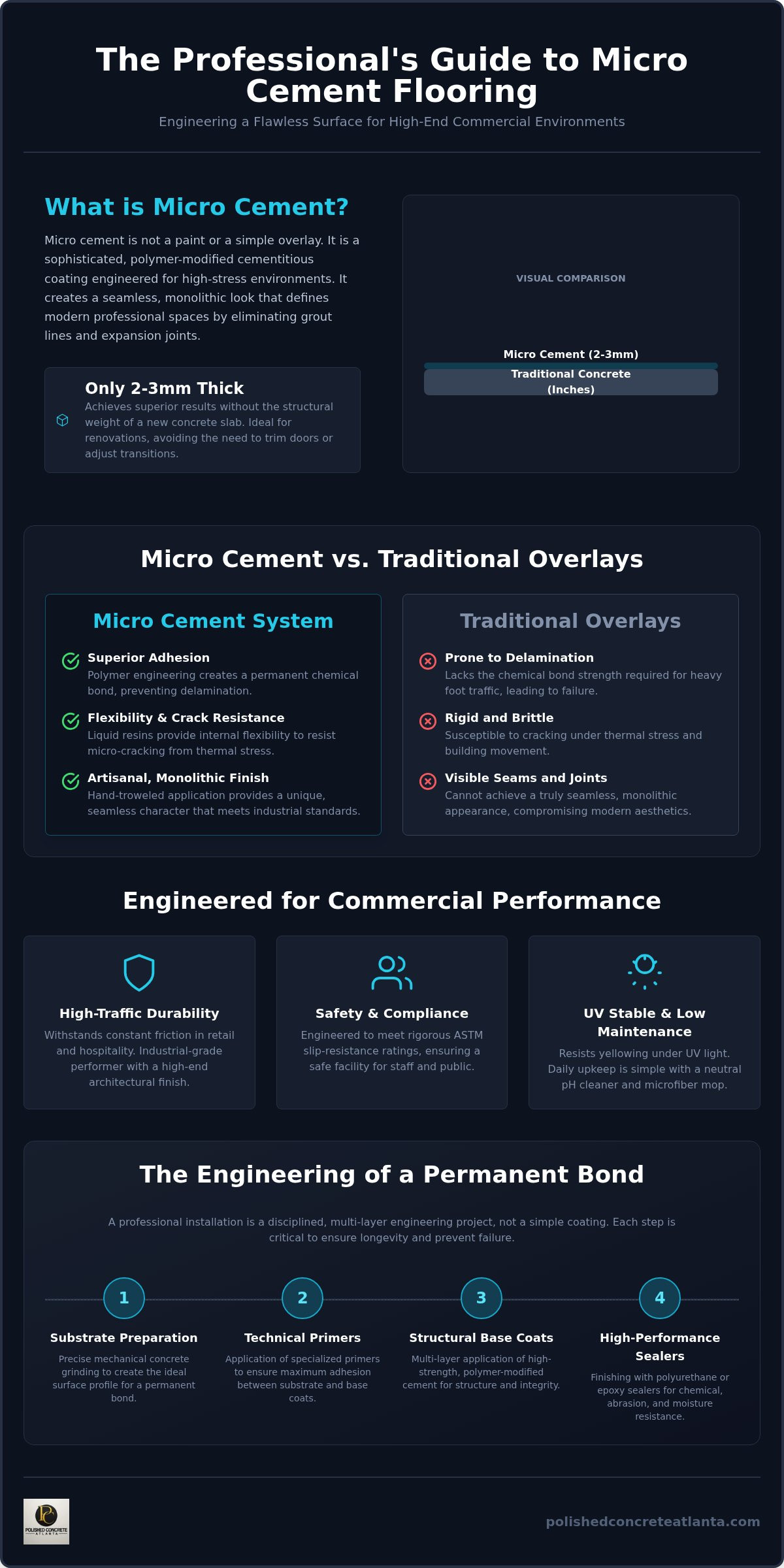
Micro cement is not a simple paint or a thin decorative wash. It's a sophisticated, polymer-modified cementitious coating engineered for high-stress environments. While traditional concrete requires inches of depth, What is Micro Cement systems achieve superior results at a mere 2-3mm thickness. This makes micro cement floors atlanta the definitive choice for commercial architects who demand a monolithic, seamless aesthetic without the structural weight of a new slab. By eliminating grout lines and expansion joints, you create a unified architectural statement that's impossible to replicate with tile or stone. It's a clean, uninterrupted surface that defines modern professional spaces.
The Anatomy of a High-Performance Micro Cement System
A truly professional system relies on a strategic blend of liquid resins and high-strength cements. These resins provide the internal flexibility necessary to resist micro-cracking while maintaining an incredible bond to the underlying substrate. The 3mm profile is a massive advantage for Atlanta commercial renovations. You don't have to trim doors, adjust floor transitions, or worry about weight limits on upper floors. The application is a disciplined, multi-layer process. It starts with technical primers for adhesion, followed by structural base coats, and finishes with specialized sealers that lock in the texture and provide chemical resistance. It's a total system, not just a topcoat.
Micro Cement vs. Traditional Concrete Overlays
Why do traditional overlays often fail in high-traffic Atlanta environments? Most lack the chemical bond strength required for heavy foot traffic. They delaminate. They crack under thermal stress. Micro cement is different. It offers higher compressive strength and superior adhesion through polymer engineering. While polished concrete relies on mechanical grinding of an existing slab, micro cement is a hand-troweled finish. This provides a unique, artisanal character that still meets industrial performance standards. You're not just getting a floor; you're getting an engineered surface that stands up to the rigors of retail and hospitality. It’s the marriage of high-end design and blue-collar durability. Results matter, and this system delivers them without compromise.
Commercial Performance: Durability and Maintenance Standards
High-traffic environments like retail showrooms and hospitality hubs in Atlanta demand flooring that doesn't just survive but thrives. Choosing micro cement floors atlanta provides a monolithic surface that withstands constant friction without the delamination risks common in inferior products. It's an industrial-grade performer disguised as a high-end architectural finish. Safety compliance is also non-negotiable. Professional systems are engineered to meet specific slip-resistance ratings, ensuring your facility remains safe for both staff and the public. We don't guess at safety; we engineer for it.
The integrity of the surface depends on the sealer. High-performance polyurethane or epoxy-based sealers protect the cementitious core from chemical spills and abrasive wear. While we focus on aesthetic appeal, we prioritize technical benchmarks. Adhering to rigorous Durability and Maintenance Standards for floor flatness and performance ensures your investment remains structural, not just decorative. Results matter, and a floor that fails to meet these standards is a liability you can't afford.
Engineered for High-Traffic Atlanta Facilities
Retail spaces and office lobbies require UV-stable surfaces that won't yellow under floor-to-ceiling windows. Micro cement offers this stability. It also provides a subtle acoustic dampening effect. Unlike the clack of hard tile, these seamless coatings absorb impact noise, contributing to a more professional atmosphere. It's the ideal solution for modern open-concept offices where sound control is a priority. If you're ready to upgrade your facility, consider our specialized commercial flooring services to ensure a flawless execution.
Maintenance Protocols for a Permanent Finish
A floor is only as permanent as its upkeep. Daily maintenance is straightforward. Use a neutral pH cleaner and a microfiber mop. This simplicity is why micro cement floors atlanta outperform high-maintenance alternatives like carpet or tile. Periodic resealing every few years maintains the moisture barrier and keeps the aesthetic sharp. This lifecycle ROI is unmatched. You eliminate the need for aggressive steam cleaning or grout scrubbing. It's a no-nonsense approach to facility management that prioritizes long-term value over short-term fixes.
The Engineering of Adhesion: Non-Negotiable Surface Preparation
A micro cement floor is only as good as the substrate it bonds to. Period. Without precision preparation, even the most advanced polymers will eventually fail. For micro cement floors atlanta projects, we begin with mechanical concrete grinding. This process isn't just for cleaning. It's designed to achieve a specific Concrete Surface Profile (CSP) that allows the resin to bite into the concrete. A smooth slab is a liability; a "toothed" slab is a foundation for a permanent bond.
Old adhesives and oils are the primary enemies of adhesion. We perform exhaustive floor glue removal and contaminant extraction before any material is mixed. If residues remain, they create a bond-breaking layer that leads to delamination. We don't hope for a bond; we engineer it through disciplined mechanical prep and chemical cleaning. Shortcuts in the preparation phase always reveal themselves in the finished product.
Addressing Sweating Slab Syndrome and Georgia Humidity
Atlanta's climate presents unique challenges for seamless surfaces. High relative humidity and vapor transmission can push a coating right off the slab. This is why moisture mitigation is a non-negotiable standard in our workflow. We use in-situ probes to measure moisture levels deep within the concrete. If we identify a risk, we integrate high-performance moisture barriers into the primer layer. This prevents "sweating slab syndrome" from compromising your investment. We solve the moisture problem before the first decorative layer is ever applied.
The Professional Installation Sequence
A disciplined sequence is what separates an industrial-grade floor from a DIY failure. Our process follows a strict technical roadmap:
- Step 1: Mechanical grinding with vacuum-contained dust extraction to create the ideal CSP.
- Step 2: Crack repair and joint stabilization using high-modulus epoxies to stop reflective cracking.
- Step 3: Multi-stage troweling to build the required 3mm depth and artisanal texture.
- Step 4: Application of high-solids polyurethane or epoxy topcoats for maximum abrasion resistance.
Don't leave your facility's integrity to chance. Contact us today for a technical floor assessment to ensure your substrate is ready for a professional-grade finish.
Selecting an Atlanta Micro Cement Partner for Industrial Scale
While micro cement is a hand-applied finish, it is not a DIY project for commercial environments. On a residential scale, minor inconsistencies might be called "character," but in a 10,000 square foot retail showroom or office lobby, they are professional failures. You need a partner who treats micro cement floors atlanta as an engineering challenge rather than a boutique art project. This requires a contractor with a deep background in industrial floor coatings. If a team lacks the heavy-duty equipment and crew size to manage large-scale pours and consistent troweling across massive spans, the aesthetic and structural integrity will suffer.
Technical expertise in substrate behavior is the most critical asset a contractor brings to your site. A partner who understands polished concrete standards knows how to evaluate a slab's hardness and porosity before the first layer of micro cement is mixed. They don't just look at the surface; they analyze the engineering of the entire floor system. This holistic approach ensures that the bond strength meets industrial requirements and that the finish remains stable under heavy foot traffic and equipment loads.
Questions to Ask Your Micro Cement Contractor
Vetting a contractor for a commercial project requires moving past aesthetic portfolios and into technical specifics. Don't settle for vague promises. Ask these definitive questions:
- Do you perform in-house moisture testing using in-situ probes or calcium chloride methods?
- What specific Concrete Surface Profile (CSP) do you target during mechanical preparation?
- Can you provide verifiable references for commercial projects exceeding 5,000 square feet in the Atlanta area?
- What is your contingency plan for addressing slab movement or existing cracks?
The Polished Concrete Atlanta Advantage
We approach every project with an unwavering commitment to technical excellence and no-nonsense pragmatism. Our extensive experience in sealed concrete and industrial flooring informs every micro cement application we perform. We don't just apply a coating; we engineer a surface. We understand that for facility managers, downtime is lost revenue. Our crews are organized to maximize efficiency without compromising the rigorous standards required for a permanent finish. When you choose us, you're investing in a strategic alliance focused on long-term asset value and uncompromising quality. We deliver results that stand up to the scrutiny of both architects and industrial inspectors.
Securing the Future of Your Commercial Surface
Investing in a commercial floor is a decision that impacts your facility's value and operational efficiency for years. You've seen that micro cement is more than a design trend; it's a technical system designed for 2026 standards. Achieving a permanent, high-performance finish requires a disciplined approach to moisture mitigation and mechanical preparation. By prioritizing these engineering standards, you eliminate the risks of delamination and cracking that plague inferior installations. Your choice of partner determines whether your floor remains a premium asset or becomes a costly liability.
With over 20 years of industrial flooring experience, we bring specialized moisture mitigation equipment and rigorous surface preparation standards to every project. We don't settle for mediocrity. We deliver industrial-grade durability with a seamless, modern aesthetic. If you're ready to elevate your facility with micro cement floors atlanta, it's time to move from vision to execution.
Request a Technical Consultation for Your Atlanta Facility today and ensure your next project is built on a foundation of professional excellence. We're ready to help you engineer a surface that exceeds your highest expectations.
Frequently Asked Questions
How long do micro cement floors last in a commercial setting?
Professional micro cement floors typically last 10 to 15 years in high-traffic commercial environments before requiring a professional refresh. Their lifespan depends on the quality of the initial substrate bond and the consistency of your maintenance schedule. Because these surfaces are monolithic and polymer-modified, they don't suffer from the grout failure or chipping common in tile. Regular resealing ensures the protective barrier remains intact against heavy foot traffic and daily wear.
Can micro cement be applied over existing tile or wood?
You can apply micro cement over existing tile or wood, provided the substrate is structurally sound and properly prepared. For tile, we perform mechanical grinding to ensure a strong mechanical bond. For wood, we use specific reinforcement layers to minimize movement. However, the stability of the final finish depends entirely on the integrity of what's underneath. We always perform a technical assessment to ensure the base doesn't compromise the micro cement floors atlanta installation.
Is micro cement prone to cracking like traditional concrete?
Micro cement is significantly more resistant to cracking than traditional concrete due to its high polymer content. These resins provide internal flexibility that allows the material to handle minor thermal expansion without fracturing. While it doesn't crack like a thick slab, it is still subject to reflective cracking if the underlying substrate moves. We mitigate this risk by stabilizing joints and repairing existing cracks with high-modulus epoxies during the preparation phase.
How much does micro cement flooring cost per square foot in Atlanta?
The investment for micro cement floors atlanta is determined by several technical factors rather than a flat rate. The condition of your existing substrate, the total square footage, and the need for specialized moisture mitigation all influence the final project scope. Because we prioritize industrial-grade preparation and premium materials, we provide custom quotes following a site evaluation. This ensures you receive a transparent assessment that accounts for the specific engineering requirements of your facility.
Is micro cement waterproof enough for commercial kitchens or bathrooms?
Micro cement is an excellent choice for commercial kitchens and bathrooms because it becomes entirely non-porous once the final sealer is applied. The seamless nature of the surface eliminates the grout lines where moisture and bacteria typically collect. It's a hygienic, waterproof solution that stands up to frequent cleaning and high humidity. We use professional-grade polyurethane sealers to ensure the moisture barrier remains impenetrable even in the most demanding wet environments.
How long is the installation and curing process before foot traffic is allowed?
The installation process for a commercial micro cement system usually spans 3 to 5 days. This timeline accounts for the multi-layer application and the necessary drying intervals between the base and finish coats. You can typically allow light foot traffic within 24 hours after the final sealer is applied. We recommend waiting a full 7 days before subjecting the floor to heavy equipment or chemical cleaning to allow the polymers to reach their full structural cure.


