
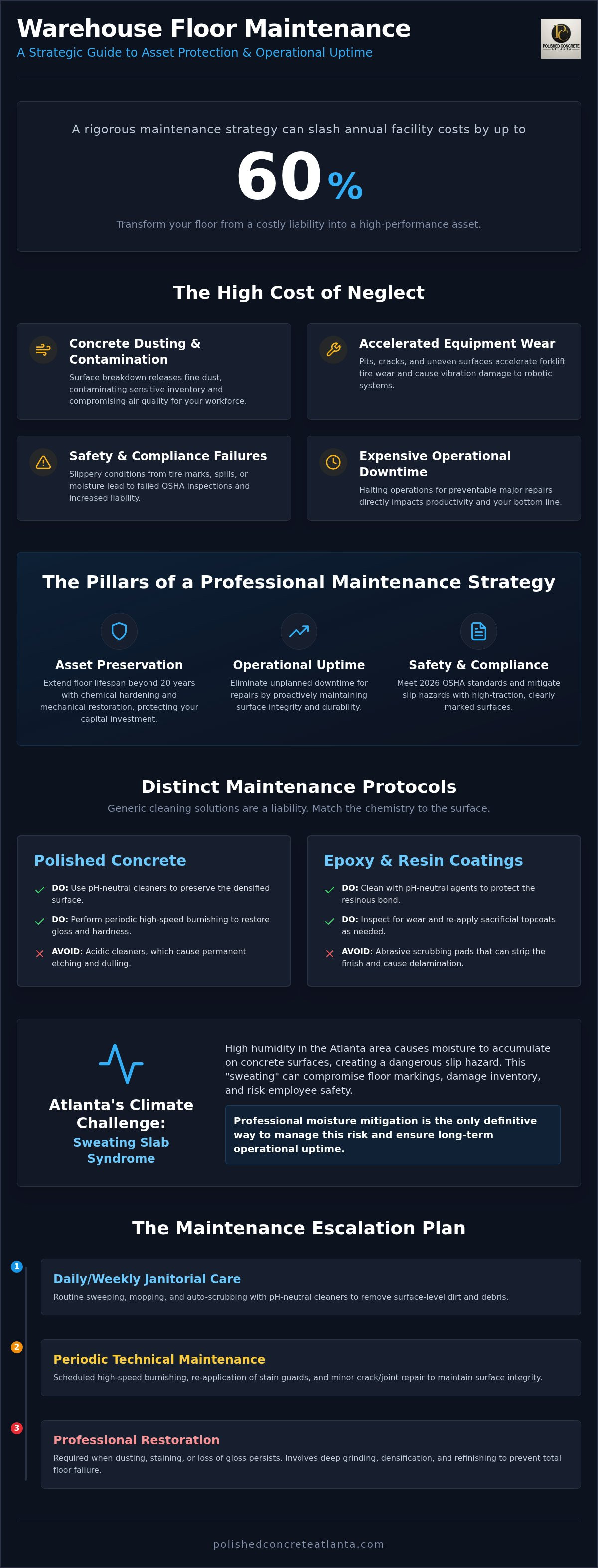
Did you know that implementing a rigorous strategy for warehouse floor maintenance can slash your annual facility costs by as much as 60%? It's a staggering figure that highlights a hard truth. Your floor isn't just a surface; it's a high-stakes engine of productivity. When concrete dusting ruins your inventory or forklift tire marks create hazardous, slippery conditions, your bottom line suffers. You've likely felt the frustration of failing a safety inspection or halting operations for a preventable repair. These aren't just inconveniences. They're expensive failures in strategy.
Effective floor care demands a sophisticated engineering approach rather than a simple janitorial checklist. This article provides the definitive strategy to eliminate operational downtime and maximize your facility's ROI through professional standards. You'll gain a thorough understanding of technical restoration, industrial-grade densification, and the critical moisture mitigation steps required for total durability, particularly within the humid Atlanta climate. We also break down the 2026 OSHA National Emphasis Program requirements to ensure your walking-working surfaces remain compliant. It's time to transform your floor from a liability into a high-performance asset.
Key Takeaways
- Industrial longevity requires a protocol beyond janitorial cleaning. You must integrate chemical hardening and mechanical restoration to protect the asset.
- Eliminate "concrete dusting" and inventory contamination. Maintaining surface integrity is the only way to protect sensitive stock and air quality.
- Discover the critical chemistry of pH-neutral cleaners. Standardized cleaning agents often destroy high-end floor finishes through chemical incompatibility.
- Master a definitive warehouse floor maintenance checklist. This helps you identify the exact point where professional warehouse floor maintenance is required to avoid total floor failure.
- Gain insights into Atlanta-specific moisture mitigation. These strategies prevent sweating slab syndrome and ensure long-term operational uptime in humid environments.
The Strategic Importance of Warehouse Floor Maintenance
High-performance logistics centers don't view warehouse floor maintenance as a simple janitorial chore. They view it as a strategic asset protection plan. True maintenance is a comprehensive protocol that integrates daily cleaning, chemical densification, and mechanical restoration. It's the definitive difference between a facility that thrives and one that slowly deteriorates under the weight of its own operations. When you commit to this level of care, you aren't just cleaning a surface; you're engineering a more reliable supply chain.
Neglecting this protocol leads to "concrete dusting." This occurs when the surface of an untreated slab breaks down into fine particulate matter. This dust doesn't just sit on the floor. It settles on sensitive inventory and compromises the air quality for your entire workforce. Beyond product damage, a degraded floor surface directly impacts your machinery. Pits and gouges accelerate forklift tire wear and cause vibration damage to sensitive electronics on autonomous mobile robots. When the floor fails, your equipment follows. A clean, well-maintained floor signals a culture of excellence. It's the "Broken Window Theory" applied to industry. When a facility looks elite, employees work with greater precision and care.
Operational Uptime and Asset Preservation
In a 24/7 logistics hub, every hour of downtime is a direct hit to the bottom line. Professional warehouse floor maintenance acts as a capital expenditure protection strategy. By implementing a rigorous care schedule, you can significantly extend the lifecycle of polished concrete warehouse floors, often pushing their functional lifespan beyond 20 years. Consistent application of professional floor cleaning methods that utilize pH-neutral chemistry ensures the surface remains densified and resistant to abrasion. We don't just clean floors; we preserve the structural integrity of your facility.
Safety Standards and Liability Mitigation
Safety isn't optional. It's a mandate. The 2026 OSHA National Emphasis Program has increased scrutiny on walking-working surfaces, making floor clarity a top priority for inspectors. Facilities must meet strict slip resistance standards to avoid heavy fines and mitigate liability. High-visibility floor markings are equally critical for separating pedestrian traffic from heavy machinery. In the Atlanta area, humidity often leads to Sweating Slab Syndrome. This moisture accumulation creates a lethal slip hazard. Professional remediation and moisture mitigation are the only definitive ways to manage this risk and keep your team safe.
Polished Concrete vs. Epoxy: Distinct Maintenance Protocols
Generic cleaning solutions are a liability. Many facility managers assume that any industrial degreaser will suffice for a concrete surface. They're wrong. A one-size-fits-all approach is the fastest way to strip a high-performance finish and compromise your investment. Effective warehouse floor maintenance relies on the precise chemistry of pH-neutral cleaners. Acidic or highly alkaline agents react aggressively with the concrete substrate or the resinous bond of a coating. This leads to immediate dulling, etching, or catastrophic delamination. You must distinguish between mechanical and chemical maintenance based on the specific wear patterns and surface types in your facility.
Mechanical maintenance involves physical processes like burnishing to restore a finish; chemical maintenance focuses on the application of sacrificial layers or specialized detergents. Identifying the signs of finish failure early is the only way to prevent substrate damage. If you notice a loss of reflectivity or increased "dusting" despite regular cleaning, your finish has likely reached its point of exhaustion. At this stage, janitorial efforts are no longer sufficient. You need a technical intervention to restore the surface hardness before the concrete itself begins to spall.
Maintaining the Luster of Polished Concrete
Polished concrete is a mechanical finish that gains its durability through densification. To maintain the aesthetic and structural integrity of high gloss concrete floors commercial, periodic high-speed burnishing is essential. This process uses heat and friction to close the concrete pores and restore the luster. We also recommend re-applying stain guards to provide a sacrificial barrier against liquid penetration. Avoid acidic substances at all costs. They cause permanent etching that requires professional grinding to remediate.
Preserving Industrial Epoxy and Coatings
Epoxy serves as a chemical barrier, but it's not invincible. The primary enemy of chemical resistant floor coatings is abrasive debris. Fine sand and grit act like sandpaper under the weight of heavy forklifts, grinding away the protective resin. Your cleaning protocol must prioritize the removal of these particulates before they can cause scratches. When the coating begins to show wear, you must decide between a "sand and reseal" or a full coating replacement. A proactive reseal is far more cost-effective than allowing the coating to fail completely. If you need a technical evaluation of your facility's surface, our industrial floor services team can provide a definitive roadmap for restoration.
The Atlanta Facility Manager’s Maintenance Checklist
Discipline is the foundation of industrial longevity. A vague cleaning schedule is a recipe for surface failure. To maintain peak operational standards, facility managers must implement a frequency-based warehouse floor maintenance checklist that accounts for both mechanical wear and environmental variables. This isn't just about aesthetics; it's about preserving the structural integrity of your slab.
- Daily: High-frequency dust mopping is your first line of defense. It removes the abrasive grit that acts like sandpaper under the weight of heavy machinery. Follow this with an automatic scrubber using non-abrasive pads and pH-neutral cleaners.
- Weekly: Conduct a walking inspection of high-traffic zones, specifically loading docks and main transit aisles. Look for joint spalling or the early signs of coating delamination.
- Quarterly: Execute a deep scrub with specialized conditioners. This process removes embedded contaminants and performs edge-to-edge detailing that daily scrubbing often misses.
- Annual: Schedule a professional assessment of the Coefficient of Friction (COF). This ensures your facility remains compliant with 2026 OSHA safety standards and provides a definitive report on surface integrity.
Combating Georgia Humidity and Moisture
Atlanta's climate presents a specific set of challenges for unconditioned warehouses. Sweating Slab Syndrome occurs when warm, humid air makes contact with a cold concrete slab, resulting in a dangerous layer of condensation. This isn't just a slip hazard; it's a precursor to coating failure. Implementing professional moisture mitigation concrete floors is the only definitive way to prevent moisture vapor from blowing your epoxy or sealer off the substrate. While industrial fans help stabilize temperatures, they cannot replace technical remediation.
Equipment and Chemistry Selection
Your equipment is only as effective as the pads you choose. For daily warehouse floor maintenance, stick to white or red pads for light cleaning. Never use black pads on a polished surface unless you intend to strip the finish. Traditional "mop and bucket" methods are entirely ineffective for large-scale industrial slabs because they simply redistribute dirt. Instead, utilize auto-scrubbers equipped with diamond-impregnated pads (DIPs). These pads use microscopic diamonds to mechanically maintain the floor's luster during every cleaning cycle, ensuring the surface remains densified and durable. If your current maintenance protocol is failing to preserve your floor's finish, contact our team for a professional consultation on industrial floor services.
Professional Restoration: When Cleaning Isn't Enough
Standard warehouse floor maintenance has its limits. Even the most disciplined cleaning protocol eventually encounters the technical reality of material fatigue. You'll recognize the "point of no return" when the floor remains dull despite scrubbing, or when concrete dusting persists regardless of how often you sweep. At this stage, janitorial efforts are no longer a solution; they're a recurring expense with no return. True revival requires a mechanical intervention that moves beyond the surface to restore the structural integrity of the slab.
Our process for concrete grinding and polishing Atlanta transforms degraded surfaces into high-performance assets. We don't just hide the damage. We grind through the exhausted top layer to reveal fresh, dense concrete that we then harden and refine. This is also the critical time to address joint spalling and structural cracks. These defects aren't just eyesores. They're operational hazards that cause expensive impact damage to forklift tires and suspension systems. Repairing these joints prevents a minor floor issue from becoming a major equipment repair bill.
Surface Preparation and Remediation
Success in restoration depends entirely on the quality of the preparation. If your facility has a history of failed coatings or old adhesives, you need professional floor glue removal Atlanta specialists. We use heavy-duty planetary grinders to strip away contaminants and create the precise mechanical profile required for new finishes. This process also levels uneven slabs, which directly improves warehouse efficiency by allowing automated equipment and forklifts to operate at peak speeds without vibration or safety risks. We solve the problem of concrete failing after coating by ensuring the substrate is technically sound before the first layer is ever applied.
Choosing the Right Industrial Partner
Industrial environments leave no room for error. You need industrial flooring contractors Atlanta facility managers can rely on for local project management and technical expertise. Cheap, quick-fix bids often ignore the underlying moisture issues or substrate weaknesses that lead to premature failure. We prioritize transparency and long-term value over low-ball estimates. Our approach is grounded in a no-nonsense consultation that identifies exactly what your facility needs for permanent results. Stop managing floor decay and start investing in longevity. Contact Polished Concrete Atlanta for a professional facility audit.
Engineer Your Facility for Industrial Longevity
A high-performance floor is the backbone of your entire supply chain. You've learned that effective warehouse floor maintenance isn't a cost center; it's a strategic investment in operational uptime and long-term asset preservation. By moving beyond basic janitorial cleaning and implementing technical protocols like pH-neutral chemistry and mechanical densification, you protect your inventory and your workforce from the risks of concrete dusting and surface failure. These steps ensure your facility remains a high-performance environment rather than a liability.
Success in the Georgia climate requires a partner who understands the specific mechanics of moisture mitigation. Serving Atlanta's industrial sector since 2004, we bring definitive expertise in Sweating Slab Syndrome remediation and precision surface preparation to every project. Don't wait for joint spalling or safety violations to dictate your operational schedule. Take control of your facility's integrity today. Secure Your Facility's Future with a Professional Floor Audit. Our team is ready to deliver the high-end craftsmanship and peace of mind your operation deserves. It's time to build a foundation that lasts.
Frequently Asked Questions
How often should a warehouse floor be professionally polished?
Professional polishing frequency depends on the specific traffic volume and mechanical wear your facility endures. While daily cleaning is essential, a technical regrind and polish is typically required every five to ten years to maintain structural integrity. High-traffic logistics hubs often need high-speed burnishing every few months to keep the surface dense and reflective. We recommend a professional audit to determine the precise point of exhaustion for your specific industrial slab.
What is the best way to remove forklift tire marks from concrete?
Use a specialized, pH-neutral rubber remover or an industrial-grade automatic scrubber equipped with a non-abrasive red or white pad. Avoid using harsh acidic cleaners that etch the concrete and cause permanent surface damage. If marks persist, it often indicates the floor's sacrificial layer has failed. In these cases, mechanical burnishing is the only definitive way to restore the finish without compromising the underlying substrate or safety standards.
Can I use household detergents on my industrial epoxy floor?
No. Household detergents often contain waxes or surfactants that leave a slippery film on industrial epoxy flooring. This residue compromises safety and attracts more debris. Over time, the wrong chemical balance can even soften the resinous bond of your coating. You must use high-performance, pH-neutral industrial cleaners designed for resinous surfaces. This ensures your floor remains durable and your facility meets the 2026 OSHA slip-resistance standards.
What causes warehouse floors to become dusty or 'chalky'?
This phenomenon, known as concrete dusting, is caused by the slow disintegration of an unhardened concrete surface. Without proper densification, the top layer of the slab breaks down into fine particulate matter under the weight of machinery. This dust ruins inventory and compromises air quality. Effective warehouse floor maintenance involves chemical hardening to close the pores and stop this "chalking" at the source. It's a clear signal that your floor requires professional restoration.
How does moisture in Georgia affect warehouse floor maintenance?
Georgia's high humidity levels often trigger Sweating Slab Syndrome in unconditioned Atlanta facilities. This occurs when warm air hits a cold slab, creating a dangerous layer of surface condensation. This moisture makes standard warehouse floor maintenance difficult and can lead to catastrophic coating delamination. We specialize in Sweating Slab Syndrome remediation and moisture mitigation to stabilize these surfaces. Ignoring these local environmental factors is the most common cause of premature floor failure in the region.
Is polished concrete or epoxy easier to maintain in a high-traffic facility?
Polished concrete generally offers lower long-term maintenance costs because it doesn't require periodic re-coating. It relies on mechanical hardness rather than a sacrificial layer. However, epoxy is superior for facilities requiring extreme chemical resistance or specific anti-microbial properties. Both systems require disciplined care to reach their full lifespan. Our industrial floor services team can help you evaluate which system provides the highest ROI for your specific facility requirements and operational challenges.


