
A wet warehouse floor isn't just a maintenance headache. It's a systemic failure of physics that puts your entire operation at risk. When moisture beads on a seemingly dry slab, your facility becomes a high-stakes liability for slip-and-fall accidents and compromised inventory. You've likely seen the disruption firsthand. Forklifts lose traction. Operations stall. This isn't a problem that clears up with a simple fan or a mop. Effective sweating slab syndrome remediation requires a disciplined, technical approach that addresses the intersection of atmospheric dew points and sub-slab capillary action.
We understand that you cannot afford mediocre results or recurring downtime. This 2026 guide delivers the professional strategies needed to eliminate surface moisture and preserve your industrial flooring assets for the long term. We'll break down the latest Georgia building code mandates, including the shift toward in-situ relative humidity testing and the necessity of high-performance vapor retarders. From mechanical surface preparation to advanced chemical stabilization, you're about to master the science of keeping your facility dry, safe, and fully operational. It's time to eliminate the uncertainty and reclaim your floor.
Key Takeaways
- Identify how Atlanta’s seasonal humidity interacts with concrete’s thermal mass to create the "perfect storm" for surface moisture.
- Understand the physics of the dew point equation to move beyond temporary fixes and address why slabs retain cold temperatures.
- Implement strategic atmospheric controls, such as HVLS fans and HVAC dehumidification, to stabilize the facility environment.
- Execute professional sweating slab syndrome remediation to eliminate slip-and-fall liabilities and protect sensitive inventory from moisture damage.
- Transition from reactive maintenance to long-term asset preservation by partnering with experts in industrial floor moisture mitigation.
Understanding Sweating Slab Syndrome (SSS) in Georgia Facilities
Sweating Slab Syndrome (SSS) is the intermittent, often sudden accumulation of moisture on the surface of an interior concrete slab. It isn't a pipe leak or a roof failure. It's a thermodynamic phenomenon where warm, moisture-laden air contacts a concrete surface that has fallen below the dew point. For Atlanta facility managers, this is a recurring seasonal crisis. The region's dense red clay soil and high relative humidity create the perfect environment for Understanding Structural Dampness and its impact on industrial throughput. When the slab "sweats," your facility doesn't just look messy. It becomes a significant liability.
The operational impact of SSS is immediate and costly. Forklift traction disappears. Throughput drops as operators slow down to avoid skidding. Safety risks skyrocket. Moisture-related flooring failures cost U.S. businesses nearly $1 billion annually. You can't afford to be part of that statistic. Professional sweating slab syndrome remediation is the only way to protect your assets and your personnel from the hidden dangers of a compromised floor.
The Symptoms of a Sweating Slab
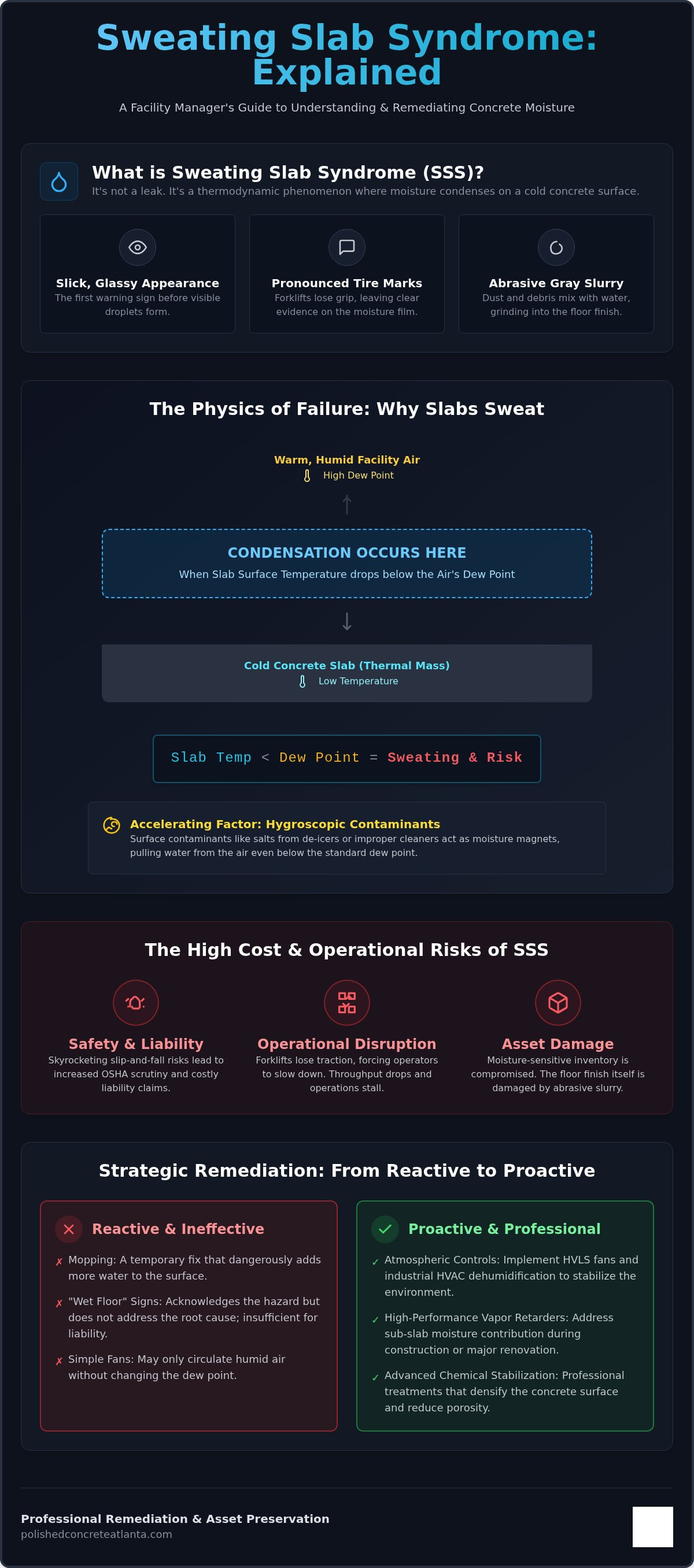
Early detection is critical to maintaining safety. Before visible droplets form, the floor often takes on a "slick" or "glassy" appearance. This isn't a sign of a clean floor; it's a warning. You'll notice forklift tire marks becoming more pronounced as rubber loses its grip on the moisture film. Dust and debris mix with this surface water, creating a gray, abrasive slurry that grinds into your concrete finish. This is distinct from hydrostatic pressure, which pushes moisture up through the slab. SSS is strictly an atmospheric interaction occurring at the surface level.
Why 2026 Facility Standards Demand Better Remediation
In 2026, OSHA scrutiny regarding floor safety and maintenance logs has reached an all-time high. A simple "Wet Floor" sign is no longer a sufficient defense in a liability claim. Modern facilities are also moving toward high-gloss polished concrete for its aesthetic and light-reflective properties. However, these smooth surfaces exacerbate the slip hazards of SSS. Traditional mopping is a reactive, dangerous response because it adds more water to an already saturated environment. Real sweating slab syndrome remediation requires a proactive, technical strategy that controls the environment and the slab temperature simultaneously. Settling for anything less is a risk to your bottom line.
The Physics of Failure: Why Concrete Slabs Sweat
Physics operates with cold indifference to your production schedule. To master sweating slab syndrome remediation, you must first understand the thermodynamic battle happening at the surface of your floor. Concrete is a massive thermal battery. It retains cold temperatures long after the Atlanta air has warmed up and become saturated with humidity. This thermal mass creates a "micro-climate" at the floor level that your wall-mounted thermostat cannot detect. While your HVAC system might report a comfortable 72 degrees at eye level, the air six inches above the slab is often significantly colder and more humid. This temperature differential is where the failure begins.
Dew Point vs. Slab Temperature
Condensation is inevitable when the slab surface temperature falls below the air’s dew point. We typically identify a 3-5 degree "danger zone" where the risk of moisture accumulation becomes critical. In Atlanta, rapid weather shifts, such as a humid morning following a cold front, trigger these events with surgical precision. The higher the relative humidity of the surrounding air, the closer the slab temperature will be to the point of total saturation and liquid condensation. When these two values intersect, your floor ceases to be a dry asset and becomes a safety hazard.
The Role of Hygroscopic Contaminants
Surface chemistry often accelerates this failure. Hygroscopic salts, often introduced through winter de-icers or improper cleaning residues, act as an invisible magnet for moisture. These contaminants actually pull water molecules out of the air at humidity levels well below the standard dew point. A dirty slab will always sweat faster and more severely than a clean, professionally maintained surface. Identifying these deposits through professional surface testing is a mandatory step in any rigorous remediation plan. If you're seeing recurring moisture, it's time to evaluate your current industrial floor services to ensure your cleaning protocols aren't sabotaging your safety.
The interaction between thermal mass and surface contaminants creates a cycle that won't break on its own. You can't just wait for the seasons to change. Effective remediation requires a dual-track approach: stabilizing the atmospheric conditions and chemically treating the surface to resist moisture. Without addressing both, you're simply managing symptoms rather than solving the problem.
Strategic Remediation: How to Stop Concrete Floor Sweating
Strategic remediation isn't a single action. It's a coordinated sequence. You can't just throw a fan at the problem and expect results. Professional sweating slab syndrome remediation requires a multi-front assault on both the air and the concrete surface itself. We don't settle for temporary fixes. We implement systems that address the core thermodynamic failures of your facility.
Atmospheric Control and Air Movement
Moving air is far more effective than heating air for stopping condensation. While some suggest cranking up the heat, this often increases the air's moisture capacity, worsening the "sweat" when it hits the cold slab. High-Volume, Low-Speed (HVLS) fans are the industrial standard for air destratification. They equalize the temperature between the ceiling and the floor, breaking the micro-climate that allows moisture to pool. You must also manage industrial bay doors; leaving them open during high-humidity periods is an invitation for disaster. In large-scale spaces, industrial-grade dehumidifiers are often necessary to keep the relative humidity below the critical saturation point.
Surface Treatments and Densification
The chemical state of your concrete dictates its susceptibility to moisture. Penetrating densifiers are essential. These treatments react with the calcium hydroxide in the concrete to create calcium silicate hydrate, effectively closing the "open" matrix of the slab. This reduces surface tension and limits the area available for moisture to cling to. However, you can't just pour chemicals on a dirty floor. Expert concrete surface preparation contractors must first remove hygroscopic salt deposits that act as moisture magnets. This ensures that moisture mitigation concrete floors perform as engineered.
Follow this disciplined five-step protocol to reclaim your facility:
- Step 1: Deploy HVLS fans to ensure constant air destratification and eliminate stagnant air pockets.
- Step 2: Optimize HVAC systems to prioritize dehumidification rather than just shifting the temperature.
- Step 3: Execute a professional deep clean to strip away hygroscopic salts and oily surface films.
- Step 4: Apply high-performance chemical densification to consolidate the concrete surface and reduce porosity.
- Step 5: Establish a monitoring program using infrared thermometers to track the slab-to-dew-point spread daily.
Stop managing the mess and start solving the problem. If your facility is struggling with seasonal moisture, contact our team for a definitive sweating slab syndrome remediation strategy that protects your assets and your people.
Professional Remediation and Asset Preservation
DIY solutions like portable fans or frequent mopping are losing battles against thermodynamics. They fail because they don't address the thermal mass of the concrete or the chemical state of the surface. Professional sweating slab syndrome remediation focuses on altering the slab's response to atmospheric shifts rather than just moving air. By partnering with industrial flooring contractors Atlanta, you transition from reactive crisis management to long-term asset preservation. We restore the functional integrity and the aesthetic luster of your floor, ensuring that moisture damage doesn't lead to permanent surface degradation or costly slip-and-fall litigation.
The Polished Concrete Atlanta Approach
Our methodology is rooted in precision and technical expertise. We begin with a definitive, no-nonsense assessment of your facility's specific risk factors, from slab temperature to salt concentration. Our specialized salt extraction process removes the hygroscopic contaminants that mops leave behind, effectively deactivating the "moisture magnets" on your floor. We then integrate advanced chemical densification with high-performance sealed concrete solutions. This dual-track approach stabilizes the surface and creates a barrier that resists condensation. We don't just treat the symptoms; we re-engineer the surface interface to handle the unique demands of the Georgia climate.
Moving from Crisis Management to Strategic Maintenance
The ROI of permanent remediation is found in operational uptime and safety. Temporary drying measures are a recurring expense that yields no long-term value. In contrast, a proactive maintenance plan for the 2026 humidity season ensures your facility remains a high-performance environment year-round. You'll eliminate the need for emergency shutdowns and reduce the wear on your cleaning equipment. High-end craftsmanship and technical rigor are the only ways to guarantee peace of mind when the dew point rises. It's time to stop fighting the weather and start controlling your environment. Secure your facility with professional SSS remediation from Polished Concrete Atlanta and invest in a floor that works as hard as you do.
Secure Your Industrial Assets for the 2026 Season
Managing an industrial facility in Atlanta requires more than just operational oversight; it demands a technical mastery of the environment. You now understand that sweating slab syndrome remediation is a disciplined necessity that goes far beyond simple airflow or mopping. By combining precise atmospheric control with advanced chemical densification, you eliminate the thermodynamic conditions that lead to failure. We don't believe in mediocre, temporary fixes that leave your floors slick and your inventory at risk. Reliability is our standard. Settling for less is a gamble with your facility's safety.
Our team brings over 20 years of industrial floor experience and specialized moisture mitigation equipment to every project we manage. As an Atlanta-based partner, we provide the local expertise required to navigate Georgia's unique climate challenges. It's time to move from reactive crisis management to a definitive, engineered solution that preserves your assets for the long term. You can reclaim your facility's safety and throughput starting today. We are ready to help you build a worry-free, high-performance environment.
Consult with Atlanta’s SSS Remediation Experts to stabilize your slab and protect your bottom line. We look forward to delivering the tangible results your business deserves.
Frequently Asked Questions
Is sweating slab syndrome the same as a moisture vapor problem?
No, sweating slab syndrome is an atmospheric issue, whereas moisture vapor problems originate from below the slab. SSS occurs specifically when warm, humid air contacts a cold concrete surface. Moisture vapor emission involves water moving through the concrete matrix due to hydrostatic pressure or a lack of a proper vapor barrier. Distinguishing between the two is vital for effective sweating slab syndrome remediation, as the treatment for one will not solve the other.
Can I fix a sweating slab by just turning up the heat in my warehouse?
Increasing the heat without controlling humidity often exacerbates the problem. Warm air has a higher capacity to hold moisture. If that warm, wet air hits a cold slab that hasn't yet reached the new ambient temperature, condensation will form even faster. You must focus on dehumidification and air movement rather than simply raising the thermostat. Relying on heat alone is a costly mistake that ignores the physics of the dew point.
Do HVLS fans actually stop concrete from sweating?
HVLS fans are highly effective because they facilitate air destratification and increase the rate of surface evaporation. By constantly moving air, these fans prevent the formation of stagnant, cold air pockets at the floor level. This helps keep the slab temperature closer to the ambient air temperature. While fans are a critical component of sweating slab syndrome remediation, they work best when paired with chemical surface treatments that reduce concrete porosity.
What are hygroscopic salts and why do they make my floor wet?
Hygroscopic salts are minerals that actively attract and retain water molecules from the surrounding atmosphere. Common sources include winter de-icers and certain industrial cleaning agents. These salts create a chemical attraction that pulls moisture to the surface even when the air isn't at the traditional dew point. If your floor remains slick while others are dry, salt contamination is the likely culprit. Professional deep cleaning is required to extract these deposits effectively.
How does polished concrete perform compared to epoxy in SSS-prone areas?
Polished concrete is a breathable system, whereas epoxy acts as a non-porous vapor barrier. In environments prone to SSS, moisture can become trapped under epoxy, leading to delamination or blistering if there is also a sub-slab moisture issue. However, polished surfaces can be exceptionally slick when condensation occurs. The solution is using high-performance densifiers to close the concrete matrix, providing the durability of epoxy with the breathability needed for long-term slab health.
What is the most cost-effective way to remediate SSS in a large facility?
The most cost-effective strategy is a dual-track approach involving HVLS fans and professional chemical densification. Fans provide immediate atmospheric relief, while densifiers offer a permanent change to the concrete’s surface tension. This combination prevents the need for constant mopping or expensive HVAC overhauls. Investing in high-quality surface preparation and stabilization early on prevents the massive hidden costs of slip-and-fall accidents and interrupted forklift operations.


