
Moisture is the undisputed number one cause of floor covering system failures across the entire United States. In the heavy humidity of Georgia, ignoring this reality is a recipe for catastrophic delamination and project delays. You likely feel the immense pressure of a tight construction schedule while waiting for concrete to cure. It is a common frustration that many project managers face. However, rushing the process without verified data is a gamble that rarely pays off. Professional concrete moisture testing Atlanta serves as your structural insurance policy against bubbling, peeling, and total floor failure.
We understand the confusion surrounding different ASTM methods and the demand for a floor that lasts decades. This article demonstrates why moisture testing is the non-negotiable first step for every successful commercial project. We will break down the current ASTM F2170-19a and ASTM F1869-23 standards, explaining how the 2018 update to in situ probe testing can actually accelerate your timeline by reducing wait times to just 24 hours. You will gain the technical clarity required to justify mitigation costs and protect your manufacturer warranties. It is time to replace guesswork with professional precision and unwavering reliability.
Key Takeaways
- Atlanta’s high humidity and clay-heavy soil create unique hydrostatic pressures that make moisture vapor transmission a constant threat to commercial floor integrity.
- Professional concrete moisture testing Atlanta utilizes modern ASTM F2170 standards to provide the internal relative humidity data required for valid manufacturer warranties.
- Different finishes require different moisture thresholds; identify why high-gloss polished concrete and epoxy systems demand the most stable substrates for long-term success.
- Avoid the "silo approach" by partnering with an expert who integrates rigorous testing with precision floor preparation and installation for a worry-free investment.
The Science of Slab Failure: Why Atlanta Humidity Demands Rigorous Moisture Testing
Concrete is essentially a hard sponge. Moisture vapor transmission (MVT) is the natural, constant migration of water vapor from the ground up through the slab's capillary network. In many regions, this process is manageable. In Georgia, it's a battle. Atlanta’s high humidity and clay-heavy soil create intense hydrostatic pressure that forces moisture into the concrete. Without professional concrete moisture testing Atlanta, you're essentially guessing about the structural foundation of your entire facility.
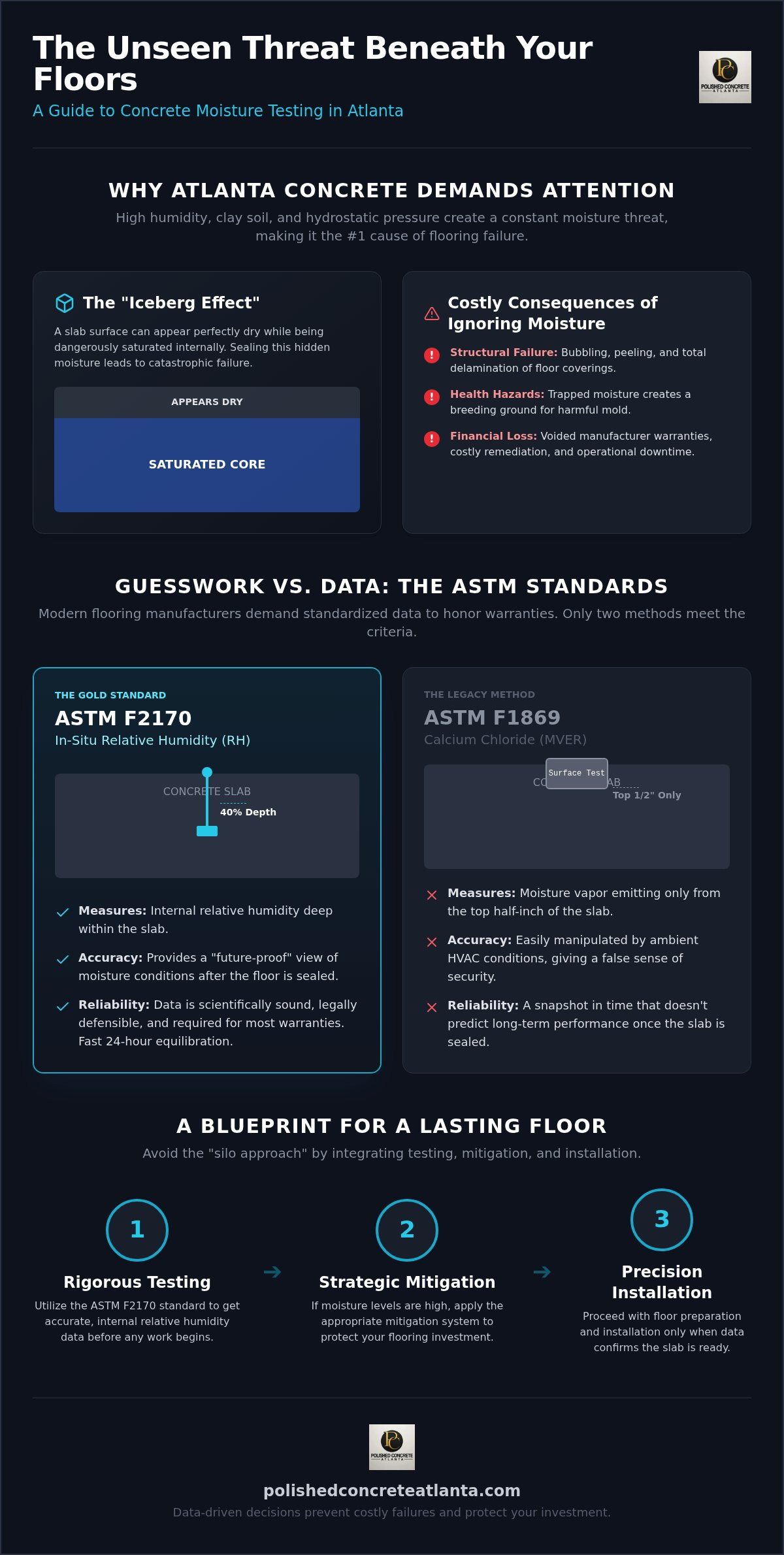
We call it the "Iceberg Effect." A slab surface can appear perfectly dry to the naked eye while remaining dangerously saturated internally. If you seal that moisture in with epoxy or non-porous flooring, the vapor has nowhere to go. It builds pressure until it causes osmotic blistering. Adhesives fail. Mold thrives in the dark, damp space beneath your floor. These aren't just aesthetic issues; they are structural failures that demand expensive remediation. Technical tools like concrete moisture meters provide the only definitive way to measure what’s happening beneath the surface.
The Atlanta Factor: Geography and Slab Performance
Georgia's high water table impacts slab-on-grade commercial facilities more than almost any other variable. In legacy Atlanta buildings, vapor retarders are often missing or have disintegrated over decades. This allows ground moisture to move freely into the concrete. Even in new construction, "seasoning" concrete in the humid Southeast takes significantly longer than in drier climates. You cannot rely on a standard 28-day cure window to guarantee a dry slab. It's science, not an opinion.
Visible Signs of Moisture Issues
Keep an eye out for efflorescence, the white mineral powder that appears as water evaporates and leaves salts behind. It’s a clear warning. In warehouse environments, "sweating slab syndrome" creates dangerous, slick surfaces that compromise safety. The financial impact of a floor failure in an active industrial facility is staggering. It isn't just the cost of a new floor; it's the cost of halting production, moving equipment, and losing revenue while the mistake is fixed. Precision concrete moisture testing Atlanta prevents this cycle before it starts.
Decoding ASTM Standards: F2170 vs. F1869 in Commercial Environments
A failed floor is a liability you can't afford. In the high-stakes world of commercial construction, precision is the only currency that matters. Relying on "mat tests" or anecdotal field methods is professional negligence. Modern flooring manufacturers now demand rigorous, standardized data before they will honor a single warranty claim. This is why concrete moisture testing Atlanta must follow established ASTM protocols. These standards eliminate the guesswork. They provide a clear, data-driven path to a successful installation.
Understanding the nuances of concrete moisture testing methods is essential for any project manager overseeing a high-value facility. While several field methods exist, the industry recognizes two primary standards: ASTM F2170 and ASTM F1869. Each serves a specific purpose; however, the shift toward internal humidity readings has fundamentally changed the landscape of floor preparation.
ASTM F2170: In-Situ Relative Humidity (RH) Testing
This is the gold standard for modern flooring. Digital probes are inserted into holes drilled to exactly 40% of the slab's depth. This isn't just a surface measurement. It measures the moisture deep within the concrete matrix. Why does this matter? It provides a "future-proof" view of slab behavior. Even if the surface looks dry, the RH probe tells you what will happen once the slab is sealed. Following the 72-hour equilibrium rule ensures the data is legally defensible and scientifically sound. It’s fast. It’s accurate. It’s definitive.
ASTM F1869: Calcium Chloride (MVER) Testing
The Calcium Chloride test measures the Moisture Vapor Emission Rate (MVER). It calculates how many pounds of water are leaving 1,000 square feet of concrete over a 24-hour period. It remains relevant for specific adhesive applications that prioritize surface dryness. But it has a major weakness. It only measures the top half-inch of the slab. HVAC conditions can easily manipulate these results, leading to a false sense of security. If the air is dry, the test looks good. But the moisture below remains a ticking time bomb.
We believe in total transparency and technical excellence. Third-party verification isn't just a checkbox; it is your defense against future litigation. If you're ready to ensure your project meets these rigorous standards, our team provides expert floor preparation and testing services to secure your investment. Don't settle for "good enough" when the longevity of your facility is on the line.
Strategic Moisture Mitigation: Protecting Your High-Performance Floor Investment
Data from concrete moisture testing Atlanta is only valuable if you know how to act on it. It isn't just about passing or failing. It's about strategic decision-making. Polished concrete systems often allow for some breathability, but epoxy and high-performance coatings are unforgiving. If you trap moisture beneath a non-porous finish, the result is inevitable: failure. High-gloss finishes demand the most stable substrates. Any vapor pressure or substrate instability will destroy the aesthetic and structural integrity of the work.
Successful mitigation integrates moisture control directly into the floor preparation workflow. It isn't an afterthought. It's a foundation. By identifying high-risk areas early, you can choose the right defensive measures before the final finish is applied. This proactive approach eliminates the "Iceberg Effect" discussed earlier, ensuring your investment remains secure for decades. Using concrete moisture testing Atlanta as a diagnostic tool allows us to build a floor that stands up to Georgia's environmental demands.
When Mitigation is Mandatory
Industry standards provide the roadmap. When RH levels exceed 75% to 80% for sensitive epoxy coatings, mitigation is no longer optional. You face a choice. You can wait for the slab to reach equilibrium naturally, which in Georgia can take months. Or, you can install a professional moisture barrier. The cost-benefit analysis usually favors the barrier. It prevents construction delays that are far more expensive than the mitigation itself. Expert concrete surface preparation contractors are essential here. They use precision grinding to create the specific surface profile required for permanent barrier adhesion.
Moisture Barrier Technologies
Epoxy-based vapor barriers are the industry's gold standard for slabs with high relative humidity. They provide a robust, impermeable shield against hydrostatic pressure. While penetrating silicates are excellent for densification, they don't offer the same level of protection as a dedicated topical membrane. Choosing the wrong defense is a costly mistake. You must ensure the mitigation layer is chemically compatible with your final polished or epoxy finish. We provide comprehensive floor moisture mitigation services to ensure your facility's floor is built to last. Precision is the only way to guarantee peace of mind.
Selecting a Partner for Integrated Concrete Moisture Solutions in Atlanta
The biggest risk to your flooring project isn't just moisture; it's the "Silo Approach." Many facilities hire one company to test and another to install. When the floor fails, the finger-pointing begins. The tester blames the installer’s prep; the installer blames the test results. This lack of accountability is unacceptable. A truly integrated approach to concrete moisture testing Atlanta ensures that the data gathered directly informs every stage of the installation. One team. One standard. Zero excuses. Accountability is the bedrock of our process.
Reliability requires specialized equipment and a veteran's perspective. Evaluating a contractor’s technical depth is essential. Do they understand the chemical compatibility of vapor barriers? Do they own the heavy-duty grinding equipment required for proper profiling? Top-tier industrial flooring contractors in Atlanta prioritize preparation as the most critical phase of the project. Without it, the most expensive finish is merely a temporary mask for a deep-seated problem. We use industry-leading digital probes to capture real-time, actionable data.
The Polished Concrete Atlanta Standard
We don't settle for mediocrity. Our "no-nonsense" approach to slab analysis removes the guesswork that plagues most commercial projects. By using precision digital probes and exhaustive surface evaluations, we eliminate uncertainty before a single drop of finish is applied. This meticulous foundation is what allows us to deliver the highest quality polished concrete floors in Atlanta. We don't just provide a service; we manage the integrity of your substrate from the ground up.
Ensuring Long-Term Performance
Execution doesn't end with the application of a barrier. Post-mitigation verification ensures the system is performing exactly as intended. For facility managers, this means total peace of mind and floors that remain compliant with manufacturer warranties for decades. High-end craftsmanship is a premium investment that pays for itself through extreme durability. Don't leave your facility's future to chance. Your next step is a professional slab evaluation to identify risks before they become failures. Secure your foundation today.
Secure Your Foundation for the Next Decade
A high-performance floor is only as reliable as the substrate beneath it. In the humid climate of the Southeast, concrete moisture testing Atlanta is the only way to eliminate the "Iceberg Effect" and ensure your facility remains operational. We've established that internal relative humidity data is the non-negotiable standard for manufacturer warranties. Rushing into an installation without this clarity is a gamble that professional facility managers simply don't take. Strategic mitigation is a proactive choice that protects both your aesthetic and structural investment.
Since 2004, we've specialized in high-performance industrial and commercial environments where failure is not an option. Our approach brings comprehensive surface preparation, testing, and finishing under one roof. This eliminates the uncertainty and finger-pointing that often complicates large-scale projects. Precision is the only way forward. You deserve a partner who manages every technical detail with unwavering discipline. Take the first step toward a worry-free floor by choosing data over guesswork. Request a Technical Slab Evaluation and Estimate today. Let's build a floor that stands the test of time.
Frequently Asked Questions
How long does concrete moisture testing take in a typical commercial facility?
Official results for in-situ relative humidity testing now require only a 24-hour equilibration period. While older standards required 72 hours, the 2018 revision to ASTM F2170 accelerated the process for faster project timelines. We install the digital probes, wait 24 hours, and capture the data. This allows you to maintain construction momentum without compromising the technical integrity of your substrate.
Can I install polished concrete if my slab has high moisture levels?
You can, but it requires a strategic approach to densification and sealing. Polished concrete is naturally more breathable than non-porous coatings like epoxy, but extreme moisture still leads to efflorescence and sweating slab syndrome. We evaluate the specific RH levels to determine if standard polishing is sufficient or if technical floor moisture mitigation is necessary to stabilize the surface for long-term use.
Is ASTM F2170 better than the calcium chloride test for Atlanta warehouses?
ASTM F2170 is the superior method for the humid Georgia climate. While the calcium chloride test only measures surface vapor emissions, RH probes measure the moisture deep within the slab's core. This provides a more accurate prediction of how the concrete will behave long-term. Most modern flooring manufacturers now mandate RH data for warranty compliance because it is much harder to manipulate with temporary HVAC settings.
What is the cost of moisture mitigation for a commercial concrete floor?
Total costs depend on the square footage of the facility, the severity of the relative humidity levels, and the required surface profile. A slab requiring a heavy-duty epoxy vapor barrier involves more intensive grinding and preparation than one needing a simple silicate treatment. We provide detailed estimates following a technical evaluation. Investing in mitigation now prevents the far greater expense of a total floor failure later.
Does new concrete always need moisture testing before being polished?
Professional concrete moisture testing Atlanta is a requirement for all new slabs, regardless of age. The common 28-day cure rule is a dangerous myth in the humid Southeast. Environmental factors and slab thickness significantly impact drying times. Testing is the only way to verify that the concrete has reached a stable equilibrium before you apply high-performance finishes or technical densifiers.
What happens if I ignore high moisture levels in my concrete slab?
Ignoring high moisture leads to catastrophic floor failure. You will likely face osmotic blistering, adhesive delamination, and dark staining known as efflorescence. Beyond the physical damage, failing to document moisture levels will void your flooring manufacturer’s warranty. This leaves your business fully liable for the massive costs of tear-out and replacement. Precision testing eliminates this financial and operational risk entirely.


