
Most industrial floor failures aren't caused by heavy machinery. They're caused by the flawed belief that a thin topical coating can solve a structural problem. You've likely seen the cycle before: a new epoxy looks perfect on day one, only to delaminate under forklift traffic or peel away after a chemical spill within eighteen months. It's a costly disruption that creates avoidable safety hazards. This is why the Ashford Formula for industrial concrete floors has become the definitive choice for facilities that prioritize long-term durability over temporary aesthetics. We understand that in a high-output environment, your floor is a critical engineering component, not just a surface.
We'll show you how to engineer a set-and-forget flooring system that withstands heavy machinery and chemical exposure for decades. You'll learn how to meet Georgia's strict building codes and OSHA's 0.5 slip resistance requirements while maintaining peak operational efficiency. This article provides a comprehensive breakdown of the 2026 engineering standards for floor flatness and moisture mitigation. True craftsmanship demands nothing less. The era of frequent floor repairs is over.
Key Takeaways
- Learn why true heavy-duty flooring is defined by structural load-bearing capacity and chemical resistance rather than simple surface aesthetics.
- Compare the long-term lifecycle costs of polished concrete versus epoxy systems to identify the most resilient investment for your specific facility.
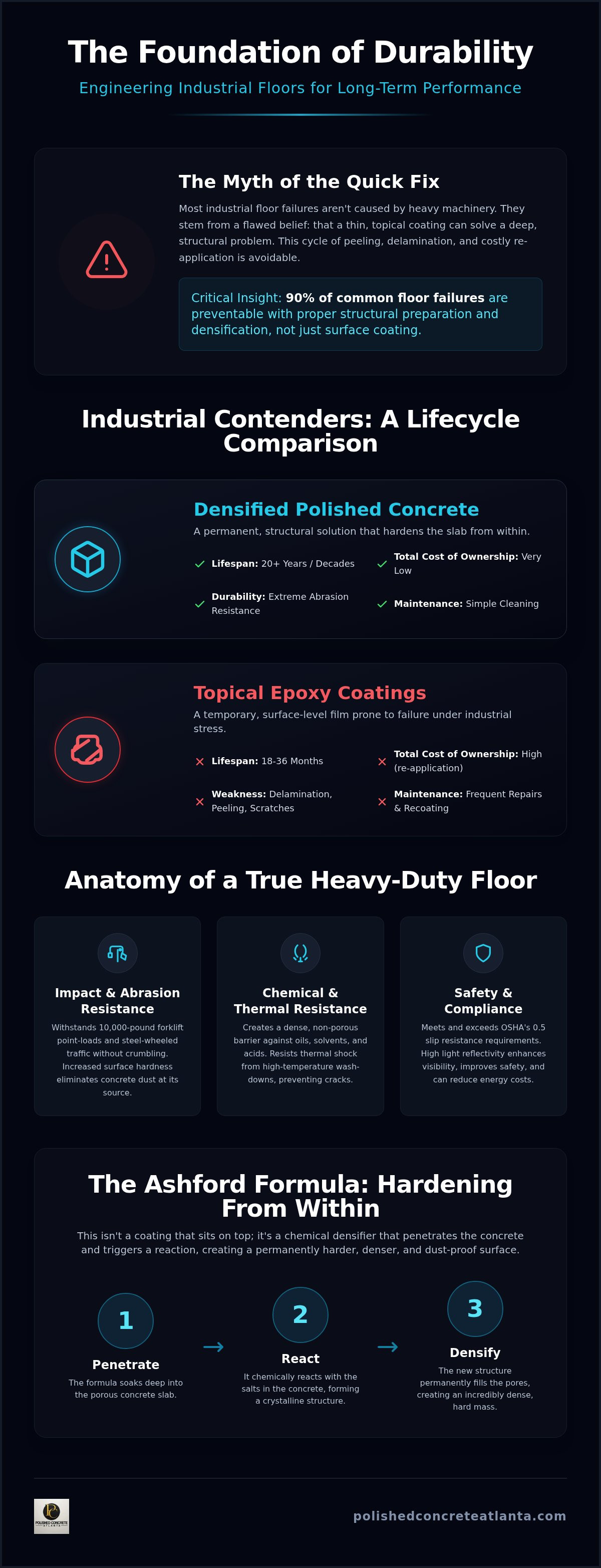
- Discover how the Ashford Formula for industrial concrete floors eliminates dust and increases surface density by chemically hardening the slab from within.
- Identify the critical surface preparation techniques that prevent 90% of common industrial floor failures and delamination issues.
- Follow a five-step strategic framework designed to ensure safety compliance and minimal operational disruption during your next flooring installation.
Defining Heavy-Duty: What Manufacturing Floors Must Withstand
Heavy-duty flooring isn't just about thickness. It's a system engineered to survive impact, abrasion, and aggressive chemical exposure without failing. Many facility managers mistake a shiny finish for durability. This is a mistake. While Polished Concrete offers high-end aesthetics, the true engineering standard for a manufacturing plant is measured in load-bearing capacity and surface density. We prioritize performance over surface-level beauty because a floor that looks good but fails under pressure is a liability.
Think about the physics of a 10,000-pound forklift concentrated on four small points of contact. A floor that hasn't been properly densified will eventually crumble under this point-loading pressure. This is where the Ashford Formula for industrial concrete floors becomes essential. It doesn't just sit on top; it integrates with the slab to create a permanent seal. We focus on the Total Cost of Ownership (TCO) because a cheap initial install that requires maintenance every two years is a drain on your bottom line. Investing in a proven system ensures you aren't paying for the same floor twice.
Impact and Abrasion Resistance
Manufacturing environments are brutal. We use the Mohs hardness scale to quantify how a surface stands up to daily abuse. Steel-wheeled dollies exert far more pressure and "bite" into the concrete than standard rubber tires. If your surface isn't hardened, it will dust. This dust isn't just a nuisance; it's a sign of your floor literally wearing away. Abrasion resistance determines the lifespan of your facility’s most used asset. By increasing the surface hardness, you eliminate the source of concrete dust and protect your machinery from airborne grit.
Chemical and Thermal Shock Requirements
Industrial floors face constant threats from oils, solvents, and acids that can penetrate and degrade standard concrete. In facilities using high-temperature wash-downs or industrial ovens, thermal shock can cause immediate cracking in inferior materials. Non-porous surfaces aren't just a preference; they're a requirement for regulatory compliance and long-term structural integrity. By utilizing the Ashford Formula for industrial concrete floors, you create a surface that resists penetration and maintains its bond even under extreme temperature fluctuations. This creates a breathable yet dense barrier that prevents delamination and keeps your plant running without interruption.
The Industrial Contenders: Polished Concrete vs. Epoxy Systems
Choosing between polished concrete and resinous coatings isn't a matter of aesthetics; it's a strategic engineering decision. Both systems offer specific advantages in durability, maintenance, and cost-efficiency. Polished concrete typically wins on long-term value, while epoxy provides an impenetrable barrier for chemical processing zones. We often recommend industrial floor coatings Atlanta for facilities where moisture and aggressive acids are daily realities. Both options significantly improve light reflectivity, which enhances safety by eliminating dark spots and reducing the energy required to light large warehouses.
A persistent myth suggests that polished surfaces are too slippery for industrial use. This is false. A properly finished floor can meet or exceed the safety standards outlined in the ACI Guide to Concrete Floor and Slab Construction. In fact, clean, dry polished concrete often provides better traction than a dirty, oil-soaked broom-finished floor. If you're managing a facility where safety and longevity are non-negotiable, consulting with an industrial floor expert is the first step toward a permanent solution.
Ashford Formula: The Sustainable Powerhouse
For high-traffic environments that don't face constant chemical saturation, the Ashford Formula for industrial concrete floors is the definitive standard. It's not a topical sealer that wears away. Instead, it initiates a chemical reaction within the slab to densify the concrete matrix. This process turns a porous surface into a hard, dust-proof mass that actually improves as it's used. The Ashford Formula for industrial concrete floors remains the benchmark for permanent densification. It's the ideal choice for polished concrete floors Atlanta warehouses and retail-hybrid facilities rely on to handle heavy forklift traffic without the need for constant recoating.
High-Performance Epoxy: Maximum Chemical Shielding
Resinous systems are engineered for the most demanding chemical and impact zones. These multi-layer coatings create a monolithic, seamless surface that's easy to sanitize and completely non-porous. This is critical for food production or pharmaceutical plants where hygiene is a regulatory requirement. Unlike densifiers, epoxy allows for the integration of customizable slip-resistance additives like quartz or aluminum oxide. These additives ensure a safe grip even in wet manufacturing areas. When you need a total shield against aggressive solvents, a high-performance epoxy is the only choice that delivers absolute protection.
The Engineering of Adhesion: Why Preparation Prevents Failure
Ninety percent of industrial floor failures occur because of inadequate substrate preparation. It's that simple. Many contractors treat the slab as a passive surface, but we view it as an active engineering substrate. Without proper mechanical profiling, even the most expensive coatings will peel. We utilize professional concrete surface preparation contractors to ensure the bond strength meets industrial standards. Whether we're diamond grinding for a smooth profile or shot-blasting to create a mechanical "anchor" for resinous systems, the goal is a clean, open-pore surface that's ready to perform.
In Atlanta, Sweating Slab Syndrome (SSS) is a constant threat to facility safety. High humidity levels cause moisture to condense on cold concrete, leading to slippery conditions and coating failure. This is why the Ashford Formula for industrial concrete floors is so effective; it allows the concrete to breathe while increasing surface density to prevent liquid penetration. Beyond moisture, industrial floors must also comply with technical standards like OSHA electrical grounding requirements to ensure a safe workspace for sensitive electronics and machinery. We don't just finish floors; we engineer them for compliance and safety.
Moisture Mitigation and Vapor Barriers
Georgia's relentless humidity drives moisture vapor through the slab from the ground up. This internal pressure is the primary cause of epoxy blistering and delamination. We don't guess about moisture levels. Our team uses Relative Humidity (RH) and Calcium Chloride testing to determine the exact moisture emission rate before a single drop of product is applied. Moisture mitigation is the insurance policy every high-performance floor requires. If the slab isn't dry and stable, the installation is destined for failure.
Removing the Past: Glue and Coating Removal
Old adhesives and failed coatings are more than just an eyesore. They represent a significant risk of "ghosting" or delamination for your new floor. Mechanical glue removal is the only reliable way to clear these contaminants and reveal the sound concrete underneath. We ensure a clean, pH-neutral slab that's optimized for maximum adhesion. Don't let the remnants of a previous floor ruin your new investment. Contact our floor prep specialists to secure your facility's future with a clean slate.
Selecting and Sustaining Your Manufacturing Floor in Atlanta
Selecting a floor is a high-stakes engineering decision. It requires a strategic framework. We recommend a five-step process: audit your environmental stressors, evaluate the substrate condition, select the appropriate engineering system, coordinate installation logistics, and commit to a lifecycle maintenance plan. This methodical approach eliminates uncertainty. Logistical planning is particularly critical. We often execute installations in stages or during scheduled shutdowns to minimize plant downtime. Working with seasoned industrial flooring contractors Atlanta facilities trust ensures your project respects local climate variables and tight production schedules.
The Ashford Formula for industrial concrete floors is a cornerstone of this strategy for many Georgia plants. It provides a permanent solution that doesn't require the frequent re-application cycles common with cheaper, topical sealers. By hardening the slab itself, you're investing in a surface that actually improves under the weight of heavy traffic. It's a set-and-forget solution for the modern manufacturer. We don't believe in temporary fixes.
Maintenance for Maximum ROI
Maintenance isn't just mopping. It's asset preservation. Routine cleaning with pH-neutral agents is mandatory to protect the chemical bond of densified concrete. Avoid acidic cleaners; they degrade the surface over time. Professional restorative polishing may be needed periodically for high-luster areas, but the core densification remains intact. For facilities with epoxy systems, you must monitor wear patterns closely. Schedule a re-coat before the resin wears through to the bare substrate. This proactive approach prevents expensive slab repairs and ensures your floor remains a high-performance asset for decades.
The Professional Partnership
Don't hire a vendor. Build a strategic alliance. A manufacturing floor is a decades-long investment that dictates the safety and efficiency of your entire operation. We prioritize transparency and rigorous engineering standards in every project. We don't settle for mediocrity. Your facility deserves a partner that carries the gravitas of a veteran and the meticulousness of a consultant. Contact Polished Concrete Atlanta for a rigorous facility assessment.
Securing the Future of Your Atlanta Manufacturing Facility
Your manufacturing facility deserves a foundation that matches your operational intensity. We've established that true durability isn't a cosmetic choice; it's a rigorous engineering requirement. By prioritizing precise mechanical preparation and selecting the Ashford Formula for industrial concrete floors, you effectively eliminate the costly cycle of delamination and frequent maintenance. This isn't just about meeting the building codes of 2026. It's about securing a permanent, set-and-forget asset that protects your machinery, your inventory, and your personnel for decades to come.
Polished Concrete Atlanta has served as the region's definitive expert since 2004. We bring specialized knowledge in Sweating Slab Syndrome remediation and remain Atlanta’s authority on industrial concrete prep. Don't leave your facility's safety or structural integrity to chance or mediocre service providers. It's time to invest in the peace of mind that comes from elite craftsmanship and proven technical standards. Request an Uncompromising Facility Assessment today to verify your floor's performance and plan for long-term success. We look forward to engineering a solution that stands the test of time.
Frequently Asked Questions
What is the most durable flooring for heavy machinery?
Polished concrete treated with the Ashford Formula for industrial concrete floors is the most durable option for heavy machinery. This system hardens the slab from within, increasing its density and abrasion resistance to withstand 10,000-pound forklift loads. While high-performance epoxy provides superior chemical protection, densified concrete offers a permanent solution that won't peel or delaminate under extreme pressure. We engineer these surfaces to handle the relentless traffic common in Atlanta’s industrial corridors.
How long does a manufacturing floor installation take?
A typical industrial floor installation takes between three to seven days, depending on the square footage and required surface preparation. We prioritize logistical efficiency to minimize plant downtime for our Atlanta clients. This timeline includes mechanical grinding, moisture testing, and the application of densifiers or coatings. Large-scale manufacturing plants often require phased installations to keep production lines moving. We provide a precise schedule after a thorough facility assessment to ensure total transparency.
Can you install epoxy over old, oil-soaked concrete?
You can install epoxy over oil-soaked concrete, but only after aggressive mechanical preparation. We use industrial-grade degreasers and diamond grinding to remove the contaminated surface layer and reveal clean, sound concrete. If oil has penetrated too deeply, the bond will fail. We don't guess; we test the substrate’s pH and porosity to ensure long-term adhesion. Proper floor preparation is the only way to prevent delamination in older Atlanta warehouses and manufacturing hubs.
How does moisture mitigation prevent floor failure in Georgia?
Moisture mitigation prevents floor failure by blocking moisture vapor transmission from rising through the slab. In Georgia's high-humidity environment, internal pressure can force topical coatings to blister and peel. We utilize technical moisture testing and specialized barriers to stabilize the concrete before installation. This process is essential for preventing Sweating Slab Syndrome, ensuring your flooring investment remains bonded and safe despite the local climate’s relentless moisture levels. It's a non-negotiable step for long-term success.
Is polished concrete too slippery for industrial environments?
Polished concrete is not too slippery for industrial settings when properly maintained. These floors meet or exceed OSHA’s 0.5 coefficient of friction standard for level surfaces. In many Atlanta facilities, a clean polished floor provides better traction than a dusty, broom-finished slab. We can also integrate specialized slip-resistance additives into resinous systems for wet manufacturing zones. Safety is a non-negotiable engineering requirement, and we verify every surface meets rigorous industry benchmarks to eliminate uncertainty.
What is the difference between Ashford Formula and standard sealers?
The Ashford Formula for industrial concrete floors is a penetrating densifier, not a topical sealer. Standard sealers create a temporary film on the surface that eventually wears away and requires frequent re-application. In contrast, the Ashford Formula initiates a chemical reaction within the concrete matrix to harden the slab permanently. It turns the floor into a dust-proof, high-density mass that actually improves with age and use. It’s a one-time application designed for long-term industrial performance.


