
If you believe the most expensive part of your flooring project is the high-performance coating, you’re looking at the wrong layer. A floor is only as good as the concrete profile beneath it. Anything less than professional commercial floor preparation Atlanta is simply a planned failure. You’ve likely dealt with the frustration of bubbling epoxy, peeling finishes, or the nightmare of moisture trapped under a fresh install. It's a costly drain on resources that halts production and compromises safety. Precision is non-negotiable.
How much is a failed installation really costing your bottom line? We understand that your priority is a floor that lasts ten years, not two. This guide will demonstrate why professional surface engineering is the single most critical factor in preventing commercial floor failure and ensuring long-term ROI. We’ll examine the technical reality of Concrete Surface Profiles (CSP), moisture mitigation strategies, and the rigorous standards required for a truly industrial-grade finish. Results matter. Let's look at the engineering required to achieve them.
Key Takeaways
- Master the "Bonding Paradox" to prevent costly epoxy delamination by ensuring your slab is mechanically engineered for maximum adhesion.
- See why planetary diamond grinding is the definitive choice over acid etching for meeting modern industrial safety and durability standards.
- Navigate the complexities of Atlanta’s high-humidity climate with expert commercial floor preparation Atlanta strategies designed to eliminate moisture-related failures.
- Evaluate the long-term ROI of slab-first engineering, utilizing premium solutions like the Ashford Formula for a dustproof, high-luster finish.
- Shift your strategy from aesthetic speed to structural integrity to ensure your facility's floor remains a high-performing asset for over a decade.
The Engineering of Adhesion: Why Surface Prep is Non-Negotiable
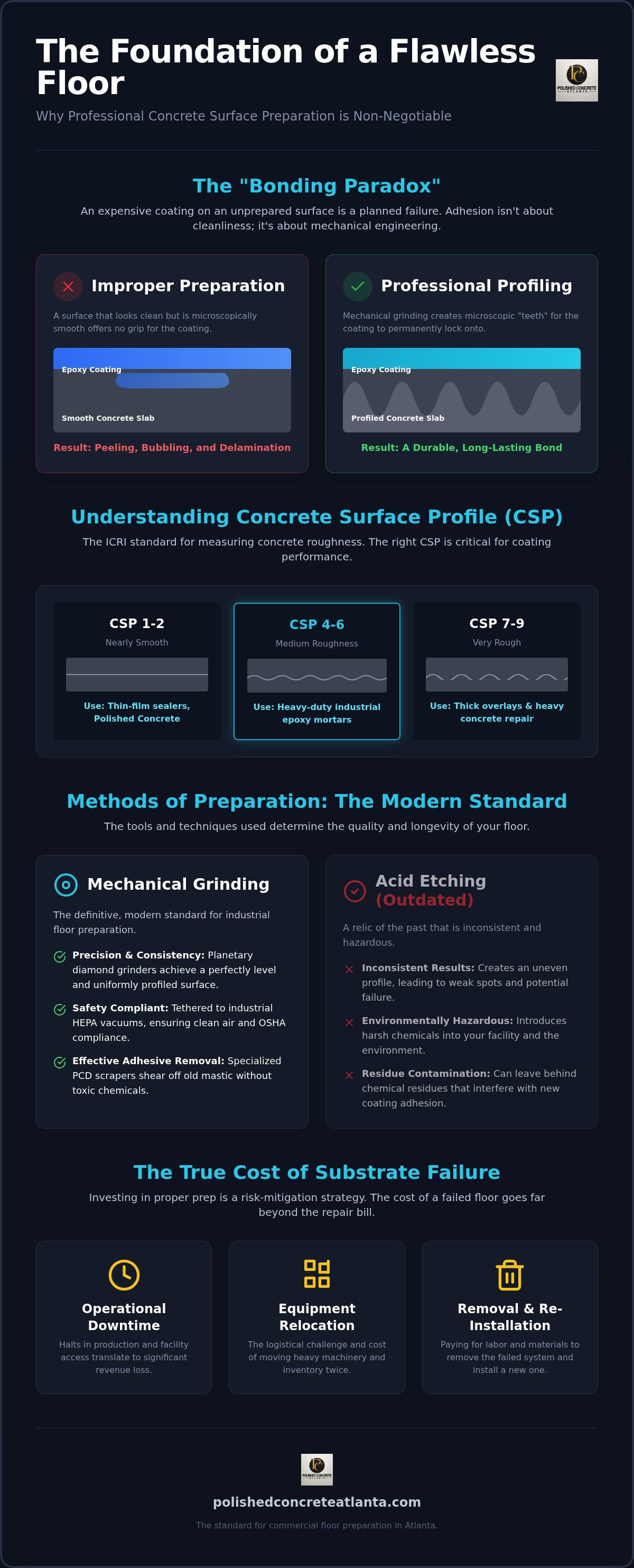
Commercial floor preparation in Atlanta is not a cleaning service. It is a rigorous process of mechanical and chemical modification designed to transform a raw concrete slab into a receptive substrate. Many facility managers fall victim to the "Bonding Paradox." This occurs when an expensive, high-performance epoxy is applied to a surface that looks clean but remains microscopically smooth. Without a mechanical anchor, the coating has nothing to grip. It will peel. It will fail. We don't guess at readiness. We follow International Concrete Repair Institute (ICRI) standards to ensure every square foot meets the specific profile required for the intended finish.
Distinguishing between cleaning and profiling is the hallmark of a professional installation. While cleaning removes surface contaminants like dust or oil, profiling actually changes the texture of the concrete. It creates "teeth" for the new material to bite into. If your contractor is only using a mop and a bucket, they aren't preparing your floor; they're just delaying its inevitable failure.
Understanding Concrete Surface Profile (CSP) Levels
CSP is the measure of the average distance from the peaks to the valleys on a concrete surface. Achieving the correct Concrete Surface Profile is the difference between a floor that lasts a decade and one that delaminates in months. The scale ranges from CSP 1 (nearly smooth) to CSP 9 (extremely rough). Different finishes require different levels of aggression. For instance, a thin-film sealer might only require a CSP 1 or 2. In contrast, heavy-duty industrial epoxy mortars demand a CSP 4 to 6 to handle the shear stress of forklift traffic. Understanding The Polished Concrete Process requires a different approach. We often aim for a lower profile that prioritizes refinement over aggressive "teeth" to achieve that signature high-luster finish.
The True Cost of Substrate Failure
The financial impact of substrate failure is staggering. When a floor peels or bubbles, you aren't just paying for a repair. You're paying for operational downtime, moving heavy equipment, and the labor-intensive removal of the failed material. Investing in professional commercial floor preparation Atlanta is a risk-mitigation strategy that protects your capital investment. Proper mechanical preparation extends the lifecycle of your commercial asset by creating a permanent bond that resists hydrostatic pressure and heavy traffic. For a deeper technical analysis of these mechanics, read our internal resource: The Engineering of Adhesion: A Definitive Guide to Concrete Surface Preparation. Elite results require an uncompromising commitment to the slab's health.
Mechanical Prep vs. Chemical Prep: Tools of the Trade
Acid etching is a relic of the past. While some contractors still rely on chemical solutions to "open" concrete pores, this method is inconsistent and environmentally hazardous. In 2026, mechanical grinding stands as the only definitive way to meet rigorous concrete surface preparation standards. We use heavy-duty planetary diamond grinders to achieve precision. These machines utilize three or more heads that rotate in opposite directions, ensuring the slab is not just profiled, but perfectly leveled. This process eliminates high spots and prepares the matrix for a flawless bond. In active commercial environments, we prioritize safety. Every grinder is tethered to an industrial HEPA-filtered dust extraction system. This keeps your facility clean and your air quality within OSHA compliance.
Before any coating touches the floor, we address structural vulnerabilities. Cracks, spalls, and joint failures are more than aesthetic issues; they're points of future delamination. We treat every imperfection with high-strength industrial fillers to restore the slab's integrity. If you're concerned about the current state of your substrate, our team at Polished Concrete Atlanta can provide a comprehensive site evaluation.
Industrial Floor Glue and Adhesive Removal
Old mastic and black adhesive are notoriously difficult to manage. Chemical strippers often turn these materials into a toxic slurry that leaches deeper into the concrete, creating a "ghosting" effect that ruins new finishes. We reject this messy approach. Our mechanical removal techniques use specialized PCD (Polycrystalline Diamond) scrapers to shear the adhesive off the surface. This leaves the slab pristine and ready for the next phase of commercial floor preparation Atlanta without the risk of chemical residue interfering with adhesion.
Concrete Grinding: The 5-Step Process for Atlanta Facilities
We approach every project with a methodical, five-step execution plan to ensure consistency:
- Step 1: Hardness Testing. We use the Mohs scale to determine the concrete's compressive strength. This dictates which diamond bonds we select.
- Step 2: Coarse Grinding. We strip away old coatings, contaminants, and the weak surface layer (laitance) to expose sound concrete.
- Step 3: Patching and Repair. We inject structural resins into cracks and patch spalled areas to create a monolithic surface.
- Step 4: Fine Grinding. We transition to higher-grit diamonds to refine the surface to the exact CSP level required for your specific finish.
- Step 5: Final Decontamination. We perform a final HEPA vacuuming and conduct moisture testing to ensure the slab is ready for the final application.
Moisture Mitigation: Solving Atlanta’s Slab Challenges
Georgia's climate demands a specific approach to commercial floor preparation Atlanta. Concrete is naturally hygroscopic. It acts like a rigid sponge. When humidity levels spike, the slab absorbs moisture from both the atmosphere and the red clay soil beneath it. This creates high Moisture Vapor Emission Rates (MVER). If you seal a damp slab without proper mitigation, that vapor pressure builds up until it has nowhere to go. The result is osmotic blistering. Your expensive coating will bubble and eventually delaminate. We don't leave this to chance.
We frequently remediate "Sweating Slab Syndrome" in non-climate-controlled warehouses and industrial facilities across the metro area. This phenomenon occurs when warm, humid air hits a cooler concrete surface, causing immediate condensation. It is a significant safety hazard and a structural threat. We solve this through a combination of mechanical profiling and specialized moisture-blocking primers. Don't let a damp slab compromise your facility's safety or your investment's longevity.
Moisture Testing Protocols (ASTM F1869 & F2170)
Surface-level readings are often misleading. We reject the "tape test" or simple calcium chloride tests (ASTM F1869) as the sole indicators of a slab's health because they only measure the top layer. Instead, we utilize in-situ Relative Humidity (RH) probe testing (ASTM F2170) to get the full picture. RH probes measure the "potential" moisture deep within the slab. This data allows us to predict exactly how the concrete will behave once it is sealed. Precision requires depth. We only proceed when the data confirms the environment is stable.
Technical Solutions for Damp Slabs
High-risk zones require high-performance engineering. We apply epoxy moisture vapor barriers designed to withstand up to 25 lbs of MVER or 100% relative humidity. This isn't a standard primer; it's a dedicated barrier that creates a permanent bond. This mitigation strategy integrates seamlessly with our Industrial Floor Coatings Atlanta, providing a stable foundation for heavy-duty finishes. Beyond adhesion, vapor control protects your indoor air quality by preventing mold growth within the concrete matrix. Secure your facility's future. Contact Polished Concrete Atlanta for a professional moisture assessment today.
The Polished Concrete Atlanta Execution Standard
Efficiency in commercial floor preparation Atlanta isn't defined by how fast a crew can finish. It's defined by how long the floor remains intact after they leave. Our no-nonsense approach prioritizes the slab's structural health over aesthetic speed. We don't cut corners. If a substrate requires extensive remediation to meet industrial standards, we report it immediately and transparently. We are committed to using the Ashford Formula for superior dustproofing and hardening, ensuring your facility remains clean and durable under heavy traffic. We coordinate directly with GCs to minimize downtime, providing a predictable, expert-led installation process that eliminates the guesswork often found with generalists.
Strategic Alliances for Atlanta Commercial Projects
We act as creative consultants for architects and facility managers from the pre-construction phase. Our expertise ensures your project complies with OSHA and industrial safety regulations from the ground up. Generalists often overlook the nuances of mechanical bonding and moisture vapor emission. We don't. By hiring a dedicated prep and finishing specialist, you gain a partner who understands the chemistry of the concrete matrix and the physics of adhesion. This discipline translates to a premium, worry-free investment for your facility.
Final Inspection and Quality Assurance
We document every CSP level and moisture reading to ensure full warranty compliance. This data-driven approach removes uncertainty and protects your long-term ROI. The transition from prep to Polished Concrete Floors in Atlanta is seamless when the foundation is engineered correctly. During the final walkthrough, "ready for finish" means more than just a clean floor. It means a substrate that is leveled, profiled, and structurally sound. We deliver results that stand the test of time. Your floor is a critical asset. We treat it like one.
Secure Your Facility's Future with Engineered Precision
Your floor's longevity isn't a matter of luck; it's the result of rigorous engineering and a refusal to settle for surface-level aesthetics. We've established that mechanical bonding through industrial-grade diamond grinding equipment is the only definitive way to ensure a permanent finish. By prioritizing deep-slab moisture testing over surface-level readings, you eliminate the risk of the peeling and bubbling that plagues many Georgia warehouses. Professional commercial floor preparation Atlanta is not just a preliminary step. It's the most critical factor in your facility's long-term ROI.
Since 2004, we've served the metro area as specialists in Sweating Slab Syndrome remediation and precision concrete profiling. We don't just apply coatings; we manage every technical detail of the substrate to ensure total success. Stop guessing about your slab's integrity and start investing in a foundation that works as hard as you do. Request a Professional Floor Evaluation from Polished Concrete Atlanta to begin your project with an authoritative partner. Let's build a surface that stands the test of time.
Frequently Asked Questions
What is the difference between concrete cleaning and professional floor preparation?
Cleaning is a superficial maintenance task that removes surface-level dirt and oils. Professional preparation is a structural engineering requirement. While a clean floor looks ready, it lacks the mechanical "teeth" needed for a permanent chemical bond. We use industrial diamond grinding to remove the weak top layer of concrete, known as laitance, and expose the sound aggregate beneath. This process creates the specific profile required for a durable finish.
How do I know if my Atlanta facility needs moisture mitigation?
Visual signs like bubbling epoxy or white mineral deposits are clear indicators of moisture issues. However, Atlanta's high humidity and clay soil often hide problems beneath the surface. We utilize ASTM F2170 in-situ probes to measure the relative humidity deep within your concrete slab. If these readings exceed the manufacturer's specifications for your flooring system, specialized moisture mitigation is the only way to prevent total floor failure.
Can you remove old carpet glue and tile mastic from concrete floors?
We exclusively use mechanical methods for floor glue removal. Chemical strippers are messy and often leave behind residues that compromise the adhesion of new coatings. Our team utilizes specialized PCD scrapers and heavy-duty planetary grinders to shear away old mastic and carpet glue. This process leaves your slab in a pristine state, ready for polished concrete or high-performance industrial coatings without the risk of chemical interference.
How long does the commercial floor preparation process typically take?
Timelines depend on the slab's current condition and the total square footage. A standard 5,000-square-foot facility usually requires two to three days for comprehensive commercial floor preparation Atlanta. We prioritize a no-nonsense schedule that minimizes downtime while ensuring every structural requirement is met. We coordinate directly with your project managers to ensure the transition from preparation to finishing is seamless, efficient, and entirely predictable.
Will concrete grinding create a lot of dust in my facility?
Dust is not an issue when you hire a professional team. We utilize industrial-grade HEPA-filtered dust extraction systems that connect directly to our grinding equipment. This creates a closed-loop system that captures the vast majority of airborne particles at the source. Your facility remains clean, and your operations stay within OSHA air quality standards. We don't believe in messy jobsites; we believe in precision, cleanliness, and safety.
Why is my epoxy floor peeling, and can prep work fix it?
Peeling epoxy is almost always a symptom of poor substrate preparation or unaddressed moisture vapor emission. If the concrete wasn't properly profiled or if vapor pressure is pushing from beneath, the bond will eventually break. Professional prep work is exactly what's needed to fix it. We grind away the failed material and mechanically engineer the surface to ensure the next application creates a permanent, monolithic bond that won't delaminate.


