
The closest contractor isn't always the right contractor. When Atlanta facility managers search for concrete floor finishing near me, proximity feels like the logical starting point, but it's rarely the variable that determines whether a floor lasts a decade or starts delaminating within months. The real differentiator is preparation, and most flooring failures trace back to a contractor who skipped it.
You already know the frustration. You've dealt with bids that look identical on paper but produce wildly different results on the floor. You've weighed polished concrete against epoxy without a clear answer. You've hired someone who seemed qualified and watched moisture push your coating off the slab six months later. Those aren't bad luck situations. They're the predictable outcome of choosing a contractor without understanding the professional standards that separate a durable installation from an expensive mistake.
This resource is built for Atlanta facility managers who need more than a vendor list. It defines what industrial-grade concrete finishing actually requires, clarifies the real differences between finishing systems, and gives you a framework for vetting local contractors on preparation standards, moisture mitigation expertise, and long-term accountability. Read this before you sign anything.
Key Takeaways
- When searching for concrete floor finishing near me, proximity should never outweigh a contractor's preparation standards — the difference between a durable installation and premature failure almost always comes down to what happens before the first coat is applied.
- Not all finishing systems are equal: polished concrete, epoxy, sealed concrete, and micro cement each serve distinct facility demands, and selecting the wrong system for your traffic load or chemical exposure profile is a costly mistake.
- Georgia's high humidity creates moisture conditions that can destroy coatings from the inside out — learn why Sweating Slab Syndrome remediation and verified moisture testing are non-negotiable steps for any Atlanta facility.
- A rigorous contractor vetting framework — covering commercial specialization, documented moisture testing, and long-term accountability — separates professional-grade partners from low-bid vendors who disappear after installation.
- Polished Concrete Atlanta brings over 20 years of industrial flooring expertise to Atlanta facilities, operating not as a vendor but as a strategic partner invested in the long-term performance of your floor.
Defining Professional Concrete Floor Finishing Standards
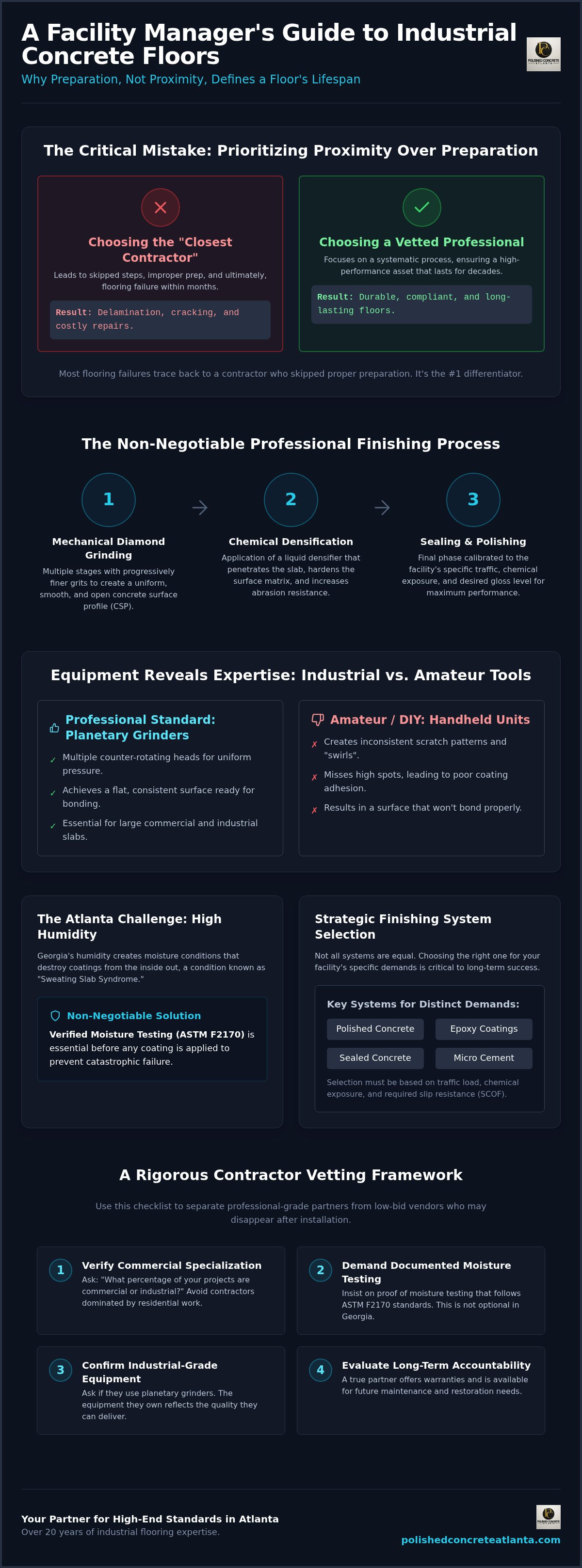
Concrete floor finishing is not a cosmetic upgrade. That distinction matters more than most facility managers realize until they're staring at a delaminating coating six months after installation. At the professional level, finishing is a systematic process of mechanical refinement and chemical densification that transforms a raw slab into a high-performance facility asset. It's infrastructure work, not surface treatment.
Just as professional floor finishing is a critical infrastructure investment, maintaining a building's envelope requires a similarly rigorous approach. For facility managers who also oversee historic properties in the Northeast, Progressive Contracting NY Corp provides specialized brownstone facade renovation and masonry restoration services that prioritize long-term structural integrity.
The standard process involves multiple stages of diamond grinding at progressively finer grits, application of a chemical densifier to harden the surface matrix, and a final sealing or polishing phase calibrated to the facility's specific traffic and chemical exposure demands. Each stage builds on the last. Skip one, and the entire system is compromised. This is why the contractor's process matters far more than their price point when you're searching for concrete floor finishing near me.
One critical equipment distinction separates professional results from amateur ones: planetary grinders. These industrial machines use multiple counter-rotating heads to apply consistent pressure across the full slab surface, achieving the uniform refinement that large commercial slabs require. Handheld rental units can't replicate this. They create inconsistent scratch patterns, miss high spots, and leave a surface that won't bond properly with coatings or densifiers. The equipment a contractor shows up with tells you everything about the quality they'll deliver.
The Difference Between Residential and Industrial Finishing
Industrial environments impose demands that residential finishing systems aren't engineered to meet. Abrasion from forklifts, chemical exposure from cleaning agents or process fluids, and sustained heavy-load traffic require coatings with significantly higher durability thresholds. Commercial finishes must also meet specific slip-resistance standards, measured by the Static Coefficient of Friction (SCOF), to satisfy OSHA and ADA safety compliance requirements. A residential-grade finish applied to a warehouse or manufacturing floor isn't just inadequate; it's a liability.
While residential specialists like Jason Becker Concreting provide the high-quality finishes necessary for home environments, industrial projects require a fundamentally different set of engineering standards and equipment.
Why Proximity Matters for Large-Scale Projects
When you're evaluating concrete floor finishing near me, local expertise carries real operational weight. Georgia contractors with deep regional experience understand the concrete mix designs common to Atlanta-area construction, which directly affects how a slab responds to grinding and densification. Local teams also mobilize faster, a critical advantage on multi-phase commercial construction schedules where floor finishing sits on the critical path. And when your facility eventually needs concrete floor restoration in Atlanta, a contractor who knows your slab's history is positioned to deliver faster diagnostics and better outcomes than one starting from scratch.
Evaluating Concrete Floor Finishing Contractors: A Selection Framework
Reviews don't tell you whether a contractor followed ASTM F2170 moisture testing standards. Star ratings don't reveal whether they understand Concrete Surface Profile requirements. When you're searching for concrete floor finishing near me, a structured vetting framework separates contractors who can deliver from those who simply have a polished website and competitive pricing.
Start with specialization. A contractor whose portfolio is dominated by residential driveways and garage floors is not equipped for the demands of a commercial warehouse or retail facility. For instance, while professional concrete driveway contractors sydney are ideal for high-end residential curb appeal, industrial work requires different equipment, different product knowledge, and a fundamentally different understanding of performance thresholds. Ask directly: what percentage of your completed projects are commercial or industrial? If the answer is vague, that's your answer.
Demand documented proof of moisture testing before any coating discussion begins. Acceptable protocols include in-situ Relative Humidity (RH) testing per ASTM F2170 or Calcium Chloride testing per ASTM F1869. A contractor who skips this step and applies coatings to an untested slab isn't cutting corners; they're transferring risk directly onto your facility. Don't accept verbal assurances. Ask for the written test results.
Equipment matters. Verify that the contractor operates planetary grinders rather than single-disc machines for large-format commercial slabs. Ask about their diamond tooling selection process, specifically how they determine the correct grit sequence for your slab's hardness and existing surface condition. Specialized certifications, such as Ashford Formula installation training or documented experience with high-build industrial epoxy systems, signal a contractor who has invested in technical depth beyond basic licensing.
Finally, request a portfolio of completed projects in the Atlanta metro area. Not stock photos. Actual job references you can contact, with facilities comparable in size and use to yours.
Technical Questions to Ask Your Contractor
These aren't optional conversation starters. They're diagnostic tools that reveal a contractor's actual process discipline:
- Floor glue removal and CSP preparation: Ask how they remove adhesive residue and what Concrete Surface Profile they target for your specific coating system. CSP 3 to CSP 5 is typically required for high-build epoxy applications.
- Slab defect remediation: How do they handle spalling, failed control joints, or structural cracks? A professional contractor has a defined protocol. A low-bid vendor fills cracks with whatever's on the truck.
- Moisture mitigation planning: Do they provide a written moisture mitigation plan for your specific slab conditions? Georgia's climate makes this non-negotiable, and the plan should reference specific products and application thicknesses.
Red Flags in Concrete Finishing Quotes
- Bids that omit surface preparation line items: If grinding, shot blasting, or moisture testing aren't explicitly listed, they're not being done.
- Promises of high-gloss finishes without mechanical polishing steps: Topical sealers can mimic the look of polished concrete briefly. They don't replicate the durability. Ask for the specific grit sequence used to achieve the finish.
- Vague coating thickness specifications: Industrial epoxy systems should specify dry film thickness in mils. A quote that lists "epoxy floor" without a mil thickness is an open door for underperforming applications.
Applying this framework before you commit protects your facility budget and your long-term floor performance. If you want to work with a contractor who answers these questions with documented processes rather than sales language, explore Polished Concrete Atlanta's commercial flooring services and see what a professional vetting conversation actually looks like.
Strategic Finishing Options for Atlanta Commercial Facilities
Choosing a finishing system isn't a stylistic decision. It's an engineering decision. The right system for a high-traffic retail showroom will fail in a chemical processing environment, and the system built for a manufacturing floor is overkill for a back-of-house storage area. When Atlanta facility managers search for concrete floor finishing near me, they need to enter that conversation already knowing which system their facility actually demands, not just which one looks good in a brochure.
Polished Concrete: The High-Performance Choice
Polished concrete achieves its finish through progressive mechanical refinement, not a topical coating that mimics the look. That distinction is everything. A mechanically polished surface bonds densifier into the slab matrix itself, creating hardness and reflectivity that won't peel, chip, or cloud over time. For retail environments, corporate lobbies, and showrooms, this translates directly into reduced lighting costs through superior light reflectivity and a surface that maintains its appearance under sustained foot traffic. Facilities considering this system should review the performance benchmarks outlined in this guide to polished concrete floors Atlanta before specifying a gloss level.
Industrial Epoxy and Coatings
Heavy manufacturing, food processing, and chemical handling environments require a system engineered for impact resistance and chemical impermeability. Industrial epoxy coatings fill that role. Applied at specified dry film thicknesses, they create a seamless, non-porous barrier that resists fluid penetration, abrasion from heavy equipment, and the thermal cycling that cracks lesser systems. Slip-resistance profiles can be adjusted through aggregate broadcast to meet OSHA requirements for specific operational zones. The full engineering case for these systems is detailed in this resource on industrial floor coatings Atlanta.
Decorative Stained Concrete
Stained concrete occupies a specific performance tier that competitors rarely explain with precision. It's not paint. Penetrating dyes and reactive stains bond chemically with the slab, meaning there's no film layer to chip, peel, or delaminate under traffic. The result is a surface that carries genuine aesthetic depth while maintaining the structural integrity of the underlying concrete. For facilities that need visual distinction without sacrificing durability, the options available through stained concrete floors Atlanta represent a serious alternative to coatings-based systems.
Sealed concrete rounds out the toolkit for low-traffic zones, back-of-house storage areas, and utility spaces where budget efficiency matters more than aesthetics. It's not a compromise system; it's the correct system for its application tier. The mistake isn't choosing sealed concrete for storage. It's applying it where industrial epoxy was required. Match the system to the demand. That's the discipline that separates a strategic flooring decision from an expensive correction two years down the road.
Solving Regional Challenges: Moisture Mitigation and Floor Prep
Atlanta's climate doesn't forgive shortcuts. Georgia's humidity levels create subslab moisture conditions that will destroy a coating from the inside out, regardless of the product's quality or the installer's reputation. This isn't a regional inconvenience. It's a structural variable that every contractor searching for concrete floor finishing near me must address with documented protocols before a single coat touches the slab.
Preparation accounts for roughly 90% of a floor's long-term performance. The finish itself is almost incidental. A premium epoxy system applied to an improperly profiled or moisture-laden slab will fail. A mid-grade coating applied over a correctly prepared surface will outlast it by years. That's not opinion. It's the consistent pattern contractors see on every remediation call.
When a project requires more than just surface prep, such as new slab installation or industrial paving, Born Integrated Construction at bicllc.net provides the structural expertise needed to ensure a high-quality foundation.
Moisture Remediation Strategies
Moisture mitigation is the process of preventing water vapor from migrating through the slab and delaminating floor finishes from beneath. In practice, this means testing first and committing to a remediation plan before any finishing discussion begins. Relative Humidity testing per ASTM F2170 establishes the actual vapor emission rate within the slab, not just at its surface. Many coatings manufacturers specify maximum RH thresholds for product warranty compliance, and those thresholds exist for a reason.
Sweating Slab Syndrome is the most acute expression of this problem in Georgia facilities. When warm, humid air contacts a cooler concrete surface, condensation forms directly on the slab, creating a slip hazard and a bond-breaking film under any applied coating. Remediation requires vapor barriers, moisture-tolerant epoxy primers, or topical moisture mitigation systems applied at verified coverage rates. Verbal assurances from a contractor that "the slab looks dry" are not a substitute for documented RH data.
The Importance of Surface Profile
Even a moisture-controlled slab fails if the surface profile is wrong. Mechanical bond between a coating and concrete depends on achieving the correct Concrete Surface Profile, and that profile can't be reached without professional grinding and contamination removal. Old adhesive residue, curing compounds, oils, and failed coatings all act as bond-breakers. Professional floor glue removal isn't a preliminary nuisance; it's a load-bearing step in the entire system.
- CSP targeting: High-build industrial epoxy systems typically require CSP 3 to CSP 5, achieved through diamond grinding or shot blasting at the correct intensity for the slab's hardness.
- Crack and joint remediation: Structural defects must be addressed before finishing. For slabs that have settled, professional leveling services like Airlift Concrete Experts provide polyurethane injection to stabilize and raise the concrete, ensuring that grinding doesn't occur over an unstable or uneven surface.
- Levelness verification: Coating systems applied over unlevel slabs pool unevenly, creating inconsistent film thickness and accelerated wear at high points.
If a contractor's quote doesn't itemize surface profile preparation and moisture testing as distinct line items, those steps aren't being performed. Don't accept that risk. Contact Polished Concrete Atlanta to review your slab's preparation requirements before any finishing system is specified.
Polished Concrete Atlanta: Your Partner for High-End Standards
There's a meaningful difference between hiring a contractor and engaging a strategic partner. Contractors complete jobs. Partners invest in outcomes. When Atlanta facility managers are still searching for concrete floor finishing near me and running into the same cycle of low bids and underperforming results, the missing variable is usually that distinction.
Polished Concrete Atlanta operates exclusively in commercial and industrial environments. No residential projects. No divided attention between garage floors and warehouse slabs. That singular focus, built over more than 20 years of industrial flooring contractors Atlanta experience, produces a depth of slab-specific knowledge that generalist contractors simply don't develop. We've worked on the full spectrum of commercial concrete conditions this region produces, and that experience is embedded in every assessment we conduct.
The approach is straightforward: preparation isn't negotiable, and every finish is built to perform under the actual demands of your facility, not the idealized conditions in a product brochure.
Our Commitment to Quality and Ethics
Transparency is non-negotiable. If a slab has limitations that will affect the final result, you'll know before the project starts, not after the invoice is submitted. Our team documents every preparation step, from surface profile verification to moisture testing results, and communicates slab conditions in plain language without burying risk in technical jargon. Rigorous adherence to industrial standards and safety regulations isn't a selling point; it's the baseline we hold every project to, regardless of scope or timeline pressure. Every detail from initial grinding through final polish is managed by a dedicated team accountable to a single performance standard: the floor has to last.
Mobilizing for Your 2026 Facility Project
Planning a flooring project for next year means making system decisions now. Our consulting process starts with your facility's specific traffic profile, chemical exposure conditions, and operational constraints, then works backward to the finishing system that actually fits. Downtime is a real cost, and our project coordination is structured to minimize it through phased scheduling and precise mobilization planning aligned to your facility's workflow.
If you're ready to move from searching for concrete floor finishing near me to working with a team that treats your floor as a long-term facility asset, the next step is a technical evaluation of your commercial concrete surface. Contact Polished Concrete Atlanta to schedule that conversation.
Your Next Floor Decision Starts Here
Searching for concrete floor finishing near me is the beginning of the process, not the decision itself. What you do with that search determines whether your facility ends up with a floor that performs for years or one that's back on your maintenance agenda before the first annual inspection. The framework in this article gives you the tools to tell the difference: preparation standards matter more than price, moisture mitigation isn't optional in Georgia's climate, and the system you specify has to match your facility's actual demands.
Polished Concrete Atlanta has operated in commercial and industrial environments since 2004. That's two decades of slab-specific expertise in high-traffic facilities, expert moisture mitigation services, and a documented process that doesn't cut corners because a schedule is tight or a bid needs to look competitive.
Your floor is a long-term facility asset. Treat the decision that way. Partner with Polished Concrete Atlanta for your next high-performance project and start with a team that's built to deliver results that last.
Frequently Asked Questions About Concrete Floor Finishing
How long does a professional concrete floor finish last?
A professionally installed polished concrete floor can last decades with proper maintenance, largely because the finish is built into the slab matrix rather than sitting on top of it as a film layer. Industrial epoxy coatings, applied at correct dry film thicknesses over a properly prepared surface, typically perform for many years before requiring recoating. The single greatest variable in lifespan isn't the product; it's the preparation quality beneath it.
Can you finish old, damaged concrete floors?
Yes, and it's one of the most common project types in commercial renovation work. Damaged slabs require a defined remediation sequence before any finishing system is applied: spalled areas are repaired, structural cracks are stabilized, and failed control joints are addressed. Skipping that sequence and finishing over damage doesn't hide the problem; it accelerates it. A thorough slab assessment before specification is non-negotiable on any restoration project.
What is the difference between polished concrete and a grind-and-seal?
Polished concrete achieves its finish through progressive mechanical refinement combined with chemical densification, creating hardness and reflectivity within the slab itself. A grind-and-seal process uses mechanical grinding to prepare the surface, then applies a topical sealer to deliver the gloss. Grind-and-seal can be the right choice for certain budget or timeline constraints, but it introduces a film layer that will eventually wear, scratch, or require recoating in ways that a true mechanical polish won't.
How do I maintain my polished concrete floors in a high-traffic area?
Daily dust mopping removes the abrasive particulate that causes micro-scratching over time, which is the primary wear mechanism in high-traffic polished concrete. Wet cleaning should use a pH-neutral cleaner; acidic or alkaline products degrade the densified surface layer. Periodic burnishing with a high-speed floor machine restores clarity and slip resistance. Avoid harsh degreasers and never use steam cleaning on a densified or sealed slab without confirming product compatibility first.
Is moisture mitigation always necessary for epoxy floors?
In Atlanta's climate, it's necessary far more often than contractors who skip testing would have you believe. Whether mitigation is required depends on verified Relative Humidity data from in-slab testing per ASTM F2170, not a visual inspection or a contractor's judgment call. If RH levels exceed the coating manufacturer's specified threshold, applying epoxy without a moisture mitigation system will produce delamination. When searching for concrete floor finishing near me, any contractor who doesn't lead with documented moisture testing is transferring that risk directly onto your facility.
How much downtime should I expect for a commercial concrete finishing project?
Downtime varies based on square footage, system type, slab condition, and cure schedules. A straightforward polished concrete project in a cleared commercial space can often return to light foot traffic within 24 hours of final densifier application. Industrial epoxy systems require full cure times before heavy equipment traffic, which can range from 24 to 72 hours depending on product specifications and ambient conditions. Phased scheduling across operational zones is the most effective strategy for minimizing disruption in active facilities.
Do you provide floor glue removal for large-scale warehouse renovations?
Floor glue removal is a core service, not an optional add-on. Adhesive residue from previous flooring systems acts as a bond-breaker that prevents any new coating or polish from adhering correctly to the slab. In large-scale warehouse renovations, this step is completed using industrial planetary grinding equipment and specialized tooling selected for the adhesive type and slab hardness. The result is a clean, profiled surface that meets the Concrete Surface Profile requirements for the specified finishing system.


