
In the high-stakes world of Atlanta facility management, a floor that peels is more than just a maintenance headache; it's a failure of professional character. You already know that Georgia’s relentless humidity is the primary adversary for standard topical coatings. You've likely seen "industrial-grade" paints bubble and chip within months because a contractor failed to respect the slab's chemistry. It's a frustrating cycle that wastes capital and compromises your brand image. This guide will help you master the technical and aesthetic requirements of commercial concrete staining Atlanta to ensure your facility remains a high-performance, durable asset through 2026 and beyond.
We're moving past superficial fixes to focus on permanent chemical integration. You'll learn how the 2026 standards for moisture mitigation, including ASTM F2170 testing, prevent the sweating slab syndrome that plagues local warehouses and showrooms. We'll also explore how biophilic design trends are shaping modern aesthetics and why rigorous surface preparation is the only way to guarantee a low-maintenance finish that lasts. This is about transforming your flooring from a recurring expense into a permanent, high-end investment that meets the latest Georgia building codes and OSHA slip resistance requirements.
Key Takeaways
- Discover why industrial-chic aesthetics are replacing high-end stone as the premier standard for 2026 Atlanta commercial interiors.
- Understand the chemical integration of acid stains to achieve permanent, variegated earth tones that will never peel or chip.
- Learn the critical role of moisture mitigation and ASTM testing in preventing floor failure within the humid Georgia climate.
- Master the technical requirements for commercial concrete staining Atlanta to ensure your facility remains a durable, high-performance asset.
- Identify the essential vetting criteria for industrial-scale contractors to ensure your large-scale project is managed with professional precision.
Beyond Aesthetics: Why Atlanta Businesses Prioritize Concrete Staining in 2026
Atlanta's commercial landscape is undergoing a decisive transformation. The era of masking high-value concrete with fragile tiles or expensive stone is over. In 2026, the industrial-chic aesthetic has matured into a professional standard for high-end retail and office environments. Savvy business owners now demand surfaces that project a sophisticated brand image without the liability of high-maintenance materials. This shift has made commercial concrete staining Atlanta a primary choice for facility upgrades. It isn't a superficial cover-up; it's a permanent transformation of the existing asset.
When comparing performance, the choice becomes clear. Epoxy flooring provides excellent chemical resistance, and polished concrete delivers a mirror-like gloss. However, stained concrete offers an organic depth that topical alternatives cannot replicate. Because the color penetrates the substrate, it avoids the common failure points of paint or thin-film coatings. It doesn't peel. It doesn't flake. It simply endures. It’s a pragmatist's approach to high-end design.
Utility Meets Design in Commercial Environments
Restaurants and boutique retail spaces leverage the unique mottling of acid-etched surfaces to create a premium atmosphere. This variegated finish is particularly effective in high-traffic corridors of Atlanta schools and gyms, where it successfully hides scuffs and daily wear. Choosing between acid staining vs. water-based dyes allows designers to control the level of translucency and color intensity. This flexibility is vital for matching specific brand palettes. Additionally, stained concrete supports 2026 sustainability initiatives. By utilizing the existing slab and reducing the need for new material manufacturing, these floors contribute directly to LEED certification for indoor environmental quality and material resources.
The 2026 Standard: Staining as a Business Asset
Facility managers prioritize stained surfaces for their seamless nature. Without grout lines to harbor debris or bacteria, maintenance overhead drops significantly. You don't need expensive specialized cleaners; simple routine care maintains the luster. The increased light reflectivity of a professionally sealed floor also improves visibility and can reduce energy expenditure in large commercial spaces. Chemical staining is a permanent molecular bond. It is a no-nonsense solution for those who value long-term asset performance over temporary fixes. It represents a strategic alliance between engineering and aesthetics.
If you're planning a corporate event or grand opening to showcase your new facility, Easy Cee Entertainment provides professional music and emcee services to elevate the occasion; to learn more, click here.
The Science of Permanent Color: Acid Stains vs. Water-Based Dyes
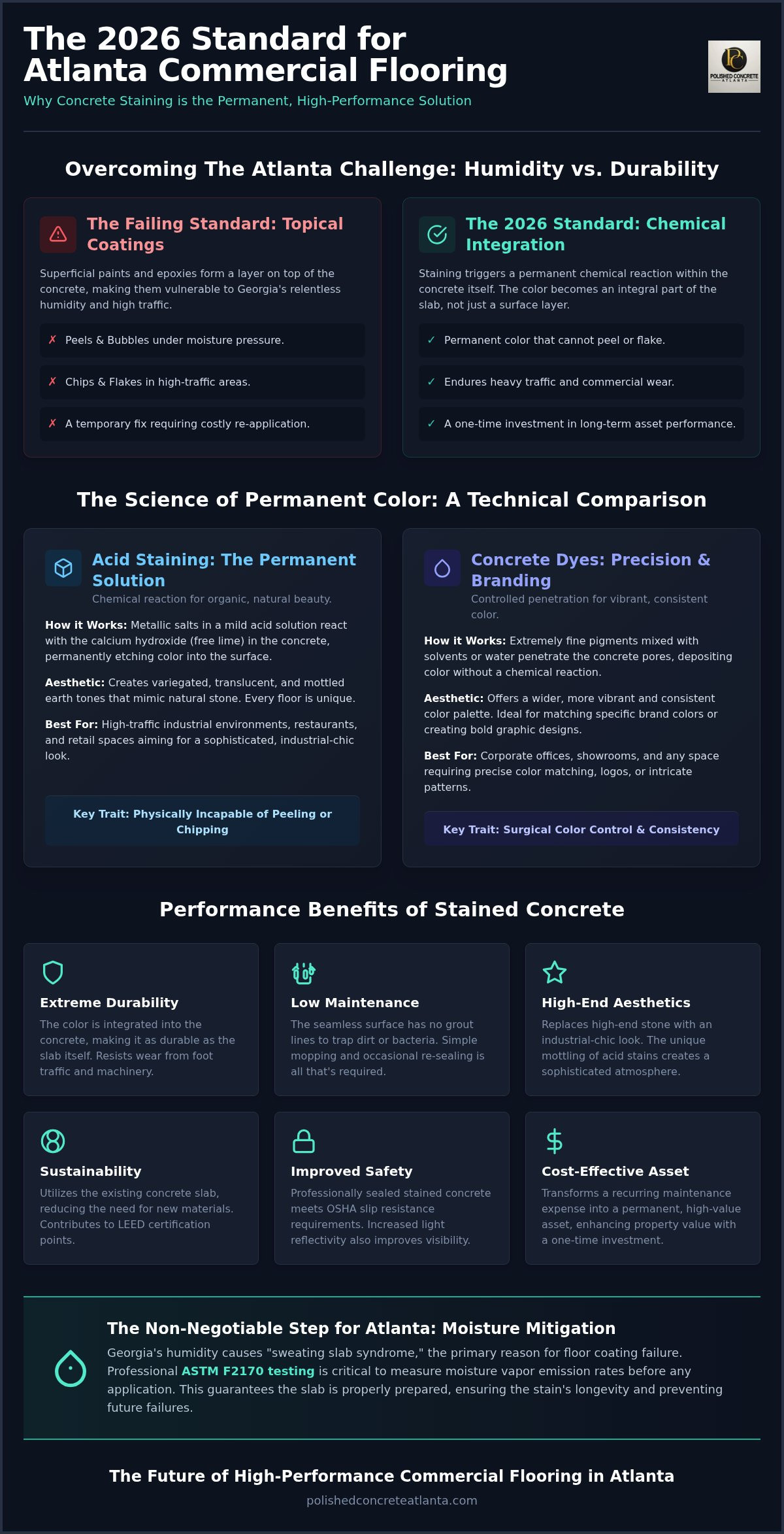
Achieving a high-performance floor requires more than an eye for design. It demands a technical understanding of the chemical interactions between the substrate and the coloring agent. Commercial concrete staining Atlanta is not a topical application; it is a permanent alteration of the concrete’s molecular structure. To select the right system for your facility, you must distinguish between the variegated depth of acid stains and the surgical precision of water-based dyes. One is an organic reaction. The other is a controlled penetration. Both require mastery to execute at scale.
Acid Staining: The Permanent Solution
Acid staining is a sophisticated chemical process, not a simple dye job. The solution consists of metallic salts and hydrochloric acid that react with the calcium hydroxide already present in the concrete. This reaction creates a permanent bond that becomes an inseparable part of the slab’s matrix. Because the stain is integrated into the material, it is physically incapable of peeling, chipping, or flaking. This makes it the definitive choice for high-traffic industrial environments where durability is the only metric that matters.
The hallmark of acid staining is its variegated, translucent appearance. Because the mineral composition of every concrete slab varies, the resulting earth tones are unique to each project. This "organic" mottling provides a high-end look that mimics natural stone while maintaining the structural integrity of industrial concrete. Maintenance is a matter of basic hygiene. A simple routine of dust mopping and occasional resealing is all that's needed to preserve the finish for decades. It is a no-nonsense investment in longevity.
Concrete Dyes: Precision and Branding
When your project requires specific corporate branding or vibrant color matching, concrete dyes are the professional's tool of choice. Dyes are composed of much smaller particles than stains, allowing them to penetrate deep into the concrete pores for a more uniform and predictable finish. This level of control is essential for incorporating corporate logos or intricate patterns in Atlanta offices and retail spaces. Whether utilizing solvent-based or water-based options, these dyes offer a palette that acid stains simply cannot reach. Many elite facilities choose to combine stained concrete with industrial-grade polishing to achieve a high-luster finish that commands attention.
Choosing the right system also involves assessing the environment. Acid stains are typically more UV-stable, making them ideal for exterior applications or facilities with heavy sunlight exposure. Regardless of the chosen colorant, success is predicated on precision surface preparation. Without a properly profiled substrate, the chemical bond will be compromised. We don't guess. We engineer the surface for total adhesion.
The Atlanta Advantage: Moisture Mitigation and Precision Surface Preparation
Atlanta's climate presents a unique set of challenges that most national contractors overlook. High relative humidity and fluctuating temperatures create a subterranean environment where moisture is constantly seeking an exit through your concrete slab. If you ignore these environmental variables, your investment in commercial concrete staining Atlanta will fail. It is that simple. Success begins with diagnosing the slab's moisture profile before a single drop of stain touches the surface. We don't guess at the condition of your substrate; we engineer it for success.
Engineering Adhesion in High-Humidity Environments
Moisture Vapor Transmission (MVT) is a silent killer of commercial floors in Georgia. When water vapor rises through the slab, it can trigger "Sweating Slab Syndrome," a condition that compromises the chemical bond of stains and sealers. Polished Concrete Atlanta utilizes advanced diagnostic tools to measure in-situ relative humidity, ensuring the slab is within the 75% threshold recommended by technical standards. For a deeper look into these mechanics, read our detailed analysis on The Engineering of Adhesion: A Definitive Guide to Concrete Surface Preparation. By addressing MVT early, we eliminate the uncertainty that leads to delamination and aesthetic failure.
The Critical Role of Floor Grinding
Mechanical preparation is the only reliable way to ensure a permanent bond. We use industrial-grade diamond grinding to open the concrete's pores and remove the "ghosts" of previous installations. This process includes professional floor glue removal and the elimination of old adhesives that can contaminate the staining process. A clean, profiled surface allows the metallic salts to react deeply within the slab, as outlined in ACI's guide to concrete staining. Skipping the preparation phase is the direct cause of 90% of commercial flooring failures. We don't take shortcuts. We level uneven slabs and remediate defects to ensure a uniform, high-performance finish. If you're concerned about humidity-related failures, secure your facility with professional floor moisture mitigation today.
Executing Excellence: Choosing Your Commercial Staining Partner in Georgia
Selecting a contractor for commercial concrete staining Atlanta involves more than reviewing a portfolio of color samples. You need a partner who understands the logistical complexity of industrial-scale projects. Can the crew handle 10,000 square feet without compromising quality? Do they have the heavy-duty equipment to maintain a tight schedule? These are the questions that separate hobbyists from industry leaders. We prioritize a no-nonsense project management approach that eliminates uncertainty. We don't just stain floors; we manage assets.
Verifying past performance is a non-negotiable step in your due diligence. Look for project galleries that showcase diverse environments, from high-traffic retail hubs to heavy-duty industrial warehouses. Experience in these varied sectors proves a contractor can adapt to specific site constraints and regional environmental factors. Polished Concrete Atlanta has remained the regional standard since 2004 because we refuse to settle for mediocrity. Our reputation is built on tangible results and the professional character of our team. We deliver what we promise.
The Polished Concrete Atlanta Difference
We believe in transparency and long-term value. Our collaborative process begins with a rigorous technical consultation and ends with a final walkthrough that ensures every specification has been met. We act as creative consultants and meticulous managers of detail. For a deeper understanding of how to vet professional teams for your next project, see our Industrial Flooring Contractors in Atlanta: A Strategic Guide to High-Performance Surfaces. This strategic alliance ensures your flooring project is a premium, worry-free investment.
Next Steps for Your Facility
The path to a high-performance floor starts with an accurate site evaluation. We assess your slab's current condition, identify potential moisture issues, and establish a realistic timeline that respects your operational needs. Most commercial staining projects require a structured sequence of grinding, staining, and sealing that cannot be rushed if you want permanent results. We provide clear expectations from day one. It's time to eliminate the guesswork. Get a definitive estimate for your commercial staining project today.
Secure Your Facility’s High-Performance Future
Your commercial flooring is more than a walking surface; it's a foundational asset that reflects your brand's integrity. We've established that the 2026 professional standards require technical mastery of moisture vapor transmission and rigorous mechanical preparation. These are the only ways to guarantee success in the volatile Georgia climate. By prioritizing chemical integration through commercial concrete staining Atlanta, you eliminate the risk of topical failures. You move beyond temporary fixes toward a permanent, industrial-grade solution that withstands heavy traffic and environmental stress.
Polished Concrete Atlanta has been the definitive choice for high-end flooring since 2004. We specialize in the difficult work that others avoid, including Sweating Slab Syndrome remediation and precision floor prep. Our approach is grounded in tangible results and the professional character of a veteran team. We don't settle for mediocrity and neither should your facility. Don't leave your durability to chance. Secure your facility's future with a professional staining consultation from Polished Concrete Atlanta. Your project deserves a standard of excellence that only two decades of mastery can provide. It's time to build a surface that lasts.
Frequently Asked Questions
How long does commercial concrete staining last in high-traffic areas?
Stained concrete lasts the lifetime of the concrete slab itself. Unlike topical coatings that wear away, the chemical bond of an acid stain is permanent. You won't face the recurring costs of stripping and replacing the finish every few years. Simply maintain the sacrificial sealer to protect the underlying color. It’s a definitive, long-term solution for high-traffic industrial and retail facilities.
Is stained concrete slippery for commercial retail spaces?
Professionally stained concrete is not inherently slippery. We engineer these surfaces to meet or exceed 2026 OSHA slip-resistance requirements by incorporating specialized grit additives into the sealer. This ensures a safe environment for employees and customers alike even in high-moisture areas. You get the aesthetic of a high-gloss floor without the liability of a slick surface. Safety and style are not mutually exclusive.
What is the difference between concrete staining and concrete painting?
Painting creates a superficial film that sits on the surface and inevitably fails. commercial concrete staining Atlanta involves a chemical reaction that penetrates the substrate to create a permanent molecular bond. This process ensures the color will never peel, flake, or bubble. You are investing in a permanent architectural feature rather than a temporary decorative cover. It is the professional standard for durability.
Can you stain old concrete that has had carpet or tile on it previously?
Old concrete is an excellent candidate for staining if the preparation is handled correctly. We use industrial diamond grinding to remove the 'ghosting' left by previous tile or carpet installations. This mechanical process clears away old adhesives and opens the concrete's pores for maximum stain penetration. The result is a revitalized surface that looks intentional and modern. We turn old liabilities into high-value assets.
How does Atlanta's humidity affect the concrete staining process?
Georgia's humidity requires a disciplined approach to moisture management. High ambient moisture can extend drying times for dyes and complicate the bonding of protective sealers. We utilize advanced diagnostic tools to ensure the slab's relative humidity is within safe parameters before we begin. We don't hope for good weather; we control the environment to ensure a flawless, predictable outcome. Reliability is our baseline.
What is the maintenance schedule for a commercial stained concrete floor?
The maintenance schedule is remarkably low-impact for facility managers. Daily dust mopping and periodic cleaning with pH-neutral solutions will keep the surface clear of abrasive debris. In high-traffic Atlanta corridors, we recommend a professional reseal every three to five years to maintain the protective barrier. This simple commitment ensures your commercial concrete staining Atlanta project retains its high-performance aesthetics for decades. It is a no-nonsense, low-maintenance flooring solution.


