
Most facility managers treat floor protection as a generic commodity; that misunderstanding is exactly why industrial floors fail within eighteen months. It's a costly mistake. If you've struggled with concrete dusting coating your machinery or feared that moisture vapor might trigger a total floor failure, you aren't alone. You need a solution that prioritizes tangible results over vague promises. Sealed concrete isn't just a secondary option to polishing. It's a high-performance, film-forming barrier engineered for environments where the slab must be shielded from aggressive industrial exposures. Total asset protection starts here.
We understand the confusion surrounding various sealer labels and the pressure to deliver a professional finish within a strict budget. You deserve a floor that's dust-free, easy to maintain, and chemically resistant. This article will provide the technical clarity you need to master the distinctions between different protective coatings. By the end, you'll know exactly how to ensure your facility floor remains a durable, high-performance asset for the long term. We'll examine the specific performance benefits of industrial sealers and outline a strategic approach to selecting the right finish for your specific operational needs. Professional standards demand nothing less.
Key Takeaways
- Differentiate between penetrating and topical systems to ensure you select the appropriate defensive barrier for your facility's unique operational demands.
- Eliminate the risk of equipment-damaging dust and moisture infiltration by implementing a high-performance sealed concrete solution.
- Discover why rigorous surface preparation and adherence to Concrete Surface Profile (CSP) standards are critical for preventing premature floor failure.
- Match your specific traffic patterns and chemical exposure levels to the right material chemistry, from rapid-deployment acrylics to heavy-duty epoxies.
The Fundamentals of Sealed Concrete: Defining the Protective Barrier
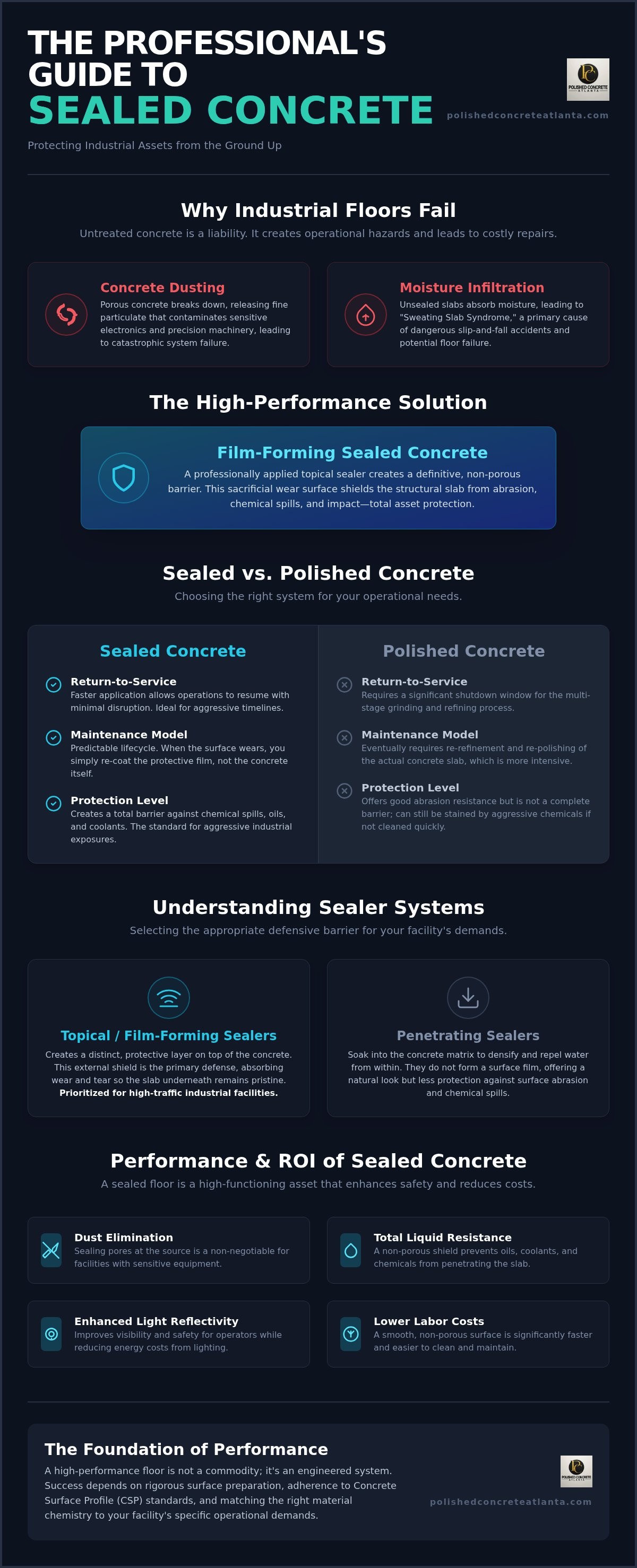
Sealed concrete is a specialized application where a film-forming protective layer is bonded to a meticulously prepared substrate. It's a definitive barrier. There's a critical technical distinction between penetrating sealers, which reside within the concrete matrix, and topical sealers that create an external shield. Understanding these Concrete sealer fundamentals is vital for long-term industrial asset management. In high-traffic facilities, we prioritize topical barriers because they establish a sacrificial wear surface. The sealer absorbs the abrasion, chemical spills, and impact. This ensures the structural slab remains untouched. It's a strategic sacrifice for the sake of durability.
Sealed Concrete vs. Polished Concrete: The Strategic Difference
Mechanical refinement isn't always the superior choice for every facility. While polished concrete offers aesthetic brilliance, it requires a significant shutdown window for the multi-stage grinding and refining process. Sealed concrete provides a faster return-to-service, allowing operations to resume with minimal disruption. It's pragmatism in action. The maintenance models also differ significantly. Polished slabs eventually require re-refinement of the concrete itself. With a sealed system, you simply re-coat the film. This creates a predictable, manageable lifecycle that fits within specific budgets and aggressive timelines.
The Anatomy of a High-Performance Film
Raw concrete is naturally porous. Those microscopic voids are the primary source of dusting, a process where the cement paste breaks down into fine particulate that contaminates sensitive equipment. High-performance sealers close these pores at the source. The durability of the system depends on film thickness and chemical composition. A robust film doesn't just sit on the surface; it anchors into the concrete's profile to resist delamination. This is why film-forming sealers remain the standard for resisting oils, coolants, and harsh chemical reagents. They provide total coverage where it matters most.
Performance Characteristics: Why Professionals Prioritize Sealed Surfaces
Professionals don't just want a floor; they want a high-functioning asset that withstands the rigors of industrial operations. Sealed concrete provides this by eliminating dusting at the source. This is a non-negotiable requirement for facilities housing sensitive electronics or precision machinery where particulate contamination can lead to catastrophic system failure. By adhering to a technical Guide To Concrete Sealers, facility managers can select systems that offer total liquid resistance. This non-porous shield prevents oils, coolants, and chemicals from penetrating the slab. It turns a vulnerable surface into a fortress.
Beyond protection, performance includes environmental optimization. High-performance sealers increase light reflectivity. In large warehouses, this translates to enhanced safety for forklift operators and a measurable reduction in energy costs. You get better visibility with fewer fixtures. It's a pragmatic win for both the safety officer and the CFO.
Remediating Sweating Slab Syndrome in Atlanta Facilities
Atlanta's high humidity creates a specific, dangerous risk known as Sweating Slab Syndrome. On unsealed or improperly prepared slabs, moisture condenses to create a slick, invisible film. It's a primary cause of slip-and-fall accidents in the Southeast. Professional sealing doesn't just look better; it's a safety requirement. We use specialized moisture mitigation techniques to ensure the surface remains dry and high-traction, even during peak humidity. If your facility is currently battling moisture issues, our experts in Sweating Slab Syndrome remediation can provide a definitive, long-term solution.
Asset Longevity and ROI
A floor is a depreciable asset. Leaving it unprotected is financial negligence. Sealed concrete prevents the slab from degrading under the weight of heavy traffic and abrasive loads. It's about ROI. When the floor is easier to clean, labor costs drop. When the slab is protected, the need for expensive structural repairs is eliminated. We position the floor as a critical component of your facility's value. You aren't just buying a coating. You're investing in the long-term integrity of your infrastructure. Results matter. Reliability is everything.
The Engineering of Adhesion: The Professional Application Standards
A high-performance industrial floor is not a coat of paint; it's a chemical bond. If that bond fails, your investment fails. Professionals understand that sealed concrete is only as reliable as the substrate preparation beneath it. We utilize the Concrete Surface Profile (CSP) standards to define the exact texture required for a specific sealer's chemistry. Most topical systems demand a CSP 2 or 3 to ensure a permanent anchor. Many contractors still rely on "acid etching," but this method is dangerously inconsistent. It often leaves behind chemical residues that actively inhibit adhesion. We use mechanical diamond grinding. It's the only way to achieve a uniform, predictable profile. Results require precision.
Step 1: Rigorous Surface Preparation
Preparation is the most labor-intensive phase of any project. It's where mediocre contractors cut corners. We begin with professional floor glue removal to eliminate old mastic and adhesives that would otherwise contaminate the new finish. Diamond grinding follows to open the concrete's capillary structure. This creates the "mechanical tooth" necessary for the sealer to bite into the slab. We also perform moisture vapor transmission testing. If a slab is exhaling excessive moisture, even the best sealer will delaminate. We identify and remediate these risks before application begins. We don't guess; we verify.
Step 2: Selection and Application of the Base Coat
The base coat serves as the system's anchor. We select primers based on your slab’s specific porosity and current condition. Uniformity is the standard. We don't tolerate "holidays" or thin spots that create weak points in your protective barrier. During this stage, we strictly monitor facility temperature and humidity levels. These environmental variables dictate the curing process and final bond strength. We manage every detail of the curing phase to ensure the system reaches its full engineered potential. Reliability is built into our process.
Step 3: High-Performance Topcoats and Finishes
The final layer is tailored to your facility's specific exposure. We apply UV-stable urethanes for areas with sun exposure or heavy-duty epoxies for maximum impact resistance. In high-traffic commercial zones, we integrate specialized slip-resistance aggregates. Safety is a core performance metric. Every project concludes with a rigorous final inspection and verification of the dry film thickness. If you're ready to upgrade your facility with a floor engineered for the long term, consult our surface preparation experts today. We deliver floors that work as hard as you do.
Strategic Selection: Choosing the Right Sealer for Your Facility
Selecting a sealer is a strategic decision, not a purchasing formality. You must match the chemistry to the specific environmental exposure of your floor. Acrylic sealers are the standard for rapid deployment in low-traffic areas. They provide an immediate, cost-effective barrier against light contamination. For heavy-duty impact resistance, epoxy coatings remain the industrial benchmark. They offer a high-build profile that absorbs physical punishment. If your facility requires UV stability or superior chemical protection, polyurethane or polyaspartic systems are the only acceptable choice. They don't yellow and cure rapidly. Conversely, lithium silicates are used for internal densification. They don't create the film-forming barrier that defines high-performance sealed concrete. Know the difference. Precision matters.
Matching Industry Needs to Sealer Chemistry
Your operational requirements dictate the material selection. In large-scale warehouse flooring, we prioritize abrasion resistance and absolute dust-proofing to protect inventory and logistics equipment. Retail environments and showrooms require a balance; the floor must look professional and remain easy to maintain under constant foot traffic. For industrial manufacturing, the focus shifts to chemical resistance and heavy load capacity. We don't believe in a one-size-fits-all approach. We analyze your traffic patterns and spill risks to determine the exact resinous system your slab requires. Results are the only metric that counts.
The Maintenance Cycle: Preserving Your Investment
A professional floor requires a professional maintenance regimen. You can't ignore a film-forming barrier and expect it to last forever. We establish cleaning protocols that extend the life of your topcoat by removing abrasive grit before it can scratch the surface. It's about proactive management. We look for early signs of wear to perform a "screen and recoat." This process allows us to refresh the protective barrier without the cost or downtime of a full strip-and-grind. It's a pragmatic way to maintain your asset's integrity while respecting your budget.
Consulting with Industrial Flooring Contractors in Atlanta
Local expertise is your greatest defense against floor failure. The unique climate challenges in the Southeast demand a partner who understands substrate behavior in high humidity. When evaluating industrial flooring contractors in Atlanta, look at their prep equipment and technical certifications. A contractor without a heavy-duty diamond grinder is not a professional; they're a liability. We bring over two decades of specialized experience to every project. Don't leave your facility's protection to chance. Request a professional evaluation of your facility floors today. Secure your asset with the industry leader.
Engineered Durability for the Modern Industrial Facility
Leaving your floor's protection to chance is a risk your operation can't afford. High-performance sealed concrete is a strategic investment in the long-term integrity of your infrastructure. We've established that success isn't found in a bucket of sealer; it's found in the rigorous mechanical profile of the substrate. By matching specific chemical barriers like epoxies or urethanes to your unique operational traffic, you eliminate the threat of dusting and chemical degradation. It's about total coverage. Precision in the preparation phase ensures that your floor remains a durable, high-performance asset rather than a maintenance liability.
Polished Concrete Atlanta brings over 20 years of industrial flooring expertise to the Atlanta region. We don't settle for mediocrity. Our specialized moisture mitigation and surface prep protocols ensure your floor remains a high-functioning asset, providing the peace of mind that comes with elite craftsmanship. It's time to replace uncertainty with results-driven professional service that prioritizes your facility's bottom line. Secure Your Facility Assets with Professional Sealed Concrete today. Your facility deserves a floor that performs with the same discipline and intensity as your business.
Frequently Asked Questions
What is the difference between sealed concrete and polished concrete?
Sealed concrete relies on a topical, film-forming barrier applied to a prepared surface to create a protective shield. Polished concrete, by contrast, uses a multi-stage mechanical grinding process to refine the slab's internal structure into a high-luster finish. While polishing offers exceptional durability, sealed systems often provide superior chemical resistance and faster return-to-service timelines for Atlanta facilities. The choice depends on your specific traffic patterns and required chemical exposure resistance.
How long does sealed concrete typically last in an industrial environment?
In a high-traffic industrial environment, sealed concrete typically maintains its protective integrity for three to five years before a maintenance recoat is necessary. This lifespan depends heavily on the volume of forklift traffic and the aggressiveness of cleaning chemicals used. We recommend a "screen and recoat" approach at the first signs of wear to prevent the substrate from being compromised. Proactive management ensures the slab remains a high-performance asset.
Can I seal a concrete floor that already has a coating or glue residue?
You cannot apply a new sealer over existing coatings or glue residue without risking immediate delamination. Successful adhesion requires a clean, porous substrate. We utilize professional diamond grinding and floor glue removal protocols to strip the slab back to its original state. This process creates the mechanical tooth necessary for the new sealer to bond permanently. Attempting to bypass this preparation phase is the leading cause of floor failure.
Is sealed concrete slippery when wet?
Topical sealers can become slippery when wet, but we mitigate this risk by integrating specialized slip-resistance aggregates into the final topcoat. Safety is a core performance metric for any industrial floor. By adjusting the grit size and density of these additives, we ensure your facility remains compliant with traction standards even in wet conditions. This is especially critical in Atlanta warehouses where high humidity often leads to surface condensation.
How long do I need to wait before driving forklifts on a newly sealed floor?
Return-to-service times vary based on the specific chemistry of the sealer used. While many systems are tack-free within hours, heavy forklift traffic typically requires 24 to 72 hours for a full chemical cure. Driving heavy loads on a floor before it reaches its engineered hardness can cause permanent indentations or delamination. We provide a definitive cure schedule for every project to ensure your operational timeline doesn't compromise the finish.
Does sealed concrete prevent moisture from coming up through the slab?
Standard topical sealers are designed to block liquids from the top down, not vapor pressure from the bottom up. If your slab has high moisture vapor transmission, a basic sealer will likely blister and fail. We solve this through specialized moisture mitigation protocols and Sweating Slab Syndrome remediation. These high-performance systems are engineered to withstand hydrostatic pressure, ensuring the sealed concrete remains bonded to the substrate regardless of underground conditions.


