
The most destructive threat to your hangar floor isn't a 50,000-pound corporate jet or caustic hydraulic fluid. It's the hydrostatic vapor pressure trapped beneath Georgia's dense red clay. You expect an aviation deck to endure brutal static point loads, aggressive chemical exposures, and round-the-clock tug traffic without blistering, staining, or hot-tire pickup. There is no margin for error. When specifying airplane hangar floor coatings Atlanta flight departments and facility directors cannot afford guesswork or surface shortcuts. Uncompromising flight operations demand an impervious surface engineered for extreme duty from the concrete slab up.
Discover how to engineer, select, and install high-performance airplane hangar floor coatings designed specifically for Georgia aviation facilities. We examine the aggressive mechanical profiling required for an unbreakable bond, advanced resin systems immune to Skydrol and jet fuels, and targeted moisture mitigation protocols. Master the technical fundamentals that prevent coating delamination, avoid costly operational groundings, and deliver a seamless, mirror-like finish built for flight-line performance.
Key Takeaways
- Understand why resisting corrosive phosphate ester hydraulic fluids like Skydrol requires impervious, high-build resin systems rather than standard commercial floor finishes.
- Evaluate the performance differences between high-solids epoxy, aliphatic urethane topcoats, and densified polished concrete when specifying airplane hangar floor coatings Atlanta operations depend on daily.
- Discover why North Georgia's high moisture vapor drive and dense sub-slab soils make precision testing and industrial moisture mitigation non-negotiable.
- Learn how heavy mechanical surface preparation sets the foundation for an unbreakable mechanical bond capable of carrying massive aircraft point loads and tug traffic.
- Master strategic zone-phasing methods to execute full floor retrofits without grounding corporate flight schedules or displacing active aircraft fleets.
Aviation Floor Engineering: Chemical Resistance and Standards in Atlanta
Hangar decks operate under extreme industrial abuse. Ground crews roll heavy aircraft tugs across the floor, while airframes impose massive static point loads on small tire footprints. Combine these physical forces with thermal shock from running engines and corrosive fluid spills, and standard commercial finishes fail rapidly. Generic retail sealers and basic epoxies can't survive this operational crossfire. When engineered improperly, concrete surfaces fracture, flake, and turn into loose debris. In an active maintenance bay, loose concrete chips become foreign object debris (FOD), threatening turbine engines and delicate flight assemblies. Specifying high-performance airplane hangar floor coatings Atlanta facilities rely on requires absolute chemical defense and zero physical compromise.
Skydrol, Jet A, and Hydraulic Fluid Defense
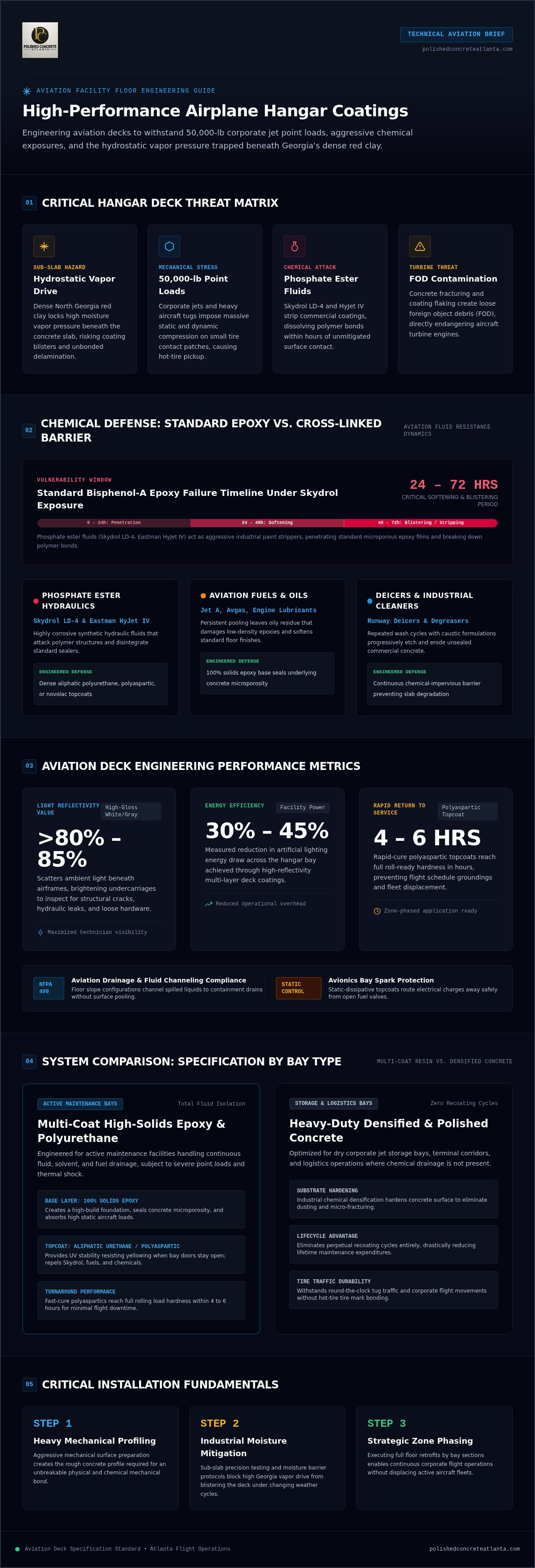
Standard bisphenol-A epoxies begin softening and blistering within 24 to 72 hours of unmitigated contact with synthetic hydraulic fluids like Skydrol LD-4 or Eastman HyJet IV. These phosphate-ester fluids act as industrial paint strippers, penetrating porous surfaces and dissolving polymer bonds. Aviation decks require highly cross-linked polymer barriers to repel destructive compounds:
- Phosphate Ester Hydraulics: Skydrol fluids demand dense aliphatic polyurethane, polyaspartic, or novolac topcoats to stop aggressive polymer breakdown.
- Aviation Fuels and Lubricants: Jet A, avgas, and synthetic engine lubricants leave oily residue that damages low-density epoxies if left pooled.
- Deicing Formulations and Cleaners: Caustic runway deicers and industrial degreasers degrade unsealed concrete surfaces over repeated wash cycles.
Engineering a cross-linked barrier locks out caustic chemistry, preventing concrete etching and costly slab degradation.
Aviation Safety Standards and Light Reflectivity
Hangar flooring must actively advance facility safety. Under NFPA 409 standards, aviation bays require floor slope configurations that channel spilled liquids safely toward containment drains without creating surface pooling. Integrating high-performance topcoats supports this drainage design while delivering measurable visual utility. High-gloss white and light-gray finishes deliver a Light Reflectance Value (LRV) exceeding 80% to 85%. That finish scatters ambient lighting across the bay floor, brightening aircraft undercarriages and cutting artificial lighting energy draw by up to 30% to 45%. Technicians spot hydraulic leaks, structural cracks, and loose hardware instantly. In sensitive avionics bays, static-dissipative topcoats route electrical charges away safely, protecting open fuel valves and fragile aircraft electronics from hazardous sparks.
Hangar Coating Systems: Comparing High-Solid Epoxy, Urethane, and Polished Concrete
Facility directors often fall into the trap of specifying a single flooring finish across an entire aviation complex. That strategy wastes capital. Successful facility planning balances chemical exposure, point-load impact resistance, and ongoing maintenance schedules. Active maintenance bays handling solvent and fuel drainage require resilient, multi-layer industrial floor coatings Atlanta aviation operators rely on for total fluid isolation. In contrast, dry aircraft storage facilities and logistics bays often perform best with hardened polished concrete floors Atlanta hangars utilize to eliminate recoating cycles completely.
Multi-Coat High-Solid Epoxy and Aliphatic Urethane
A high-build 100% solids epoxy creates the foundation of high-performance airplane hangar floor coatings Atlanta flight departments demand. This thick base seals underlying concrete microporosity and absorbs structural loads. An aliphatic polyurethane or polyaspartic topcoat finishes the assembly. Polyurethanes provide exceptional UV stability under direct sunlight when hangar bay doors remain open, resisting yellowing and chemical degradation. When turnaround speed is paramount, rapid-cure polyaspartic topcoats reach full roll-ready hardness in just 4 to 6 hours.
Heavy-Duty Densified and Polished Concrete
Resinous topcoats aren't always necessary for non-maintenance bays. In dry storage hangars without chemical drainage needs, densified concrete eliminates topical delamination entirely. Penetrating silicates react directly with free lime in the slab, forming permanent crystalline structures that harden the wear surface. This process creates an abrasion-resistant deck capable of handling continuous tug traffic and heavy equipment loads without requiring topical polymer recoats.
Point Load Capacity and Wheel Plasticizer Defense
A corporate jet rolling into a hangar concentrates tens of thousands of pounds onto small tire contact patches. When hot aircraft tires touch low-grade floor coatings, chemical plasticizers leach from the synthetic rubber into the polymer matrix. Inferior coatings soften, bonding directly to the tire tread and peeling off the slab upon departure. Industrial-grade cross-linked polymer systems prevent hot-tire pickup and tire marking by maintaining structural rigidity under intense compressive loads.
Partnering with a proven technical team at polishedconcreteatlanta.com ensures your facility selects the exact surface engineering required for your specific flight operations.
Atlanta Climate Factors: Moisture Mitigation and Slab Preparation
North Georgia's underlying geology creates silent havoc for aviation facilities. The metro Atlanta basin sits atop dense red clay soil that retains water and creates perched water tables beneath hangar foundations. When ambient humidity spikes during warm spring and summer cycles, moisture vapor drives upward through the porous concrete. This hydrostatic pressure carries dissolved alkaline salts directly to the surface, breaking down chemical bonds and causing catastrophic coating delamination. Unmitigated moisture also causes Sweating Slab Syndrome, where condensation creates an invisible, slick film over smooth concrete. Working alongside experienced concrete surface preparation contractors ensures these environmental vulnerabilities are identified and neutralized before applying final finishes.
Moisture Testing and Vapor Barrier Systems
Never rely on surface visual checks. Quantifying concrete slab moisture demands quantitative scientific data:
- In-Situ Relative Humidity Probes: Testing conducted via ASTM F2170 establishes internal slab relative humidity. Slabs exceeding 75% to 80% RH require active mitigation.
- Specialized Vapor Primers: High-performance 100% solids epoxy moisture mitigation barriers bond into the concrete pore network, withstanding up to 100% RH and significant vapor emission rates.
- Sweating Slab Remediation: Solving chronic slab sweating combines specialized densification with engineered micro-traction media, eliminating hazardous condensation films without compromising cleanability.
Mechanical Diamond Grinding vs. Acid Etching
DIY paint manufacturers frequently suggest acid etching to profile concrete. In commercial aviation, that approach is unacceptable. Acid washing introduces massive volumes of water into an already moisture-laden slab, etches non-uniformly, and leaves residual acidic salts that sabotage polymer bonding. High-performance airplane hangar floor coatings Atlanta facilities demand require precision industrial diamond grinding or mechanical shot blasting to achieve an ICRI Concrete Surface Profile of CSP 2 to CSP 3. Heavy planetary grinding heads open the concrete cap, level surface irregularities, and expose uncompromised aggregate. Integrated, HEPA-filtered vacuum extractors capture hazardous respirable silica dust during grinding operations, protecting active hangar avionics and adjacent personnel.
If you're dealing with recurring slab moisture issues or preparing a flight bay retrofit, contact Polished Concrete Atlanta to schedule comprehensive moisture testing and industrial floor preparation.
Specifying Your Hangar Flooring: Logistics and Contractor Selection
Unplanned downtime grounds flight operations. For corporate flight departments and charter operators across metro airfields like PDK, Falcon Field, and McCollum, taking a hangar bay out of commission creates immediate logistical friction. You can't park active flight assets on an open apron for weeks. Precision execution requires a detailed operational strategy before equipment ever unloads. Specifying the high-performance airplane hangar floor coatings Atlanta operators trust demands strict quality checkpoints, verifiable contractor capabilities, and meticulous installation phasing.
Evaluating Atlanta Industrial Flooring Contractors
Don't hire a commercial painter for an aviation asset. Vetting teams against proven industrial flooring contractors Atlanta standards separates seasoned industrial specialists from generic coating installers. Require these baseline qualifications:
- Dedicated Heavy Machinery: Verify the contractor owns heavy planetary diamond grinders and integrated HEPA extraction systems rather than relying on rented, lightweight equipment.
- Aviation-Grade Liability Coverage: Ensure the company carries comprehensive commercial liability policies tailored to high-value aircraft environments.
- Documented Track Record: Demand verified case histories proving sustained performance under heavy wheel loads and harsh fluid environments.
Project Phasing, Curing, and Return to Service
Disciplined logistics keep your flight schedule intact. Professional installers execute zone-phased installations, dividing large bays into dedicated operational sections. Flight crews stage aircraft on one side of the hangar while the installation crew grinds, repairs, and coats the other. Once cured, operations switch sides cleanly.
Respect cure schedules. Rapid-cure polyaspartics accept foot traffic quickly, but full chemical cross-linking against heavy aircraft tugs and static gear weight requires strict adherence to manufacturer curing windows. Rushing aircraft onto green coatings invites immediate failure.
To eliminate uncertainty and protect your aviation investments, schedule a site evaluation with Polished Concrete Atlanta for uncompromising specification and professional installation.
Engineer Your Aviation Deck for Decades of Flight-Line Performance
Aviation facilities leave no room for compromise. A failed floor risks grounded flight schedules, foreign object damage, and expensive concrete repairs. Long-term durability relies on three core engineering pillars: aggressive mechanical profiling to guarantee mechanical bond strength, dense barrier systems immune to Skydrol and aviation fuels, and targeted sub-slab moisture mitigation. When specified correctly, high-performance airplane hangar floor coatings Atlanta flight departments install transform porous concrete into an ultra-durable, light-amplifying operational asset.
Serving the Atlanta commercial and industrial concrete flooring market since 2004, Polished Concrete Atlanta delivers specialized technical expertise in Sweating Slab Syndrome remediation, certified moisture defense, and heavy-duty planetary diamond grinding equipment. We engineer resilient surfaces built to withstand punishing aircraft point loads, constant tug traffic, and North Georgia's severe hydrostatic pressure. Take command of your facility's operational foundation. Consult with Polished Concrete Atlanta for aviation flooring to build a hangar deck that performs at the highest flight-line standard.
Frequently Asked Questions
Why does Skydrol hydraulic fluid destroy standard epoxy hangar floor coatings?
Skydrol is an aggressive synthetic phosphate-ester hydraulic fluid that acts as an industrial solvent and paint stripper. Standard bisphenol-A epoxies lack the chemical cross-link density needed to resist its molecular penetration. Within 24 to 72 hours of unmitigated exposure, standard epoxies soften, blister, and delaminate from the concrete substrate. Protecting against Skydrol requires a dense, highly cross-linked aliphatic polyurethane, polyaspartic, or specialized novolac topcoat barrier.
How long does an industrial airplane hangar floor coating take to cure?
Cure times depend directly on the chosen resin chemistry and environmental conditions. Multi-coat 100% solids epoxy systems generally accept light foot traffic within 24 hours but require 7 full days to reach complete chemical cure and withstand heavy aircraft wheel loading. Rapid-cure polyaspartic systems accelerate this timeline dramatically, achieving roll-ready strength for aircraft tugs and flight operations in just 4 to 6 hours when specifying fast-turnaround airplane hangar floor coatings Atlanta facilities demand.
What causes sweating slab syndrome in Atlanta airplane hangars?
Sweating Slab Syndrome occurs when warm, moisture-laden ambient air enters an unconditioned hangar and contacts a cold, dense concrete slab whose temperature sits below the dew point. In metro Atlanta, dense clay soils and elevated humidity drive this condensation cycle, creating a slick moisture film across unmitigated floors. Remediating slab sweating requires specialized deep densification treatments, active surface profiling, and coordinated airflow strategies to prevent hazardous traction loss and aircraft hydroplaning.
Can polished concrete be utilized as an airplane hangar flooring solution?
Yes, polished concrete serves as an exceptional flooring solution for non-maintenance corporate hangars, equipment storage bays, and dry aviation facilities. Polished concrete eliminates topical delamination, hot-tire pickup, and recurring recoating cycles. However, because concrete remains micro-porous despite chemical densification, active maintenance hangars exposed to frequent Skydrol, Jet A, or solvent spills require seamless, non-porous resinous coating systems to prevent sub-surface fluid contamination and compliance violations.
What concrete surface profile (CSP) is required for aviation floor coatings?
Commercial aviation specifications require an International Concrete Repair Institute profile of ICRI CSP 2 to CSP 3 for standard high-build coatings, and up to CSP 5 for heavy-duty systems. Achieving this mechanical profile requires industrial planetary diamond grinding or shot blasting to fracture the weak surface laitance and open concrete pores. Acid etching is prohibited in aviation environments because it leaves chemical residues, uneven profiles, and unmanaged slab moisture.
How do high-gloss reflective hangar coatings improve maintenance operations and safety?
High-gloss white and light-gray coatings deliver a Light Reflectance Value (LRV) exceeding 80% to 85%, bouncing ambient lighting into previously shadowed areas beneath aircraft wings and fuselages. This amplified illumination allows mechanics to spot hydraulic seepage, structural hairline cracks, and stray hardware instantly. For professional airplane hangar floor coatings Atlanta operations rely on, superior reflectivity simultaneously improves safety, reduces auxiliary lighting energy demands by up to 45%, and eliminates dark foreign object debris risks.


