
Surface coatings don't protect heavy-traffic industrial floors; they simply delay the inevitable failure. If you manage an active warehouse or logistics hub, you already know the daily toll. Airborne concrete dust contaminates sensitive inventory, relentless forklift traffic gouges untreated aisles, and high Georgia humidity constantly triggers sweating slab issues. Specifying the right industrial concrete hardener application Atlanta facilities require changes this dynamic completely. It eliminates the uncertainty by transforming porous, vulnerable concrete into a dense, monolithic surface.
You shouldn't have to endure endless re-coating cycles or disruptive operational downtime. Deep chemical densification permanently locks down the slab's crystalline pore structure, dramatically increasing surface compressive strength and stopping dusting at the source. The result is uncompromising durability without flaking, peeling, or tire marking. In this 2026 buyer's guide, we break down the critical chemistries, surface preparation benchmarks, and procurement standards you need to make an informed investment in your facility's long-term infrastructure.
Key Takeaways
- Learn why deep-penetrating reactive hardeners permanently eliminate concrete dusting by neutralizing unreacted free lime within the slab matrix.
- Compare the performance, penetration depths, and reaction profiles of sodium, lithium, and colloidal silica chemistries to match your operational demands.
- Understand why mechanical diamond grinding is a mandatory prerequisite for any successful industrial concrete hardener application Atlanta facilities undertake.
- Discover the critical vetting criteria for choosing specialized industrial floor contractors equipped with heavy planetary machinery over facility generalists.
Evaluating Industrial Concrete Hardeners for Atlanta Commercial Facilities
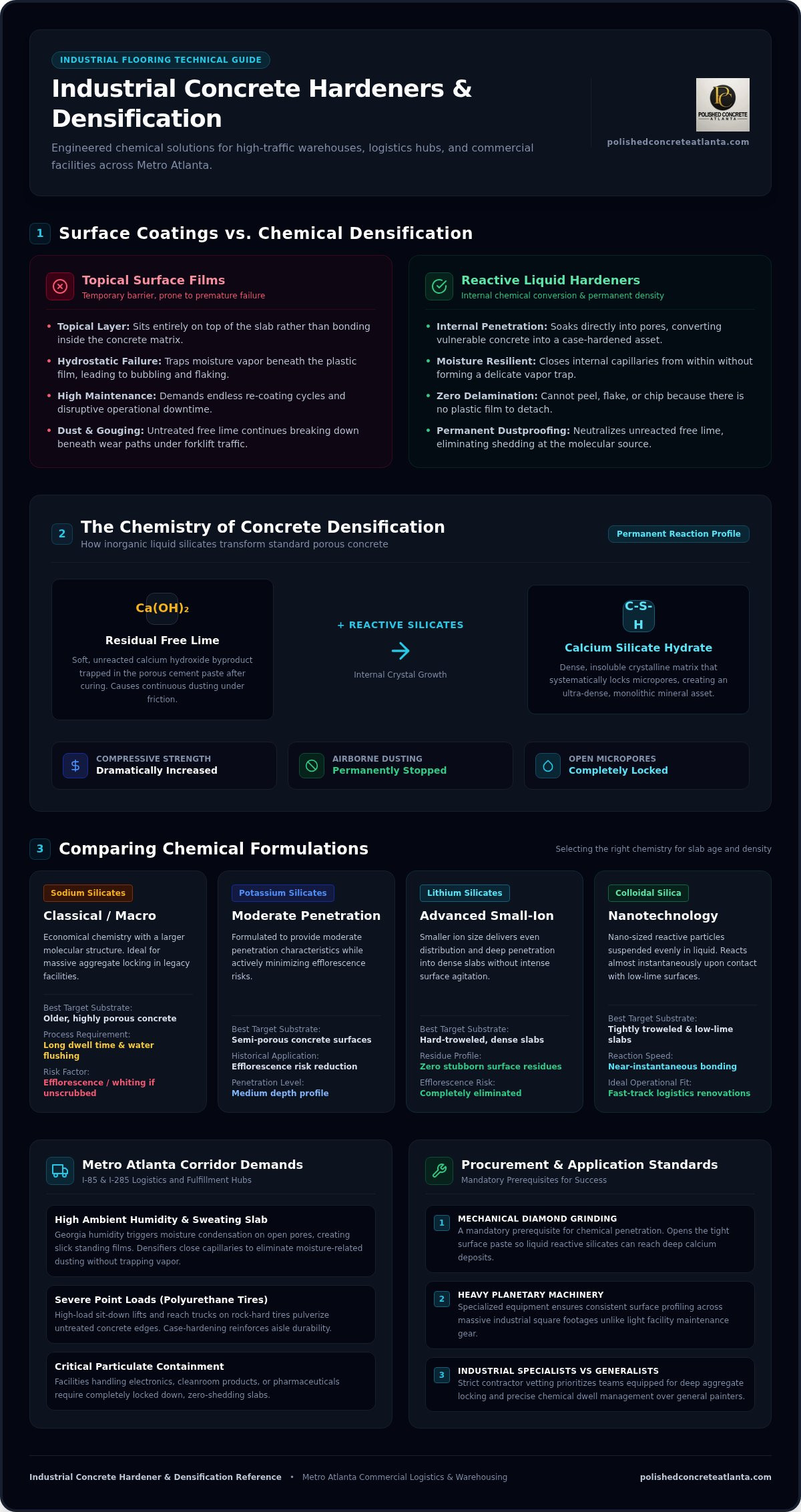
A true chemical hardener is an active reaction, not a plastic surface film. Topical sealers sit on top of the concrete, wearing down quickly and eventually trapping moisture underneath. When hydrostatic pressure builds beneath a standard film-forming coating, bubbling and flaking follow fast. Liquid silicate hardeners take the opposite approach. They soak directly into the matrix, transforming the existing porous slab into an impermeable, case-hardened structural asset. That permanence matters. Standard concrete naturally produces unreacted free lime as it cures. Under constant industrial traffic, this soft compound breaks down into continuous airborne dust, contaminating electrical panels, inventory, and mechanical gear. Proper concrete densifier treatments end this breakdown entirely.
High ambient humidity across Georgia complicates slab dynamics significantly. When moisture vapor travels upward through an unsealed slab, it accelerates chemical dusting and triggers Sweating Slab Syndrome. Untreated pores condense warm, humid air into standing surface films, turning active transit paths into severe slipping hazards. An engineered industrial concrete hardener application Atlanta facilities rely on closes these capillaries from within, preventing recurring moisture-related dusting without creating a topical vapor trap.
The Chemistry of Concrete Densification
Densification triggers an internal chemical conversion. Inorganic silicates react directly with residual calcium hydroxide (free lime) trapped in the cement paste to generate insoluble calcium silicate hydrate (C-S-H) crystals, systematically locking open micropores and transforming brittle concrete paste into an ultra-dense, monolithic mineral structure. The concrete stops shedding powder. Its structural density expands permanently.
Operational Demands in Metro Atlanta Distribution Hubs
Heavy fulfillment hubs lining the I-85 and I-285 corridors experience extreme operational abuse. High-load sit-down lifts and reach trucks running on rock-hard polyurethane tires generate severe, concentrated point loads that pulverize unhardened concrete edges. Facilities handling cleanroom products, electronics, or pharmaceuticals cannot tolerate shedding floors. A professional industrial concrete hardener application Atlanta operations depend on ensures tight particulate containment, higher surface compressive strength, and clean traffic paths.
Comparing Chemical Hardener Chemistries: Sodium, Lithium, and Colloidal Silica
Every commercial concrete slab possesses unique porosity, age, and wear characteristics. Because no single chemical solves every floor issue, selecting the wrong molecular profile leads to premature failure or severe aesthetic defects. Sodium silicates, lithium silicates, and colloidal silica function differently beneath the surface. Knowing their specific reactive behavior is essential for plant managers evaluating an industrial concrete hardener application Atlanta facilities need for heavy daily traffic.
Substrate permeability and curing age dictate which formulation performs best:
- Sodium Silicates: Economical, larger molecular structure best suited for older, highly porous concrete requiring significant mass stabilization.
- Potassium Silicates: Moderate penetration, historically utilized to reduce efflorescence risks on semi-porous surfaces.
- Lithium Silicates: Smaller ion size, delivering even distribution and deeper penetration in dense slabs without intense agitation.
- Colloidal Silica: Nano-sized reactive particles engineered for tightly troweled slabs, reacting almost instantaneously upon contact.
Traditional Sodium Silicates vs Advanced Lithium Formulations
Sodium silicates require significant dwell times and labor-intensive water flushing to prevent white discoloration. If the contractor fails to scrub unreacted sodium salts before they dry, permanent efflorescence and whiting ruin the finish. Lithium silicates eliminate this risk entirely. Their smaller molecular profile penetrates hard-troweled slabs evenly without leaving stubborn surface residues. Still, for massive warehouses where deep aggregate locking is the priority, classical specifications like Ashford Formula installation provide legendary, decades-long lifecycle performance.
Colloidal Silica and Fast-Reaction Technologies
Colloidal silica takes reactivity to the microscopic scale. Its nanoscale particles suspend evenly in liquid, bonding rapidly with low-lime surfaces where traditional silicates struggle to react. In fast-track logistics renovations facing tight commissioning deadlines, colloidal silica cures rapidly so operations can resume with minimal delay. Treated surfaces achieve superior abrasion resistance ratings, maintaining structural integrity against relentless steel and composite wheel traffic.
Matching Formulations to Facility Operational Profiles
Different facilities demand different protection levels. Heavy logistics centers require deep chemical densification to resist industrial oils, coolant spills, and tire gouging, while light assembly plants prioritize dust mitigation and light reflectivity. While dry shake aggregate floor hardeners are placed during fresh pours, liquid densifiers provide deep post-cure stabilization for operating facilities. If your operation requires specialized chemical containment alongside densification, consult the definitive guide to industrial floor coatings Atlanta for a comparative breakdown of engineered coating barriers. To evaluate your facility's slab profile, partner with the specialists at Polished Concrete Atlanta for an on-site technical assessment.
The Industrial Application Process: Surface Preparation to Final Cure
Chemical hardeners cannot penetrate a closed, contaminated slab. Spraying chemicals over old curing compounds, carbon film, or carpet mastics is a complete waste of capital. Achieving true structural densification requires strict mechanical surface prep to open the concrete's micro-capillary network. Industry benchmarks indicate that up to 90% of industrial floor failures stem directly from improper surface preparation. Review the engineering of adhesion and concrete surface preparation to see why diamond grinding remains non-negotiable for lasting performance.
Precision execution follows a disciplined, multi-phase technical protocol:
- Mechanical profiling: Stripping surface contaminants and opening capillary pores.
- Chemical saturation: Flooding the slab to drive active silicate penetration.
- Progressive refining: Diamond honing and burnishing to harden and close the profile.
Substrate Diagnostics and Mechanical Diamond Grinding
Field diagnostics start with Mohs scratch tests to establish matrix hardness and pick the correct diamond segment bonds. Heavy planetary grinders then cut through surface laitance to expose unhydrated cement, achieving an exact ICRI Concrete Surface Profile of CSP 1 to CSP 2. This step strips away lingering adhesives and tire rubber, leaving clean, open capillaries ready for chemical absorption.
Precision Application, Saturation, and Dwell Time Management
Technicians apply the densifier with industrial sprayers, keeping the concrete continuously saturated for 30 to 45 minutes. Dry spots must be eliminated immediately during this window. In non-conditioned Atlanta warehouses, elevated summer humidity and fluctuating airflow require careful dwell-time management to prevent premature drying. Authoritative technical reviews like recent technical analyses confirm that uniform liquid dispersion during the dwell phase directly dictates final crystalline depth.
Post-Hardening Polishing and Burnishing Protocols
After internal cross-linking finishes, progressive resin-bond diamond polishing passes hone the concrete to specified gloss levels. High-speed propane burnishers run weighted pads across the slab, generating thermal friction that accelerates curing and tightens the surface matrix. For complete multi-stage polishing specs, consult the standard for polished concrete floors in Atlanta. To ensure your facility's next industrial concrete hardener application Atlanta project follows strict ICRI mechanical profiling standards, contact Polished Concrete Atlanta to schedule an on-site technical inspection.
Selecting an Industrial Flooring Partner in Metro Atlanta
General facility maintenance providers often claim they can treat concrete, but industrial densification isn't a janitorial side task. Handymen and multi-service consolidators rely on lightweight floor buffers and rental gear that barely graze the concrete cap. They lack the downward head pressure and tooling required to profile hardened slabs. For a high-performance industrial concrete hardener application Atlanta plant managers must partner with specialized contractors who deploy heavy planetary grinding fleets and understand slab chemistry down to the aggregate.
Contractor Verification Checklist for Industrial Facilities
Before awarding a contract, demand documented proof of technical capability:
- Dedicated heavy machinery: Heavy three-phase planetary grinders capable of uniform aggregate cutting and continuous ICRI CSP profiling.
- Positive dust control: Continuous HEPA-filtered vacuum extraction systems meeting strict OSHA respirable crystalline silica standards.
- System certification: Factory-trained applicator status for specialized inorganic silicate systems, including Ashford Formula Installation.
Contractors lacking these baseline qualifications introduce substantial failure risk. Review our comprehensive evaluation framework for industrial flooring contractors in Atlanta to ensure your procurement process protects long-term facility capital.
Operational Planning to Minimize Facility Downtime
A round-the-clock distribution hub cannot halt operations for weeks. Proven industrial flooring teams execute phased zone scheduling, isolating specific picking aisles or staging lanes while adjacent logistics bays run uninterrupted. Because modern liquid silicates react internally without lengthy drying cycles, treated slabs can often receive active forklift traffic within hours of final burnishing. Polished Concrete Atlanta engineers every industrial concrete hardener application Atlanta facilities contract with minimal friction, delivering permanent slab hardening that eliminates dusting and combats humidity without disrupting production schedules.
Fortify Your Slab Matrix for Decades of Heavy Traffic
Sacrificial surface coatings can't withstand round-the-clock logistics traffic or Georgia's punishing humidity. Real facility durability requires transforming the concrete from within. By pairing disciplined mechanical diamond grinding with advanced reactive densifier chemistry, you eliminate dusting, boost surface compressive strength, and prevent recurring operational downtime. The right chemical formulation doesn't merely coat your slab; it permanently locks the crystalline matrix.
Executing an effective industrial concrete hardener application Atlanta facilities rely on demands heavy machinery and proven technical expertise. Polished Concrete Atlanta brings decades of specialized industrial restoration experience to your site, utilizing in-house three-phase planetary grinding fleets and certified Ashford Formula installation protocols to deliver dust-free, durable results. Protect your operational throughput and build a cleaner, safer workspace. Schedule an Industrial Slab Evaluation with Polished Concrete Atlanta today to engineer lasting durability into your facility floor.
Frequently Asked Questions
What is the primary difference between a concrete hardener and a topical concrete sealer?
A chemical hardener penetrates deep into the concrete to react internally with free lime, creating a permanent crystalline structure within the pores. Topical sealers simply deposit a thin sacrificial film across the slab's exterior. Under heavy industrial forklift traffic, topical films quickly scratch, peel, and delaminate. Penetrating hardeners cannot flake off because they become an integral part of the concrete matrix itself.
How long does an industrial concrete hardener application take to cure before forklift traffic resumes?
Most facilities can resume light foot traffic within two to four hours after final burnishing. Solid-tire forklift traffic and heavy logistics staging typically return within 24 hours of completing an industrial concrete hardener application Atlanta facilities schedule. Because reactive liquid hardeners cure through an internal chemical conversion rather than solvent evaporation, turnaround times are substantially faster than traditional epoxy or polyurethane coating installations.
Can chemical hardeners eliminate dusting on older, deteriorating warehouse slabs in Atlanta?
Yes, provided the concrete still contains unreacted calcium hydroxide and receives proper mechanical preparation. Older slabs with chalking surfaces require initial diamond grinding to remove brittle, carbonated concrete paste. Once fresh aggregate capillaries are exposed, applying an inorganic silicate like Ashford Formula permanently locks down loose particles. It neutralizes dusting at the source, transforming crumbly floor surfaces into durable, non-dusting operational assets.
How does high humidity in Georgia affect the liquid hardener and densifier application process?
Elevated ambient humidity slows the surface evaporation of the carrier water, extending chemical dwell times. Installers must actively manage application volume so the solution stays wet on the slab for the full 30 to 45 minutes without pooling. Densification also helps remediate Sweating Slab Syndrome. By closing microscopic capillaries, it prevents moisture vapor from drawing unreacted salts to the surface during humid summer weather.
Is diamond grinding strictly necessary before applying an industrial chemical hardener?
Mechanical diamond grinding is non-negotiable for commercial and industrial facilities. Unprepped concrete features a tight, carbonated surface cap, curing compounds, and chemical residues that prevent liquid hardeners from penetrating open pores. Achieving an ICRI Concrete Surface Profile of CSP 1 or CSP 2 ensures the chemical densifier soaks deeply into the concrete. Skipping grinding leads to weak surface bonding and wasted chemical product.
What ongoing maintenance is required to preserve a chemically hardened industrial concrete floor?
Chemically hardened floors require straightforward, low-cost maintenance routines. Regular cleaning with an automatic floor scrubber using neutral-pH detergents removes abrasive grit, road salts, and dirt before they cause surface wear. Routine water scrubbing actually helps tighten the silicate finish over time, improving natural sheen under continuous traffic. Avoid aggressive acidic cleaners, which etch the surface and degrade the underlying mineral matrix.


