
Your warehouse floor isn't just "sweating" because of the humidity; it's a fundamental thermal mass failure that threatens your entire operation. When the dew point shifts on a humid Georgia morning, your facility becomes a high-risk liability zone. You've likely seen your team struggle with forklifts sliding on slick concrete or inventory soaking up moisture from the ground up. This isn't a problem that a mop can fix. Professional sweating slab syndrome remediation Atlanta is the only way to neutralize the internal salts and thermal imbalances that turn your industrial floor into a hazard. It's about more than just aesthetics. It's about maintaining a facility that meets the rigorous demands of OSHA standard 29 CFR 1910.22.
We eliminate the uncertainty of moisture migration with a definitive, chemical-based approach. Our protocol moves beyond temporary fixes to provide a bone-dry, high-traction surface that withstands Atlanta's aggressive humidity cycles. You'll learn how we utilize technical surface preparation, authorized Ashford Formula installation, and strategic moisture mitigation to protect your assets. We're here to restore your floor's integrity and ensure your facility remains compliant with the 2024 International Building Code standards adopted by Georgia in 2026. Let's solve the failure at its source.
Key Takeaways
- Identify how Georgia’s high humidity and concrete thermal mass create the "dew point trap" that causes persistent surface moisture.
- Mitigate liability risks by ensuring your facility meets OSHA standard 29 CFR 1910.22 for dry, high-traction walking surfaces.
- Implement professional sweating slab syndrome remediation Atlanta to chemically neutralize internal salts and restore floor integrity permanently.
- Utilize technical surface preparation and floor grinding to open concrete pores, allowing for superior adhesion of moisture mitigation systems.
- Upgrade to polished concrete or Ashford Formula installation to transform a hazardous slab into a durable, high-performance industrial asset.
Understanding Sweating Slab Syndrome in the Atlanta Climate
Sweating Slab Syndrome (SSS) isn't just a nuisance; it's a structural failure that turns your facility into a liability. It occurs when moisture accumulates on the surface of an otherwise dry concrete slab, creating a slick, dangerous film. Many facility managers mistake this for a simple spill or a leaky roof. It isn't. Sweating slab syndrome remediation Atlanta requires an understanding of how Georgia’s high humidity interacts with the massive thermal mass of your floor. While traditional moisture vapor transmission comes from beneath the slab, SSS is an atmospheric event triggered by the dew point.
The Thermal Mass Problem
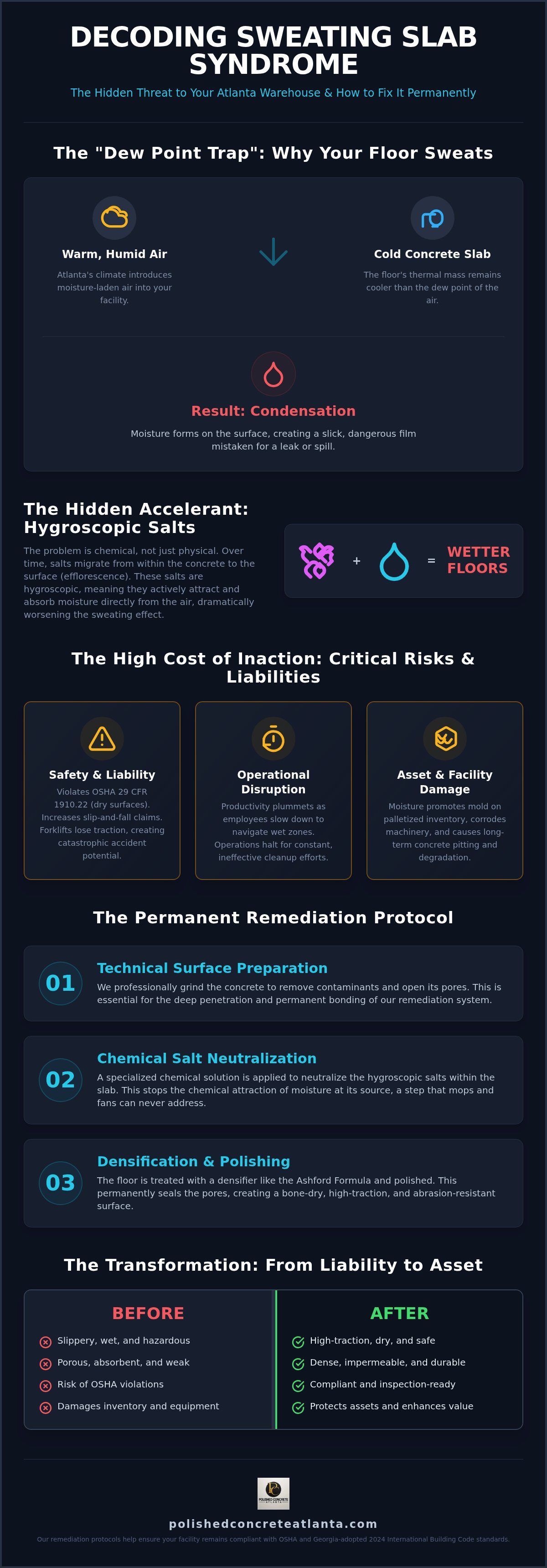
Industrial concrete slabs in Atlanta act like giant batteries for cold temperatures. During the volatile transitions of spring and autumn, the air temperature spikes while the concrete remains chilled from the previous night. When that warm, moist Georgia air enters your warehouse and hits a floor surface below the dew point, condensation is inevitable. This is the "Dew Point Trap." Without a functional Vapor barrier and proper thermal regulation, your floor becomes a magnet for moisture. Fans and mops are just band-aids. They don't address the temperature differential that causes the failure in the first place.
Hygroscopic Salts and Efflorescence
The problem goes deeper than just air meeting cold stone. Over time, concrete develops internal salts that migrate to the surface. You'll recognize this as a white, powdery substance called efflorescence. These are hygroscopic salts. They don't just sit there; they actively pull moisture from the Atlanta air. This chemical attraction accelerates the sweating process, making the floor wet even when conditions seem mild. Porous concrete acts like a sponge, holding these salts in a cycle of wetting and drying that compromises the surface. True sweating slab syndrome remediation Atlanta involves more than just drying the air; it requires a chemical shift within the slab itself to stop the moisture draw.
The High Cost of Inaction: Liability and Operational Risks
Ignoring SSS isn't just a maintenance oversight; it's a gamble with your company's future. OSHA standard 29 CFR 1910.22 is absolute. It requires employers to keep walking-working surfaces in a clean, orderly, and dry condition. When a 10,000lb forklift hits a wet patch, physics takes over and safety protocols fail. Friction disappears. Braking distances double. Steering becomes a suggestion rather than a control. This isn't theoretical; it's a daily reality for facilities lacking professional industrial floor services.
Professional sweating slab syndrome remediation Atlanta addresses these risks before they become headlines. Beyond the obvious physical dangers, there's a hidden drain on your bottom line. Employees move slower. They're anxious. Productivity drops as teams divert energy toward navigating around hazardous zones instead of fulfilling orders. You're paying for full-speed labor but receiving a fraction of the output during every humidity spike.
Industrial Safety and Workers' Comp
Slip-and-fall accidents remain the primary driver of workers' compensation claims in Georgia. They're expensive and entirely preventable. A single forklift impact can compromise an entire racking system, leading to structural repairs and immediate inventory loss. Facility managers who ignore the clear warning signs of SSS are knowingly maintaining a workplace hazard that exposes their organization to catastrophic legal and financial liability.
Inventory and Equipment Protection
The principles of concrete durability and safety are universal; for those considering high-quality outdoor concrete projects, Marlin Exteriors, Inc. provides expert guidance on choosing between materials like gunite and fiberglass for custom pool construction.
Moisture is the silent enemy of your assets. It promotes rapid mold growth in palletized cardboard and organic packaging, which often renders your products unsalable. Sensitive machinery faces accelerated corrosion in high-humidity zones where condensation settles on metal surfaces. Over time, these persistent moisture cycles lead to the structural degradation of the concrete itself, causing pitting and surface scaling. It's a slow-motion failure that only stops with a definitive remediation strategy. Don't wait for a total system collapse to take action.
The Remediation Protocol: A Technical Approach to Dry Floors
Effective sweating slab syndrome remediation Atlanta isn't achieved with a mop and a prayer. It requires a disciplined, data-driven protocol that addresses the slab’s chemistry. We don't guess. We measure. Our process begins with a precise diagnostic phase where we monitor slab temperature, relative humidity, and the ambient dew point. This data allows us to identify the exact conditions triggering the failure. Once we understand the environment, we move to high-performance surface preparation.
We utilize concrete floor grinding to strip away failed coatings and open the slab's capillary structure. This mechanical step is non-negotiable. If you don't open the pores, your chemical treatments will simply sit on the surface and fail. We ensure the concrete is ready to receive the remediation chemistry at a molecular level.
Capillary Restriction and Densification
We stop moisture at the source by utilizing lithium-based densifiers. These industrial-grade chemicals react with the calcium hydroxide in your concrete to create calcium silicate hydrate. This reaction effectively plugs the pores of the slab. By restricting capillary action, we prevent the migration of hygroscopic salts that pull moisture from the air. Unlike retail-grade sealers that form a temporary film, our densification process creates a permanent change within the concrete matrix. It's a definitive solution for a complex problem.
Advanced Moisture Mitigation Techniques
For facilities in high-risk zones, we implement moisture mitigation concrete floors protocols featuring authorized Ashford Formula installation. This isn't just a surface treatment; it's a deep-penetrating sealer that hardens and dust-proofs the slab for the long haul. We verify every project with post-remediation testing to ensure the surface meets rigorous traction standards even during humid Georgia mornings. If you're tired of temporary fixes, it's time for a professional sweating slab syndrome remediation Atlanta strategy that actually works.
Strategic Floor Protection with Polished Concrete Atlanta
Remediation shouldn’t be a temporary patch; it's an opportunity to upgrade your facility’s core infrastructure. When we execute sweating slab syndrome remediation Atlanta, we aren't just drying a floor. We're re-engineering the surface for long-term performance. If your slab requires deep grinding to open the pores for chemical treatment, you're already halfway to a premium finish. Transitioning to polished concrete floors Atlanta during this process is a strategic move that combines safety with high-end industrial aesthetics.
Our project management approach is grounded in pragmatism. We understand that your warehouse or manufacturing plant can't simply stop. We coordinate our remediation protocols around your operational schedule to minimize downtime. Our "No-Nonsense" guarantee is simple: we solve the moisture failure before we ever apply the final finish. We don't hide problems under a coat of paint. We eliminate them. Results matter most.
Beyond Remediation: High-Performance Finishes
Choosing the right surface is critical when dealing with moisture-prone environments. While some industrial floor coatings Atlanta offer excellent chemical resistance, cheap epoxy can trap moisture vapor, leading to osmotic blistering. Polished concrete, conversely, allows the slab to breathe while maintaining a high-traction surface. This breathability is vital for slabs without an effective vapor retarder. Once remediated, a simple maintenance protocol ensures your floor remains a high-performance asset that stays dry regardless of the Georgia dew point.
The Atlanta Professional Standard
We’ve served Georgia’s industrial and commercial sectors since 2004. We've seen every type of moisture failure and mastered the craft of permanent resolution. Our reputation is built on transparency and the delivery of long-term value. We don't settle for mediocrity, and you shouldn't either. If your facility is struggling with unpredictable slippery floors, you need a partner who prioritizes results over flowery promises. Contact Polished Concrete Atlanta for a professional slab evaluation and secure the peace of mind that comes with elite craftsmanship. We finish what we start. We do it right.
Take Control of Your Industrial Environment
Sweating Slab Syndrome isn't a problem that disappears with the seasons; it's a structural failure that compromises your safety and your bottom line. You've seen how the dew point trap and hygroscopic salts create hazardous conditions that no amount of cleaning can resolve. By choosing professional sweating slab syndrome remediation Atlanta, you're investing in a definitive solution that addresses the slab’s chemistry and thermal mass. It's about more than just a dry floor. It's about maintaining OSHA compliance and protecting your equipment from the ground up.
We’ve been serving the Atlanta industrial sector since 2004 with a focus on uncompromising reliability. Our status as authorized Ashford Formula installers combined with our industry-leading moisture mitigation tech ensures that your facility remains a high-traction, high-performance asset. Don't settle for mediocrity or temporary fixes that fail when the humidity spikes. It's time to eliminate the uncertainty and restore your floor's professional finish. Secure Your Facility with Professional Remediation today and experience the peace of mind that comes with elite craftsmanship. Your facility deserves a floor that performs as hard as your team does.
Frequently Asked Questions
What is the main cause of sweating slab syndrome in Atlanta warehouses?
The primary cause is the intersection of high ambient humidity and the slab's thermal mass. In Atlanta, warm, moist air enters the facility and condenses on the cold concrete surface once it drops below the dew point. Internal hygroscopic salts often exacerbate this by pulling moisture from the air. Professional sweating slab syndrome remediation Atlanta addresses these chemical and thermal imbalances rather than treating them as simple spills. It's a systemic failure.
Can SSS be fixed by just adding more industrial fans?
Industrial fans are a temporary measure that addresses surface evaporation but ignores the underlying failure. While they may provide short-term relief, they don't solve the thermal mass issues or the salt migration within the concrete. Effective remediation requires a chemical change to the slab's density. We use lithium-based treatments to plug pores and restrict the capillary action that makes your floor a magnet for atmospheric moisture. Don't settle for band-aids.
How long does the concrete remediation process typically take?
Project timelines vary based on the square footage and the severity of the moisture failure. Most industrial remediation projects are completed within three to five days. This schedule includes the diagnostic phase, mechanical floor grinding to open the pores, and the application of chemical densifiers. We prioritize efficiency to ensure your facility returns to full operational capacity quickly. We don't believe in dragging out projects or leaving details unfinished.
Is sweating slab syndrome the same as a leaking pipe or roof?
Sweating slab syndrome is fundamentally different from mechanical leaks. A leaking pipe or roof introduces liquid water from a specific source, whereas SSS is a systemic failure involving condensation and moisture vapor. It's often invisible until the floor becomes slick. Identifying the difference is critical for safety. If your floor is wet but your roof is sound, you're likely dealing with a thermal mass issue that requires specialized chemical intervention and professional assessment.
Will remediating my floor interfere with daily warehouse operations?
We understand that downtime is a non-starter for your business. Our team utilizes a collaborative project management approach to work around your facility's specific operational schedule. We often perform remediation in phases or during off-peak hours to minimize disruption. You won't have to shut down your entire warehouse. We coordinate every detail to ensure a seamless transition from a hazardous environment to a bone-dry, high-traction facility with total reliability.
Does polished concrete make a sweating slab problem worse?
Polished concrete actually improves the situation by allowing the slab to breathe while increasing surface density. Unlike thick epoxy coatings that can trap moisture and cause blistering, polished concrete remains vapor-permeable. When combined with sweating slab syndrome remediation Atlanta, polishing provides a durable, high-traction finish that meets OSHA standards. It transforms a liability into a high-end industrial asset that resists the condensation cycles typical of the Georgia climate. It's the professional standard.


