
Most commercial flooring failures start long before the first footfall; they begin with the assumption that a floor is just a surface coating rather than a deep chemical transformation. If you're tired of watching expensive coatings peel or staring at the uninspired gray of raw industrial concrete, you aren't alone. Achieving a world-class result with decorative concrete staining commercial projects requires more than just a mop and a bucket of pigment. It demands an uncompromising commitment to surface profile standards and chemical bonding. No shortcuts. No excuses.
You want a floor that reflects your brand's professional standards without the crushing weight of high lifecycle maintenance costs. We understand that reliability isn't a luxury; it's a requirement for your facility's bottom line. This 2026 performance guide will teach you how to master the technical nuances of concrete staining to ensure a high-durability finish that withstands industrial-scale traffic. We'll explore the latest EPA-compliant low-VOC formulations, the critical importance of ASTM F2170 moisture testing, and why diamond grinding to a CSP 1–2 profile is the only way to guarantee a permanent bond. Let's build a floor that lasts.
Key Takeaways
- Identify why a permanent chemical bond is the only way to prevent delamination and peeling in high-traffic commercial environments.
- Navigate the technical trade-offs between reactive acid stains and water-based dyes for your next decorative concrete staining commercial project.
- Evaluate the performance benefits of hybrid stain-and-polish systems compared to traditional epoxy coatings for long-term lifecycle savings.
- Mitigate the risk of floor failure by mastering industrial-grade preparation standards, from moisture testing to precise mechanical grinding.
- Streamline project execution by implementing mandatory on-site mock-ups and rigorous contractor vetting to ensure total brand consistency.
The Value Proposition of Decorative Concrete Staining for Commercial Facilities
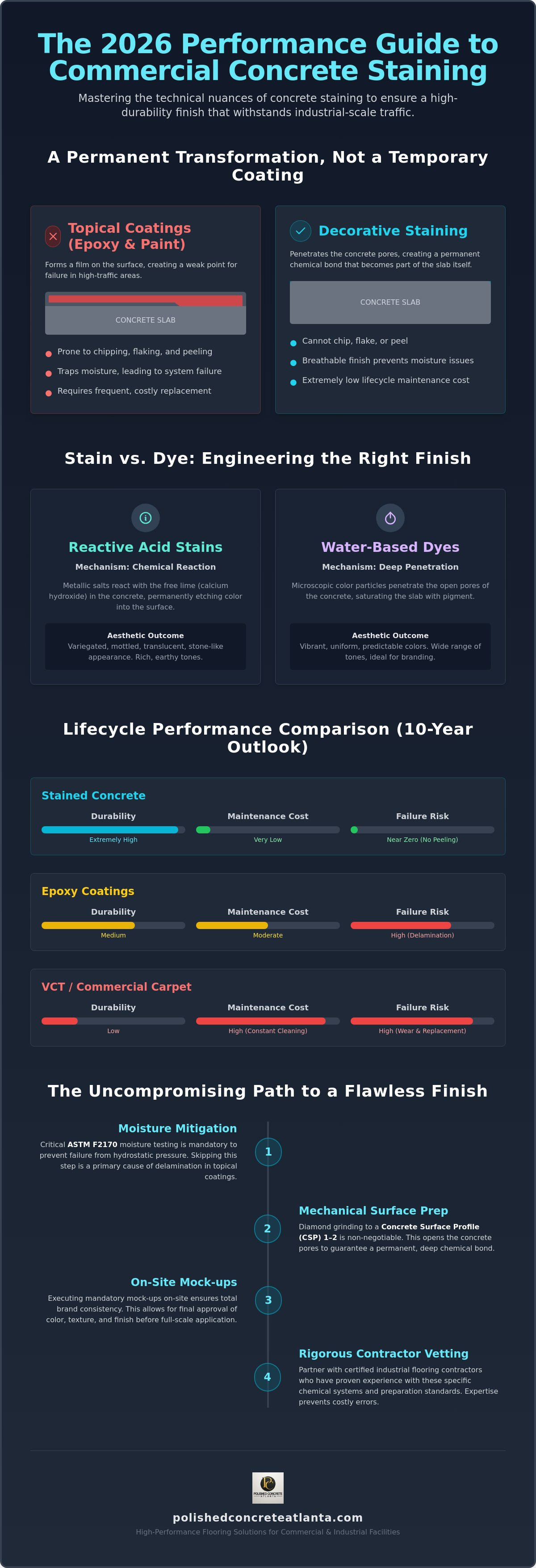
Commercial flooring is often a battle between aesthetics and endurance. Most facility managers assume they have to choose one or the other. They're wrong. Professional decorative concrete staining commercial systems provide a permanent chemical integration with the concrete substrate that topical coatings simply cannot match. While paints and epoxies form a film on the surface, staining penetrates the pores of the slab. It creates a finish that is as resilient as the building itself. This isn't a temporary mask; it's a structural transformation.
Topical coatings are prone to delamination and peeling, especially in high-traffic zones where heavy machinery or constant foot traffic is the norm. Once a coating is breached, moisture and chemicals can migrate underneath, leading to a total system failure. Staining eliminates this risk. Because the color is achieved through the chemical reaction of acid stains or the deep penetration of dyes, there is no "layer" to fail. You get a floor that remains vibrant and intact under the most demanding conditions. It cannot chip. It cannot flake.
This is a no-nonsense aesthetic upgrade. It's about pragmatism. You want a floor that looks like a high-end architectural statement but performs like an industrial workhorse. Staining delivers that dual benefit. It's the most cost-effective way to transform a raw slab into a professional asset without the fragility of traditional flooring materials. We don't settle for "good enough" when your facility's reputation is on the line. This same commitment to quality applies to exterior surfaces; for instance, high-performance patterned concrete driveways north east show how decorative concrete can enhance property entrances while maintaining structural integrity.
Beyond Aesthetics: The Functional Benefits for Atlanta Businesses
Staining offers functional advantages that go far beyond a simple color change. In large warehouses, the increased light reflectivity of a stained and sealed surface can significantly reduce energy costs by maximizing existing overhead lighting. These surfaces also provide exceptional resistance to UV degradation. This is essential for facilities with large windows or indoor-outdoor transitions where traditional resins would yellow or crack. Modern office environments also benefit from the hypoallergenic, VOC-compliant properties of these floors. They support healthy indoor air quality while maintaining a sophisticated, professional look that reflects your brand's standards.
Staining as a Strategic Asset: Lifecycle Cost Analysis
Facility managers must look at the total cost of ownership. Over a 10-year period, the maintenance costs for VCT or commercial carpet are staggering. You're dealing with constant cleaning, repairs, and eventually, a full replacement that disrupts operations. Choosing decorative concrete staining commercial solutions is different. It's a premium, worry-free investment. It preserves the structural integrity of the slab because it doesn't trap moisture or require aggressive chemical adhesives. The maintenance routine is simple. It's predictable. By partnering with experienced industrial flooring contractors Atlanta, you're opting for a floor that provides long-term value and protects your bottom line.
Acid Stains vs. Water-Based Dyes: Engineering the Right Finish
Engineering a high-performance floor requires more than an eye for color; it requires a deep understanding of concrete chemistry. When selecting a decorative concrete staining commercial system, you must decide between reactive acid stains and non-reactive dyes. This decision is binary. One creates a permanent chemical bond through a reaction with the substrate, while the other utilizes microscopic pigments to saturate the slab. Which path fits your facility's operational demands? The answer depends on the age of your concrete, its porosity, and your brand's specific aesthetic requirements.
Choosing the wrong chemistry leads to poor adhesion and premature fading. We don't guess. We analyze the slab to ensure the selected medium integrates perfectly with the existing calcium hydroxide levels. Whether you need the variegated, stone-like depth of a reactive stain or the precise, vibrant branding of a water-based dye, the execution must be flawless. Reliability starts with selecting the correct tool for the job.
Reactive Acid Stains: The Industrial Standard for Depth
Reactive acid stains are the gold standard for projects requiring a permanent, organic appearance. These stains consist of metallic salts dissolved in a mild acid solution. When applied, they react with the calcium hydroxide in the concrete to create unique, variegated patterns that mimic natural stone or aged leather. Acid staining is a permanent chemical change to the concrete surface. Because the color becomes part of the slab, it cannot wear away or peel. The palette is primarily limited to earthy tones like terra cottas, soft greens, and deep tans, making it the ideal choice for facilities seeking a sophisticated, timeless aesthetic. If your project demands industrial-grade preparation and best practices, reactive stains are often the first choice for long-term durability.
Concrete Dyes: Speed and Precision for Modern Offices
For modern commercial spaces that require vibrant colors or intricate logos, water-based dyes are the superior solution. Dyes have a much smaller molecular size than stains, allowing them to penetrate even the densest, power-troweled concrete surfaces. This microscopic saturation ensures a more uniform, monotone appearance that is perfect for consistent branding. One of the greatest advantages of dyes is their rapid drying time. In a fast-paced commercial environment, minimizing facility downtime is critical. Dyes allow for a multi-color application and sealing within a single shift. This versatility makes them the preferred choice for retail showrooms and corporate offices where precision is non-negotiable. If you're ready to transform your facility with a custom-engineered finish, exploring our options for stained concrete is the logical next step.
The choice between these two systems ultimately hinges on the "mottled" versus "monotone" aesthetic. Acid stains provide movement and character. Dyes provide predictability and punch. By understanding the porosity of your slab and the traffic patterns of your facility, we can engineer a decorative concrete staining commercial solution that meets your exact performance standards. We don't just provide a floor; we provide a strategic asset.
Performance Comparison: Stained Concrete vs. Epoxy and Polished Finishes
Selecting a commercial flooring system is a high-stakes decision where failure is not an option. You must choose between the chemical resilience of epoxy, the mechanical strength of polished concrete, or the permanent aesthetic integration of decorative concrete staining commercial solutions. Each system serves a distinct operational purpose. We don't believe in one-size-fits-all answers. We believe in engineering the right surface for the specific rigors of your environment. Reliability starts with understanding the technical trade-offs between these finishes.
For many facilities, stained concrete floors Atlanta offer a superior lifecycle value compared to thick-build industrial epoxies. While epoxy is the standard for chemical labs or heavy manufacturing plants that require a seamless, impermeable barrier, it's often overkill for retail showrooms or corporate lobbies. Staining provides the deep architectural appeal these spaces demand without the risk of topical delamination. You should reference the ACI Guide to Decorative Concrete to understand how these systems differ in material composition and long-term bond strength.
One of the most effective strategies for high-traffic facilities is the hybrid approach: combining staining with polished concrete floors Atlanta. This method utilizes the deep color penetration of a dye or stain followed by the mechanical refining of the slab. The result is a floor that is both visually striking and incredibly dense. It also addresses the critical issue of Sweating Slab Syndrome. Unlike non-breathable coatings, stained and polished surfaces allow moisture vapor to pass through the slab naturally, preventing the hazardous pooling of water that leads to slip-and-fall accidents. Safety is non-negotiable. All commercial finishes must meet ANSI/NFSI standards for slip resistance to protect your facility from liability.
The Professional Verdict: Utility vs. Aesthetic
Epoxy is your heavy-hitter for harsh chemical environments. Staining is your refined solution for high-end professional spaces. If you're weighing the pros and cons of these systems, our deep dive into polished concrete vs epoxy flooring provides the granular data you need to make an informed choice. Staining wins when you want a permanent, breathable finish that won't peel under the pressure of foot traffic or rolling loads. It's a strategic choice for decorative concrete staining commercial applications where brand image and durability are equally weighted.
Maintenance Realities: Keeping the Luster in High-Traffic Zones
The idea of a no-maintenance floor is a myth. High-performance floors are low-maintenance, but they still require a disciplined protocol to maintain their professional standards. For stained commercial floors, this means daily dust mopping to remove abrasive grit and weekly damp mopping with pH-neutral cleaners. The role of sacrificial waxes and high-performance sealers is also critical. These layers act as a buffer, taking the brunt of surface wear so the stained concrete remains protected. These steps aren't suggestions; they're requirements to preserve the pride of your craftsmanship and ensure your floor remains a high-value asset for years to come.
The Critical Path: Industrial-Grade Preparation and Moisture Mitigation
Execution is everything. You can select the highest-quality pigments and the most advanced sealers, but if your substrate isn't properly prepared, the system will fail. It's a harsh reality that 90% of decorative floor failures are directly attributable to poor concrete surface preparation. In a commercial environment, you don't have the luxury of downtime for repairs. We treat the preparation phase as the foundation of your investment. This isn't just about cleaning; it's about engineering the slab to receive a permanent chemical bond.
For renovation projects, this process often begins with meticulous floor glue removal Atlanta. Residual adhesives from old VCT or carpet act as a barrier, preventing stain penetration and leading to blotchy, unprofessional results. We utilize heavy-duty diamond grinding equipment to strip away these contaminants and open the "pores" of the concrete. This mechanical process ensures that the decorative concrete staining commercial system can anchor itself deep within the substrate. Without this step, you're merely painting the surface. And paint peels.
In our local climate, moisture mitigation concrete floors is a non-negotiable requirement. Georgia's high humidity and varying water tables create a high risk for flooring failure if the slab isn't tested and treated. Ignoring moisture levels is a gamble that professional facility managers cannot afford to take. We eliminate that risk through rigorous technical standards.
Surface Profiling: The Science of Adhesion
We adhere to the International Concrete Repair Institute (ICRI) standards to determine the exact texture required for your floor. Chemical cleaning or simple acid washing is insufficient for commercial-grade staining because it doesn't provide a consistent profile. We target a Concrete Surface Profile of CSP-1 to CSP-2 to ensure successful stain absorption. This mechanical refining removes the "laitance" or weak top layer of the concrete, exposing the durable material underneath. It's a precise, dust-mitigated process that guarantees the longevity of the finish. CSP-1 and CSP-2 are the non-negotiable targets for successful staining.
Moisture Remediation: Defeating the Georgia Humidity
Hydrostatic pressure and osmotic blistering are the silent killers of stained floors. When moisture vapor travels through the slab, it can carry alkaline salts to the surface, destroying the bond of your sealer and causing white, cloudy patches known as efflorescence. We utilize both Calcium Chloride testing (ASTM F1869) and Relative Humidity (RH) probe testing (ASTM F2170) to get a complete picture of your slab’s health. Polished Concrete Atlanta’s mitigation services act as the "uncertainty eliminator" for your project. We provide the data-driven solutions needed to stabilize your floor before the first drop of stain is applied. Don't leave your facility's integrity to chance. If you're concerned about your slab's readiness, contact us for a professional moisture assessment today.
Implementing Decorative Staining: A Facility Manager’s Execution Strategy
Successful execution of a decorative concrete staining commercial project isn't an accident. It's the result of a disciplined project management framework that prioritizes technical precision over convenience. For a facility manager, the transition from conceptual design to site execution is where the most significant risks emerge. You aren't just buying a floor; you're managing a chemical process that must be integrated into a broader construction or renovation schedule. This requires a partner who understands the high stakes of commercial operations. Reliability is built on a foundation of rigorous planning and uncompromising standards.
Vetting industrial flooring contractors Atlanta is your first line of defense. Don't settle for generalists who treat staining as an afterthought. You need a specialist who can provide a documented history of large-scale commercial success. Ask for their specific protocols on dust mitigation and trade coordination. A professional contractor doesn't just show up with a sprayer. They show up with a plan that accounts for every variable of your facility's environment, from slab porosity to the surrounding humidity levels.
The 2026 Professional Checklist
Efficiency depends on hitting specific milestones without regression. We recommend utilizing a professional concrete staining services checklist to track progress from the initial diamond grinding to the final application of high-performance sealers. One of the most critical steps in this process is the on-site mock-up. Never approve a color based on a digital swatch or a pre-poured sample from a previous project. The unique chemistry of your specific slab will dictate the final hue. On-site samples are mandatory for color approval to eliminate the risk of aesthetic disappointment and ensure brand consistency across your entire facility.
Coordination with other trades is equally vital. A finished floor is vulnerable during the final stages of construction. You must ensure that heavy equipment, plumbing chemicals, and metal shavings from other contractors don't compromise the integrity of your stained surface. Once the project is complete, a professional finish should show uniform color distribution and a flawless sealer bond. Ensure your contractor provides a comprehensive maintenance manual. This document is your roadmap for preserving the floor's luster and structural integrity for the next decade. It's about long-term value, not just a day-one look.
Strategic Alliance: Choosing the Right Partner
At Polished Concrete Atlanta, we believe that an elite skill set should always be backed by a blue-collar work ethic. We don't just provide a service; we form a strategic alliance with our clients to manage every granular detail of the project. Our commitment to rigorous standards and transparent communication ensures that your decorative concrete staining commercial project is delivered on time and above expectations. We eliminate the uncertainty that plagues most commercial renovations. If you're ready to secure a floor that reflects your brand’s professional excellence, consult with our authoritative experts for your next Atlanta commercial project. We'll handle the details. You enjoy the results.
Securing Your Facility’s Long-Term Aesthetic Integrity
Choosing a commercial floor shouldn't be a gamble. You've seen that the difference between a failing surface and a permanent asset lies in the chemistry of the bond and the rigor of the preparation. By prioritizing moisture mitigation and selecting the right stain for your slab's unique profile, you're investing in a floor that stands up to industrial traffic without sacrificing architectural appeal. It's time to move past temporary fixes toward a definitive, high-performance solution. Reliability isn't just a goal; it's a requirement for your operations.
Our team brings over 20 years of industrial flooring expertise in Georgia to every project. We specialize in technical moisture mitigation for high-risk slabs and maintain uncompromising professional standards for high-luster, durable finishes. We understand that your reputation is built from the ground up. Don't settle for mediocrity when your brand's image is at stake. When you're ready to master the nuances of decorative concrete staining commercial projects, we're the dedicated partner you need to eliminate uncertainty. Partner with Atlanta’s Authority in Commercial Concrete Staining and ensure your facility reflects the elite standards of your business. Let's build a floor that lasts.
Frequently Asked Questions
Is decorative concrete staining permanent for commercial use?
Staining is a permanent chemical transformation of the concrete substrate. It isn't a topical film or paint that sits on the surface. Because the color penetrates deep into the concrete's pores, it won't delaminate or peel under heavy foot traffic. It's an uncompromising solution for facilities that demand long-term aesthetic integrity and durability without the risk of surface failure.
How long does the commercial staining process take to complete?
Project timelines are dictated by the scope of work and the condition of the slab. A standard 10,000 square foot facility typically requires three to five days for a professional installation. This window allows for the essential phases of industrial-grade surface preparation, chemical application, and final sealing. We prioritize a methodical pace to ensure the floor is ready for industrial-scale traffic.
Can you stain old concrete floors that have existing glue or oil stains?
Yes, old concrete floors are viable candidates for staining provided they undergo rigorous preparation. Success hinges on professional floor glue removal and diamond grinding to strip away old contaminants and adhesives. We expose the clean, reactive substrate required for a high-quality finish. This process turns a worn industrial slab into a sophisticated, professional asset that reflects your brand’s standards.
What is the difference between acid stain and concrete dye?
Acid stains react chemically with the minerals in the concrete to create earth-toned, mottled patterns with significant depth. Dyes utilize smaller molecules to saturate the concrete for more vibrant, uniform color consistency. Both systems are excellent for decorative concrete staining commercial applications. The choice depends on whether your brand identity requires an organic, stone-like appearance or a precise, monotone finish.
How much does decorative concrete staining cost per square foot in Atlanta?
Project costs are influenced by the degree of mechanical grinding required and the specific moisture levels of your slab. We don't provide generic estimates because every commercial facility has unique operational demands and substrate conditions. A detailed site-specific consultation is the only way to establish a professional budget. We prioritize transparency and long-term value over low-bid shortcuts that lead to floor failure.
What maintenance is required for a commercial stained concrete floor?
Maintenance is straightforward but requires a disciplined protocol to preserve the floor's luster. You'll need daily dust mopping to remove abrasive grit and weekly damp mopping with a pH-neutral cleaner. Periodic re-application of a high-performance sealer or sacrificial wax maintains the surface protection. These simple steps ensure your floor remains a high-value, low-maintenance asset for years to come without expensive repairs.
Will forklift traffic damage the stained finish?
Forklift traffic won't peel the color because the stain is integrated into the slab itself. However, heavy rolling loads will eventually wear down the protective sealer if the floor isn't properly maintained. We recommend high-performance industrial sealers for facilities with frequent machinery use. Regular maintenance and sacrificial layers are the best way to protect your investment from the rigors of industrial-scale traffic.
How does moisture mitigation affect the staining process?
Moisture mitigation is a non-negotiable prerequisite for a successful project in the humid Atlanta climate. High relative humidity (RH) levels in the slab can lead to sealer failure, osmotic blistering, or white efflorescence. We test every slab to ensure it's chemically stable before the decorative concrete staining commercial process begins. Eliminating moisture uncertainty is the only way to guarantee a permanent, worry-free floor bond.


