

Most commercial designers believe that achieving a perfectly seamless, grout-free floor in the humid Georgia climate is a recipe for eventual cracking and delamination. They're wrong. You've likely seen the results of poor craftsmanship; visible expansion joints, moisture-related failures, and surfaces that lose their bond within months. You want a high-end, minimalist aesthetic that doesn't compromise on structural integrity. We understand that vision. This guide explores how micro cement floors Atlanta installations provide a high-performance, waterproof finish when backed by industrial-grade engineering and meticulous substrate preparation.
With the 2026 Georgia building codes now in full effect, technical precision is no longer optional. It's the baseline. We'll examine the critical role of moisture mitigation and the specialized grinding processes required to ensure your architectural surface remains flawless and easy to clean for years to come. You don't need a floor that just looks good today. You need a permanent solution. This is how you achieve it.
Key Takeaways
- Distinguish between decorative microtoppings and industrial-grade cementitious-resin composites to ensure your surface withstands heavy commercial traffic.
- Prioritize mechanical surface preparation; diamond grinding is the non-negotiable foundation for creating the permanent bond required to eliminate delamination risks.
- Implement micro cement floors Atlanta in high-end retail and corporate environments to achieve a high-performance, waterproof, and grout-free aesthetic.
- Identify why substrate repair and industrial moisture barriers are critical engineering steps for surviving the specific humidity challenges of the Georgia climate.
- Master the project timeline by understanding the technical phases of installation, from aggressive initial grinding to the final architectural application.
What are Micro Cement Floors? Understanding the Architectural Overlay
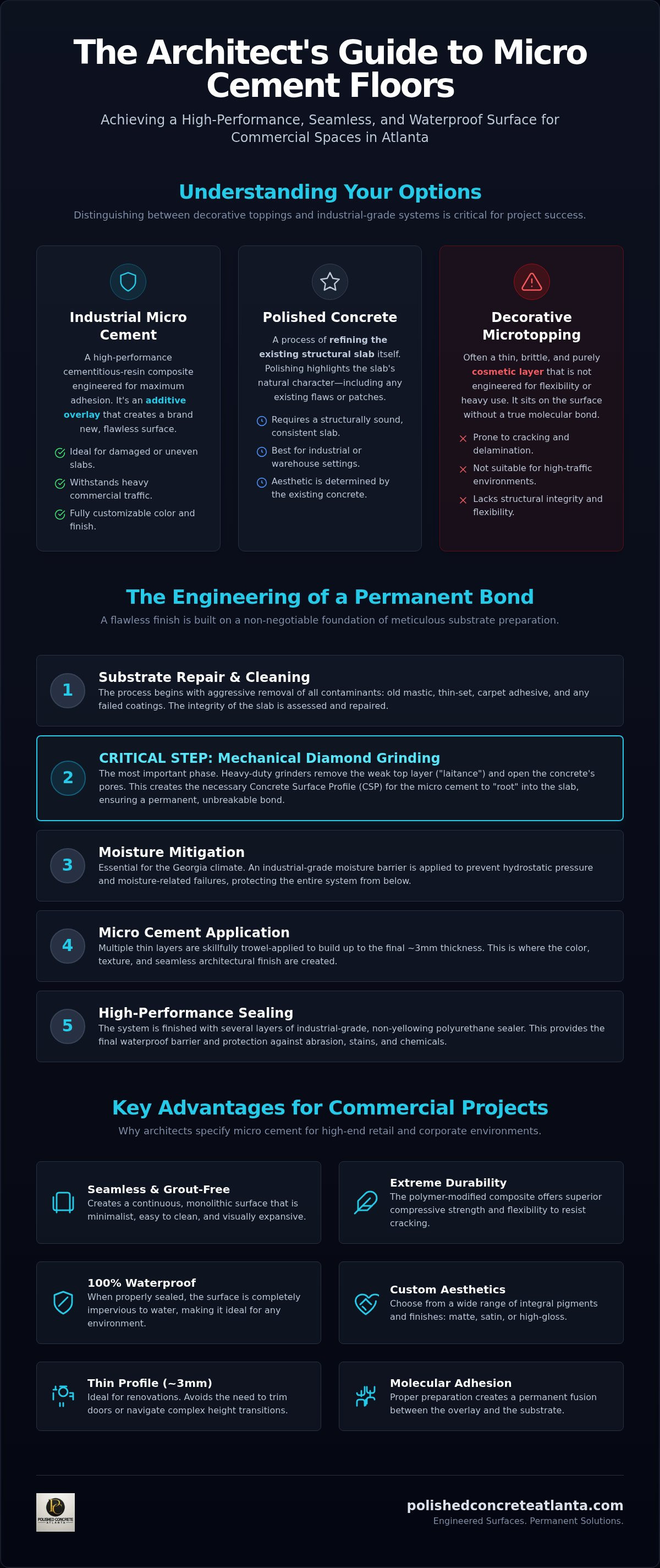
Micro cement is not a simple DIY coating or a basic paint-over solution. It is a high-performance cementitious-resin composite engineered for maximum adhesion and structural flexibility. Unlike standard concrete, this material relies on a high-strength cementitious binder modified with advanced polymers to achieve its signature durability. When architects specify micro cement floors Atlanta for high-traffic commercial projects, they are choosing a system that bonds at a molecular level to the substrate. It is a sophisticated architectural tool, not a cosmetic mask.
There is a critical distinction between generic "microtoppings" and industrial-grade micro cement systems. A microtopping is often a thin, brittle layer prone to cracking under stress. In contrast, our industrial systems are designed for the rigors of commercial use. One of the most significant advantages is the seamless nature of the application. Because the resin components allow for minor substrate movement, we can often eliminate the need for visible expansion joints across large open areas. This creates an uninterrupted visual plane that traditional concrete cannot match. With a profile of only 3mm, it is the ideal solution for renovations. You can achieve a modern, industrial look without the need to trim doors or navigate complex floor height transitions. It is efficiency meeting elegance.
Micro Cement vs. Polished Concrete: Which is Right for You?
The choice between these two systems depends entirely on your existing slab and your design goals. While polished concrete floors Atlanta facilities rely on refining the structural slab itself, micro cement is an additive process. If your slab is riddled with unsightly patches or mismatched pours, polishing will only highlight those flaws. Micro cement provides a fresh, uniform canvas. For industrial warehouses where utility is the only metric, a functional "grind and seal" might suffice. However, for retail environments where the floor is part of the brand identity, the controlled consistency of an overlay is the superior investment. We provide the technical clarity to help you choose the right path for your specific square footage.
The Aesthetic Appeal: Minimalist Design in Atlanta Facilities
The "raw concrete" aesthetic has become a staple in the high-end developments of Buckhead and West Midtown. It projects a sense of permanence and modern sophistication. Micro cement allows you to customize this look far beyond standard industrial gray. You can select from a wide range of integral pigments to match your brand's color palette perfectly. The finish options are equally versatile. Whether you require a muted matte for a gallery feel, a subtle satin for a professional lobby, or a high-gloss finish to maximize light reflectivity, the choice is yours. We don't believe in one-size-fits-all solutions. We deliver tailored architectural surfaces that perform as well as they look.
The Engineering of Adhesion: Why Preparation is the Priority
A micro cement system is only as high-performing as the bond it shares with the underlying slab. This is our "No-Nonsense" rule. If the bond fails, the entire architectural surface fails. Period. Achieving a permanent connection requires more than just a clean surface; it demands a total transformation of the concrete's profile. When we install micro cement floors Atlanta, we treat the substrate as the most critical component of the project. You cannot shortcut the engineering required to fuse a polymer-modified overlay to an old, contaminated concrete base.
Mechanical profiling is the only way to guarantee long-term integrity. We utilize heavy-duty diamond grinding to remove the "laitance"—that weak, brittle top layer of concrete—and open the pores of the slab. This process creates a specific surface profile (CSP) that allows the micro cement to "root" into the concrete. For those seeking the highest standards, following rigorous technical specifications for concrete overlays ensures that the mechanical bond is unbreakable. Without this aggressive preparation, the overlay is merely sitting on top of the floor, waiting to delaminate.
Critical Floor Preparation Services
Renovating commercial spaces often reveals a history of failed flooring. We specialize in professional floor glue removal Atlanta to eliminate old mastic, thin-set, and carpet adhesives. These chemical residues are toxic to micro cement adhesion. Even a microscopic film of old glue can cause a chemical reaction that prevents the resin from curing. Once the slab is decontaminated, we perform precision concrete floor leveling. A flat, stable substrate is mandatory before the first architectural layer is ever applied. If your project requires an expert substrate analysis, we handle the grinding and leveling that others outsource.
Moisture Mitigation: Protecting Your Investment
Atlanta's high humidity creates a unique challenge: Sweating Slab Syndrome. Sub-slab moisture vapor travels upward through the concrete, and if it's trapped by an overlay, it creates osmotic pressure. This leads to blistering and bond failure. We prevent this by applying industrial-grade, epoxy-based moisture barriers that seal the slab from the inside out. To ensure accuracy, the Calcium Chloride test is the industry standard for measuring vapor emission. We don't guess when it comes to moisture; we use data to protect your facility from future failures. This disciplined approach is why our seamless surfaces survive where others peel.
Commercial Applications for Micro Cement in Atlanta
Micro cement is the definitive solution for Atlanta enterprises that refuse to choose between industrial performance and high-end design. In the competitive landscape of Buckhead retail or West Midtown's corporate hubs, your facility's floor serves as the foundation of your brand's physical identity. Unlike traditional materials that rely on grout lines or repetitive patterns, micro cement floors Atlanta installations offer a monolithic, expansive surface that commands attention. It's a strategic choice for high-traffic environments where downtime is costly and aesthetic excellence is mandatory.
High-end retail showrooms utilize this system to create a sophisticated, neutral backdrop that directs all focus toward luxury merchandise. The seamless nature of the material also allows for modern office lobbies to execute flawless transitions from the floor directly onto feature walls and reception desks. This "total look" is impossible with tile or hardwood. In the hospitality sector, restaurants benefit from a non-porous surface that doesn't harbor bacteria or odors. For residential high-rise developments, micro cement provides the coveted "industrial loft" aesthetic without the structural weight of a full-depth concrete pour. It delivers the look of a massive slab in a fraction of the thickness.
Durability Standards for High-Traffic Zones
Commercial viability depends on compressive strength. Modern micro cement systems are engineered to withstand the constant vibration and foot traffic of a busy facility without cracking. We enhance this inherent strength with high-performance topcoats that provide superior scratch and chemical resistance. Maintaining that "like-new" finish doesn't require specialized equipment; a disciplined cleaning protocol with pH-neutral solutions is usually sufficient. If you're ready to upgrade your facility with an uncompromising architectural finish, contact our commercial flooring team for a technical consultation.
Waterproofing and Wet Area Performance
Hygiene and safety are non-negotiable in commercial restrooms, spas, and kitchens. Micro cement is inherently waterproof when properly sealed, making it the preferred choice over porous stone or tile. We can customize the surface texture to achieve specific slip-resistance ratings without compromising the minimalist aesthetic. Furthermore, we can install seamless coving—curving the floor material up the wall—to eliminate the corners where dirt and moisture typically collect. This creates a fully tanked, hygienic environment that is easy to sanitize and impossible to leak. It's the standard for 2026 facility management.
Executing a Flawless Installation: What to Expect
A superior finish is the result of a disciplined, phase-based installation. We do not skip steps. We do not rush the cure. When installing micro cement floors Atlanta, the process begins with deep grinding to achieve the necessary mechanical profile. This is followed immediately by substrate repair and the application of a high-performance moisture barrier if the slab's vapor emission rates exceed 2026 standards. These initial stages are purely industrial. They are the invisible insurance policy for your architectural surface.
The aesthetic transformation occurs during the multi-layer application phase. Our technicians use artisanal troweling techniques to create the specific movement and texture your design requires. Each layer must bond perfectly to the one beneath it. Once the final coat is set, we apply specialized sealers to ensure maximum hardness and stain resistance. This isn't just a floor. It's a high-performance system engineered for the long haul. We handle the technical heavy lifting so you can focus on the results.
Timeline and Logistics for Atlanta Businesses
A typical 2,000 sq. ft. commercial installation requires a five to seven day window. Site conditions must be strictly managed for a flawless result. We require a climate-controlled environment with stable temperatures between 60 and 80 degrees to ensure proper resin cross-linking. Dust control is non-negotiable. While you can typically resume light foot traffic within 24 hours of the final seal, a full chemical cure takes approximately seven days. We provide a precise schedule so you can manage your facility's operations without surprises. We value your time as much as your floor.
Choosing an Atlanta Industrial Flooring Contractor
The technical complexity of micro cement demands a commercial concrete floor contractor who understands the physics of the slab. General painters or residential crews often lack the heavy-duty grinding equipment and HEPA-filtered dust extraction systems required for a clean, professional install. You need a partner with a deep background in industrial floor coatings Atlanta. This expertise ensures that your decorative finish is supported by industrial-grade durability. Ask potential contractors about their equipment and their moisture testing protocols. If they aren't using data to drive their decisions, they aren't the right partner for your project. Don't settle for a cosmetic fix when you can have an engineered solution.
Elevate Your Facility with Engineered Precision
You shouldn't settle for a floor that only looks the part. A truly seamless architectural surface is built from the slab up, requiring the technical precision of diamond grinding and advanced moisture mitigation. We've established that micro cement is an engineered system designed to survive the rigors of high-traffic commercial use while delivering a flawless, minimalist aesthetic. It's the definitive choice for modern facility management in 2026. Period.
When you choose micro cement floors Atlanta for your next project, you're investing in a surface backed by over 20 years of local flooring expertise and specialized moisture mitigation technology. We don't just apply a cosmetic finish; we manage the entire substrate preparation process using premium industrial-grade materials to ensure long-term bond integrity. This level of discipline is what separates a premium architectural surface from a failed overlay. Your vision deserves the certainty of expert craftsmanship and a partner who understands the physics of the floor. Let's build a surface that commands respect and performs without compromise.
Request a Professional Consultation for Your Atlanta Micro Cement Project
Frequently Asked Questions
How long do micro cement floors last in a commercial setting?
A professionally installed micro cement floor typically lasts 10 to 15 years in a high-traffic commercial environment. Its longevity is tied directly to the quality of the industrial sealer and the discipline of your maintenance routine. Because the material is a resin-modified composite, it doesn't suffer from the brittleness of standard concrete. It's a permanent architectural solution. It's built to endure.
Can micro cement be applied over existing tile or wood?
Is micro cement prone to cracking like traditional concrete?
Micro cement is engineered for flexibility and is far less prone to cracking than standard concrete. The polymer resins within the mix allow the material to handle minor vibrations and thermal expansion. It's an architectural overlay, not a structural pour. While it won't crack on its own, it can't fix a failing foundation. We always address slab movement issues before we begin the application.
How do you clean and maintain seamless micro cement floors?
You should clean your micro cement floors Atlanta installations with a soft broom and a damp mop using a pH-neutral detergent. Avoid bleach, ammonia, or citrus-based cleaners. These chemicals will eventually eat through the protective topcoat and leave the surface vulnerable to stains. For commercial spaces, a routine schedule of dust mopping is usually enough to keep the floor in peak condition.
What is the price difference between micro cement and polished concrete?
Micro cement is a premium architectural finish that typically costs more than a standard polished concrete service. This is due to the intensive labor involved in artisanal troweling and the cost of the high-performance resin components. While polishing is a subtractive process that refines your existing slab, micro cement is an additive system that provides a uniform, high-end look regardless of the slab's original condition.
Does micro cement require expansion joints in large Atlanta warehouses?
Most expansion joints can be bridged with micro cement to create a perfectly seamless, monolithic surface. This is a major advantage for large-scale facilities wanting a clean aesthetic. However, true structural isolation joints that go through the entire depth of the slab must be maintained. We'll evaluate your facility's joint plan to determine where we can achieve a seamless finish and where we must respect the building's movement.


