
A failed floor is more than a cosmetic eyesore; it's a structural liability that signals a breakdown in technical engineering. Most commercial facility managers wait until they see bubbling epoxy or mold growth to prioritize a professional concrete moisture barrier installation. By then, the damage is already done. You understand that unexpected downtime for remediation is not just an inconvenience. It's a direct hit to your bottom line and operational integrity. High-traffic environments demand a foundation that can withstand constant hydrostatic pressure without flinching. Total reliability. Precision matters.
This guide delivers the definitive technical requirements to ensure your facility remains compliant and functional. You'll master the transition from outdated calcium chloride tests to the rigorous ASTM F2170 relative humidity probes required by modern manufacturers. We'll examine why the 2026 building codes now mandate a 10 mil vapor retarder and how Class A puncture resistance protects your investment. From achieving the correct mechanical surface profile to meeting OSHA's latest coefficient of friction standards, we provide the roadmap to a permanent flooring solution. Professional excellence starts from the ground up.
Key Takeaways
- Distinguish between standard residential vapor barriers and high-performance industrial moisture mitigation systems designed for massive scale.
- Identify the critical technical requirements for a successful concrete moisture barrier installation, focusing on liquid-applied epoxy for superior long-term durability.
- Implement rigorous diagnostic testing protocols like ASTM F2170 to eliminate the uncertainty of moisture vapor emission rates before coating application.
- Discover why mechanical surface profiling to a CSP 3+ standard is the only reliable way to prevent hydrostatic pressure from compromising your floor.
- Navigate regional compliance standards and environmental factors to protect your facility against Atlanta’s unique humidity and soil drainage patterns.
What is Concrete Moisture Barrier Installation and Why is it Critical?
Professional concrete moisture barrier installation is not a suggestion. It's a technical necessity. Unlike basic residential solutions, industrial moisture mitigation is a sophisticated system engineered to suppress high Moisture Vapor Emission Rates (MVER). You aren't just laying down plastic. You're managing a complex chemical environment. In a commercial facility, the financial impact of ignoring moisture is staggering. It leads to catastrophic floor failure, massive remediation costs, and operational shutdowns that erode your bottom line. Precision is the only path to protection.
When moisture is trapped between a concrete slab and a non-breathable industrial coating, it creates what we call the "sandwich effect." The vapor has nowhere to go. Pressure builds. Eventually, the bond fails. This isn't just a surface issue; it is a structural breakdown that compromises the integrity of your entire facility. You need a solution that addresses the physics of the slab, not just the aesthetics of the floor. Reliability demands it.
Vapor vs. Moisture Barriers: Understanding the Difference
A standard Vapor barrier typically refers to a thin poly-film installed under a new slab to slow the migration of ground moisture. However, commercial moisture mitigation systems are designed to handle the vapor already present within the concrete. We measure the effectiveness of these materials by their permeability, or "perms." In high-humidity regions like Georgia, liquid water is only half the battle. Invisible vapor transmission carries alkaline salts to the surface, where they wreak havoc on your finish. MVER is the quantitative measurement of the amount of water vapor that emits from a concrete slab over a specific period, typically expressed in pounds per 1,000 square feet over 24 hours. If this rate exceeds your flooring manufacturer's limits, failure is inevitable.
The Consequences of Improper Moisture Control
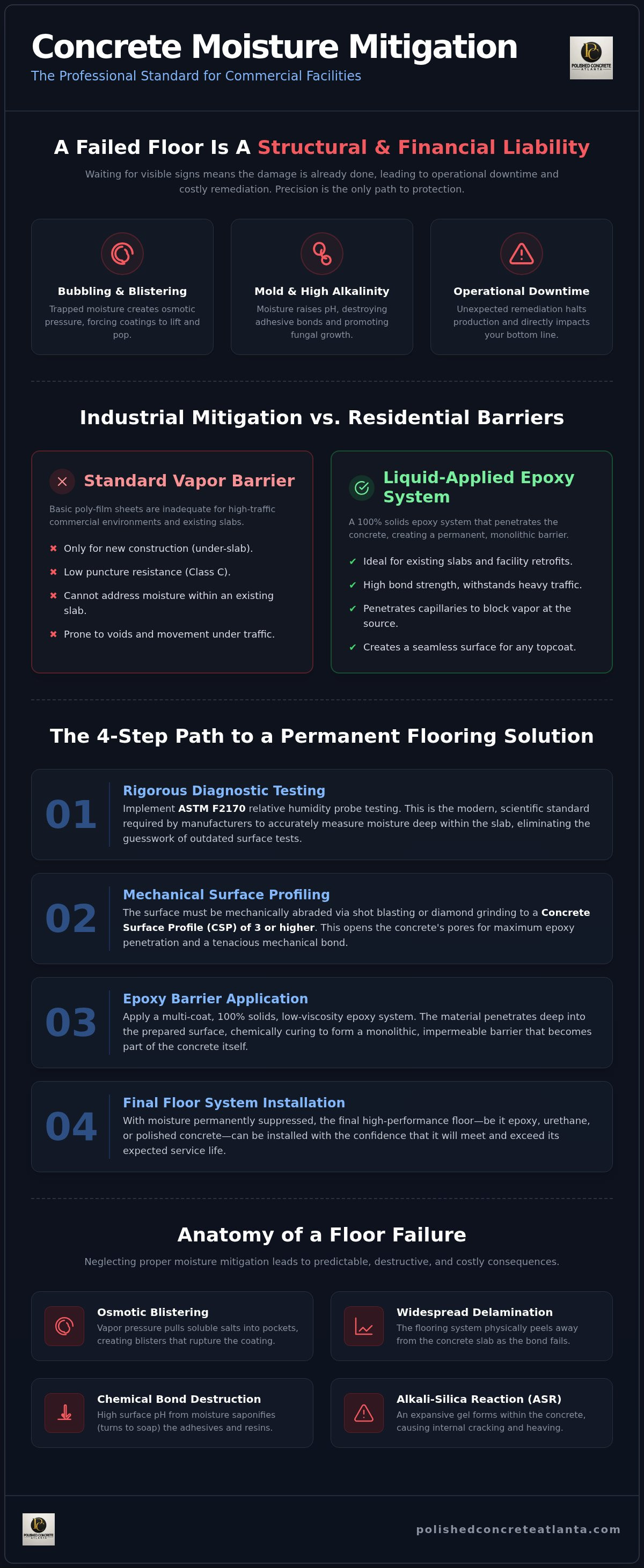
The results of a neglected slab are both visible and destructive. Osmotic blistering occurs when moisture vapor pulls soluble salts into a concentrated pocket, creating enough pressure to "pop" your epoxy or resinous coating. This often leads to widespread delamination. Beyond the coating, moisture drastically spikes the pH level of the concrete surface. High alkalinity destroys the chemical bond of adhesives and resins, turning a premium investment into a peeling mess. Furthermore, excessive internal moisture can trigger an Alkali-Silica Reaction (ASR), where a reactive gel forms and expands, causing the concrete to crack and heave from within. You cannot afford to guess. You must mitigate.
Choosing the Right Mitigation System: Liquid vs. Sheet Membranes
Commercial concrete moisture barrier installation requires a strategic choice based on the project's lifecycle stage. Sheet membranes serve as a preventative measure during new construction, placed directly on the subgrade before the pour. However, for the vast majority of retrofit or renovation projects, these are physically impossible to install. This is where liquid-applied systems become the definitive standard. The choice isn't just about material; it's about the physics of the environment. High-traffic industrial zones don't tolerate the slight movements or voids often found under loose-laid sheets. You need a system that becomes part of the slab itself.
Your selection depends on the final finish and the slab's age. If you're installing a non-breathable resinous coating, the moisture mitigation system must be absolute to prevent osmotic pressure from tearing the floor apart. For facilities with heavy machinery or constant forklift traffic, the bond strength of the barrier is the difference between a 20-year floor and a 6-month failure. Don't settle for residential-grade plastic when your operations depend on structural integrity.
Liquid-Applied Epoxy Moisture Barriers
For existing commercial slabs, 100% solids epoxy is the uncompromising leader. These systems use a low-viscosity resin that penetrates deep into the concrete capillaries, creating a permanent mechanical lock that surface-level sheeting cannot achieve. This deep penetration is essential when preparing for high-performance topcoats like industrial epoxy or urethane. Because polished concrete requires a surface free of physical membranes to achieve its signature clarity, liquid-applied chemical barriers are the only viable choice for premium polished concrete prep. When you follow the ACI Guide for Concrete Slabs, you realize that substrate preparation dictates the success of the entire system. It's about engineering the bond from the inside out.
Sheet Membranes and Underlayments
In new commercial construction, reinforced polyethylene membranes ranging from 10-mil to 20-mil are standard. They provide a vital barrier against ground moisture, but they have severe limitations. They don't account for the moisture already held within the concrete mix. Additionally, sheet-based systems are inherently vulnerable. Every pipe penetration or column support creates a potential leak point that must be meticulously sealed with specialized tapes or mastics. Under the heavy weight of forklifts, these membranes can shift or tear if the base isn't perfectly compacted. If you're unsure which path fits your facility's specific load requirements, professional floor moisture mitigation services can provide the diagnostic clarity needed to make a final decision. Total reliability is the goal.
The Professional Installation Process: From Testing to Bond
Concrete moisture barrier installation is a rigorous engineering sequence. It isn't a simple application; it's a four-phase technical protocol designed to eliminate the variables that lead to floor failure. You cannot skip steps. You cannot compromise on precision. Success begins with data and ends with a verifiable chemical bond. When you're managing a commercial facility, you need a process that stands up to the highest industrial standards. Reliability is the only goal.
- Phase 1: Diagnostic moisture testing (RH and Calcium Chloride).
- Phase 2: Mechanical surface preparation (CSP 3+).
- Phase 3: Chemical application at specified mil thickness.
- Phase 4: Integrity verification and cure testing.
Testing and Diagnostics: Measuring the Invisible
Phase one focuses on diagnostic testing. We don't guess. We measure. Using ASTM F2170 in-situ relative humidity (RH) probes, we capture the moisture levels deep within the slab's core, not just the surface. This provides a three-dimensional view of the slab's hydration. We complement this with ASTM F1869 calcium chloride testing to determine the vapor emission rate at the surface. A basic "plastic sheet test" is insufficient for commercial warranties. It's an amateur method that fails to account for the internal vapor pressure that destroys high-end coatings. You must understand RH percentages; most resinous systems require the slab to be below 75% or 85% RH. Documenting these results creates a permanent facility record. When selecting materials, we reference the ASTM E1745 Standard to ensure the barrier meets Class A performance requirements for puncture resistance and vapor permeance. Data drives the decision.
Mechanical Prep: The Key to Adhesion
Phase two is mechanical surface preparation. This is the most critical stage for long-term adhesion. Diamond grinding or shot blasting is non-negotiable. You must achieve a Concrete Surface Profile (CSP) of 3 or higher. This process removes laitance, curing compounds, and residual contaminants that block the mitigation agent's path. If you're dealing with a renovation, this includes professional Floor Glue Removal Atlanta to strip away old adhesives. The goal is to "open" the concrete capillaries. This allows the mitigation chemistry to penetrate and lock into the substrate. Without this mechanical lock, even the best barrier will eventually delaminate.
Phase three is the precision application of the mitigation agent at the manufacturer-specified mil thickness, usually 10 to 15 mils for liquid epoxies. We ensure a continuous, monolithic film. Finally, phase four involves integrity testing. We verify the cured barrier is free of pinholes or fish-eyes. This meticulous approach to concrete moisture barrier installation ensures your floor survives the most demanding industrial environments. Precision is the standard. No shortcuts.
Addressing Hydrostatic Pressure: The #1 Cause of Floor Failure
Hydrostatic pressure is the silent killer of commercial flooring. It isn't a suggestion of moisture; it is a physical force. Many facility managers mistakenly believe that applying a standard sealer to the surface will contain the issue. This is a dangerous fallacy. A top-side sealer is a cosmetic fix for a structural problem. Without a comprehensive concrete moisture barrier installation, rising groundwater will eventually overcome the bond of your floor coating. It's a matter of physics, not luck. Professional mitigation acts as a structural insurance policy for your facility, protecting your investment from the ground up; similarly, you can explore Exterior Masonry and Facade Restoration to ensure the building’s envelope remains equally secure.
Slab-on-grade construction is particularly vulnerable to this phenomenon. As water accumulates beneath the slab, it creates an upward pressure that forces moisture through the concrete's capillary network. This isn't just about dampness. It's about a relentless energy that seeks to equalize. If your floor system isn't engineered to resist this specific force, failure is a certainty. Reliability requires a proactive stance.
What is Hydrostatic Pressure?
Think of your concrete slab like a dense, heavy sponge. When the water table rises or drainage is poor, water is pushed into the concrete's pores from the bottom up. This is hydrostatic pressure. In older Atlanta facilities, this is a recurring nightmare due to the high red clay content in the soil, which traps water against foundations and prevents natural drainage. You must distinguish between simple dampness and active pressure. Dampness is a presence. Active pressure is a movement. This upward force can reach levels that exceed the tensile strength of standard adhesives and resins, leading to total system collapse.
Why Surface Sealers Fail Under Pressure
Surface sealers fail because they lack the deep mechanical lock necessary to resist vertical force. When vapor pressure builds, it searches for the path of least resistance. This results in visible distress: pinholes, fisheyes, and localized peeling as the coating is literally pushed off the substrate. We don't just "seal" floors. We engineer them. At Polished Concrete Atlanta, our systems are designed to integrate with the slab's chemistry, ensuring the barrier can withstand significant PSI from below. If you want to eliminate the risk of delamination and ensure long-term durability, you need professional floor moisture mitigation that addresses the root cause of the pressure. Total coverage. Zero uncertainty.
Atlanta Standards for Commercial Moisture Mitigation
Operating in the Southeast requires a specialized understanding of geological and atmospheric pressure. Atlanta's red clay is dense and slow-draining, often trapping water against commercial slabs and driving hydrostatic force to critical levels. A standard concrete moisture barrier installation in this region cannot be a generic application. It must be a site-specific engineering response. Compliance with the 2024 International Building Code (IBC) and the 2026 Georgia Amendments is now the baseline for any professional project. We don't just meet these standards; we exceed them to ensure your facility remains operational under the most demanding conditions. Reliability is non-negotiable.
The value of a single-source contractor cannot be overstated. When one team handles the mechanical grinding, the moisture mitigation, and the final high-performance finish, you eliminate the risk of inter-layer incompatibility. There is no finger-pointing between vendors. Every phase of the project is managed with a holistic view of the final result. This approach secures your long-term ROI by permanently breaking the "rip and replace" cycle that plagues facilities with poorly prepared floors. Do it once. Do it right.
Climate Considerations for Georgia Facilities
Seasonal humidity swings in Atlanta are aggressive. High ambient moisture during Southeastern summers can skew relative humidity readings and extend cure times for liquid barriers. In unconditioned warehouses, these factors are magnified. The local water table fluctuates significantly with seasonal rainfall, often increasing the vapor pressure against the slab during the wet months. We utilize advanced ASTM F2170 probes to ensure our data is accurate regardless of the weather outside. Precision requires constant vigilance. Data dictates the timeline.
Selecting an Atlanta Mitigation Expert
You need a partner who understands the technical nuances of the Georgia substrate. When evaluating a professional floor preparation contractor, ask about their diagnostic equipment and their commitment to achieving a CSP 3+ profile. Do they document their RH readings? Do they use 100% solids epoxy systems? An expert will provide clear, data-driven answers that leave no room for uncertainty. They should be able to explain how they'll meet the 2026 mandates for vapor retarder thickness and puncture resistance. Protect your facility with professional moisture mitigation from Polished Concrete Atlanta. Your floor is the foundation of your business. Treat it with the respect it deserves.
Secure Your Facility’s Foundation for the Next Decade
Professional concrete moisture barrier installation is the difference between a high-performance asset and a recurring liability. You've seen how precision diagnostics and mechanical surface profiling eliminate the guesswork that leads to delamination. By addressing hydrostatic pressure at its source, you aren't just following code; you're protecting your bottom line from the "rip and replace" cycle. Total reliability is a choice. It requires a partner who understands that moisture mitigation is a technical engineering process, not a surface treatment.
Polished Concrete Atlanta brings the gravitas of a veteran-owned and operated firm that's mastered the craft since 2004. We specialize in high-performance industrial prep and carry deep expertise in Georgia’s unique climate-specific mitigation requirements. We don't settle for mediocrity. Our team manages every detail to ensure your facility remains operational and compliant. Take the uncertainty out of your flooring investment today. Request a Professional Moisture Assessment for Your Atlanta Facility. Your operations deserve the peace of mind that comes from elite craftsmanship. Let's build a floor that stands the test of time.
Frequently Asked Questions
How do I know if my concrete floor needs a moisture barrier?
Professional diagnostic testing is the only reliable way to determine if your slab requires mitigation. You shouldn't rely on visual inspections alone. While visible signs like efflorescence, dark damp spots, or bubbling epoxy indicate a problem, they often appear only after significant damage has occurred. We utilize ASTM F2170 relative humidity probes to measure the moisture deep within the slab's core. If your readings exceed the thresholds set by your flooring manufacturer, a concrete moisture barrier installation is a technical necessity. Data eliminates the risk of failure.
Can I install a moisture barrier over old floor glue or paint?
No. You cannot install a high-performance moisture barrier over existing contaminants like glue, paint, or curing compounds. Adhesion is everything. These materials act as a bond-breaker that prevents the mitigation chemistry from penetrating the concrete capillaries. We require mechanical surface preparation to reach a CSP 3+ profile. This involves diamond grinding or shot blasting to strip the slab down to clean, open concrete. If you skip this step, the barrier will eventually delaminate. Clean substrate is the standard.
How long does concrete moisture barrier installation take?
The timeline typically spans 24 to 48 hours depending on the facility size and the required preparation. Most of this window is dedicated to mechanical grinding and diagnostic testing. Once the surface is prepared and the barrier is applied, it usually requires 12 to 24 hours to cure before you can install the final floor covering. We prioritize efficiency to minimize your downtime. However, we never rush the technical cure times. Precision takes the time it needs.
Is a vapor barrier the same as a moisture barrier?
Technically, they serve different roles in commercial construction. A vapor barrier is usually a plastic sheet installed under the slab during the initial pour to block ground moisture. A moisture barrier, or mitigation system, is a top-side chemical treatment applied to an existing slab to suppress high vapor emission rates. You need mitigation when the sub-slab barrier is missing, damaged, or insufficient for your specific floor finish. They aren't interchangeable. One is a preventative layer; the other is a structural solution.
What happens if I skip moisture mitigation for my epoxy floor?
Skipping mitigation leads to catastrophic delamination and osmotic blistering. Moisture vapor creates upward pressure that physically separates the epoxy from the concrete. This results in unsightly bubbles that eventually crack and peel under traffic. Beyond the aesthetic failure, excessive moisture often voids your flooring manufacturer's warranty. You'll be left with the full cost of a "rip and replace" project. Don't gamble with your investment. Mitigation is your insurance policy.
How much does commercial moisture mitigation cost per square foot?
The investment for a moisture mitigation system depends on the specific condition of your slab and the required mechanical preparation. Factors such as the existing Concrete Surface Profile (CSP), the volume of old adhesive that needs removal, and the results of your ASTM moisture tests dictate the scope of work. A slab with high hydrostatic pressure requires a thicker mil application than one with moderate vapor emissions. We provide tailored assessments based on your facility's unique data. Accuracy drives value.
Does polished concrete require a moisture barrier?
Polished concrete is naturally breathable, but it still requires moisture management in certain environments. While it handles vapor transmission better than non-breathable epoxy, extreme moisture levels can lead to Sweating Slab Syndrome or heavy salt migration. These issues create slip hazards and dull the floor's clarity over time. We assess your local water table and slab age to determine if a penetrating sealer or a full mitigation system is necessary. Every slab is different. Reliability is the goal.


