
Your industrial floor isn't just "wet" because of the Atlanta humidity; it's failing on a molecular level. While many facility managers treat moisture as a seasonal nuisance, a slick slab is actually a structural liability that compromises both safety and productivity. We provide definitive sweating slab syndrome solutions that address the root cause of these hazards rather than just masking the symptoms. You've likely dealt with the headache of conflicting advice, where HVAC contractors demand more fans while flooring installers suggest superficial sealers. It's an exhausting cycle that leaves your inventory at risk and your team exposed to slip-and-fall hazards.
We understand the frustration of managing a facility that feels like a liability. You'll learn how to identify the precise atmospheric and capillary triggers causing your floor to "sweat" and how to implement high-performance remediation that lasts. This guide outlines a strategic approach to moisture mitigation, focusing on the 2026 OSHA standards for floor friction to ensure your facility remains compliant. From advanced moisture testing to the application of the Ashford Formula, we provide a roadmap to reclaim your floor's integrity. It's time to stop managing the moisture and start eliminating it.
Key Takeaways
- Identify the underlying physics of dew point and hygroscopic salts that transform your industrial floor into a high-risk safety hazard.
- Implement definitive sweating slab syndrome solutions that move beyond temporary fan usage toward permanent structural remediation.
- Discover how the Ashford Formula utilizes molecular densification to close concrete pores and eliminate the surface chemistry failures that lead to sweating.
- Ensure your facility meets 2026 safety requirements by prioritizing a high-friction, dry environment through a rigorous moisture mitigation protocol.
What is Sweating Slab Syndrome (SSS) and Why is it Dangerous?
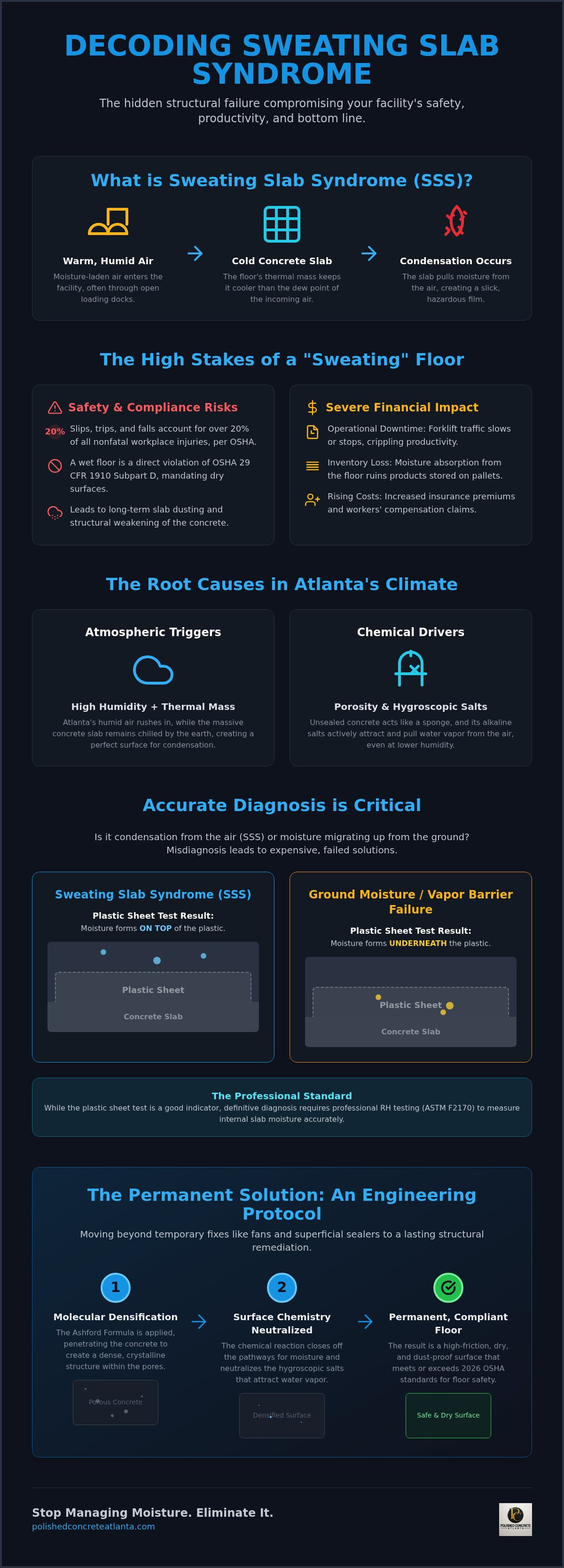
Sweating Slab Syndrome (SSS) is more than a seasonal nuisance; it's a structural failure that creates a high-stakes liability for industrial facilities. To understand What is Sweating Slab Syndrome, you must look at the physics of the dew point. When warm, moisture-laden air enters a facility and makes contact with a concrete slab that is at or below the dew point temperature, condensation forms instantly. This isn't a leak or a spill. It's the intermittent development of surface moisture caused by the slab's thermal mass acting as a cooling agent. The slab essentially pulls water out of the air, creating a slick, hazardous film across your entire operation.
The dangers are immediate and documented. According to OSHA's 2026 safety standards, slips, trips, and falls account for over 20% of all nonfatal workplace injuries. A "sweating" floor is a direct violation of 29 CFR 1910 Subpart D, which mandates that walking-working surfaces be kept clean and dry. Beyond the immediate safety risks, recurring SSS leads to slab dusting and structural weakening. Moisture accelerates the breakdown of the concrete's surface chemistry, turning a once-solid floor into a source of grit and fine particulate matter. Implementing engineering-grade sweating slab syndrome solutions is the only way to halt this degradation and protect your facility's long-term value.
The Financial Impact of SSS
Identifying SSS vs. Ground Moisture
Effective remediation requires an accurate diagnosis. Is the moisture condensing from the air or migrating from the soil? A simple "plastic sheet test", taping a 24-inch square of poly to the floor for 48 hours, provides a quick visual. If moisture is on top of the plastic, it's SSS. If it's underneath, you have a vapor barrier failure. However, professional RH testing (ASTM F2170) is the only definitive way to measure internal slab moisture. Our sweating slab syndrome solutions focus on this data-driven approach. Misdiagnosing the source leads to expensive, ineffective fixes that fail to address the actual problem. We don't guess. We engineer results.
The Root Causes: Why Atlanta Concrete Floors Sweat
Atlanta's climate is relentless. High humidity isn't just an outdoor discomfort; it's the primary catalyst for floor failure in Georgia's industrial hubs. Concrete is a stubborn thermal mass. It resists rapid temperature changes. While the Georgia air warms quickly during spring and summer mornings, the slab remains chilled by the earth beneath it. This temperature differential creates a permanent cooling surface that pulls moisture directly out of the atmosphere. Identifying the right sweating slab syndrome solutions requires looking beyond the air and into the chemistry of the slab itself.
Atlanta’s Humidity and the Thermal Mass Effect
Concrete stays cool far longer than the ambient air. In large facilities, open loading docks invite humid air to rush across these cold surfaces. This isn't just a building-wide issue; stagnant air pockets in corners or behind racking systems create localized "sweat zones." Poor insulation and lack of proper air movement allow these zones to become chronic safety hazards. The moisture doesn't just appear. It's engineered by the environment.
The Chemical Driver: Porosity and Salts
Unsealed concrete is a sponge for more than just liquid water. It's filled with hygroscopic salts that act as "salt magnets." These alkaline compounds actively attract water vapor from the air, even when the humidity isn't at 100%. This chemical attraction explains why a porous, raw slab will "sweat" while a properly treated surface remains dry. To address this, we focus on The Engineering of Adhesion: A Definitive Guide to Concrete Surface Preparation to ensure the slab's surface chemistry is neutralized before remediation begins.
Surface contaminants further complicate the issue. Legacy floor glue, oils, and rubber tire marks change the surface tension of the concrete. These materials trap moisture and prevent natural evaporation, leading to persistent slick spots. In some cases, the problem isn't the air at all, but a failed or non-existent vapor barrier beneath the slab. When ground moisture migrates upward, it meets the surface contaminants and creates a slurry that compromises safety. If you suspect your facility is suffering from these complex interactions, our Industrial Floor Services specialists can provide a definitive site evaluation to determine the exact source of your moisture intrusion.
Effective sweating slab syndrome solutions must account for these variables. You can't just blow a fan on a chemical problem and expect a permanent result. It takes a holistic approach that combines mechanical refinement with molecular densification to close the pores and lock out the moisture for good.
Sweating Slab Syndrome Solutions: A Multi-Stage Engineering Protocol
Stop relying on temporary patches. True sweating slab syndrome solutions require a dual-track approach: immediate tactical mitigation and long-term structural remediation. While many contractors suggest fans as a cure-all, they only address the symptom of evaporation. We treat the slab as a complex chemical system that requires stabilization. Reliability is built through engineering, not guesswork. You need a floor that remains dry regardless of the Georgia humidity levels outside your loading docks.
Immediate Tactical Responses
Tactical responses manage the daily crisis. Deploying High-Volume Low-Speed (HVLS) fans ensures consistent airflow across the concrete's thermal mass, which helps equalize surface temperature and reduces the rate of condensation. In climate-controlled industrial spaces, dehumidification strategies are essential to keep the dew point below the slab temperature. You must also implement rigorous cleaning protocols. Dust, salt, and debris are hygroscopic; they pull moisture out of the air and hold it against the surface. Removing these contaminants is a non-negotiable first step in maintaining a safe environment.
Permanent Strategic Solutions
Permanence requires mechanical and chemical intervention. We move beyond surface-level fixes by utilizing professional moisture mitigation systems to block vapor migration. Before any treatment, we conduct in-situ relative humidity testing (ASTM F2170) to get an accurate measure of the slab's internal condition. As premier Industrial Flooring Contractors in Atlanta: A Strategic Guide to High-Performance Surfaces, we employ mechanical refinement to grind away the salt-rich top layer of the slab. This process eliminates the alkaline magnets that attract moisture and removes legacy contaminants like oils or floor glue.
We then transition the floor to sealed concrete to drastically reduce porosity. This multi-stage protocol closes the concrete's pores and eliminates the hygroscopic action that leads to sweating. By densifying the slab, you create a surface that is easier to maintain and far more resistant to moisture intrusion. If your facility is currently a safety risk, schedule our Industrial Floor Services to implement a permanent, high-performance solution that protects your team and your inventory.
The Ashford Formula and the Polished Concrete Atlanta Standard
Topical sealers are a liability in industrial environments. When moisture migrates through a slab, generic coatings often delaminate, peel, or trap vapor, creating a bubbled, unsightly mess that fails to solve the underlying problem. We don't settle for superficial fixes. Our sweating slab syndrome solutions rely on the Ashford Formula, the global gold standard for permanent concrete densification. This treatment doesn't sit on the surface; it becomes part of the floor. By choosing a chemically reactive solution over a temporary film, you ensure your facility remains dry, safe, and operational for decades.
Molecular Densification: The Ashford Advantage
The Ashford Formula works through a complex chemical reaction that targets the calcium hydroxide within the concrete. It converts these soft minerals into hard, chemically resistant calcium silicate hydrate. This process permanently alters the molecular structure of the slab, closing the capillary tracts that allow moisture and salts to migrate to the surface. The results are definitive:
- Elimination of Dusting: By hardening the surface, the treatment prevents the breakdown of concrete into fine particulate matter.
- Salt Mitigation: It locks in the hygroscopic salts that otherwise act as moisture magnets.
- Superior Cleanability: Densified floors don't absorb oils or contaminants, making them significantly easier to keep dry.
Unlike topical sealers that wear away under heavy forklift traffic, this penetrating bond strengthens over time. It creates a floor that is not only resistant to sweating but also harder and more durable than the day it was poured.
Partnering for a Safe Facility
Reliability is the hallmark of our process. Since 2004, we've provided specialized remediation for Atlanta's largest warehouse and distribution hubs. We understand that your operation cannot stop for weeks of construction. Our team utilizes a methodical, high-impact approach to minimize disruption while ensuring your floor meets the 2026 safety requirements. The Polished Concrete Atlanta Standard focuses on achieving a high Dynamic Coefficient of Friction (DCOF). We target a 0.5 COF for level surfaces and 0.8 for ramps, ensuring compliance with OSHA 29 CFR 1910 Subpart D even in challenging humidity. We are not just contractors; we are your strategic partners in facility safety. Contact Polished Concrete Atlanta for a professional moisture assessment and SSS remediation plan.
Secure Your Facility with Engineered Floor Integrity
Managing a sweating slab shouldn't be a seasonal struggle that compromises your team's safety or your inventory's value. True reliability comes from addressing the slab's chemistry, not just its environment. By combining mechanical refinement with molecular densification, you eliminate the hygroscopic triggers that lead to moisture hazards. Implementing these definitive sweating slab syndrome solutions ensures your facility meets rigorous safety requirements while providing a low-maintenance, dry surface. As a Certified Ashford Formula Installer and Atlanta's authority on high-performance concrete since 2004, we specialize in SSS remediation for large-scale industrial facilities. We bring the technical expertise and disciplined execution required to solve your moisture issues permanently. Don't let a slick floor remain a liability in your operation. Request Your Professional Moisture Mitigation Assessment Today. Take the first step toward a safer, more productive work environment.
Frequently Asked Questions
Is polished concrete more slippery than normal concrete when it sweats?
Polished concrete is not inherently more slippery than raw concrete when both are saturated with surface moisture. While its reflective finish looks slick, the safety of a floor is determined by its Dynamic Coefficient of Friction (DCOF). We engineer our surfaces to meet 2026 OSHA standards, targeting a 0.5 DCOF for level floors. Raw concrete's porosity actually traps moisture and salts, which can create a more persistent slipping hazard than a refined, densified surface.
Can HVLS fans alone solve Sweating Slab Syndrome?
HVLS fans cannot solve the underlying structural or chemical causes of SSS. They are tactical tools that increase evaporation and help equalize surface temperatures, but they don't address the slab's porosity or the hygroscopic salts that attract moisture. For permanent sweating slab syndrome solutions, you must combine air movement with mechanical refinement and molecular densification to close the concrete's pores and eliminate the chemical attraction of water vapor.
What is the dew point, and how does it relate to my warehouse floor?
The dew point is the specific temperature at which air becomes saturated with water vapor, causing it to condense into liquid. Your warehouse floor acts as a massive thermal heat sink that stays cooler than the ambient air. When Georgia's humid air enters your facility and touches a slab that is at or below the current dew point, moisture forms instantly. This physical reaction is the primary driver of Sweating Slab Syndrome in Atlanta.
How much does it cost to fix Sweating Slab Syndrome?
The cost of remediation depends on the scale of the facility, the current level of slab porosity, and the specific moisture triggers identified during testing. Factors like existing surface contaminants and the depth of mechanical grinding required will influence the project scope. We focus on providing a high-performance, long-term investment that eliminates the recurring costs of workplace injuries and inventory damage. A professional assessment is the only way to determine a precise project budget.
Does the Ashford Formula prevent concrete from sweating?
The Ashford Formula prevents sweating by closing the capillary tracts within the concrete and neutralizing hygroscopic salts. It converts soft calcium hydroxide into hard calcium silicate hydrate, creating a dense surface that doesn't "pull" moisture from the air. While it cannot change the laws of physics regarding dew point, a densified slab stays drier and recovers faster than a porous, untreated floor. It's a critical component of our sweating slab syndrome solutions.
Will moisture mitigation stop SSS if the problem is atmospheric?
Moisture mitigation specifically targets water vapor migrating upward from the ground through the slab. While SSS is primarily an atmospheric condensation issue, many Atlanta facilities suffer from both. Blocking ground-level vapor reduces the total moisture load on the slab's surface. This allows our chemical densification and mechanical refinement processes to work more effectively against atmospheric condensation. A holistic approach ensures the floor remains dry from both directions.


