
Ninety percent of industrial floor failures are traced back to improper surface preparation. That's a staggering reality for facility managers who expect their infrastructure to last. In the humid Georgia climate, cutting corners on floor prep isn't just a mistake; it's a guaranteed path to costly downtime. You've likely seen it before. Dusting concrete starts to infiltrate your sensitive machinery. Moisture trapped beneath an inferior coating causes bubbling and peeling within months. When you're looking for industrial concrete floor finishing Atlanta demands a higher standard of engineering. You need a surface that stands up to the rigors of 2026 production schedules without constant intervention. Results matter.
You deserve a facility that operates without the constant shadow of maintenance costs. We agree that your floor should be a strategic asset, not a recurring headache. This article provides the blueprint to master the technical requirements and strategic choices necessary for high-performance flooring. We'll examine the 2026 Georgia Building Code requirements for slip resistance and the precise mechanical processes that eliminate sweating slab syndrome. You'll learn how to secure a maintenance-free, high-durability floor that meets every safety standard. It's time to move from temporary fixes to permanent engineering solutions.
Key Takeaways
- Understand why 90% of industrial floor failures are caused by surface prep and how to engineer a bond that ensures absolute durability.
- Discover the 2026 slip-resistance and light-reflectivity standards required for safety compliance and energy efficiency in Georgia warehouses.
- Evaluate the lifecycle performance of polished concrete versus epoxy coatings based on your facility's specific utility and 10-year operational horizon.
- Master the strategic choices for industrial concrete floor finishing Atlanta projects to eliminate moisture-related failures and concrete dusting.
- Learn how to vet partners who provide a no-nonsense project management approach to minimize your facility's operational downtime.
Industrial Concrete Floor Finishing Standards in Atlanta
Industrial concrete finishing is a rigorous refinement process, not a surface treatment. It involves mechanical grinding and chemical densification to transform a porous substrate into a high-density strategic asset. Many local contractors focus on aesthetics or "look." We focus on load-bearing performance. Residential-grade solutions inevitably fail in heavy-duty Atlanta industrial environments because they lack the bond strength to handle 24/7 forklift traffic and heavy machinery. When you invest in industrial concrete floor finishing Atlanta standards, you're hiring a strategic partner to manage facility longevity. The Polished concrete process must be executed with precision to ensure the surface withstands the specific mechanical stresses of your operation. Professional industrial concrete floor finishing Atlanta requires more than just equipment; it requires a deep understanding of structural integrity.
The Atlanta Industrial Climate: Humidity and Slab Health
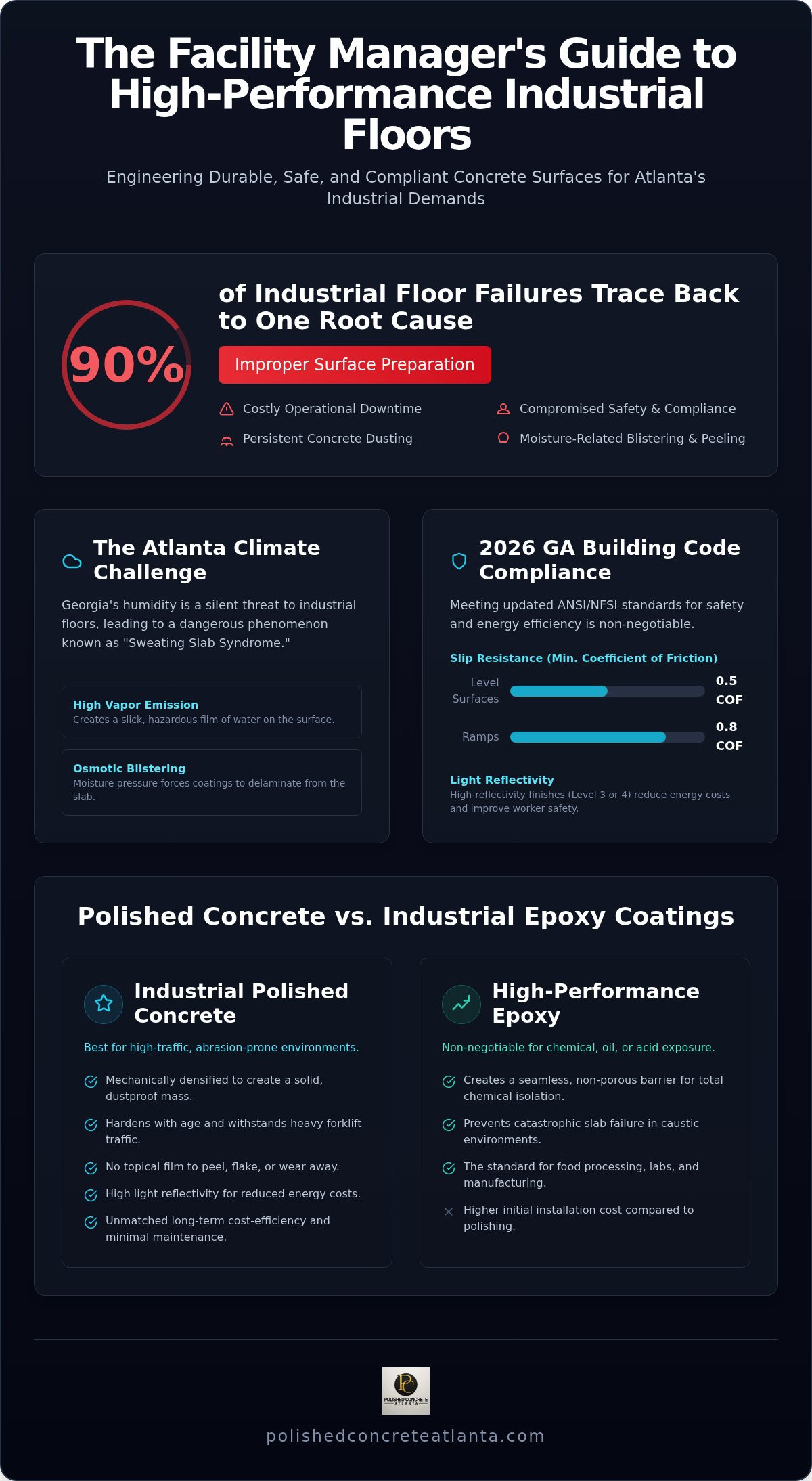
Georgia's humidity is a silent killer for industrial floors. High moisture levels increase vapor emission rates, leading to "Sweating Slab Syndrome" in unconditioned warehouses. This phenomenon creates a slick, dangerous film of water on the surface that compromises both safety and bond integrity. Without professional moisture mitigation, coatings will suffer from osmotic blistering. This occurs when moisture pressure forces the finish to delaminate from the slab. You need a partner who understands local geology and climate to engineer a floor that breathes without failing. We prioritize these environmental factors during the initial consultation to eliminate uncertainty.
Regulatory and Safety Compliance for 2026
The 2026 Georgia Building Code has tightened safety requirements for all industrial zones. Compliance with ANSI and NFSI standards is now a prerequisite for professional operation. Beyond slip resistance, light reflectivity has become a key engineering metric for modern facilities. High-reflectivity finishes (Level 3 or 4) maximize ambient light, reducing energy consumption and improving worker safety in high-traffic zones. Brighter workspaces lead to fewer accidents and higher productivity. For level industrial surfaces, the current standards require a minimum Coefficient of Friction (COF) of 0.5, while ramps must maintain a 0.8 COF. We don't just aim for these numbers; we hit them through disciplined project management and verified testing.
Evaluating Polished Concrete vs. Industrial Epoxy Coatings
Choosing between mechanical polishing and resinous coatings isn't about preference; it's about engineering for your facility's specific utility. In the high-stakes environment of industrial concrete floor finishing Atlanta, this decision dictates your operational overhead for the next decade. Polished concrete excels in high-traffic logistics where abrasion resistance is paramount. Conversely, epoxy systems are the standard for environments requiring total chemical isolation. Don't fall for the "durability myth" that one system fits every scenario. Mastering industrial concrete floor finishing Atlanta standards means choosing the right technology for the right traffic pattern. A 10-year lifecycle analysis often reveals that while epoxy has a higher initial installation cost, its protection in caustic environments prevents catastrophic slab failure that polishing cannot stop.
The Case for Industrial Polished Concrete
For high-traffic logistics hubs and retail warehouses, polished concrete floors Atlanta facilities rely on offer unmatched sustainability and cost-efficiency. These systems utilize the Ashford Formula for permanent densification. This process turns the concrete into a solid, dustproof mass that actually hardens as it ages. It's the definitive choice for climate-controlled facilities where high light reflectivity can significantly reduce energy costs. Because there is no topical film to peel, flake, or wear away, your maintenance schedule remains minimal. If your primary operational challenge is heavy forklift traffic and long-term surface abrasion, mechanical refinement is your most reliable path.
High-Performance Epoxy and Resinous Systems
When chemicals, oils, or food acids enter the equation, high-performance coatings are non-negotiable. The industrial floor coatings Atlanta manufacturers install are engineered as multi-layer systems to provide superior impact and chemical resistance. These resinous barriers prevent hazardous contaminants from reaching the porous substrate, ensuring structural integrity in food prep and heavy manufacturing zones. Unlike polished surfaces, these systems can be tailored with specific aggregates to meet 2026 safety requirements for high-slip areas. It's a premium, worry-free investment for high-risk zones. Selecting the wrong system leads to premature failure and massive operational downtime. We help you identify the precise engineering requirements of your space to ensure a flawless installation. If you're ready to secure a floor that matches your facility's output, consult with our project management team to eliminate the guesswork.
The Critical Role of Surface Preparation and Moisture Mitigation
Ninety percent of industrial floor failures aren't caused by the finish itself. They're caused by what's underneath. Improper surface preparation is the single greatest risk to your facility's infrastructure. In the high-stakes world of industrial concrete floor finishing Atlanta, we treat the "Engineering of Adhesion" as a mandatory discipline. Mechanical grinding beats chemical etching every time. Etching is a shortcut that leaves behind hazardous residues and inconsistent profiles. Grinding creates a specific, open concrete capillary structure that ensures a permanent mechanical bond. We don't just clear the surface; we transform it. This includes meticulous floor glue removal and the complete remediation of previous failed coatings to ensure your new investment has a flawless foundation.
Technical Steps in Concrete Floor Grinding
Precision grinding follows a rigorous progression of diamond tooling. We move from aggressive metal bonds to fine resins, refining the surface one grit at a time. This isn't just about smoothness. It's about floor leveling. Modern warehouses increasingly rely on autonomous mobile robots (AMRs) that require extremely tight tolerances to function safely. A wavy floor isn't just an eyesore; it's a technical failure for your robotics. As leading concrete surface preparation contractors, we prioritize these engineering specs to ensure your facility is future-proofed for 2026 automation standards.
Advanced Moisture Remediation Strategies
Moisture mitigation is your mandatory insurance policy. Atlanta's humid climate makes in-situ RH probe testing essential. We don't rely on outdated Calcium Chloride tests that only measure surface emissions. We look deep into the slab. If emission rates are high, we apply high-solids moisture vapor barriers to lock down the substrate. This professional moisture mitigation prevents the "delamination disaster" where hydrostatic pressure literally rips the finish off the concrete substrate. It's the difference between a floor that lasts decades and one that fails in six months. Don't leave your facility's health to chance. Contact Polished Concrete Atlanta today to secure a partner who manages every technical detail from prep to finish.
Strategic Implementation: Selecting Your Atlanta Finishing Partner
Selecting the right partner for industrial concrete floor finishing Atlanta facilities is a high-stakes decision that dictates your operational future. You aren't just hiring a crew with grinders; you're securing a project management team that understands the intersection of engineering and logistics. Since 2004, Polished Concrete Atlanta has specialized in complex industrial restoration. This veteran presence ensures that we anticipate slab anomalies before they become critical failures. Transitioning from a failing, dusting slab to a high-performance industrial asset requires more than just labor. It requires a partner who treats your floor as a strategic component of your business infrastructure. Results matter. Excellence is the only standard we accept. For facility owners who also manage commercial or showroom spaces in the Greater Nashville area, McGrath Floor & Design offers the specialized consultation and high-quality selections necessary to ensure every environment meets those same standards of excellence.
The initial site assessment is the most critical stage of any project. We identify hidden slab defects, such as high vapor emission rates or structural cracks, that others might overlook. As leading industrial flooring contractors Atlanta managers trust, we act as creative consultants. We don't just provide a quote; we provide a technical roadmap tailored to your facility's specific load-bearing and chemical resistance requirements. This collaborative process eliminates uncertainty and ensures the final product aligns with your 2026 production goals. We don't guess. We verify.
Execution and Long-Term Value
Execution is about discipline. Our teams follow rigorous standards to ensure every square foot of your facility meets the promised engineering specs. Once the installation is complete, we provide maintenance schedules designed to preserve the surface for decades. This long-term value is what separates a professional finish from a temporary coating. You gain the peace of mind that comes with a professionally engineered industrial surface. It's time to stop managing floor failures and start focusing on your core operations. To move forward with a partner who values integrity as much as durability, Contact Polished Concrete Atlanta for a definitive project estimate and secure your facility's foundation today.
Securing Your Facility’s Future Foundation
Your industrial floor is a strategic asset that dictates the efficiency of your entire operation. It's time to move past temporary fixes and embrace the 2026 engineering standard. We've established that high-performance surfaces depend on the "Engineering of Adhesion" and choosing a system tailored to your specific utility. Whether you require the extreme chemical resistance of an epoxy system or the high-traffic durability of polished concrete, the precision of your installation determines your long-term ROI. For superior industrial concrete floor finishing Atlanta demands a partner who manages every technical detail with uncompromising discipline.
Since 2004, Polished Concrete Atlanta has delivered elite results for complex industrial environments. Our expertise in Sweating Slab Syndrome Remediation and our A+ rating for industrial integrity ensure your project is managed with total transparency. We eliminate the uncertainty of moisture failures and concrete dusting. It's time to invest in a floor that matches the scale of your ambition. Request a Professional Industrial Flooring Consultation today to finalize your facility's roadmap to excellence. You're building a legacy; we're here to ensure the ground beneath it never fails.
Frequently Asked Questions
How long does the industrial concrete finishing process take in a warehouse?
The timeline for industrial concrete floor finishing Atlanta projects depends heavily on facility size and the level of required surface preparation. A standard 20,000 square foot warehouse typically requires five to seven days for a full mechanical polish or epoxy installation. This includes the grinding stages, densification, and final refinement. We use a disciplined project management approach to minimize your downtime. We coordinate every phase to ensure your production schedule remains intact without sacrificing integrity.
Can you repair a concrete floor that is currently sweating or delaminating?
You can absolutely repair floors suffering from sweating or delamination, provided you address the underlying moisture issues first. We specialize in Sweating Slab Syndrome Remediation to stop the accumulation of surface condensation. Delamination usually indicates a bond failure from previous inferior coatings or high vapor emissions. Our process involves stripping the failed material and engineering a new mechanical bond. We don't just patch the surface; we solve the structural moisture problem to prevent a recurrence.
What is the difference between sealed concrete and polished concrete for industrial use?
Sealed concrete utilizes a topical film to protect the surface, while polished concrete is a mechanical refinement of the slab itself. Sealed systems are often more cost-effective initially but require frequent re-application in industrial zones. Polished concrete is a permanent solution that hardens the substrate through densification. For high-traffic facilities, polishing offers superior durability and lower maintenance. It eliminates the risk of the peel and flake cycle common with basic topical sealers.
Is polished concrete or epoxy better for forklift traffic in Atlanta?
Polished concrete is generally superior for heavy forklift traffic due to its extreme abrasion resistance and lack of a topical film that can tire-mark or peel. However, if your facility handles corrosive chemicals or frequent spills, an industrial epoxy system is the better choice. We assess your specific traffic patterns to recommend the most durable industrial concrete floor finishing Atlanta standard for your needs. Both systems are engineered to meet 2026 safety and slip-resistance requirements.
Do you provide floor glue removal for large-scale industrial renovations?
We provide comprehensive floor glue removal and mastic remediation for large-scale industrial renovations. Removing legacy adhesives is a critical step in the Engineering of Adhesion that ensures your new finish bonds correctly. We use heavy-duty planetary grinders with specialized diamond tooling to strip away old glues, thin-sets, and failed coatings. This process leaves behind a clean, profiled substrate. It's a mandatory requirement for any high-performance industrial floor that needs to withstand rigorous daily use.
How does moisture mitigation work for slabs on grade in Georgia?
Moisture mitigation for Georgia slabs involves a technical combination of testing and high-solids vapor barriers. We use in-situ RH probes to measure the internal relative humidity of the concrete. If levels exceed safe thresholds, we apply a specialized moisture vapor barrier that suppresses emissions. This is essential in Atlanta's humid climate to prevent hydrostatic pressure from delaminating your floor finish. It acts as a permanent shield, securing your investment against the region's environmental challenges.


