

Recurring concrete dust can be a symptom of a slab problem, not simply a product problem. The right concrete hardener and dustproofer application can help control dust and strengthen suitable concrete, but it won’t correct weak concrete, contamination, or deeper floor damage. For commercial and industrial facilities in Atlanta, that distinction matters: the wrong preparation can cost time without solving the issue.
Before treating a working floor, assess the slab and set a clear goal. This guide explains how to identify conditions that may affect treatment, prepare the surface, apply a hardener and dustproofer, and evaluate the results. Product instructions must match the site conditions, and not every product or floor behaves the same way. The priority is diagnosis first, application second.
Key Takeaways
- Assess dusting, wear, coatings, repairs, and visible moisture before deciding whether the slab is suitable for treatment.
- Identify stains, contaminants, or existing treatments that could prevent a hardener from penetrating the concrete.
- For reliable concrete hardener and dustproofer application, follow the current product data sheet and adapt the process to the slab’s condition.
- Apply the treatment evenly and handle any excess as directed. Product requirements can vary.
- Evaluate dust reduction, residue, surface uniformity, and operational suitability after the specified cure period.
Concrete hardener and dustproofer application: what the treatment can, and cannot, do
Dust on a concrete floor can point to a weak or porous surface, but it doesn’t automatically mean the whole slab needs the same treatment. Liquid hardeners and dustproofers penetrate accessible concrete rather than forming a protective film on top. Formulations and intended results differ, so assess the floor before choosing a product.
Dustproofing is a penetrating treatment intended to reduce loose surface dust by hardening suitable concrete. The result depends on the product, the slab’s condition, and correct application. It isn’t a universal fix for every dusty floor.
How a concrete hardener reacts with the slab
Many hardeners use reactive silicates. In suitable concrete, these chemicals react with compounds in the slab to form calcium silicate hydrate, or C-S-H. This binding material can help densify the near-surface concrete and reduce dusting. The reaction and results aren’t identical across products.
Sodium, lithium, and other silicate formulations aren’t interchangeable. Their directions and performance characteristics vary. Porosity, existing coatings or contamination, and the concrete’s overall condition can affect penetration and results. In polished concrete work, densifiers may be part of a process that leaves the surface mechanically ground, honed and polished, but a hardener alone doesn’t create a polished finish.
When dustproofing is, and is not, a suitable response
Light dusting on a porous but otherwise sound surface may be appropriate for assessment. Dust can also accompany more serious deterioration. Look for patterns and other signs, not just powder underfoot:
- Surface dusting: Fine powder across an otherwise intact floor may indicate a surface condition worth evaluating.
- Scaling or delamination: Flaking, peeling, or areas separating from the slab suggest damage that a penetrating hardener won’t repair.
- Cracks or breakdown: Deep cracks, crumbling concrete, or recurring deterioration call for a broader assessment of the floor.
- Moisture concerns: Active moisture issues need to be evaluated separately. Applying a hardener doesn’t resolve their cause.
A hardener isn’t a repair material or a film-forming sealer. If the surface is severely scaled, damaged, or affected by moisture, treating the visible dust alone can miss the real problem. Concrete floor grinding and preparation help establish whether a treatment is suitable before concrete hardener and dustproofer application begins.
Before application, assess the concrete and prepare the surface
Preparation starts with a floor walk-through, not a bucket of hardener. Map areas of dusting and wear, and note stains, coatings, previous repairs, and visible moisture indicators. Compare conditions across the floor. A dusty traffic lane, for example, may call for a different assessment than a broad area of peeling or deterioration.
Concrete condition and product compatibility determine preparation requirements. There’s no universal surface preparation recipe. Let the treatment’s current technical data sheet and the slab itself guide the work. Cleaning can remove barriers to penetration, but it can’t restore failing concrete or resolve an underlying moisture problem.
Check whether the slab is a candidate for treatment
Assess whether the surface is sound or crumbling, how readily it absorbs moisture, and whether coatings, residues, or previous treatments may block penetration. Distinguish ordinary surface dusting from persistent dampness, severe scaling, delamination, or other signs of ongoing breakdown. Those conditions warrant a broader floor assessment before treatment. For a deeper look at substrate evaluation and preparation principles, see this concrete surface preparation guide.
Clean and prepare without compromising the surface
Remove loose debris, dust, and residues using a method suited to the concrete and the selected product system. Identify oil, adhesive, coatings, or other contamination that could interfere with penetration, and address it before treatment rather than spreading it during cleaning. If grinding or other mechanical preparation is needed, choose a method for the actual surface and intended finish instead of applying it automatically.
Check product directions for requirements such as surface dryness, preparation method, and compatibility with existing materials. Don’t assume directions for one silicate formulation apply to another. The American Concrete Institute recognizes proper installation and finishing procedures for dry-shake hardeners. That’s a distinct application method, which reinforces why preparation and handling must match the system being used.
In an Atlanta commercial facility, plan access, ventilation, and work sequencing around operations while following the product’s safety and application guidance. Polished Concrete Atlanta provides floor preparation, including glue removal, and concrete floor grinding to prepare commercial and industrial surfaces for new finishes. Careful diagnosis comes first. Then concrete hardener and dustproofer application can proceed with the surface ready for the chosen system.
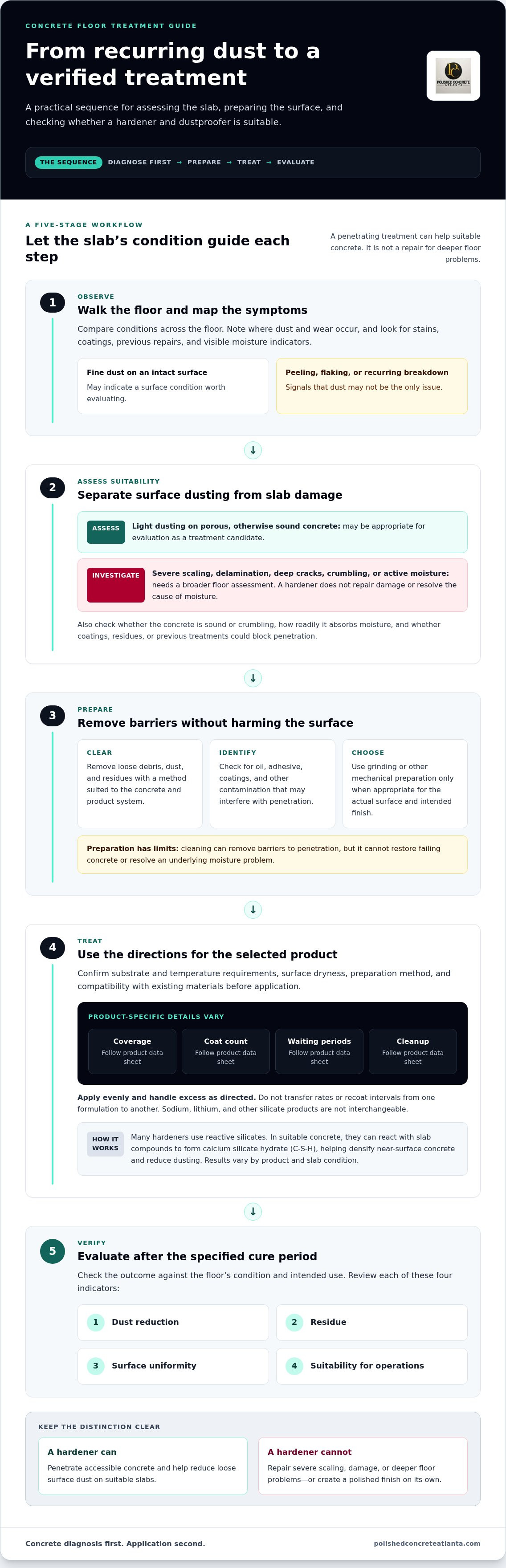
How to apply a concrete hardener and dustproofer step by step
Follow the current technical data sheet for the selected formulation. Coverage, coat count, temperature limits, waiting periods, and cleanup instructions vary. Don’t use a rate or recoat interval from another product as a general standard. The sequence below is a planning framework, not a substitute for product directions.
- Confirm readiness. Verify that the concrete is prepared as specified, compatible with the treatment, and free of conditions that could interfere with penetration. Review the product’s substrate and temperature requirements.
- Organize the work zone. Select the application tools and protective equipment stated by the manufacturer. For a commercial floor, define work zones, barricades, and access routes before opening the product.
- Prepare the product. Mix, stir, dilute, or otherwise prepare it only as directed. Don’t assume every formulation is ready to use or requires the same handling.
- Apply in a controlled manner. Distribute the treatment evenly at the stated application rate. Work systematically, keeping a wet edge if the instructions call for it, and prevent unintended pooling or premature drying.
- Manage coats and residue. Apply another coat only if the product directions require it, and observe the specified interval. Remove excess or residue using the stated method. Leaving it to dry on the floor may affect the finish.
- Protect the treated area. Keep foot traffic, vehicles, and equipment off the surface for the product-specific period. Plan phased access if facility operations must continue nearby.
Preparation is part of the system, not a cosmetic step. The U.S. Bureau of Reclamation discusses the importance of concrete surface preparation for repair materials and coatings. Those methods aren’t a universal hardener specification, but they reinforce why surface condition and product requirements matter.
A penetrating hardener and a film-forming sealed-floor system serve different roles. Review this sealed concrete guide to understand the distinction before selecting a treatment approach. For commercial and industrial floors in Atlanta, Polished Concrete Atlanta provides floor preparation, concrete grinding, and concrete finishing services suited to the slab and facility’s needs.
After application: verify results and plan the right floor-care approach
A treated floor needs time before its performance can be judged. Wait until the curing period specified in the product’s current technical data sheet has passed, then compare the results with the goals set before work began. Immediate impressions can be misleading, especially if the area hasn’t returned to normal traffic and cleaning conditions.
Check outcomes and respond to remaining dust
Inspect the same locations noted during the initial walk-through. Record whether dusting has decreased, and check for uneven appearance, visible residue, or areas that still affect operations. A consistent inspection helps distinguish isolated trouble spots from a floor-wide issue.
Persistent dust doesn’t automatically mean the slab needs another coat. Residue, missed or uneven coverage, contamination, or deeper concrete deterioration may be contributing. Review the treatment directions and establish compatibility before considering any repeat application. Improved surface performance is not a guarantee against all future wear or dust.
Match floor care to the site
Maintenance depends on traffic, cleaning methods, the concrete’s condition, and the treatment system. A warehouse aisle exposed to equipment may need a different inspection and cleaning plan than a lightly used commercial area. Use cleaning practices compatible with the floor, and track recurring dust or wear so changes can be addressed before they disrupt operations. For facility managers coordinating broader property maintenance alongside interior floor care, discover Atlas Exterior Solutions LLC to explore professional exterior and soft washing solutions.
When professional concrete floor treatment makes sense
Professional assessment is valuable when dust persists after treatment, the slab has mixed conditions, or coatings, repairs, moisture concerns, and heavy use complicate the decision. Polished Concrete Atlanta works with commercial and industrial floors, including concrete floor grinding and Ashford Formula installation. An assessment can help determine whether preparation, grinding, treatment, or a different floor system best fits the site. For more on planning durable surfaces for local facilities, explore this industrial flooring guidance for Atlanta facilities.
A measured review completes concrete hardener and dustproofer application: compare results with project goals, then set a care plan suited to actual conditions. Discuss your concrete floor project with Polished Concrete Atlanta.
Make the Next Floor Treatment a Confident One
A durable dust-control plan starts with the slab, not the applicator. Assess concrete condition and compatibility first, prepare the surface for the chosen treatment, then follow its current technical data sheet for application and cure requirements. Judge the result after the specified cure period against practical goals such as reduced dust and suitability for facility operations.
That’s the difference between following generic steps and making a sound concrete hardener and dustproofer application. The right treatment can improve a suitable surface, but it won’t repair deeper deterioration or prevent every instance of future wear and dust.
Polished Concrete Atlanta is privately owned and operated. The company serves commercial and industrial facilities in Atlanta with concrete floor grinding, floor preparation, and Ashford Formula installation.
Ready to plan a treatment around your facility’s needs? Discuss your commercial concrete floor project with Polished Concrete Atlanta. A clear assessment and the right preparation can help you choose the next step with confidence.
Frequently Asked Questions
What does a concrete hardener and dustproofer do?
A concrete hardener and dustproofer is a penetrating treatment that can react with suitable concrete to densify its surface and reduce dusting. The concrete hardener and dustproofer application result depends on the product’s chemistry and the slab’s condition. It won’t repair deep deterioration, resolve moisture problems, or correct structural defects. Review the current product technical data sheet and assess the floor before setting expectations or choosing a treatment.
Can you apply a concrete hardener and dustproofer to old concrete?
Yes, existing concrete may be suitable if its surface is sound, clean, and compatible with the selected treatment. Age alone doesn’t determine whether it’s a candidate. Check for coatings, contamination, moisture concerns, and signs of deterioration, and compare the slab with the product’s substrate requirements. Formulations differ, so don’t apply one product’s minimum-age requirement to every hardener. The slab’s condition and the manufacturer’s directions should guide the decision.
How do you prepare concrete before applying a dustproofer?
Remove loose dust, debris, residues, and incompatible coatings using a method suitable for the concrete and selected product. Inspect for contamination, surface defects, moisture indicators, and deeper deterioration before treatment. The concrete must meet the product’s preparation and substrate requirements. Cleaning alone won’t correct a failing surface. For an Atlanta commercial floor, plan preparation around facility access and operations so the work area can be controlled and kept clear during treatment.
How long does concrete hardener take to dry before traffic?
There’s no universal wait time before foot traffic or equipment can return. The required curing, drying, or recoat period depends on the formulation and application conditions. Check the current technical data sheet for the exact timing, and keep the treated area protected until the instructions allow access. For commercial facilities, include barricades and phased access in the work plan so staff and equipment stay off the floor for the full product-specific period.
Will a concrete hardener stop all concrete dust?
No. A hardener may reduce dusting when it comes from a treatable surface condition and the product is correctly selected and applied. It can’t guarantee a dust-free floor, particularly if the concrete is badly deteriorated or the dust is related to moisture or another underlying issue. Assess the slab first, then inspect results after the specified cure period. Persistent dust may signal residue, uneven treatment, contamination, or a deeper concrete problem.
Can a concrete hardener be applied before polishing or sealing?
Some hardeners are incorporated into particular polishing or floor-treatment systems, while others may not be compatible with later finishes. The sequence matters because an unsuitable treatment can affect subsequent finishing or adhesion. Confirm the intended system, surface preparation, and application order using the product documentation and project requirements. For Atlanta commercial floors, coordinated planning is useful when grinding, polishing, or sealed concrete work is part of the same project.


