
What if the right finish is the last thing you should choose? Can your existing commercial floor be restored, and which approach suits your facility? Commercial concrete floor restoration Atlanta projects should start with the slab, not a product selection. Visible wear, residue, uneven areas, or moisture concerns can point to different preparation needs. Choosing a finish before assessing those conditions can lead to a scope that does not address the floor’s actual requirements.
It’s reasonable to want a clean, professional floor while managing disruption to facility operations. The path forward depends on the concrete’s condition, any old adhesive or moisture issues, and how the space is used. An on-site assessment and a clear preparation plan help define the work before finishing begins.
This guide explains what to look for when evaluating a commercial slab, how polished, stained, sealed, or epoxy flooring may suit different facilities, and what preparation can involve, including grinding, leveling, glue removal, or moisture mitigation. You’ll also learn how to plan around operational requirements and choose an approach based on the floor you have, not assumptions.
Key Takeaways
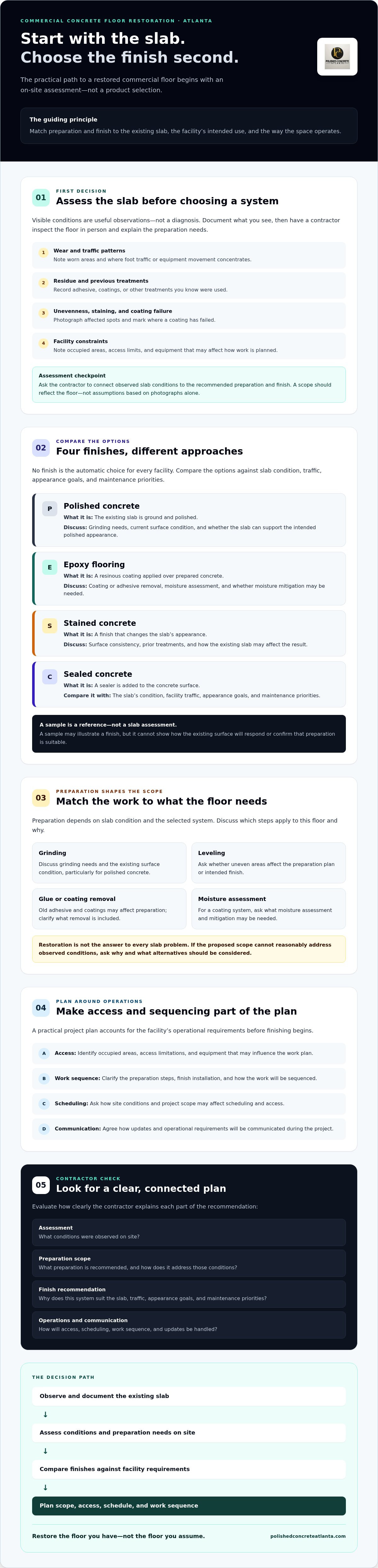
- Start with the slab’s condition. Note wear, residue, unevenness, staining, and coating failure before deciding on a finish.
- Compare polishing, epoxy, stained concrete, and sealed concrete against your facility’s traffic, appearance goals, and maintenance priorities.
- For commercial concrete floor restoration Atlanta, align preparation and finish choices with the existing slab and the way your facility operates.
- Clarify how site conditions, project scope, and the selected system will affect access, scheduling, and the work sequence.
- Evaluate contractors by how clearly they explain their assessment, preparation scope, finish recommendation, and communication plan.
Commercial Concrete Floor Restoration in Atlanta Starts with a Slab Assessment
Commercial concrete floor restoration improves an existing slab through appropriate preparation and finishing. It does not mean installing a new concrete floor. A worn surface may be suitable for restoration, but appearance alone cannot establish the slab’s condition or identify the right finish. Begin with an on-site assessment before selecting a system.
A concrete slab can be ground-bearing or suspended, and understanding its construction provides useful context when evaluating it. Facility managers can document visible conditions, but a contractor should assess the slab and preparation needs in person. Worn areas, adhesive residue, unevenness, staining, and coating failure are useful observations, not a diagnosis on their own.
What should an Atlanta facility manager inspect before restoring a floor?
Make a practical record before discussing finishes. Note where foot traffic and equipment movement concentrate, mark regular equipment routes, and photograph worn areas, stains, unevenness, and spots where a coating has failed. If you know what treatments were previously used, record those too. Old adhesive or coatings may affect preparation.
Also note occupied areas, access limitations, and equipment that could influence how work is planned. Share this information with a contractor, then ask them to inspect the slab on site and explain the preparation they recommend. A useful scope reflects observed conditions rather than assumptions drawn from photographs alone.
When might restoration make sense instead of replacement?
Restoration may be worth considering when the existing slab is suitable for the facility’s intended use and the planned preparation and finish address its condition. That depends on the slab, operational demands, and project requirements. Polished, stained, sealed, and epoxy finishes are not automatically appropriate for every floor.
If the proposed restoration scope cannot reasonably address the observed conditions, ask the contractor to explain why and what alternatives should be considered. Restoration is not the answer to every slab problem. For more context, see Concrete Floor Restoration Atlanta: Reviving Assets. For commercial concrete floor restoration Atlanta, an honest assessment is the first step toward choosing a practical path forward.
Compare Commercial Concrete Restoration Options for Atlanta Facilities
Each finish serves a different purpose. Polished concrete is created by grinding and polishing the existing slab. Epoxy flooring applies a resinous coating over prepared concrete. Stained concrete changes the slab’s appearance, while sealed concrete adds a sealer to the surface. These options are not interchangeable, and no finish is the automatic choice for every facility.
Compare the options against slab condition, traffic, appearance goals, and maintenance priorities. A sample may help illustrate a finish, but it cannot show how the existing surface will respond or whether the preparation is suitable. The U.S. Bureau of Reclamation’s Guide to Concrete Repair offers a reference for understanding damage assessment and repair methods. For a project-specific recommendation, ask a contractor to connect the proposed finish to the slab’s condition and intended use.
When should a facility consider polishing, epoxy, or sealed concrete?
Start with the job the floor needs to do, then consider its appearance. Polishing works with the existing concrete surface. Epoxy is a coating option for facilities considering a resinous system. Staining focuses on appearance, while sealing applies a surface treatment. The right choice depends on the slab and project requirements, not a universal ranking.
| Option | Potential fit | Preparation to discuss | Questions to confirm |
|---|---|---|---|
| Polished concrete | Facilities seeking a finished concrete surface | Grinding needs and existing surface condition | Can the slab support the intended polished appearance? |
| Epoxy flooring | Facilities considering a resinous coating system | Coating or adhesive removal; moisture assessment | What preparation and moisture mitigation may be needed? |
| Stained concrete | Projects where color or visual character matters | Surface consistency and prior treatments | How might the existing slab affect the result? |
| Sealed concrete | Facilities considering a sealed surface | Surface cleaning and preparation requirements | What appearance and care expectations are appropriate? |
How do existing coatings, glue, or moisture affect finish selection?
Old coatings or adhesive can affect preparation and may need to be removed before a new finish is applied. Moisture concerns also need to be assessed before coating installation. That review can help determine whether mitigation is appropriate. Ask the contractor to describe the preparation sequence, what each step addresses, and how it relates to the selected system. For more preparation context, look for The Engineering of Adhesion: A Definitive Guide to Concrete Surface Preparation.
For commercial concrete floor restoration Atlanta, compare the assessment and preparation plan as carefully as the finish itself. You can also review commercial concrete flooring options while defining your project requirements.
Plan Commercial Floor Restoration Around Atlanta Facility Operations
A floor plan must work with the facility’s operating schedule, not just on paper. For commercial concrete floor restoration Atlanta projects, agree on the sequence: site review, defined scope, preparation, finish work, and handover. Timing and access depend on actual site conditions, the selected system, and the project scope. Avoid relying on assumed durations before the site has been reviewed.
What should the restoration scope clarify before work starts?
Put the boundaries in writing. Identify the areas included, the preparation required, the selected finish, and any exclusions. If adhesive removal, floor leveling, or moisture mitigation may be needed, ask how those needs will be assessed and reflected in the scope. Confirm who coordinates site access, communicates with occupants, and handles operational handoffs. The University of Vermont concrete repair guide also outlines practical preparation considerations for concrete repair.
How can businesses reduce disruption during floor restoration?
Discuss phasing early. The facility team may need to coordinate work areas around traffic routes, equipment movement, active zones, or business-hour constraints. Confirm how access to each area will be managed and whether nearby operations need protection. Request a schedule based on the site review and agreed scope, then clarify who is responsible for updates and handoffs.
Before work begins, resolve these questions:
- Which areas are included, and what preparation and finish work is in scope?
- How will the team assess adhesive, leveling, or moisture mitigation needs?
- Can work be phased around active routes and facility zones?
- Who will coordinate access, occupant communication, and operational handoffs?
- What site conditions or scope decisions could affect the schedule?
Clear answers help facility managers plan access, brief occupants, and reduce avoidable coordination gaps. To discuss floor preparation and finishing for your facility, connect with Polished Concrete Atlanta.
Choose a Commercial Concrete Restoration Contractor in Atlanta with Confidence
A reliable contractor should explain the reasoning behind the scope, not just name a finish. For commercial concrete floor restoration Atlanta, compare providers by their relevant commercial and industrial experience, how they assess the slab, what preparation they include, and how they communicate when project conditions need clarification. For projects where floor restoration is part of a broader commercial renovation or facility rollout, partnering with a multi-trade specialist like Synergized Tradesman provides a single accountable relationship to keep operations and scheduling aligned. A useful proposal connects observed floor conditions and facility needs to specific preparation and finishing work.
What questions should you ask a commercial flooring contractor?
Ask how the contractor evaluates the slab and determines preparation needs. Have them explain why the proposed finish suits your facility’s use, appearance goals, and priorities. Before approving the scope, clarify how potential changes will be reviewed, who coordinates site access, and how your team will receive updates. Clear answers make it easier to compare proposals on the work itself.
- What will the on-site assessment cover?
- Which preparation steps are included, and what could change the scope?
- Why is this finish appropriate for the slab and facility?
- How will access, communication, and operational handoffs be coordinated?
How can Polished Concrete Atlanta support a restoration project?
Polished Concrete Atlanta serves commercial and industrial environments with concrete polishing, epoxy flooring, stained concrete, sealed concrete, and floor preparation. Depending on assessment findings, a project may also involve floor glue removal or floor moisture mitigation. The company focuses on preparation and finishing for existing concrete, not new concrete pouring. Ask whether the proposed work fits your specific slab and project requirements.
For added perspective on selecting a contractor for demanding facility surfaces, read Industrial Flooring Contractors in Atlanta: A Strategic Guide to High-Performance Surfaces. Apply the same practical checks here: look for a clear assessment, a defined preparation scope, a reasoned finish recommendation, and a communication plan your operations team can follow.
If you’re planning a commercial floor project in Atlanta, discuss your facility, existing slab, and project requirements with Polished Concrete Atlanta. That conversation can help clarify which restoration-related services may suit the floor.
Move Forward with a Clear Floor Restoration Plan
A sound restoration decision starts with the slab, not a preferred finish. Document visible conditions and discuss preparation needs, then compare polishing, epoxy, staining, or sealed concrete against the facility’s use and priorities. A defined scope and early operations planning also help teams coordinate access, communication, and work areas.
For commercial concrete floor restoration Atlanta, Polished Concrete Atlanta provides commercial and industrial concrete finishing services, including floor preparation, glue removal, and moisture mitigation. The appropriate approach depends on the existing slab and project requirements, so clear assessment and communication matter from the first discussion.
Ready to explore practical next steps for your facility? Discuss your Atlanta commercial concrete floor restoration project. Start with the existing floor and a clear scope so you can evaluate an approach that fits your facility and operations.
Frequently Asked Questions
Can a commercial concrete floor be restored instead of replaced?
Yes, an existing commercial concrete floor may be restorable if the slab’s condition and intended use suit the proposed preparation and finish. Whether a particular slab is suitable cannot be confirmed from an online description. Have a contractor assess it on site, including visible damage and previous treatments. If the slab or project requirements fall outside the restoration scope, discuss alternatives instead of assuming a finish will solve the problem.
What does commercial concrete floor restoration include?
Commercial concrete floor restoration improves an existing slab through assessment, suitable preparation, and a selected finish. Depending on the floor, work may include concrete grinding, polishing, floor leveling, old glue removal, or moisture mitigation, followed by polishing, epoxy flooring, staining, or sealing. The scope should reflect the slab and facility requirements. Restoration focuses on existing concrete, not pouring a new floor.
How do I choose between polished concrete and epoxy for a commercial floor?
Match the system to the slab, facility use, appearance goals, and maintenance priorities. Polished concrete is produced by grinding and polishing the existing surface. Epoxy is a resinous coating system applied over prepared concrete. Ask a contractor to explain how each option fits your facility and what preparation it requires. For an Atlanta project, an on-site assessment can help determine whether the existing slab suits either finish.
Can old floor glue be removed before concrete restoration?
Yes, floor glue can be removed as part of suitable concrete preparation. Its presence and condition should be reviewed on site because they can affect the preparation plan and finish selection. Ask whether removal is included in the proposed scope and how the surface will be prepared afterward. Polished Concrete Atlanta offers floor glue removal, with the appropriate approach depending on the slab and project.
Does moisture affect commercial concrete floor restoration?
Yes, moisture concerns can influence finish selection and preparation, particularly before installing a coating system. Have the contractor assess the slab and explain whether moisture mitigation is appropriate before finishing begins. Do not assume a coating will address an underlying moisture issue by itself. Polished Concrete Atlanta offers floor moisture mitigation for commercial and industrial environments. The contractor should confirm which methods suit the assessed floor and project requirements.
How can a business keep operating during concrete floor restoration?
Coordinate the work plan with facility operations before the project begins. Discuss whether work can be phased around traffic routes, active areas, equipment movement, and access needs. Decide who will communicate restrictions to occupants. The schedule should reflect the site review, selected finish, and agreed scope rather than an assumed duration. For commercial concrete floor restoration Atlanta, early planning can help teams manage access and handoffs, while the work plan still depends on actual site conditions.


