

What if the fastest route to a flatter commercial floor creates problems beneath the finished surface? Self leveling underlayment for commercial floors can help correct an uneven slab, but success depends on more than choosing a product labeled “self-leveling.” Moisture, surface condition, project requirements, and the planned flooring system all matter.
Before choosing a system, confirm that the existing concrete is suitable, preparation is thorough, and the work can be coordinated with facility operations. Start with the slab, not the product. This buyer’s guide explains when self-leveling underlayment may be appropriate, what to check in the substrate and product documentation, and how to plan the transition from leveling to the finished floor. In Atlanta, where commercial facilities may need to coordinate floor work with ongoing operations, clear decisions up front help avoid preventable surprises.
Key Takeaways
- Self-leveling underlayment prepares a surface for a planned finish, but it won’t correct every slab issue without proper assessment and preparation.
- Before choosing self leveling underlayment for commercial floors, evaluate the concrete’s soundness, cleanliness, surface profile, and moisture conditions.
- Compare systems by substrate requirements, compatible finishes, installation conditions, and manufacturer guidance, not by product label alone.
- Align leveling decisions with the intended floor, including whether polished concrete or a coating is part of the project.
- Plan the sequence from finish selection and slab inspection through system confirmation and installation, including how work will affect facility access and operations.
Self-Leveling Underlayment for Commercial Floors: What It Does and What It Does Not
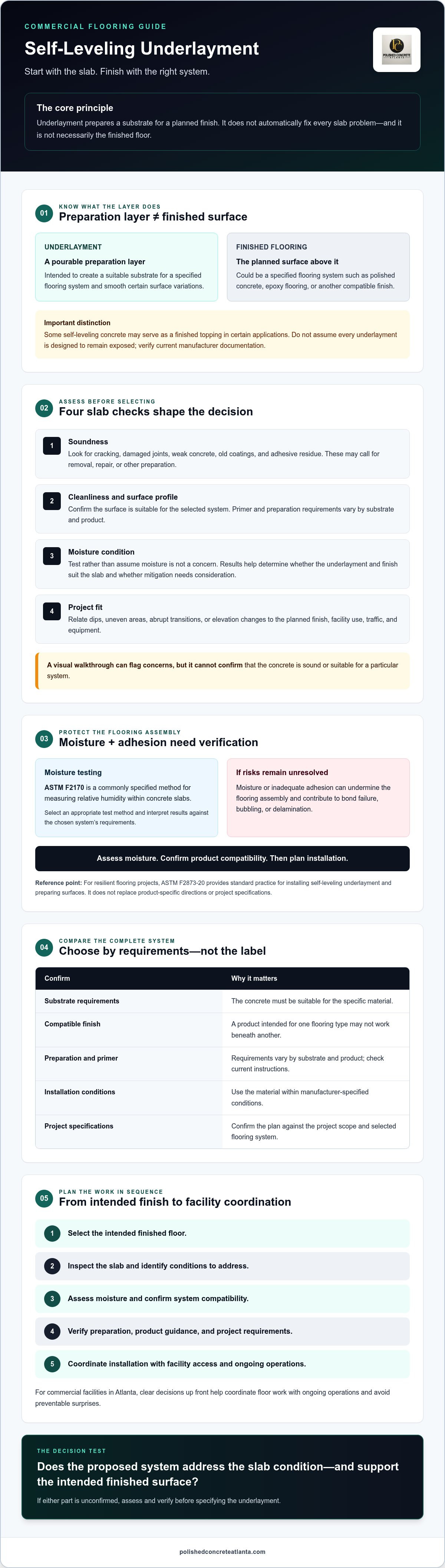
Self-leveling underlayment is a pourable preparation layer intended to create a suitable substrate for a specified flooring system. It can smooth certain surface variations, but “self-leveling” doesn’t mean it will correct every slab automatically. The concrete still needs assessment and appropriate preparation, and the product must be used within the conditions its manufacturer specifies. Self-leveling concrete can also serve as a finished topping in some applications, but that doesn’t make every underlayment suitable as an exposed wear surface.
In brief: leveling underlayment prepares the substrate; the compatible finish above it is the floor people use. Treat that distinction as a starting point, not a product guarantee. Confirm in current manufacturer documentation whether a specific material is designed to remain exposed.
When a commercial concrete slab may need leveling
Dips, uneven areas, abrupt transitions, or noticeable elevation changes may affect how the planned flooring fits and performs. The importance of each condition depends on the finish and facility use. A surface requirement for one system may not suit another, and traffic or equipment can affect project priorities. Appearance alone can’t establish whether underlayment is appropriate. A professional slab assessment can help identify what needs correction and whether leveling is the right preparation approach.
Underlayment versus finished flooring
Underlayment is generally a layer beneath a finished flooring system, not a substitute for polished concrete, epoxy flooring, or another specified finish. Confirm that the underlayment and finish are compatible. Don’t assume a product intended for one flooring type will work beneath another. For a project aiming for polished concrete or a coating, base the plan on the existing slab and selected finish rather than assuming a poured leveling layer belongs in the assembly.
That’s the practical test for self leveling underlayment for commercial floors: does the proposed system address the slab condition and support the intended finished surface? Commercial concrete floor leveling and preparation can help clarify the approach, but verify the product’s suitability and the specific project scope before work is specified.
How Slab Condition, Moisture, and Adhesion Affect Underlayment Performance
A suitable product can still fail to perform if the concrete beneath it isn’t ready. Before selecting self leveling underlayment for commercial floors, assess the slab as a system: its soundness, cleanliness, surface profile, moisture condition, and any materials left by previous flooring. Product choice should follow that assessment, not the other way around.
What to inspect before choosing a system
Review the slab’s visible condition and look for cracking, damaged joints, weak concrete, old coatings, or adhesive residue. These conditions can affect whether the surface needs removal, repair, or another preparation step before underlayment is considered. A visual walkthrough can flag concerns, but it can’t confirm that the surface is sound or suitable for a particular system.
Primer and preparation requirements vary by substrate and product. Confirm both against current manufacturer instructions and project specifications. For a closer look at the preparation principles behind a reliable bond, see this guide to concrete surface preparation.
Moisture and bond: the risks a product label cannot resolve alone
Assess moisture rather than assuming it is not a concern. Testing helps determine whether the proposed underlayment and finished floor suit the slab and whether moisture mitigation needs consideration before installation. ASTM F2170 is a commonly specified method for measuring relative humidity within concrete slabs. The project team should select an appropriate test method and interpret results against the requirements of the chosen system.
Unresolved moisture or inadequate adhesion can undermine the flooring assembly and contribute to bond failure, bubbling, or delamination. A product label alone can’t establish that the slab meets the system’s requirements. Assess moisture and confirm product compatibility before installation.
For resilient flooring projects, ASTM F2873-20 provides standard practice for installing self-leveling underlayment and preparing surfaces. It’s a reference point, not a replacement for product-specific directions or project specifications. For Atlanta facilities, a professional review of concrete preparation and moisture concerns can help clarify next steps. Commercial floor preparation and moisture mitigation are relevant services to discuss with Polished Concrete Atlanta.
How to Compare Self-Leveling Underlayments for a Commercial Floor Project
Compare systems against the slab, planned finish, and facility’s operating needs. A product that looks suitable in a catalog may not meet the project’s substrate requirements or installation constraints. For self leveling underlayment for commercial floors, use current manufacturer technical data sheets and project specifications, not broad marketing claims.
| Comparison factor | What to verify |
|---|---|
| Substrate requirements | Approved concrete conditions, surface preparation, and any required primer. |
| Compatible finishes | Whether the underlayment is approved beneath the specified coating, resilient finish, or other flooring system. |
| Installation conditions | Manufacturer guidance for application conditions, curing, and readiness for the next layer. |
| Facility coordination | Traffic exposure, operating schedule, access restrictions, work sequence, and plans for reopening the area. |
Questions to ask when reviewing product documentation
Confirm which substrates are approved, which primer and preparation steps are required, and which flooring systems are compatible. Check instructions for curing, traffic exposure, and when the next layer or facility use can proceed. Don’t assume one system’s directions apply to another. If instructions are unclear or conflict with project documents, ask the manufacturer and a qualified flooring professional for clarification before selecting a system.
Search listings can help locate information, but they aren’t a substitute for original technical documentation. Treat online directories and industry databases as starting leads, then verify all claims directly in manufacturer technical data sheets and the project specification.
Match the leveling approach to the planned commercial finish
The next layer matters. A coating or resilient finish may have distinct substrate and compatibility requirements, so confirm the complete assembly rather than evaluating underlayment in isolation. For coating-related considerations, review this guidance on industrial floor coatings. Polished concrete is a different finish path, not an underlayment product; assess the existing concrete and intended finish accordingly.
For a project-specific discussion of slab assessment and preparation, discuss commercial floor preparation with Polished Concrete Atlanta.
Planning Commercial Floor Leveling in Atlanta: From Assessment to Finished Surface
A dependable commercial floor project follows a defined sequence. Start with the finish, then evaluate the slab and facility requirements before selecting a leveling system. For Atlanta facilities, this helps align product decisions with actual building conditions and keeps project coordination on the agenda from the outset.
A practical project sequence for facility decision-makers
Before requesting proposals, document the intended finish, visible problem areas, operating needs, and constraints such as restricted access or occupied spaces. Then arrange an assessment of the concrete, preparation needs, and moisture concerns. These findings can help determine whether self leveling underlayment for commercial floors is appropriate and which system requirements need confirmation.
Before scheduling work, agree on the scope, relevant product documentation, work sequence, and responsibility for each stage. Clarify how areas will be accessed, which operations may need to pause or move, and what conditions must be met before the next flooring layer is installed or the space reopens. Check all product-specific timing and requirements against current manufacturer guidance.
When to involve an Atlanta concrete flooring contractor
Involve a qualified flooring professional if the slab’s condition, moisture, previous adhesive, or compatibility with the intended finish is uncertain. An assessment can connect preparation and leveling decisions to the final surface rather than treating each step in isolation. Polished Concrete Atlanta provides concrete floor leveling, floor preparation, and moisture mitigation for commercial and industrial environments. Confirm the company’s specific scope before treating underlayment installation as part of the work.
For broader project considerations, consult this industrial flooring contractor guide. A sound plan accounts for both floor conditions and facility operations, including work sequencing around access needs and active areas.
Discuss your commercial floor conditions with Polished Concrete Atlanta to explore assessment, leveling, preparation, or moisture-mitigation needs.
Set Your Commercial Floor Project Up for Success
A reliable leveling decision starts with the finished floor in mind. Assess the slab’s condition and moisture, then confirm that the proposed system suits both the substrate and the selected finish. Self leveling underlayment for commercial floors is a preparation choice, not a substitute for sound surface preparation or project coordination.
Check manufacturer guidance and align work stages with facility access and operations. Evaluating the slab, product, and finish together helps your team make informed decisions before installation begins.
Polished Concrete Atlanta provides concrete floor leveling, floor preparation, and moisture mitigation for commercial and industrial environments. The team can help assess commercial floor conditions and preparation needs. Discuss your commercial floor leveling project to plan the next steps.
Frequently Asked Questions
Is self-leveling underlayment suitable for every commercial concrete floor?
No. Self-leveling underlayment is suitable only when the existing slab and planned finish meet the selected system’s requirements. Concrete soundness, cleanliness, surface profile, moisture, cracks, joints, and previous coatings or adhesive can all affect suitability. A floor that looks uneven may need a different preparation approach. Have the slab assessed and check current manufacturer instructions before specifying self leveling underlayment for commercial floors.
Can self-leveling underlayment be used as the finished commercial floor?
Usually, underlayment is a preparation layer beneath a separate finished flooring system, not the wear surface itself. Some products may be designed for exposed use, but confirm that product-specific exception in current manufacturer documentation. Don’t assume underlayment can handle facility traffic as a finished floor. Confirm the complete assembly, including the intended finish and its compatibility with the leveling material.
How do you prepare a concrete floor before applying self-leveling underlayment?
Start by assessing the slab, then follow the selected manufacturer’s preparation instructions. The surface may need cleaning and removal of contaminants, old coatings, or adhesive that could interfere with bonding. Review cracks, joints, weak concrete, and the required surface profile as well. Primer requirements depend on both the substrate and system. Confirm preparation steps against product documentation and project specifications instead of relying on habit.
What happens if a concrete slab has moisture before underlayment is installed?
Moisture doesn’t automatically rule out underlayment, but assess and manage it before selecting the system. Excess or unresolved moisture can compromise adhesion and contribute to problems such as bubbling or delamination in the flooring assembly. Use an appropriate test method and compare the results with the requirements of the proposed underlayment and finish. If mitigation may be needed, resolve that question before installation rather than relying on underlayment alone.
Does self-leveling underlayment make an uneven floor perfectly level?
No. “Self-leveling” describes how a material flows; it doesn’t guarantee a perfectly level surface or correct every elevation problem. The slab still needs suitable preparation, and the product must suit the condition and intended use. Underlayment may smooth certain irregularities, while substantial elevation differences may require another approach. A professional assessment can help distinguish surface-smoothing needs from more significant floor-level concerns.
How do I choose a self-leveling underlayment for a commercial floor?
Choose based on the existing slab and planned finish, not the product label alone. Verify approved substrates, required primers, preparation steps, compatible flooring systems, installation conditions, and manufacturer guidance for curing and traffic. Also consider facility access, operating schedules, and work sequencing. For Atlanta projects, Polished Concrete Atlanta provides concrete floor leveling, floor preparation, and moisture mitigation to help assess existing floor conditions and preparation needs.


