

What if the slab, not the densifier product, determines whether your floor project succeeds? For facility teams researching “commercial concrete densifier application Atlanta,” the first question is whether the existing concrete is suited to the treatment and the finish you need.
Concrete dusting and a worn appearance can undermine facility standards, but densifier application isn’t a fix for every slab problem. It can harden the concrete surface and help reduce dusting; it won’t fill cracks or replace the preparation required for a different flooring system. If your project includes a full epoxy coating, densifier may not be the right treatment for that slab.
This guide explains what densification does, what it doesn’t, and how slab condition shapes the work. You’ll learn how grinding and surface preparation fit into the application, what to consider when coordinating work with facility operations, and how Ashford Formula installation can be scoped for a commercial concrete floor. The goal is a clear plan based on your floor’s needs and your facility’s demands.
Key Takeaways
- See how inspection, preparation, treatment, reaction management, and cleanup fit into a controlled application process.
- Learn why product instructions govern application rates, dwell times, and finishing steps.
- Use a practical planning checklist to coordinate work zones, equipment movement, access, and reopening.
- Compare densifier, sealer, and coating by their purpose and surface behavior before defining your project scope.
- Plan commercial concrete densifier application Atlanta around the slab’s condition and your facility’s operating needs.
What Commercial Concrete Densifier Application Can, and Cannot, Do for Atlanta Facilities
A densifier is a treatment designed to penetrate suitable concrete and react within its surface, rather than dry as a separate film on top. The reaction can make the surface denser and help reduce dusting, but results depend on the slab and the application. This Concrete densifier overview explains the general treatment. For facility managers, the practical question is whether the existing floor and its intended use suit densification.
How densification differs from a sealer or coating
Densification changes the concrete near its surface. A sealer or coating leaves a topical layer and can create different surface behavior. These systems aren’t interchangeable. The desired appearance, traffic, and operating demands help determine the right approach. For example, a facility seeking a polished concrete finish needs a broader grinding and finishing plan, not just densifier. A floor project focused on protection may call for another system. Explore how sealed concrete performance relates to industrial use.
Densifier won’t repair structural damage, correct an uneven slab, or conceal deep contamination. Treatment alone also won’t create a decorative polished finish. Those outcomes require separate assessment and, where appropriate, additional floor preparation or a different flooring system.
Which commercial slab conditions deserve assessment first?
Before commercial concrete densifier application Atlanta, assess the specific slab instead of assuming conditions are uniform across warehouses or commercial buildings. Dusting and visible wear are surface symptoms. Contamination, old sealer, coatings, or previous treatments may affect preparation and compatibility. Cracks, movement, or recurring moisture concerns may point to underlying issues that surface treatment alone won’t resolve.
A sound project scope distinguishes what the surface shows from what may be happening below it. Inspection and concrete grinding help establish the slab’s condition and preparation needs before treatment is selected. If a full epoxy flooring system is planned, its bonding requirements must also shape the sequence. Densifier isn’t automatically right for every coating project.
- Potential fit: A suitable existing slab needs dust reduction or is part of a planned polished concrete floor.
- Needs closer assessment: The surface is worn, contaminated, previously treated, or showing signs of deeper slab concerns.
- Not a standalone fix: Structural damage, unevenness, and the need for a decorative finish require separate solutions in the project scope.
That fit assessment sets the direction. Next, define the application sequence.
How Commercial Concrete Densifier Application Works on an Existing Slab
Commercial concrete densifier application Atlanta is a managed sequence, not a single pass across the floor. The slab’s condition shapes preparation, while the treatment manufacturer’s current instructions govern product-specific steps. In a working facility, a clear scope coordinates floor work with access needs and avoids treating application details as universal.
Why surface preparation comes before densifier
Residue, existing coatings, sealers, or contaminants can block or interfere with access to the concrete surface. Preparation may include concrete grinding or other work, depending on the slab and project scope. The right method follows the floor’s actual condition, not a fixed recipe. Begin with an inspection and identify preparation needs before treatment starts. The guide to concrete surface preparation explains why the substrate matters.
Application, reaction, and finish: follow the specification
Once the surface is ready, apply the treatment with attention to consistent coverage across the work area. The specified reaction period, handling of excess material, and cleanup depend on current manufacturer instructions. Application rates, dwell times, and finishing steps vary by product, so follow its current technical documentation. Even application supports a controlled process, but the slab itself influences the final result.
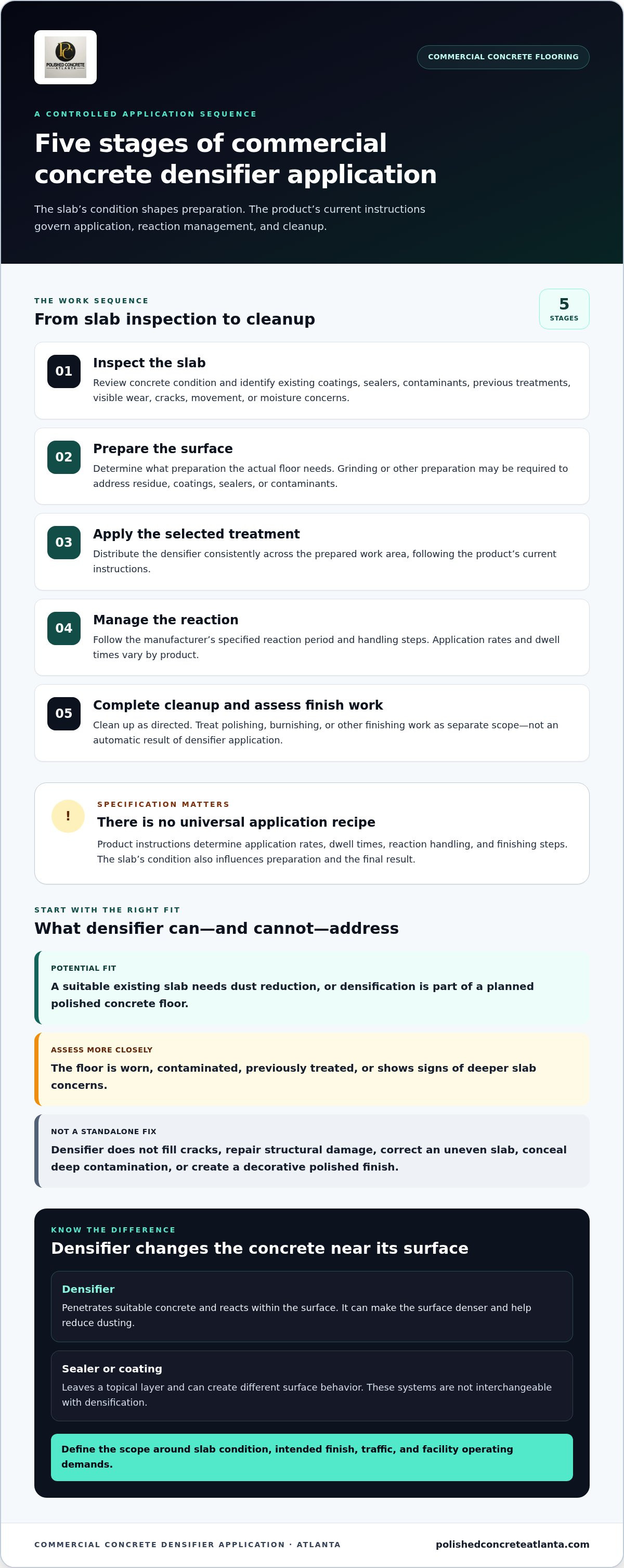
- Inspect: Review the slab, its condition, and any existing surface treatments.
- Prepare: Determine whether grinding or other surface preparation is needed for the project.
- Apply: Distribute the selected treatment according to its current instructions.
- Manage the reaction: Follow the product’s specified reaction and handling steps.
- Clean up: Complete cleanup as directed, then assess any separate finishing work in the scope.
In brief: inspect the slab, prepare the surface, apply the treatment, manage its specified reaction, and complete cleanup according to the manufacturer’s instructions.
Polishing or burnishing may be included as separate finishing work. Densifier application alone doesn’t define a decorative finish. A clearly scoped project connects preparation, treatment, finishing, and facility coordination without assuming every floor will respond identically. For a commercial floor plan that includes concrete preparation and densifier application, those details belong in the project scope.
Planning Atlanta Commercial Densifier Work Around Slab Readiness and Operations
A well-planned commercial concrete densifier application Atlanta project starts with two realities: the slab’s condition and the way the facility runs. A warehouse with active forklift routes has different access needs from a commercial space with steady pedestrian traffic. Define the intended floor outcome and operational limits before setting work zones or sequencing preparation and treatment.
What to assess before setting the work sequence
Review existing coatings, adhesives, contamination, and visible wear, then consider how the floor is used. These conditions can affect preparation and the treatment sequence. Clarify whether the priority is dust control, a refined appearance, or compatibility with another finish. That decision helps determine whether the project scope should include concrete grinding, other floor preparation, or additional flooring work.
Operations matter just as much. Identify pedestrian routes, equipment access points, loading activity, and areas that can be separated from daily traffic. If the slab varies across the facility, plan by zone rather than assuming one sequence will suit every area. Local environmental conditions, including humidity, are site variables to assess for the specific project, not factors to assume affect every Atlanta slab in the same way.
How to reduce avoidable disruption at an Atlanta facility
Coordinate access restrictions with facility operations before scheduling work. Use this checklist to surface conflicts early:
- Access: Identify entrances, pedestrian detours, and areas that must remain available.
- Equipment: Map routes for forklifts and other vehicles, including where movement must pause or change.
- Work zones: Decide whether the scope can be divided into phases and how each area will be separated from active operations.
- Reopening: Coordinate reopening expectations with the project sequence and applicable treatment instructions.
- Facility communication: Share planned boundaries and access changes with staff who manage deliveries, traffic, and daily work.
Reopening should follow the project scope and product instructions, not a generic schedule. Preparation, treatment, and additional finishing work can all affect when each area is ready for its intended use. Clear coordination gives operations teams a practical basis for adjusting traffic and equipment movement.
For a project plan that accounts for slab readiness and active operations, discuss commercial floor preparation with Polished Concrete Atlanta.
Choosing Commercial Concrete Densifier Application in Atlanta
The right floor treatment depends on what the facility needs the slab to do. Is the priority reducing dust from suitable concrete, adding a surface treatment, or creating a distinct finished layer? For commercial concrete densifier application Atlanta, start with the floor objective, then match it to the existing slab and the demands of daily operations.
Match the treatment to the facility’s floor objective
This comparison is a discussion framework, not a substitute for assessing the concrete. Product systems vary, and the slab’s condition, prior treatments, and planned use affect what fits.
| Option | Primary purpose | Surface behavior | Project considerations |
|---|---|---|---|
| Densifier | Increase surface density and help reduce dusting on suitable concrete. | Reacts within the concrete rather than forming a separate film. | Assess slab condition and existing treatments. It won’t independently resolve structural, moisture, or substrate problems. |
| Sealer | Provide a specified treatment for the concrete surface. | Behavior depends on the sealer system. Some penetrate, while others leave a surface layer. | Define the desired appearance and operating needs, then select a system suited to the floor. |
| Coating | Create a distinct finished surface layer. | Forms a layer over the prepared concrete. | Preparation and compatibility with the existing slab are central to planning. |
A densifier can support dust control, but a goal that requires a topical layer or a particular decorative finish calls for a different or additional system. Treatment alone doesn’t solve moisture concerns or structural damage. The project scope should distinguish those needs rather than assign every floor problem to one product.
What a professional application scope should make clear
A clear scope connects the slab assessment to the preparation approach, selected treatment, and facility coordination. It should explain how concrete grinding or other floor preparation fits the work and account for access and operational needs. Polished Concrete Atlanta provides concrete grinding, floor preparation, and Ashford Formula installation for commercial floors. The company also offers polished concrete, epoxy flooring, stained concrete, and moisture mitigation for commercial and industrial environments.
For a commercial densifier project in Atlanta, discuss your slab and floor preparation needs with Polished Concrete Atlanta to establish a scope built around your facility’s requirements.
Set Your Facility Up for the Right Floor Plan
A floor project is an opportunity to make daily operations more predictable, not simply to change how concrete looks. Before moving ahead, identify the practical result your team needs: less visible dust, a more refined surface, or a floor system designed around another operating priority. Then align that goal with a clear scope, decision-makers, and access plan.
For commercial concrete densifier application Atlanta, the next step is a project discussion grounded in the facility’s actual conditions. Bring details about known slab concerns, current floor treatments, traffic patterns, and areas that must remain accessible. Those details help shape a practical path from assessment to a treatment plan that fits your site, rather than relying on assumptions.
Polished Concrete Atlanta can help define a scope around your commercial floor needs. Discuss your commercial concrete densifier project in Atlanta and take the next step with a clear plan for your facility.
Frequently Asked Questions
What does a concrete densifier do to a commercial floor?
A concrete densifier reacts within suitable concrete to increase surface density and may help reduce dusting. Unlike a coating, it isn’t intended to create a separate film over the slab. For a busy Atlanta warehouse, that distinction matters: densification addresses the concrete surface, while a coating creates a different floor layer. The result depends on the slab, preparation, and application, so densifier shouldn’t be treated as a guaranteed fix for every floor issue.
Can concrete densifier be applied to an old commercial slab?
Yes, an old slab may be a candidate, but age alone doesn’t determine suitability. Its condition does. For example, a floor with years of forklift traffic may have worn areas, embedded residue, or previous treatments that change the preparation required. Cracks, moisture concerns, and other underlying issues also need separate assessment. A site review helps determine whether densification fits the floor’s condition and the facility’s intended use.
Does concrete densifier replace a concrete sealer?
No. A densifier and a sealer have different purposes, so one shouldn’t automatically be treated as a replacement for the other. Densifier reacts within suitable concrete; a sealer provides a specified surface treatment, with behavior depending on the system selected. Whether either option suits a commercial floor depends on its intended use, current condition, and desired finish. For commercial concrete densifier application Atlanta, evaluate the complete floor system rather than choosing by product category alone.
How long does a commercial concrete densifier application take?
There’s no single duration that applies to every commercial floor. The work plan depends on the area involved, preparation needs, slab conditions, facility access, and the selected product’s instructions. Separate the application work from the time an area must remain restricted: reaction, cleanup, finishing, and reopening requirements can affect operations differently. A warehouse with multiple work zones, for instance, may need a phased coordination plan rather than one facility-wide schedule.
Can a densifier be applied over an existing floor coating?
The key question is whether the treatment can reach the concrete. An intact coating sits between the densifier and the slab, so assess the coating type and condition before deciding on preparation. The project may require removing or mechanically preparing the existing layer, depending on the floor and treatment instructions. If the coating is meant to remain, don’t assume the densifier can be applied over it. Compatibility and access to the concrete should guide the plan.


