
What if the right finish depends less on appearance than on the condition of the slab beneath it? Atlanta GA commercial floor resurfacing starts with that question. Cracks, uneven areas, old adhesive, and moisture can all affect which options make sense. Your facility’s traffic, cleaning routines, and operating constraints also shape how the work should be planned.
A durable floor starts with understanding whether the existing concrete can support the finish you want and what preparation it needs. Polishing, staining, sealing, and epoxy coatings serve different purposes, so choosing by appearance alone can overlook practical needs such as routine cleaning and access during the project.
This guide explains how to assess an existing commercial floor, compare resurfacing finishes, and plan around your facility’s requirements. You’ll learn when grinding, leveling, glue removal, or moisture mitigation may belong in the project scope, and how a preparation-first approach can reduce avoidable surprises. The goal is a practical path from worn concrete to a finish suited to your facility.
Key Takeaways
- Use the slab’s condition and facility demands to guide Atlanta GA commercial floor resurfacing decisions, not appearance alone.
- Compare polished, stained, sealed, and epoxy finishes by the look you want and the maintenance your facility can support.
- Document existing finishes and residue, then identify where grinding, leveling, or glue removal may be needed.
- Set project priorities around work areas, access constraints, and operating needs before planning the sequence.
- Resurfacing renews an existing floor, but it does not replace addressing structural slab problems.
Atlanta GA Commercial Floor Resurfacing: What It Can, and Cannot, Solve
Commercial floor resurfacing renews an existing floor by preparing its surface and applying a finish suited to the slab and facility. It can change the floor’s appearance and surface characteristics. It is not new concrete pouring, and it cannot resolve every structural problem in a slab.
Resurfacing renews the surface of an existing floor; substrate repair addresses problems within or beneath the concrete itself. That distinction matters. Worn finishes, adhesive residue, and uneven areas are reasons to investigate, but they do not show by themselves whether the slab is ready for a particular finish or whether a deeper issue exists.
Which existing commercial floors may be candidates for resurfacing?
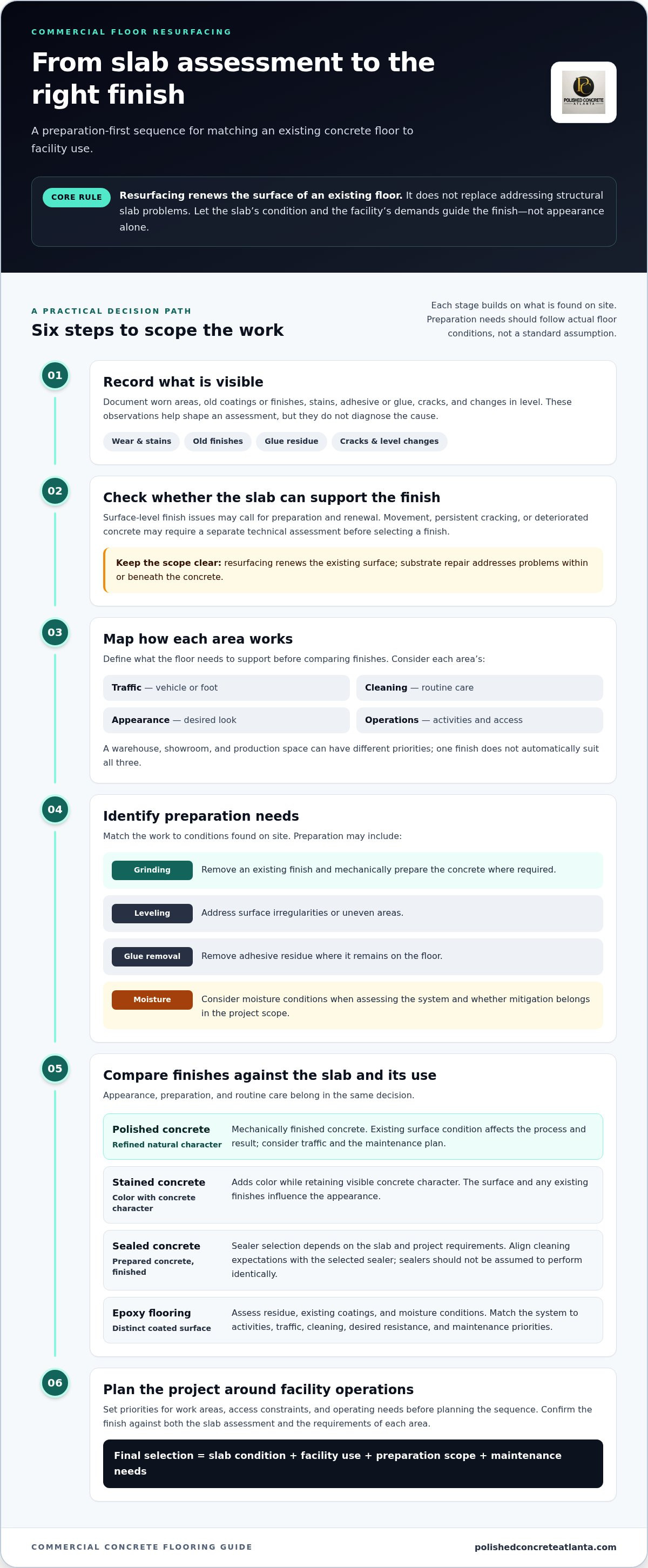
Start by recording visible wear, old coatings, stains, glue, cracks, and changes in level. These observations help shape an assessment, but they do not diagnose the cause. A surface-level finish problem may call for preparation and renewal. Movement, persistent cracking, or deteriorated concrete may need a separate technical assessment before you select a finish. Suitability depends on the slab’s actual condition and the requirements of the planned system.
Preparation may include concrete grinding to remove an existing finish, leveling to address surface irregularities, or floor glue removal where adhesive remains. The right scope follows the conditions found on site rather than a standard assumption.
What should resurfacing accomplish for an Atlanta facility?
Define success by what the floor needs to support: vehicle or foot traffic, routine cleaning, appearance, and the activities in each area. A warehouse may prioritize practical upkeep under equipment traffic. A showroom may place more emphasis on a consistent visual finish, while a production space may have different operational demands. One finish does not automatically suit all three.
Polished concrete, stained concrete, sealed concrete, and epoxy flooring offer different approaches. For a general overview of the process and materials involved, see Polished concrete. The decision should still account for the specific slab and facility. For more on comparing floor demands across industrial spaces, see this industrial flooring contractors guide.
Before choosing a finish, map how each area is used, how it is cleaned, and what appearance it needs. This gives the decision a clear basis and helps identify where preparation or further assessment belongs in the project scope.
Compare Commercial Resurfacing Finishes by Floor Condition and Facility Use
The right finish depends on the concrete you have and the work the floor must support. For Atlanta GA commercial floor resurfacing, compare appearance, preparation, and routine care together rather than choosing by finish name alone.
| Finish | Appearance | Preparation considerations | Maintenance priorities and potential fit |
|---|---|---|---|
| Polished concrete | Exposes and refines the concrete’s natural character. | Requires mechanical preparation; existing surface condition affects the process and result. | Consider it for facilities seeking a refined concrete look and a maintenance plan suited to their traffic. |
| Stained concrete | Adds color while retaining visible concrete character. | The concrete surface influences how the stain appears; assess existing finishes and surface condition. | May suit areas where appearance is a priority and the slab can support the desired finish. |
| Sealed concrete | Finishes prepared concrete while preserving its underlying look. | Preparation and sealer selection depend on the slab and project requirements. | Align cleaning expectations with the selected sealer. Different sealers should not be assumed to perform identically. |
| Epoxy flooring | Creates a coated surface with a distinct finished appearance. | Surface preparation is central; consider residue, existing coatings, and moisture conditions. | Evaluate it for commercial or industrial spaces based on use, desired resistance, and maintenance priorities. |
When polished, stained, or sealed concrete may fit
Polished concrete is mechanically finished existing concrete, so the slab’s condition helps determine its suitability. Stained concrete adds color while retaining visible concrete character, so the surface affects the final appearance. Sealed concrete uses a selected sealer to finish prepared concrete. Each option calls for an assessment rather than assumptions. For more information about polished concrete in Atlanta facilities, explore commercial polished concrete flooring.
When an epoxy or industrial coating may fit
Epoxy and other resinous systems are coating options for commercial and industrial concrete. Match the system to the facility’s activities, traffic, cleaning routine, and desired resistance characteristics. Do not assume every coating has the same specifications or upkeep needs. For work areas with different floor demands, compare those priorities against the industrial floor coatings guide. Facility managers can also consult OSHA standards for walking-working surfaces when considering floor safety and upkeep.
Use the comparison to narrow the options, then base the final choice on the slab assessment and intended use. The condition of the concrete and the needs of the facility should guide the finish selection.
Assess the Slab and Preparation Needs Before Resurfacing
A finish is only as dependable as the surface beneath it. Before selecting a system, build a clear picture of the existing floor and the conditions it must handle. This gives the preparation plan a practical basis and helps identify whether grinding, leveling, glue removal, or moisture mitigation belongs in the project scope.
Use this sequence to organize the assessment:
- Document the current finish. Note whether the concrete is bare, coated, stained, sealed, or covered by another material. Record areas where the finish is worn or damaged.
- Identify residue. Mark adhesive, glue, paint, or remnants of previous flooring that may affect preparation.
- Inspect the surface. Record visible cracks, uneven areas, deterioration, and signs that may call for further assessment.
- Clarify facility demands. Document traffic, cleaning routines, work activities, and operating constraints relevant to the selected finish.
Preparation creates the surface conditions a finish needs for adhesion. Skipping or misjudging it can undermine the resurfacing plan. The scope should respond to what the assessment reveals, not follow a one-size-fits-all checklist.
Identify surface, adhesive, and level concerns
Existing coatings and floor glue can affect how the concrete must be prepared before a new finish is applied. Concrete grinding removes or abrades surface materials, while leveling addresses uneven areas. They solve different preparation needs, and a floor may require one, both, or neither. Review this concrete surface preparation guide for a closer explanation of how preparation supports adhesion.
Account for moisture and adhesion risks
Moisture conditions matter because they can affect the suitability of a coating plan and its bond to the concrete. The assessment should consider the slab, intended finish, and project conditions rather than assume one test or mitigation approach applies everywhere. Where conditions call for it, floor moisture mitigation can be included as a specialized preparation measure. It is a project-specific step, not a universal fix.
For Atlanta GA commercial floor resurfacing, matching the preparation plan to both the slab and facility use helps reduce avoidable uncertainty. Plan your floor preparation and resurfacing around the conditions identified in the assessment.
Plan Commercial Floor Resurfacing in Atlanta Around Operations
A clear project plan starts with how the facility works, not just the square footage. Identify the areas involved, who needs access, what activities must continue, and what the finished floor needs to look like. These details connect the slab’s condition to a practical scope and sequence.
Build a practical project brief
Capture the essentials before planning the work. A useful brief gives the project team a shared picture of the facility and its priorities:
- Facility type and floor area, broken down by distinct use areas where relevant.
- Current surface, including existing finishes, visible wear, residue, or uneven areas.
- Traffic patterns, cleaning routines, and operational priorities for each area.
- Access constraints, restricted zones, and operating windows that may affect sequencing.
- Desired appearance and whether polished, stained, sealed, or coated concrete is being considered.
Separate must-haves from preferences. For example, a work zone that needs to remain accessible may shape how areas are sequenced, while a customer-facing space may place greater weight on appearance. These priorities inform planning, but they do not establish a fixed project duration.
Move from assessment to a defined scope
Develop the preparation plan and finish selection together. The scope may include grinding, leveling, glue removal, or moisture mitigation where floor conditions call for those steps, followed by a finish suited to the facility’s use. Polished Concrete Atlanta provides existing-floor preparation and polished, stained, sealed, and epoxy finishes for commercial and industrial spaces.
Schedule and sequencing depend on the floor condition, preparation required, selected system, and overall project scope. A well-defined brief brings access needs and operating constraints into the planning process early. For Atlanta GA commercial floor resurfacing, outline the facility’s use areas, access requirements, finish expectations, and concerns about the existing floor.
A project-specific scope connects preparation to the chosen finish. Discuss your commercial floor resurfacing project.
Set Your Resurfacing Project in Motion
A well-planned floor project gives your team a chance to align facility priorities before work begins. Use those priorities to shape a clear scope, with the finish and preparation plan grounded in your building’s needs. That is the foundation for treating Atlanta GA commercial floor resurfacing as a deliberate facility investment rather than a rushed reaction to wear.
Polished Concrete Atlanta is privately owned and operated and has served commercial and industrial environments since 2004, with services spanning concrete polishing, coatings, staining, and preparation. Bring your facility requirements and concerns about the existing floor into the project conversation. Discuss your Atlanta commercial floor resurfacing project to take the next step with a clearer plan.
Your facility can move forward with confidence, one well-defined decision at a time.
Frequently Asked Questions
How long does commercial floor resurfacing take?
Commercial floor resurfacing timing depends on floor area, condition, preparation needs, the selected finish, and site access. Removing adhesive or addressing moisture can add work compared with a simpler renewal. The plan also needs to account for the selected system’s application and return-to-use requirements. In Atlanta, share operating windows and access constraints early so the sequence can reflect how your facility functions.
Can commercial concrete be resurfaced without closing the entire facility?
Sometimes, if work areas can be separated and access managed safely, parts of a facility may remain operational. A facility with distinct bays, for example, may be able to plan work around separate zones, while a shared corridor can create different access challenges. The project plan should identify routes, restricted areas, and operational priorities. Whether phased work is practical depends on the site layout, selected system, and scope.
What affects the cost of commercial floor resurfacing in Atlanta?
The cost of Atlanta GA commercial floor resurfacing depends on the floor area and the work required to prepare it. Existing coatings or adhesive may need removal, and uneven areas may call for leveling. Moisture mitigation, finish selection, transitions between areas, and site access can also affect the scope. A useful project estimate begins with the actual floor conditions and a clearly defined finish plan, not square footage alone.
Can a commercial floor be resurfaced over an existing coating?
It may be possible, but the existing coating’s condition and bond to the concrete matter. Peeling, worn, contaminated, or poorly adhered material can affect preparation and the suitability of applying another finish over it. Coating systems also have different requirements. The assessment should identify what is present and whether it can remain or needs removal. Covering a questionable surface without addressing it can compromise the new finish.
Does commercial floor resurfacing fix moisture problems?
No, applying a new finish alone does not resolve every moisture concern. Moisture conditions may affect coating selection and adhesion, so they need to be considered in the project plan. Depending on the floor and intended system, moisture mitigation may be included as a specialized preparation measure. Persistent dampness or recurring surface symptoms can have different causes, so mitigation should be selected for the conditions identified rather than treated as a universal fix.
What is the difference between resurfacing and pouring a new concrete floor?
Resurfacing renews an existing concrete floor through preparation and a suitable finish. Pouring a new floor is a separate construction process that places new concrete rather than working with the existing surface. The distinction matters if the current slab has structural concerns: a finish renewal is not a replacement for evaluating those conditions. For facility planning, establish whether the project is about renewing the floor’s surface or changing the concrete substrate itself.


