

Choosing heavy-duty flooring for forklift traffic Atlanta facilities need starts with the concrete beneath the vehicles. A worn surface, damaged finish, or floor that disrupts warehouse operations calls for more than picking a coating. Traffic patterns, existing finishes, moisture, and slab condition all help determine the right approach.
Start by matching the flooring plan to actual site conditions. Consider where forklifts travel, turn, brake, and stage loads, then assess the concrete in those areas. That gives you a more useful basis for comparing finishes and planning the work.
This 2026 buyer’s guide explains how to assess forklift activity and an existing slab, then compare polished concrete, epoxy flooring, and preparation options for Atlanta commercial and industrial facilities. It also covers project details to plan around facility schedules. With a clearer understanding of traffic and floor conditions, you can make a more informed flooring decision.
Key Takeaways
- Map forklift routes, turns, braking, and loaded movement to understand where floor use is concentrated.
- Assess the existing concrete before selecting a finish. Slab condition and preparation requirements affect which options make sense.
- Compare polished concrete, epoxy flooring, and sealed concrete based on project conditions, maintenance routines, and facility priorities.
- Choose heavy-duty flooring for forklift traffic Atlanta facilities can plan around by matching the finish to actual traffic and floor conditions.
- Include access, work zones, and operating schedules in the project plan.
Heavy-Duty Flooring for Forklift Traffic in Atlanta: Start with How Your Facility Operates
Floor condition affects how forklifts move through a facility and where surface wear tends to show up. An open aisle may look sound while repeated turning, braking, loading, or staging wears a smaller work zone. Selecting heavy-duty flooring for forklift traffic Atlanta facilities can rely on starts with mapping these operating patterns, not choosing a finish based on appearance alone.
Forklift type is only one part of the assessment. Facilities using similar vehicles can have different routes, traffic frequency, handling tasks, and concrete conditions. Record travel lanes, turning zones, staging areas, loading points, and movement across shifts. This helps identify concentrated-use areas and gives the flooring plan a practical focus.
Which forklift traffic patterns place the greatest demands on floors?
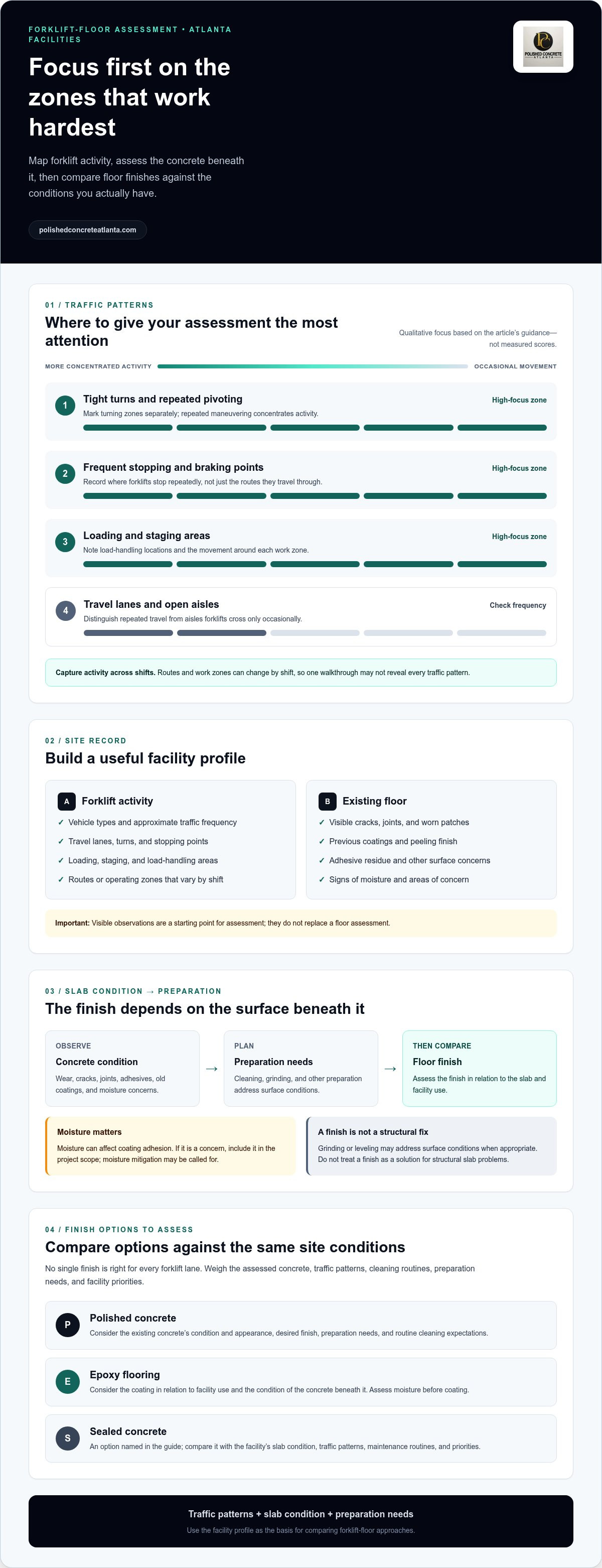
Pay close attention to repeated travel lanes, tight turns, frequent stopping points, and loading or staging areas. A forklift may cross an open aisle occasionally but pivot and brake repeatedly in a smaller work zone. Mark these areas separately during an Atlanta facility assessment. Note whether routes change by shift or operating zone, since one walkthrough may not capture every pattern.
What should Atlanta facility teams record before comparing flooring?
Make a site record before comparing finishes. Include vehicle types, approximate traffic frequency, load-handling areas, and current surface concerns. Mark visible cracks, worn patches, joints, previous coatings, adhesive residue, and signs of moisture. These observations are a useful starting point for a floor assessment, but they do not replace one.
The existing concrete is the substrate that receives a polished finish, sealer, or coating. Record visible conditions rather than assuming the surface is uniform. For background on concrete slab design and types, consider how slab construction relates to the facility beneath the floor. For broader project context, the industrial flooring contractors guide explores planning high-performance commercial and industrial surfaces.
Bring your notes together into a working facility profile: where vehicles travel, where activity concentrates, and what the existing floor shows. This gives you a sounder basis for comparing polished concrete, epoxy flooring, and sealed concrete than forklift specifications alone.
How Concrete Condition and Floor Preparation Shape Forklift-Floor Performance
The substrate is the existing concrete that receives polishing, a sealer, or a coating. Its condition helps determine which finish may suit the project and what work should come first. A coating name alone does not establish how a floor will perform under forklift traffic. Worn areas, residue, or an incompatible old finish need to be considered before selecting and applying a new finish.
Preparation belongs in every flooring decision because the finish depends on the surface beneath it.
How does existing concrete affect the flooring approach?
Assess visible wear, cracks, joints, old adhesives, and the condition of previous coatings. These details help distinguish surface conditions from concerns that need further evaluation. For example, adhesive residue or a peeling coating can affect the preparation required before a new finish is applied. Floor grinding and leveling may address surface conditions when appropriate, but a finish should not be treated as a fix for structural slab problems.
Why do preparation and moisture mitigation matter?
Cleaning, grinding, and other floor preparation address surface conditions that can interfere with the selected finish. Moisture also belongs in the assessment, particularly before applying a coating, because it can affect adhesion. When moisture is a concern, it should inform the project scope and may call for moisture mitigation. For a closer look at the process, this concrete surface preparation guide explains why the surface needs deliberate preparation.
For an Atlanta warehouse, connect what you observe on the slab to how the facility operates. A worn aisle, old adhesive in a staging area, or moisture concerns in a particular zone can each affect the preparation plan. Selecting heavy-duty flooring for forklift traffic Atlanta facilities need means assessing both traffic demands and concrete conditions, rather than relying on a product label.
Polished concrete, epoxy flooring, and sealed concrete are options to assess for existing floors. The right approach depends on the project conditions and preparation needs. Polished Concrete Atlanta provides floor preparation, including glue removal and moisture mitigation, as well as concrete finishing. Explore concrete floor preparation and finishing for your facility project.
How to Evaluate Heavy-Duty Flooring Options for Atlanta Forklift Lanes
No single finish is right for every forklift lane. Compare options against the assessed concrete, traffic patterns, cleaning routines, and project priorities. Use the table as a starting point, then weigh each option against the conditions in your facility.
| Option | Project considerations | Preparation and maintenance planning | Facility priorities to weigh |
|---|---|---|---|
| Polished concrete | Evaluate the condition and appearance of the existing concrete, along with the desired finish. | Plan preparation around the slab’s current condition; define routine cleaning expectations. | May be worth assessing where the existing concrete and finish goals align. |
| Epoxy flooring | Consider the coating in relation to facility use and the condition of the concrete beneath it. | Account for cleaning and surface preparation before coating, plus ongoing care expectations. | Assess when a coating system fits project priorities and site conditions. |
| Sealed concrete | Review the existing surface and the finish the facility wants to achieve. | Include appropriate preparation and establish a maintenance routine for the selected finish. | Compare it with other options based on operating needs and slab condition. |
When should a facility assess polished concrete?
Consider polished concrete for an existing slab when its condition, appearance goals, and cleaning routine fit the facility’s plans. Review the actual forklift lanes and the full area under consideration, not just a convenient sample of open floor. Polished concrete is not a universal guarantee against forklift damage. Its suitability depends on the concrete and how the space operates.
When should a facility assess epoxy or sealed concrete?
Assess epoxy flooring against site needs, the existing slab, and preparation requirements. Sealed concrete is another finish option, with suitability determined by the project rather than the product label. For more context on coating systems, explore this industrial floor coatings guide.
As you compare heavy-duty flooring for forklift traffic Atlanta options, identify the trade-offs that matter most to your facility: finish appearance, cleaning routines, preparation scope, and fit with operating conditions. Weigh these criteria together rather than assuming one surface is always best. Polished Concrete Atlanta provides polished concrete, epoxy flooring, and sealed concrete for commercial and industrial facilities. Explore Atlanta flooring services to review options for your facility.
Planning a Forklift-Flooring Project with an Atlanta Concrete Specialist
A clear project plan connects the flooring decision to your facility’s operations. Define the work area, document the existing floor, and include access and scheduling in the scope from the start. This gives the flooring team a practical basis for matching preparation and finish options to your commercial facility.
What belongs in a clear flooring project scope?
Identify the areas under consideration, current surface conditions, forklift routes, and operating priorities. Note which zones need to remain accessible and how work areas relate to daily movement. The scope should describe the proposed preparation and finish based on the floor assessment, along with access and scheduling considerations. Define affected zones clearly, without assuming a completion time before project conditions are understood.
How can Atlanta facilities move from assessment to a flooring plan?
Use a project-specific assessment to determine whether polishing, epoxy flooring, or another preparation and finish approach fits the existing concrete and facility priorities. Polished Concrete Atlanta serves commercial and industrial facilities in Atlanta with concrete polishing, epoxy flooring, floor preparation, and moisture mitigation for existing concrete floors.
- Document operations. Summarize vehicle movement, active lanes, staging areas, and schedule considerations.
- Assess the existing floor. Map visible wear, cracks, joints, old coatings, and moisture concerns across the proposed work zones.
- Define finish priorities. Clarify what matters most, such as appearance, cleaning routine, and fit with the way each area is used.
- Plan access and work areas. Identify affected zones, traffic adjustments, and scheduling needs so the scope reflects facility operations.
This sequence turns the question of heavy-duty flooring for forklift traffic Atlanta facilities need into a defined project shaped by the concrete, operating demands, and site requirements. Polished Concrete Atlanta helps Atlanta businesses assess and plan concrete-flooring projects around these conditions.
Discuss your Atlanta flooring project and take the next step toward a plan grounded in your facility’s existing floor and operating needs.
Make Your Next Flooring Decision with Confidence
A forklift-flooring project is an opportunity to align the floor with how your facility needs to operate, not just address the wear visible today. Use route observations, a slab assessment, and finish priorities to shape a project scope for each work zone. A measured plan helps your team make the decision with a clearer understanding of the conditions involved.
For heavy-duty flooring for forklift traffic Atlanta facilities are considering, Polished Concrete Atlanta provides concrete polishing, epoxy flooring, and floor preparation. The right direction depends on the existing concrete and your operating needs.
Turn your facility observations into a focused project discussion. Discuss your Atlanta commercial flooring project and explore an approach grounded in your site conditions.
Frequently Asked Questions
Can polished concrete handle forklift traffic?
Polished concrete may suit forklift traffic when the existing slab and facility conditions support that approach. Assess the busiest travel paths alongside lower-traffic areas, paying particular attention to turning and staging zones where movement repeats. Include cleaning practices and visible surface changes in the review. This helps facility teams assess polishing against actual operating patterns without assuming a particular load rating or damage-proof result.
Does forklift tire type affect industrial flooring selection?
Tire type is one useful equipment detail, but it does not determine the floor system on its own. Record forklift models or tire configurations alongside travel frequency, turning locations, loads handled, and slab condition. A vehicle used mostly on a straight aisle creates a different traffic pattern from one repeatedly maneuvering at a transfer point. Evaluate the full use case.
Can an existing concrete floor be prepared for forklift traffic?
An existing concrete floor can often be prepared for a new finish, but suitability depends on its condition and project requirements. Grinding may address surface conditions, leveling may be relevant where the floor profile calls for it, and glue removal can matter when adhesive remains. Moisture mitigation may also be part of the plan. Preparation is not a substitute for addressing structural slab concerns, and it cannot promise a specific performance result.
How does moisture affect an industrial floor coating?
Moisture can interfere with coating adhesion, so it should be considered before coating work begins. Atlanta facilities should include visible dampness or recurring moisture concerns in the slab assessment rather than assuming the surface is ready. Moisture mitigation can be included when the project assessment indicates it is appropriate. This helps align heavy-duty flooring for forklift traffic Atlanta sites need with actual floor conditions, rather than relying on a universal fix.
How can a warehouse plan flooring work around active forklift operations?
Plan around operations by marking forklift routes, identifying the zones included in the work, and noting access constraints such as receiving areas or shift-change movement. Share these details during scope development so the work sequence reflects facility priorities. Coordinate internal communication about restricted areas and alternate routes as needed. Base the work plan on the agreed scope and site requirements, not an assumed fixed installation timeline.


