
What if the right moisture solution depends less on the finish you want and more on what the slab is telling you? A coating or polished finish can perform as intended only when moisture conditions and surface preparation are addressed first. For concrete moisture mitigation for commercial buildings Atlanta teams manage, documented slab conditions should guide the decision, not guesswork.
It’s reasonable to want clear answers before committing to a commercial floor finish. Moisture testing helps establish whether mitigation is needed and informs preparation and finish compatibility. It also helps distinguish slab moisture mitigation, which supports a flooring system over concrete, from building waterproofing, which addresses water intrusion into the structure. These approaches serve different purposes.
This buyer’s guide explains how commercial slab moisture is assessed, which findings matter when selecting a mitigation approach, and how facility use affects flooring decisions. You’ll also learn how floor preparation fits into the process, so you can plan for a suitable finish based on site conditions.
Key Takeaways
- Slab moisture can affect a floor finish, but it’s different from leaks, foundation seepage, and surface spills.
- Start with the intended finish, then inspect and test the slab. Project conditions and finish requirements help determine the appropriate assessment.
- Compare mitigation options against test findings, concrete condition, facility use, and the finish rather than relying on a one-size-fits-all solution.
- For concrete moisture mitigation for commercial buildings Atlanta projects, connect assessment and mitigation planning with substrate preparation and the next flooring step.
- Commercial moisture mitigation and floor preparation can support a considered path toward polished concrete, epoxy, or another suitable finish.
What Commercial Concrete Moisture Mitigation in Atlanta Addresses
Concrete moisture mitigation for commercial buildings Atlanta projects involves preparing an existing slab to manage moisture-related risks beneath a planned floor finish. It isn’t a diagnosis of every damp area or a universal fix for water problems. The right response depends on conditions in the concrete and the finish the facility needs.
Floor moisture mitigation prepares a concrete slab and flooring system to manage moisture-related risks. Building waterproofing is intended to limit water entry into the structure. The distinction matters. Moisture within or moving through a slab can affect the interface between concrete and a coating or sealer. A leak or foundation seepage points to water entering the building and may call for a different investigation.
How slab moisture can affect a commercial floor finish
Concrete contains pores, and moisture can move through them toward the surface depending on conditions in and around the slab. If moisture levels are incompatible with a planned coating or sealer, adhesion or finish performance may be affected. That doesn’t mean every blister, discoloration, or bond issue is caused by moisture. Surface preparation, contamination, and other conditions can also play a role.
The finish guides the assessment. A coating, sealer, and polished concrete system interact with the slab differently, so compatibility should be considered before work begins. Atlanta’s climate is relevant context, but location alone doesn’t establish that a facility has a moisture problem. Conditions need to be assessed at the site.
When floor moisture mitigation differs from waterproofing
A commercial floor assessment focuses on the concrete and the finish planned for it. Dampness beneath a coating may involve moisture moving through the slab. A visible leak, foundation seepage, or water pooling after a spill has a different source and requires a different scope of investigation.
Drainage and foundation concerns shouldn’t be treated as coating-preparation issues. Floor moisture mitigation addresses risks at the slab and finish interface. It doesn’t correct active water entry or replace investigation of the building envelope. For broader context on construction moisture barriers, see Damp proofing in construction. Keeping these issues distinct helps focus the flooring decision on actual site conditions.
How Atlanta Commercial Slabs Are Assessed Before Moisture Mitigation
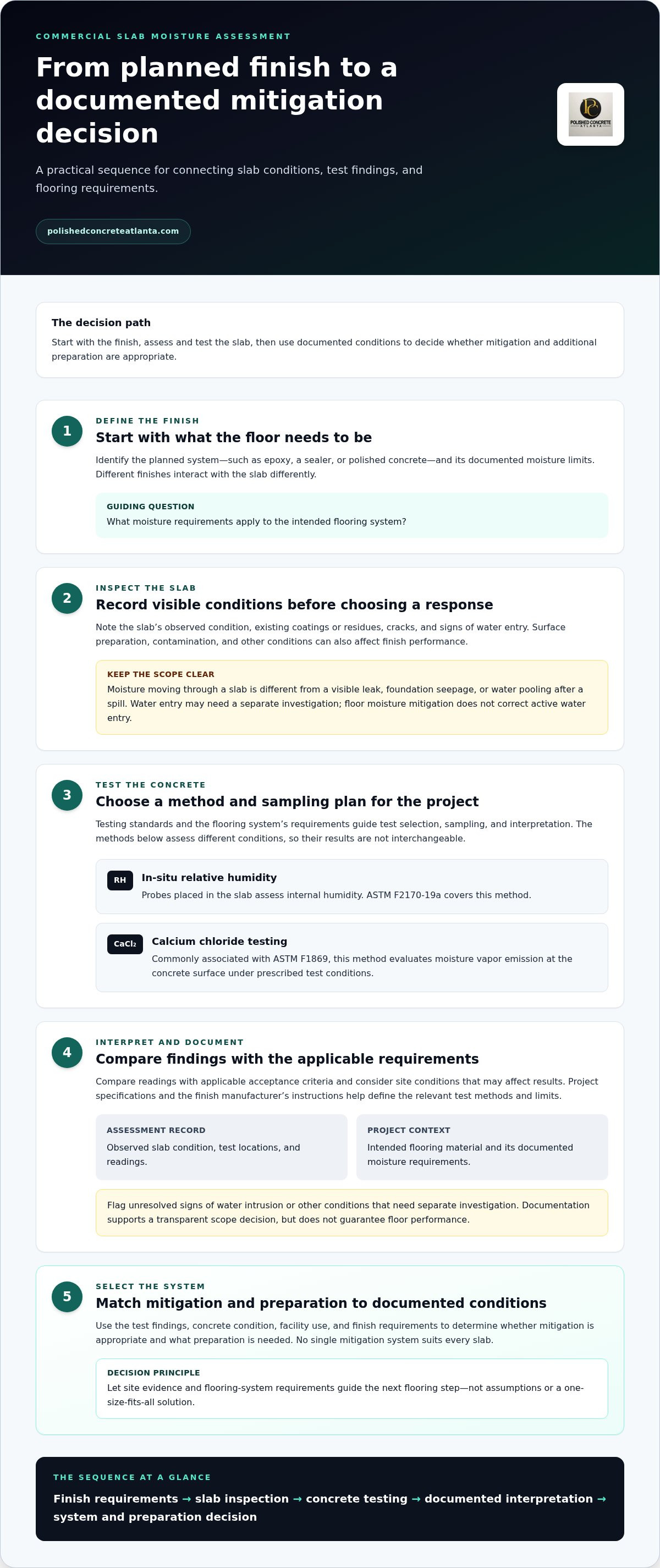
A sound mitigation decision starts with evidence, not assumptions. For concrete moisture mitigation for commercial buildings Atlanta projects, assessment connects the slab’s measured condition to the requirements of the floor finish. A practical sequence is:
- Define the finish. Identify the planned system, such as epoxy, a sealer, or polished concrete, and its documented moisture limits.
- Inspect the slab. Note visible conditions, existing coatings or residues, cracks, and signs of water entry.
- Test the concrete. Select a method and sampling plan suited to the project and finish requirements.
- Interpret the findings. Compare readings with the applicable acceptance criteria and consider site conditions that may affect results.
- Select a system. Use the documented conditions and finish requirements to determine whether mitigation is appropriate and what preparation is needed.
Testing standards and flooring-system requirements guide the details. The American Concrete Institute (ACI) standards provide broader technical resources on concrete and floor construction. Project specifications and the finish manufacturer’s instructions help define applicable test methods and acceptance limits.
Which concrete moisture tests may inform the decision?
In-situ relative humidity testing uses probes placed in the slab to assess internal humidity. ASTM F2170-19a covers this method. Calcium chloride testing, commonly associated with ASTM F1869, evaluates moisture vapor emission at the concrete surface under prescribed test conditions. These methods examine different conditions, so their results aren’t interchangeable. Test selection, sampling, and interpretation should follow the applicable method and the flooring system’s requirements.
What should a commercial slab assessment document?
A useful record identifies the slab’s observed condition, test locations, readings, and relevant project context, including the intended flooring material and its documented moisture requirements. It should also flag unresolved signs of water intrusion or other conditions that need separate investigation. Documentation makes the scope decision more transparent, but it doesn’t guarantee how a floor will perform. Site findings still need to guide preparation and system selection.
For a project-specific path from assessment to floor preparation, explore commercial moisture mitigation and floor preparation.
How to Compare Moisture Mitigation Options for an Atlanta Facility
No single mitigation system suits every slab. Compare documented test findings with the concrete’s condition, the intended finish, and how the facility operates. A system appropriate beneath an epoxy floor may not suit a polished concrete plan. Active water entry also requires a different investigation from moisture moving through a slab.
Common approaches include moisture-mitigating primers or coatings and membrane systems designed to reduce moisture transmission beneath a floor finish. Their preparation requirements and compatibility differ. The Concrete moisture testing and mitigation methods overview provides additional context on assessment and mitigation approaches.
| Decision factor | What to compare |
|---|---|
| Test findings | Readings and test locations against the selected system’s documented limits. |
| Substrate condition | Surface soundness, existing coatings or residue, and preparation needed for adhesion. |
| Intended finish | Compatibility with epoxy, a sealer, polished concrete, or another specified system. |
| Facility use | Traffic, operating needs, disruption during preparation and installation, and ongoing care requirements. |
Which project criteria should guide the selection?
Start with the slab readings and the finish system’s stated moisture limits. Then assess whether the substrate can be prepared to meet that system’s requirements. Factor in traffic and facility operations. An active commercial space may need careful coordination around work areas and access. Preparation is part of the decision, not an afterthought. This guide to concrete surface preparation explains why the substrate matters to adhesion.
What should facility managers clarify before approving scope?
Make sure the proposed scope identifies the test results and site observations it relies on, the planned substrate preparation, and how mitigation will integrate with polishing, epoxy, or another specified finish. Review the system’s documented compatibility and maintenance requirements alongside operational impacts. For concrete moisture mitigation for commercial buildings Atlanta projects, these details keep the decision tied to actual conditions rather than assumptions.
Explore commercial floor moisture mitigation in Atlanta as part of planning your facility’s floor system.
Plan Commercial Concrete Moisture Mitigation and the Next Flooring Step
Moisture mitigation is one part of a coordinated flooring plan. A practical sequence is to review slab assessment findings, define mitigation based on those conditions and the intended finish, prepare the concrete, then install the selected floor system. Each step should reflect the actual slab and facility requirements. Mitigation can address moisture-related flooring risks, but it doesn’t remove every possible source of moisture or resolve water intrusion elsewhere in a building.
Polished Concrete Atlanta provides commercial floor moisture mitigation and floor preparation for existing concrete, alongside polished concrete, epoxy, stained, and sealed concrete flooring. Bringing these services together helps align slab preparation with the finish objective. For facilities considering coating systems, the Atlanta industrial floor coatings guide offers additional context on planning for commercial use.
Coordinate moisture mitigation with the intended floor finish
The finish influences preparation and compatibility decisions. Epoxy, sealed concrete, stained concrete, and polished concrete each have distinct requirements for the concrete surface and how the finish interacts with it. A mitigation scope should account for the selected system, its documented requirements, and the substrate condition rather than assume one approach fits every floor. For projects focused on a protective sealer, see the guide to sealed concrete standards.
Turn assessment findings into a clear project scope
A well-defined scope records the assessment findings, planned substrate preparation, mitigation work, and finish objectives. It should also identify project-specific requirements and coordination needs, including facility operations. Timelines and specifications depend on those conditions, so they should be established for the actual project rather than assumed in advance.
This coordinated approach helps facility teams understand how each decision supports the next flooring step. For concrete moisture mitigation for commercial buildings Atlanta, Polished Concrete Atlanta brings moisture mitigation and floor preparation together with commercial finish options, including epoxy and polished concrete. Discuss your Atlanta commercial floor project and plan the next step around your slab and intended finish.
Move Forward With a Floor Plan Built on Evidence
A dependable commercial floor project starts with measured slab conditions and a clear finish objective. Moisture testing and site observations help establish whether mitigation is appropriate, while the intended system guides preparation and compatibility decisions. The goal is a scope grounded in evidence, not assumptions or a one-size-fits-all fix.
For concrete moisture mitigation for commercial buildings Atlanta facilities need, a coordinated approach matters: assess the slab, plan preparation and mitigation, then align that work with the selected finish. Polished Concrete Atlanta provides commercial floor moisture mitigation and preparation alongside polished concrete, epoxy, stained, and sealed concrete solutions.
Ready to plan the next step for your facility? Discuss your Atlanta commercial floor project and bring your slab findings and finish goals into one clear plan.
Frequently Asked Questions
What is concrete moisture mitigation for a commercial building?
It’s preparation that helps manage moisture-related risks where a concrete slab meets a planned floor finish. For concrete moisture mitigation for commercial buildings Atlanta projects, the approach should be based on slab assessment and the intended system, such as epoxy or a sealer. Mitigation isn’t the same as repairing a leak or waterproofing a foundation. It’s one part of preparing existing concrete for a compatible commercial finish.
How do you test a commercial concrete slab for moisture?
Testing typically uses a method selected for the slab, project conditions, and planned floor system. In-situ relative humidity testing uses probes to assess conditions within the concrete, while calcium chloride testing measures moisture vapor emission at the surface. They assess different conditions and aren’t interchangeable. The method, sampling approach, and acceptance criteria should follow the applicable test standard and the flooring system’s documented requirements.
Can Atlanta humidity cause moisture problems in a concrete floor?
Atlanta’s humid climate can influence moisture conditions around a building, but humidity alone doesn’t establish that a particular slab needs mitigation. Moisture may move through concrete, and indoor conditions can also affect drying and readings. That’s why site observations and appropriate slab testing matter more than assuming a problem based on location. A documented assessment helps distinguish measured slab conditions from general climate concerns before a finish is selected.
What happens if a commercial concrete floor is coated before moisture is assessed?
Without assessment, the project team may not know whether slab conditions meet the coating system’s moisture requirements. If they don’t, moisture can contribute to adhesion or finish-performance problems, though it isn’t the only possible cause of coating defects. Surface condition and preparation matter too. Testing before coating helps determine whether mitigation or additional preparation is appropriate and gives the team a clearer basis for planning the flooring system.
Is moisture mitigation the same as basement waterproofing?
No. Floor moisture mitigation addresses moisture-related risks at the concrete slab and planned flooring system. Basement waterproofing addresses water entry into a building, such as seepage through a foundation or an active leak. These types of work have different objectives. If water is visibly entering or collecting, that condition requires investigation beyond the floor finish scope. A slab assessment can help clarify the flooring question, but it doesn’t diagnose drainage or foundation problems.
How do I choose a moisture mitigation approach for a commercial floor?
Choose based on documented test findings, slab condition, facility use, and the intended finish’s written requirements. Consider preparation needs, system compatibility, operational disruption, and ongoing maintenance rather than assuming one approach fits every floor. For concrete moisture mitigation for commercial buildings Atlanta facilities need, Polished Concrete Atlanta connects moisture mitigation and floor preparation with commercial finishes such as polished concrete, epoxy, stained, and sealed concrete. The final scope should reflect site conditions.


