

What if the right floor treatment still isn’t right for your distribution center? Dust, wear, and maintenance demands can strain operations, but the slab’s condition and the way your facility runs matter just as much as the product. For teams searching “Ashford Formula installers for distribution centers Atlanta,” the first step is deciding whether the treatment fits the building, not simply scheduling the work.
Ashford Formula installation can be part of a facility-specific floor plan, with slab preparation considered alongside traffic patterns, operating requirements, and the concrete’s existing condition. To limit avoidable conflicts with material handling and facility access, identify the work areas and operational constraints early. Results depend on the slab, so a clear assessment matters.
This guide explains how to evaluate Ashford Formula for a distribution center, identify slab and operational factors that affect suitability, and plan a scope around your workflow. It also covers when grinding, glue removal, or moisture mitigation may be relevant to preparing an existing floor. Polished Concrete Atlanta provides Ashford Formula installation and related concrete-floor services for commercial and industrial facilities in Atlanta. Start with the conditions on your floor.
Key Takeaways
- Start with your facility’s priorities, including dust control, surface durability, maintenance demands, and material-handling needs.
- Assess the slab’s condition, contamination, previous treatments, and moisture concerns before deciding whether Ashford Formula fits.
- Build the installation scope around the floor’s actual needs. Grinding, glue removal, or moisture mitigation may be relevant depending on site conditions.
- When comparing Ashford Formula installers for distribution centers Atlanta, focus on slab review, preparation, work sequencing, and clear project communication.
- Plan access and operational coordination early so the flooring scope reflects how your distribution center functions.
Why Atlanta distribution centers consider Ashford Formula for concrete floors
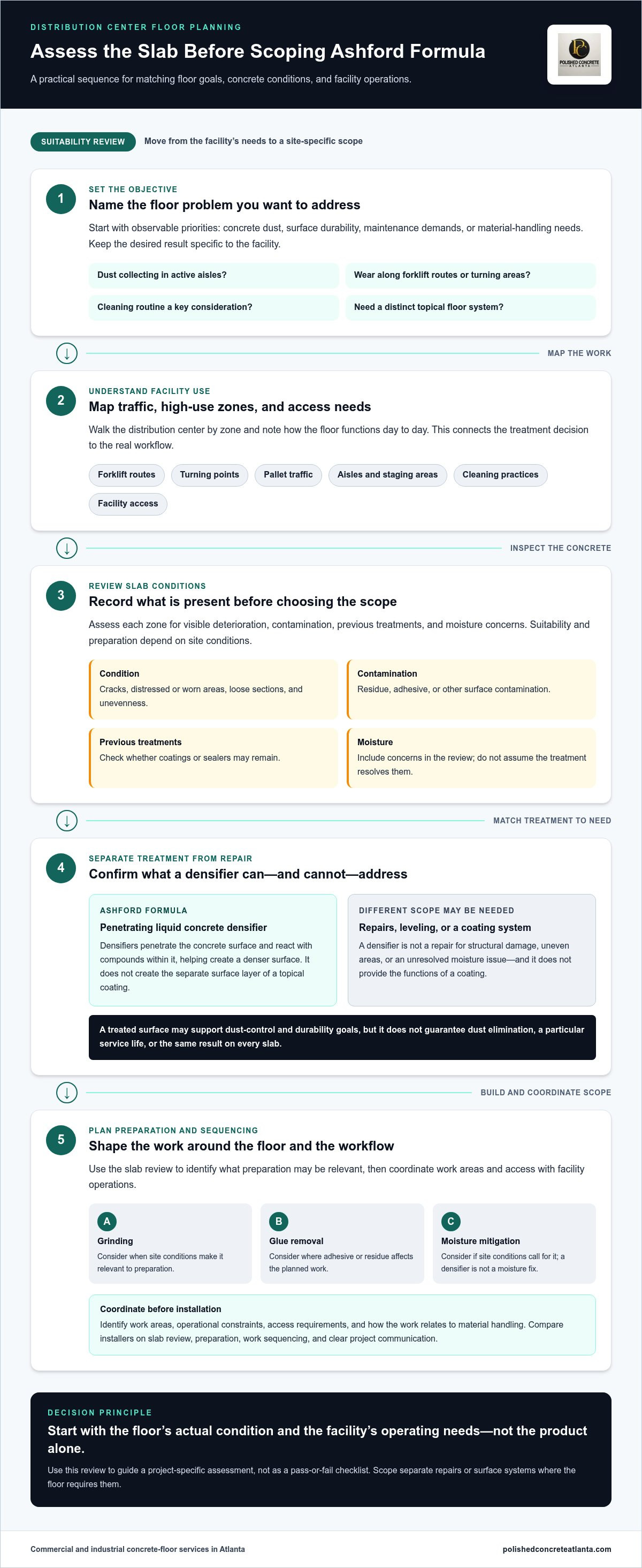
Distribution-center floors support a working system of forklift and pallet traffic, cleaning routines, aisles, and staging areas. Ashford Formula may suit facilities looking to address concrete dust and improve surface durability, but the right choice depends on the slab and the facility’s priorities. It is a treatment, not a fix for every floor problem.
What does Ashford Formula do to a concrete floor?
Ashford Formula is a liquid concrete densifier. In general, densifiers penetrate the concrete surface and react with compounds within it, helping create a denser surface. Assess the product’s chemistry and application requirements against current manufacturer documentation. For a foundational explanation, see What is a Concrete Densifier?
A densifier treats concrete within its surface; a film-forming coating sits on top of the floor. A penetrating treatment does not create the same separate surface layer as a topical coating. That distinction helps narrow the options, but it does not determine by itself whether a particular floor is a good candidate.
Which distribution-center priorities can it support?
Start with observable operating concerns. Is concrete dust collecting in active aisles? Do forklift routes or turning areas show surface wear? How often is the floor cleaned, and would a change in surface treatment fit the maintenance routine? These questions connect the flooring decision to daily work instead of relying on product claims alone.
A treated surface may support dust-control and durability goals, but it does not guarantee that dust will be eliminated, promise a particular service life, or produce the same result on every slab. Existing deterioration, contamination, previous treatments, and moisture conditions can affect suitability and preparation. A densifier should not be treated as a repair for structural damage, uneven areas, or an unresolved moisture issue.
Compare the treatment category with the facility’s actual performance requirements. If the project calls for a distinct topical system, evaluate that separately. A penetrating densifier and a coating are not interchangeable simply because both are used on concrete. The industrial floor coatings guide can help frame that comparison.
For Atlanta facility teams researching Ashford Formula installers for distribution centers Atlanta, the practical first decision is to define the floor objective, then compare the treatment with the slab and workflow. Product characteristics matter, but site conditions determine what they can deliver.
How to assess whether Ashford Formula suits your distribution-center slab
Ashford Formula is not a one-size-fits-all answer. Suitability depends on the slab’s current condition, the result you want, and the demands placed on each area of the facility. A useful review separates what the treatment may address from repairs or surface systems that require a different scope.
What slab conditions should the project review cover?
Walk the floor by zone and record visible deterioration, surface contamination, and previous treatments. Note cracks, worn or loose areas, residue, and places where coatings or sealers may remain. Include moisture concerns in the review. Moisture does not automatically rule out a densifier, but the treatment should not be assumed to resolve a moisture problem. Suitability and preparation depend on site conditions.
- Slab condition: Is the surface sound, or are there visibly distressed areas that need separate attention?
- Floor objective: Is the priority dust control and surface durability, or do you need to address unevenness, damage, or another defect?
- Existing treatments: Could coatings, sealers, adhesive, or other contamination affect the planned preparation?
- Moisture and operations: Are there moisture concerns, and how will work areas relate to access and material handling?
Use this checklist to guide a project-specific review, not as a set of pass-or-fail thresholds. A densifier treats concrete; it does not repair damaged sections, level a floor, or provide the functions of a coating. If the facility needs one of those outcomes, scope it separately rather than expecting one treatment to solve every floor issue.
How should facility use shape the decision?
Map forklift routes, turning points, staging areas, and other high-use zones. Note the equipment that moves through them and the cleaning practices used across the building. This helps distinguish a general dust-control goal from localized wear or a requirement for a different surface system. Documenting these details ties the installation scope to daily operations.
For broader facility planning, the Atlanta industrial flooring contractor guide can help frame how flooring choices relate to site demands. Buyers comparing Ashford Formula installers for distribution centers Atlanta can use the same decision factors to keep slab review, preparation, and operational needs in view. For concrete-floor work in Atlanta, explore Atlanta Ashford Formula installation.
What to plan before Ashford Formula installation in an operating facility
Installation planning should address both what the concrete needs and how the distribution center must function. A clear scope connects the floor objectives to slab review, preparation based on actual conditions, work zones, and access coordination. There is no single downtime window that fits every building. Plan the sequence around the floor and the facility’s operating requirements.
- Define the objective: Identify the floor concern the treatment is intended to address and which areas matter most.
- Review the slab: Document existing finishes, residues, visible distress, and conditions that may affect preparation.
- Scope preparation: Include work indicated by the site review, such as grinding, glue removal, or moisture mitigation.
- Coordinate access: Map affected zones, equipment routes, staging areas, and facility coordination points.
How should the floor be assessed and prepared?
Review the floor area by area. Existing coatings, sealers, adhesive residue, or surface contamination may affect preparation, while visible deterioration may need separate attention. Concrete grinding and floor glue removal can be appropriate where site conditions call for them. Consider moisture mitigation when the assessment identifies a moisture concern. These services are based on the project’s needs, not automatic steps for every installation. The concrete surface preparation guide explains why surface condition matters to a flooring scope.
How can installation planning reduce operational disruption?
Turn the building layout into a coordination plan. Mark the work areas alongside active forklift routes, pedestrian access, staging locations, and nearby operations that may be affected. If a zone connects to a critical material-handling route, identify that constraint early so the sequence can account for facility needs. Establish how access and work areas will be coordinated without assuming uninterrupted operations or a standard downtime period.
Polished Concrete Atlanta provides Ashford Formula installation for commercial and industrial floors, with preparation services included when site conditions call for them. To define the floor scope and operational constraints for your distribution center, plan your Ashford Formula installation.
Choosing an Ashford Formula installer for an Atlanta distribution center
A clear scope is the basis for a sound installation decision. It should connect the treatment to the slab’s observed condition, the facility’s objectives, and the realities of working around operations. For teams searching “Ashford Formula installers for distribution centers Atlanta,” these details offer a more useful basis for comparison than a product description alone.
What should a clear project scope explain?
The scope should identify the floor areas included and describe the conditions observed there. A high-traffic aisle, a staging zone, and a low-use area may have different priorities. State the objective for each area, such as addressing concrete dust or supporting surface durability, so the treatment is evaluated against a defined need.
Tie preparation to specific findings instead of assuming it is needed across the entire facility. The project plan can explain whether grinding, glue removal, or moisture mitigation is relevant and why. It should also identify areas that need separate attention rather than implying that a densifier will correct every slab defect. Clear boundaries help facility teams understand what the installation covers.
Include operational coordination in the scope. Note affected work zones, access routes, staging locations, and the sequence for coordinating with facility operations. This gives everyone a shared plan without assuming a standard downtime window or uninterrupted material handling.
How can Polished Concrete Atlanta support the project?
Polished Concrete Atlanta provides Ashford Formula installation as part of its commercial and industrial concrete-floor services. Related services include floor preparation, concrete grinding, glue removal, and moisture mitigation. The slab review and project requirements determine which preparation services belong in the scope, keeping the work aligned with the facility’s needs. The company has operated since 2004.
A facility-specific scope also clarifies what areas are included, what preparation is planned, and how access and sequencing relate to daily operations. That detail helps decision-makers align expectations before work begins. No two slabs should be treated as identical.
Ready to discuss the conditions and operating needs of your Atlanta facility? Discuss your Atlanta distribution-center floor project.
Set the Next Step for Your Distribution Center Floor
Turn the flooring decision into a practical project brief. Mark the areas that matter most, note what the floor needs to accomplish, and identify operational constraints that could shape access or sequencing. This gives your facility team a clear starting point for discussing the work and keeps the decision grounded in the building’s priorities.
Your search for Ashford Formula installers for distribution centers Atlanta should lead to more than a product discussion. Establish a project scope that reflects your slab, your facility’s workflow, and the outcome you are seeking. With those priorities in view, you can move forward with greater clarity.
Polished Concrete Atlanta provides Ashford Formula installation for commercial and industrial concrete floors in Atlanta. Discuss your Atlanta distribution-center floor project to take the next step toward a scope built around your facility.
Frequently Asked Questions
What is Ashford Formula used for in a distribution center?
Ashford Formula is used to treat concrete floors when a facility is seeking a denser surface and better control of concrete dust. Distribution centers may consider it for areas with regular forklift movement or ongoing cleaning demands. It is not a substitute for every flooring system, so match the treatment to the floor’s condition and the facility’s objective. Atlanta teams searching “Ashford Formula installers for distribution centers Atlanta” should focus on that fit.
Can Ashford Formula be applied to an existing concrete warehouse floor?
An existing concrete floor may be a candidate, depending on its condition and surface history. Adhesive residue or a previous coating may affect the preparation plan, while worn or distressed areas may need separate attention. Assess the whole floor, including differences between warehouse zones. Existing concrete is not automatically suitable or unsuitable; the project scope should reflect the actual slab conditions.
Does Ashford Formula stop concrete dusting permanently?
No treatment should be presented as a guarantee that concrete dusting will never return. Dust-control results depend on the concrete, its condition, application, and the wear it experiences in service. If dust becomes noticeable again, document where it appears and whether it follows a traffic route, a cleaning change, or a particular floor area. That information can help distinguish a surface-treatment concern from another slab or operational issue.
Is Ashford Formula the same as a concrete coating or sealer?
No. Ashford Formula is a concrete densifier that penetrates the surface, while a film-forming coating creates a distinct layer over the concrete. Sealed concrete is also a separate floor-treatment category, so the intended finish and performance requirements matter when comparing options. If a facility specifically needs a topical system, a densifier should not be assumed to provide the same surface layer or serve as a direct replacement.
How should a distribution center prepare for Ashford Formula installation?
Before work begins, identify the floor areas involved and move stock or equipment from those areas according to the project plan. Flag adhesive residue, existing finishes, and locations where the concrete looks different from adjacent sections. Facility operations should also identify who coordinates access and how material handling will be managed around the work. A defined preparation plan helps prevent avoidable conflicts between the floor scope and warehouse activity.
Can Ashford Formula fix damaged or moisture-affected concrete?
No. Ashford Formula is a treatment, not a repair for damaged, uneven, or moisture-affected concrete. Crumbling or visibly distressed areas may need separate evaluation, while moisture concerns call for attention to their source and an appropriate project scope. Polished Concrete Atlanta provides floor preparation and moisture-mitigation services alongside Ashford Formula installation, so related work can be included based on the facility’s actual conditions.


