
A high-performance floor is a strategic asset, not a luxury. In a city where red piedmont clay and 50 inches of annual rainfall create relentless hydrostatic pressure, mediocre concrete floor finishing atlanta projects are a recipe for disaster. You've likely seen the results of cutting corners: delaminating coatings, "sweating" slabs, and inconsistent gloss that ruins a facility's professional image. It's an expensive mistake you can't afford to repeat. We understand that your priority is a surface that remains dust-free and resilient under heavy industrial traffic. Reliable results require technical rigor, not just a bucket of sealer. No fluff. Just results.
This professional roundup establishes the 2026 benchmark for industrial and commercial finishes. We cut through the noise to provide expert criteria for selecting systems that actually last. You'll gain a clear understanding of the latest moisture mitigation protocols and why the current shift toward matte textures is redefining durability. From advanced floor grinding techniques to the specific requirements of the 2024 International Building Code, this is your roadmap to a worry-free, high-luster investment. The standard has changed. It's time to catch up.
Key Takeaways
- Master the 2026 standards for multi-stage mechanical refinement to ensure your commercial space benefits from high-reflectivity and sustainable durability.
- Decode the technical "Grit Sequence" and the essential role of chemical densifiers in creating a surface that withstands heavy industrial traffic.
- Evaluate the top providers of concrete floor finishing atlanta offers by prioritizing technical equipment, project scale, and proven moisture mitigation expertise.
- Secure your investment by focusing on the "engineering of adhesion," where professional floor glue removal and surface preparation dictate the total lifespan of your finish.
The Landscape of Concrete Floor Finishing in Atlanta: 2026 Standards
Superior concrete floor finishing atlanta projects demand more than a simple coating. True finishing is a rigorous, multi-stage mechanical and chemical refinement process that transforms a raw, porous slab into a high-performance asset. In Atlanta's 2026 commercial market, the shift is decisive. Forward-thinking firms are abandoning temporary aesthetic fixes in favor of sustainable, high-reflectivity flooring that slashes lighting costs and maintenance overhead. Polished concrete has moved from an architectural trend to the mandatory baseline for modern warehouse and retail environments. You must distinguish between "cosmetic" finishing and "industrial" finishing. One looks acceptable for a season; the other survives decades of relentless forklift traffic and chemical exposure.
Why Atlanta Businesses are Moving Away from Traditional Coverings
Identifying the Primary Finishing Systems
Selecting the correct system requires a "no-nonsense" assessment of your facility's daily operations. Mechanical polishing involves a precise sequence of diamond-grinding steps to achieve a natural, permanent luster. This Polished Concrete Process creates a dense, abrasion-resistant surface that won't peel or flake. For environments requiring total chemical isolation, high-performance epoxy flooring remains the gold standard. If your priority is dust-proofing a vast industrial space on a tight schedule, an Ashford Formula installation provides world-class densification. High-traffic zones require deep mechanical refinement. Light-duty storage areas might only need a professional grind-and-seal. We match the technical system to the actual traffic. No guesswork. Just engineering.
Technical Benchmarks: What Defines a High-Performance Finish?
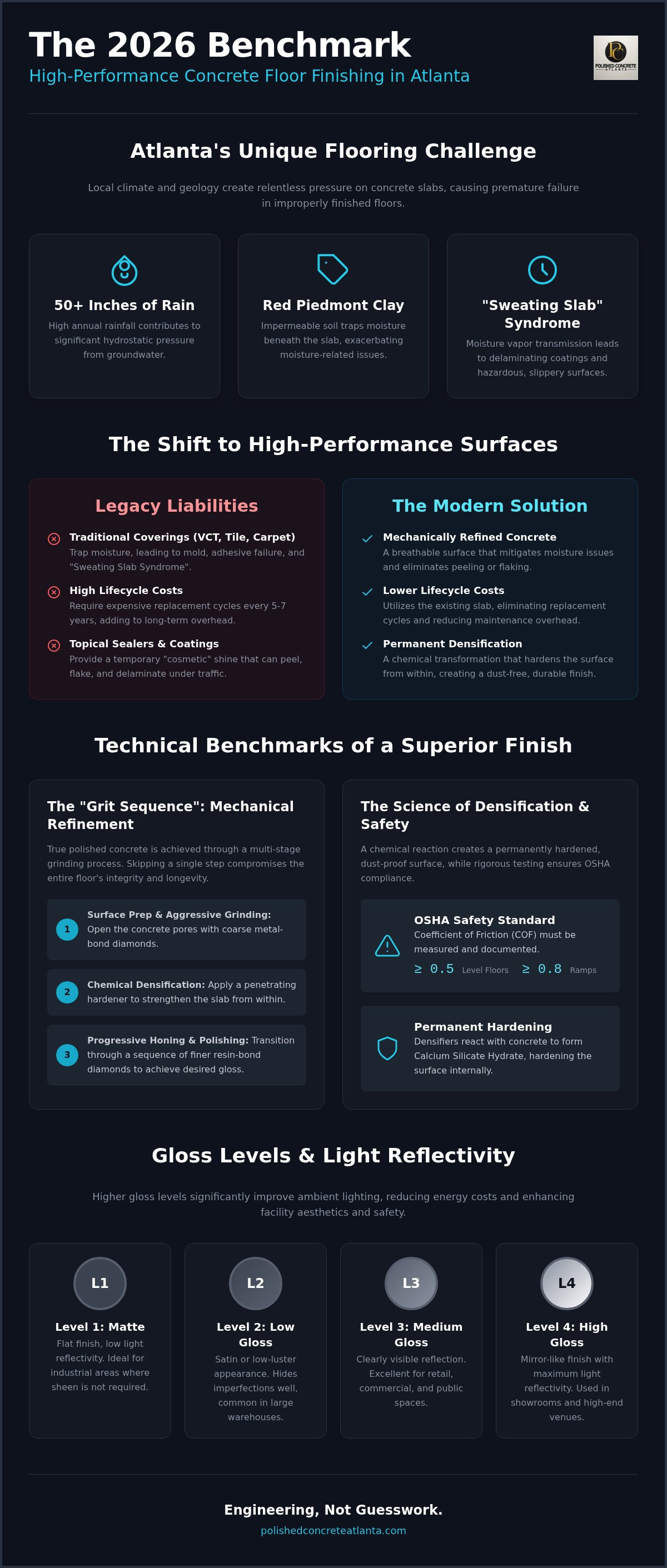
A floor that looks good today might fail tomorrow. Many contractors rely on topical sealers to mimic the look of a high-end finish. This is a costly mistake. True concrete floor finishing atlanta depends on a precise grit sequence. We begin with aggressive metal-bond diamonds to open the surface and remove imperfections. We then transition through a series of resin-bond diamonds, refining the slab at each stage. If a provider skips a single grit in the sequence, the resulting "shiny" surface is merely a temporary illusion. You need mechanical refinement, not a cosmetic mask. High-performance results require adherence to these invisible technical benchmarks.
The Science of Densification and Hardening
Chemical densifiers react with calcium hydroxide in the concrete to create calcium silicate hydrate, effectively closing the pores and hardening the wear surface. This chemical transformation is non-negotiable for industrial environments. Deep penetration ensures the slab is permanently dust-proofed and resistant to abrasion. While cheap topical sealers eventually peel or flake away, permanent densification becomes part of the concrete itself. It doesn't sit on the surface. It changes the surface. This is the difference between a floor that wears out and a floor that wears in.
Safety compliance in 2026 requires a rigorous focus on the Coefficient of Friction (COF). We measure every surface to ensure it meets OSHA Concrete Safety Standards, which currently mandate a 0.5 COF for level floors and 0.8 for ramps. A high-performance finish must balance aesthetic appeal with worker safety. Slip resistance is a technical benchmark we never compromise on. If your contractor cannot provide documented COF data, they are leaving your business exposed to unnecessary risk. We prioritize safety through measurable data, not guesswork.
Gloss Levels and Light Reflectivity Standards
We define polished concrete through four distinct gloss levels, ranging from a flat Level 1 Matte to a mirror-like Level 4 High Gloss. Level 3 and 4 finishes maximize light reflectivity, which can significantly reduce energy costs in large Atlanta distribution centers by magnifying ambient light. However, many 2026 projects are shifting toward Level 1 and 2 matte finishes. These lower-gloss options show fewer imperfections and reduce visual noise in high-traffic areas. The framework for selection depends on your lighting needs and maintenance capacity. A high-performance polished concrete floor must be tailored to the specific demands of your operation.
Top Concrete Finishing Businesses in Atlanta: A 2026 Evaluation
Selecting a partner for concrete floor finishing atlanta is a high-stakes decision that dictates the long-term ROI of your facility. You aren't just hiring a contractor; you're choosing a technical consultant to manage a critical building asset. In 2026, the market is divided between general construction firms and dedicated finishing specialists. True experts adhere to the ASCC Polished Concrete Technical Standards to ensure every project meets rigorous durability benchmarks. Whether you require a boutique team for a high-end showroom or an industrial giant for a million-square-foot warehouse, technical precision remains the only metric that matters.
Polished Concrete Atlanta: The Industry Veteran
Operational since 2004, Polished Concrete Atlanta stands as the region's original authority. They don't pour new concrete. This singular focus allows them to master the art and science of refinement without the distractions of general masonry. They are the benchmark for polished concrete floors Atlanta facility managers trust for complex remediation and industrial upgrades. Their specialized approach to concrete floor finishing atlanta solves problems that leave other contractors guessing. They prioritize technical rigor and long-term value over quick, cosmetic fixes.
High Definition Floors: The Durability Specialists
For massive industrial environments, High Definition Floors offers a systematic philosophy focused on structural longevity. They specialize in heavy-traffic systems designed to withstand the brutal demands of 24/7 warehouse operations. Their services extend beyond simple polishing to include comprehensive joint filling and professional floor leveling. They focus on the integrity of the finish, ensuring the surface remains resilient under the weight of heavy machinery. If durability is your primary concern, their methodical approach delivers predictable, high-performance outcomes.
The Role of Specialized Finishing Boutiques
Beyond the large-scale industrial players, Atlanta hosts several specialized boutiques that focus on craftsmanship and precision. These firms often utilize remote-control grinding technology to achieve a level of detail that manual equipment cannot match. While they may not handle million-square-foot distributions, they are invaluable for commercial projects where aesthetic excellence is paramount. The value of a boutique lies in personal accountability and meticulous attention to detail. When evaluating these providers, prioritize those with a dedicated focus on finishing rather than general concrete placement. Expertise is non-negotiable.
Don't settle for a generalist when your facility requires an expert. Secure your investment by partnering with the veteran team at Polished Concrete Atlanta today.
Project Execution: From Surface Preparation to Final Inspection
Execution is where the amateur and the expert diverge. A high-luster surface is worthless if it delaminates within six months. Expert concrete surface preparation contractors understand that the "engineering of adhesion" is the most critical phase of concrete floor finishing atlanta. We don't just grind; we profile the slab to ensure a permanent bond. The final inspection isn't just a visual walk-through. It's a technical verification of gloss consistency and surface integrity using digital meters. Precision is mandatory. No shortcuts.
The Non-Negotiable: Moisture Mitigation and Glue Removal
Old adhesive residues are silent project killers. If even a microscopic layer of legacy glue remains, your new coating will fail catastrophically. We utilize heavy-duty planetary grinders for the professional floor glue removal Atlanta facilities require for a clean slate. In the humid Southeast, moisture is your primary adversary. Sweating Slab Syndrome occurs when moisture vapor is trapped beneath an impermeable surface, leading to puddling and safety hazards. We remediate this through advanced moisture testing and specialized vapor barriers. We eliminate the risk before the first drop of finish is applied.
Maintenance and Long-Term Care for Finished Floors
A definitive maintenance schedule preserves your investment and ensures your concrete floor finishing atlanta remains a high-performing asset. Polished floors require daily dust mopping to remove abrasive particles that act like sandpaper under foot traffic. You must use specialized pH-neutral cleaners. Standard acidic or alkaline soaps will etch the surface and destroy the luster over time. It's a common mistake that leads to premature dulling.
For high-traffic commercial environments, expect a professional re-polishing cycle every 24 to 36 months to maintain peak performance. Epoxy systems require different protocols, focusing on preventing deep scratches that compromise the chemical-resistant barrier. Clean spills immediately. Use walk-off mats at every entrance. Proper care isn't a suggestion; it's an operational requirement to guarantee the 20-year lifecycle promised by high-end mechanical refinement. We provide the technical assurance that your floor stays as resilient as the day it was finished.
Defining the Future of Your Industrial Surface
The 2026 market demands more than just a shiny surface. It requires an engineering-first approach to concrete floor finishing atlanta that prioritizes technical grit sequences, chemical densification, and rigorous moisture mitigation. You've seen why cutting corners on surface preparation leads to catastrophic failure in Georgia's humid climate. By focusing on mechanical refinement rather than topical masks, you ensure a lifecycle that spans decades. Reliability isn't an accident. It's the result of technical rigor.
Choosing a partner is about eliminating uncertainty. We've been serving the Metro Atlanta area since 2004, bringing an uncompromising focus to industrial-grade moisture mitigation and high-traffic retail environments. Our expertise in specialized systems provides the technical assurance your project deserves. Don't leave your facility's foundation to generalists who lack dedicated finishing equipment. Your investment requires the steady hand of a veteran.
It's time to install a floor that reflects the integrity of your business. Secure a technical consultation with Polished Concrete Atlanta today to discuss your specific operational requirements. Your vision deserves elite craftsmanship. Let's build a surface that withstands the test of time.
Frequently Asked Questions
What is the difference between polished concrete and a grind and seal?
Polished concrete involves a multi-stage mechanical refinement using diamond abrasives to close the surface pores. It creates a permanent, breathable finish that doesn't peel or flake. A grind and seal, by contrast, relies on a topical sealer to provide gloss and protection. While the latter is often faster to install, it requires frequent re-application as the coating wears away. Mechanical polishing is the elite choice for long-term industrial durability and value.
How much does professional concrete floor finishing cost in Atlanta?
Investment levels for concrete floor finishing atlanta projects depend on several technical variables. The current condition of the slab, the required gloss level, and the complexity of surface preparation all dictate the final project cost. While basic sealing is the entry-point option, high-performance mechanical polishing represents a premium investment with a significantly lower lifecycle cost. We recommend a technical site evaluation to determine the specific requirements of your facility.
Can any existing concrete floor be polished to a high gloss?
Most existing slabs can undergo refinement, but the final result depends on the structural integrity of the concrete. Slabs with low compressive strength or excessive soft spots may not achieve a mirror-like finish without extensive repairs. We evaluate the aggregate distribution and surface hardness during the initial grind. If the concrete is too porous, we may suggest alternative industrial systems to ensure you receive a surface that meets our rigorous standards.
How long does the concrete finishing process typically take for a commercial space?
Timeline expectations are governed by the scale of the facility and the depth of required preparation. A standard 10,000-square-foot industrial project often requires five to seven business days for a full mechanical polishing sequence. This includes the time needed for floor glue removal and chemical densification. We prioritize on-schedule completion through disciplined project management. We don't cut corners to save time; we use superior equipment to maintain a fast, high-impact pace.
Is polished concrete slippery when wet compared to other flooring?
Polished surfaces are not inherently more slippery than other hard-surface flooring options. When kept clean and dry, they often exceed the 0.5 coefficient of friction required by OSHA standards. We measure slip resistance throughout the finishing process to ensure compliance. If your facility is prone to spills, we can integrate specialized anti-slip additives into the final refinement stages. Safety is a non-negotiable metric in every project we execute. We prioritize data over guesswork.
Why is moisture mitigation necessary for concrete floors in Georgia?
Georgia's impermeable red piedmont clay and high annual rainfall create significant hydrostatic pressure beneath your slab. This pressure forces moisture vapor through the porous concrete, leading to Sweating Slab Syndrome or the failure of non-breathable coatings. Professional moisture mitigation is the only way to stabilize the environment. It's a technical necessity for any concrete floor finishing atlanta project to prevent delamination and ensure the long-term integrity of the finish.


