

The right floor isn’t always the system with the toughest-sounding name. It’s the one that matches your facility’s actual exposures, slab conditions, and operating schedule. Industrial urethane cement flooring may suit demanding environments, but the label alone doesn’t show whether a particular system fits your processes or installation constraints.
Choosing a floor means weighing performance needs against the risk of premature failure. Poor surface preparation or unaddressed moisture can compromise a new floor, and comparing urethane cement with epoxy is difficult unless you assess both against the same criteria.
This guide explains how to document your facility’s requirements, what to verify about concrete preparation and moisture testing, and what to ask contractors before approving a system. It also covers how to assess project readiness and choose a contractor in Atlanta. Polished Concrete Atlanta lists industrial flooring, floor preparation, concrete grinding, and moisture mitigation among its services. Ask the company directly whether it currently installs urethane cement. The goal is a flooring specification supported by evidence, not guesswork.
Key Takeaways
- Document washdowns, temperature changes, traffic, impact, and chemical exposure before deciding whether industrial urethane cement flooring fits your facility.
- Request current manufacturer documentation that addresses your specific operating conditions.
- Evaluate the existing concrete, moisture conditions, and preparation requirements before approving a flooring system.
- Compare contractor proposals by their scope, supporting documentation, and relevant experience, not just the system name.
- Before selecting an Atlanta-area contractor, confirm their urethane cement capability and request the exact proposed system and scope.
What Is Industrial Urethane Cement Flooring, and Where Does It Fit?
In brief: Industrial urethane cement flooring is a resinous floor system that combines polyurethane resin with cementitious components. Formulations, installation requirements, and documented performance vary by manufacturer. Treat the system name as a starting point for evaluation, not proof that a particular floor suits your facility.
Polyurethane is used across a wide range of settings, as the overview of polyurethane applications illustrates. However, a broad description of the material cannot establish how a specific flooring formulation will perform under your process conditions. Check claims against current manufacturer documentation for the exact system being proposed.
How urethane cement differs from epoxy flooring
Urethane cement and epoxy are both resinous flooring systems, but their formulations and intended applications can differ. Neither is the automatic choice for every facility. Compare proposed systems against the same factors: chemicals and cleaning methods, concrete conditions, preparation requirements, installation plan, and manufacturer specifications. For a wider overview of industrial options, see this industrial floor coatings guide.
Which facility conditions should prompt an evaluation?
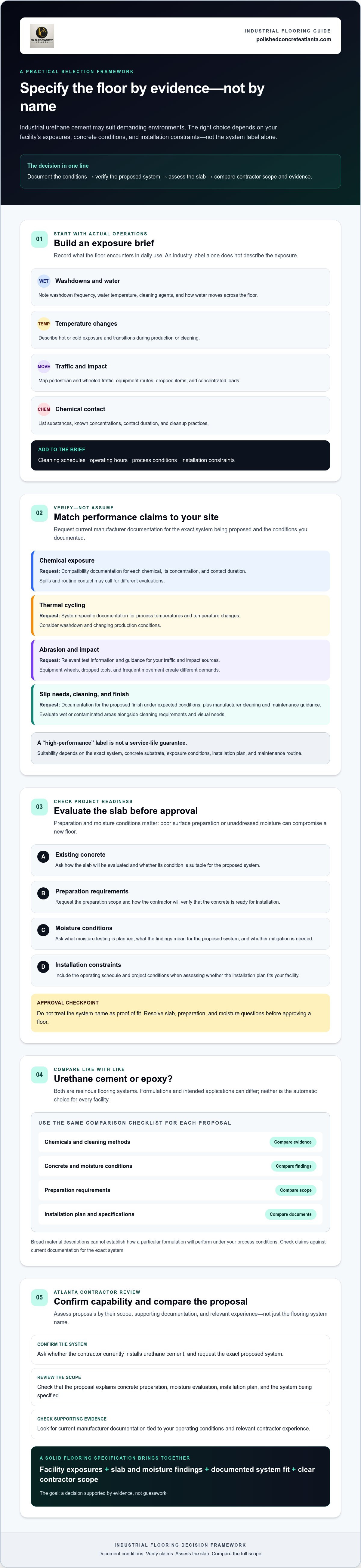
Assess actual operations rather than relying on the facility’s industry label. A production floor may face several exposures, so record the details before specifying a system:
- Wet processes: Record washdown frequency, water temperature, cleaning agents, and how water moves across the floor.
- Temperature changes: Note hot or cold exposure and transitions during operations or cleaning.
- Traffic and impact: Describe pedestrian and wheeled traffic, equipment routes, dropped items, and concentrated loads.
- Chemical contact: List substances, known concentrations, contact duration, and cleanup practices.
Include cleaning schedules and operating hours in your project brief. This helps a contractor assess exposure demands alongside slab conditions and installation constraints. Don’t rely on general claims of chemical, thermal, or impact resistance. Ask for product data that matches your documented conditions.
What Performance Claims Should You Verify Before Choosing Urethane Cement?
A “high-performance” label is not a service-life guarantee. Suitability depends on the exact system, concrete substrate, exposure conditions, installation plan, and maintenance routine. For industrial urethane cement flooring, request evidence tied to your facility rather than a generic claim about the product category.
Check each claimed property against current manufacturer documentation and your site conditions. Use the table to turn broad claims into specific questions:
| Decision factor | Evidence to request | Project implication |
|---|---|---|
| Chemical exposure | Compatibility documentation for each chemical, its concentration, and contact duration | Spills and routine contact may require different evaluations. |
| Thermal cycling | System-specific documentation for process temperatures and temperature changes | Washdown and changing production conditions may affect system selection. |
| Abrasion and impact | Relevant test information and guidance for your traffic and impact sources | Equipment wheels, dropped tools, and frequent movement create different demands. |
| Slip needs | Options and documentation for the proposed finish under expected conditions | Evaluate wet or contaminated areas alongside cleaning requirements. |
| Cleaning and appearance | Manufacturer guidance for cleaning agents, maintenance, and available finishes | Confirm the finish meets both operational and visual needs. |
Assess exposure and compare systems using evidence
Give the contractor a chemical list, cleaning procedures, temperature ranges, and operating schedule. Describe equipment traffic and likely impacts instead of assuming a universal threshold. OSHA’s walking-working surface requirements underscore the importance of maintaining floors and addressing hazards. The specific flooring system still needs to be evaluated for your use.
Compare urethane cement, epoxy, and other floor systems using the same criteria: documented suitability, substrate requirements, finish and maintenance needs, and installation constraints. Distinguish published product properties from contractor assumptions. Preparation also matters. Review this concrete surface preparation guide for context on the substrate’s role in coating performance.
For an Atlanta project, a discussion of floor preparation and moisture mitigation may help clarify those parts of the scope. Ask any contractor about experience with the exact system you’re considering, and confirm directly whether they install urethane cement.
How to Evaluate Your Slab and Project Before Specifying Urethane Cement
Choose a flooring system only after assessing the concrete it must bond to and the conditions it must withstand. A site review can reveal constraints that a product description won’t capture. Use this assessment to prepare a clear project brief before requesting a system recommendation.
Assess the slab and define the scope
- 1. Document operations. Record wet processes, chemical contact, equipment and pedestrian traffic, cleaning routines, and operating schedules. Note where exposures differ across the facility.
- 2. Inspect visible slab conditions. Photograph cracking, worn areas, previous coatings, contamination, adhesive residue, and known moisture concerns. These observations can inform further evaluation, but they don’t determine the repair plan on their own.
- 3. Discuss moisture evaluation. Ask what testing is appropriate for the slab and proposed system, who will conduct it, and how results will affect the recommendation. Testing and mitigation are project-specific. Don’t assume one method or result applies to every floor. This overview of key ASTM standards offers context on concrete preparation and moisture testing.
- 4. Define preparation requirements. Ask how the contractor will assess the existing surface, address coatings or contaminants, and determine the preparation needed. The proposed method should reflect the slab findings and system requirements.
- 5. Map the schedule. Identify access restrictions, shutdown windows, production schedules, and areas that may need phased work. Confirm local service coverage and site access for the Atlanta project.
- 6. Request system documentation. Get the exact proposed system, current manufacturer instructions, preparation and application requirements, and product-specific return-to-service information in writing. Clarify who is responsible for testing, preparation, installation, and final acceptance.
Turn site findings into a verifiable plan
Before approving industrial urethane cement flooring, ask how each site observation affects the proposed scope. A contractor should explain how slab conditions, preparation, and moisture findings relate to the selected system, rather than prescribe work without an assessment. For additional context on evaluating providers, review this Atlanta industrial flooring contractor guide.
Polished Concrete Atlanta offers services including floor preparation and moisture mitigation. For help with those parts of a project, discuss your concrete floor conditions with the company. Confirm directly whether it currently installs urethane cement before considering it as an installer.
How to Select an Atlanta Flooring Contractor and Confirm the Right Next Step
For industrial urethane cement flooring, look for a contractor who can connect the proposed system to your facility’s documented conditions and explain the scope clearly. A useful proposal identifies responsibilities, assumptions, and unanswered questions before you approve the work.
Contractor checklist before approval
- Relevant experience: Ask about comparable industrial applications and experience with the exact system proposed. Confirm who supplies the system and whether the installer has used it in similar conditions.
- Site-specific recommendation: Ask how the proposed system addresses your operations, exposure demands, existing slab, and facility requirements. Request explanations based on your project, not general claims about a flooring category.
- Complete written scope: Confirm what the proposal includes for substrate preparation, moisture evaluation, application, scheduling, and final acceptance criteria. Clarify responsibility for each task and what conditions could change the scope.
- Current documentation: Request the exact system name and current manufacturer documentation before approval. Check that the documents support the stated performance and installation requirements for your site.
- Clear communication: Look for direct answers about uncertainties, access needs, work sequencing, and how updates or changes will be handled. Ask that important assumptions and decisions be recorded in writing.
When to discuss an Atlanta project
Request a project discussion if the slab’s condition, moisture concerns, or operating demands make system selection uncertain. Prepare the facility’s use, Atlanta site location, existing-floor information, relevant exposure details, and required work windows. This gives a contractor a useful starting point and helps determine whether an on-site assessment is appropriate.
Polished Concrete Atlanta focuses on Atlanta and lists industrial coatings, floor preparation, concrete grinding, and moisture mitigation among its services. Ask directly whether the company currently installs urethane cement before considering it for that work.
Discuss your industrial flooring project and share the site details that will help clarify your needs. Confirm service availability and the proposed scope before moving forward.
Make the Flooring Decision With Clear Evidence
The right floor is the one supported by your facility’s actual operating conditions, not simply a demanding-sounding system name. For industrial urethane cement flooring, base the decision on documented exposure requirements, the existing slab, and current manufacturer information. A clear scope for preparation, moisture evaluation, installation, and acceptance makes it easier to compare proposals on meaningful terms.
For Atlanta facilities, Polished Concrete Atlanta lists industrial coatings, floor preparation, concrete grinding, and moisture mitigation among its capabilities. Ask the company directly whether urethane cement installation is currently available and verify its experience with the specific system under consideration.
Bring your operating details and slab information into the first project discussion. Discuss your industrial flooring project and clarify which services and system options fit the proposed scope. Then compare the recommendations against your facility’s needs and the system documentation.
Frequently Asked Questions
What is industrial urethane cement flooring?
Industrial urethane cement flooring is a resinous system made with polyurethane resin and cementitious components. Formulations and installation requirements vary by manufacturer, so the system name alone doesn’t show whether it suits a particular facility. Compare the proposed system’s documentation with your cleaning methods, temperature changes, chemical contact, traffic, and slab conditions. The project scope should also explain how the concrete will be evaluated and prepared.
Is urethane cement flooring better than epoxy?
Neither system is universally better. The right choice depends on the facility’s exposures and project requirements. Compare the exact systems for documented chemical and temperature suitability, substrate requirements, finish, maintenance, and installation constraints. For example, a floor exposed to frequent hot-water washdowns has different demands from one used mainly for dry storage and pedestrian traffic. Ask contractors to support their recommendations with current manufacturer documentation, not broad claims about a flooring category.
Can urethane cement flooring be installed over existing concrete?
It may be considered for existing concrete, but the slab must be evaluated before selecting a system. Cracks, previous coatings, contamination, adhesive residue, wear, and moisture concerns can affect preparation and recommendations. Ask what assessment or testing the proposed system requires, who will perform it, and how the findings will shape the scope. Don’t assume existing concrete is ready for a new floor without that review.
How long does urethane cement flooring take to install?
Installation and return-to-service timing depend on the exact system, slab condition, required preparation, project size, and installation plan. Ask for a written schedule that separates assessment, preparation, application, and the manufacturer’s stated return-to-service requirements. Share operating hours, access limits, shutdown windows, and any areas that may need phased work. Verify timing for the proposed system and site conditions rather than planning a production restart around a generic estimate.
Does urethane cement flooring resist chemicals and heat?
Performance depends on the exact formulation and the type, concentration, temperature, and duration of exposure. Request current manufacturer documentation that addresses the chemicals used at your facility and the temperature conditions the floor will encounter, including cleaning or washdown procedures. Also provide details about spills and cleanup practices. A general claim of chemical or heat resistance isn’t enough to confirm suitability for your operation.
How do I choose an industrial flooring contractor in Atlanta?
Compare Atlanta contractors by relevant project experience, site evaluation process, preparation scope, system documentation, schedule, and communication. Ask for the exact proposed system and current manufacturer information, and confirm who handles testing, preparation, installation, and acceptance. Polished Concrete Atlanta lists industrial coatings, floor preparation, concrete grinding, and moisture mitigation among its services. Ask the company directly whether it currently installs urethane cement and has experience with the proposed system.
Contact Polished Concrete Atlanta to discuss your Atlanta industrial flooring project, including your slab conditions, operating exposures, and preparation needs.


