

What if the concrete beneath your facility shapes the finish more than the color or gloss you choose? Diamond ground concrete finishes reveal the slab itself, so aggregate exposure, existing repairs, and surface variation all influence the final appearance. A sample that looks ideal in one area may not represent every section of the floor.
You can manage that uncertainty by knowing what to assess. This guide explains how aggregate exposure affects appearance, why existing slab conditions can make a finish look less consistent, and how grinding differs from polishing and grind-and-seal. It also covers how to weigh appearance against facility use and maintenance needs before selecting a finish.
For Atlanta commercial and industrial facilities, start with the slab and the demands of the space, not an expectation of a one-size-fits-all result. Polished Concrete Atlanta provides concrete grinding and polishing, along with staining and sealed-concrete options where appropriate. Here’s what to discuss with a finishing contractor before work begins, so you can set realistic expectations.
Key Takeaways
- Diamond ground concrete finishes vary with the slab, the selected level of aggregate exposure, and the intended result. Set expectations before choosing a look.
- Distinguish preparation grinding, polished concrete, and grind-and-seal by asking how each process treats the surface and what maintenance it calls for.
- Choose a finish by considering facility use, traffic, rolling loads, spills, cleaning routines, and acceptable disruption during the project.
- Ask an Atlanta contractor how they’ll assess the existing slab and address preparation, dust control, phasing, access, and facility coordination.
What Are Diamond Ground Concrete Finishes, and What Shapes Their Appearance?
Diamond grinding is a mechanical process that removes or refines concrete at the surface using diamond tooling. It describes how the slab is worked, not the finished appearance or flooring system. That distinction matters. Grinding alone doesn’t guarantee a glossy surface, a particular amount of exposed aggregate, or a uniform result. Those outcomes depend on the specified process and the condition of the concrete.
Diamond ground concrete finishes can look different from one facility to another because slabs vary in composition, color, prior treatments, repairs, and wear. The grinding process also affects what becomes visible. A clear specification helps distinguish the work being done from the appearance you want to achieve.
How does diamond grinding change an existing concrete floor?
Diamond tooling works across the concrete surface to remove material and refine or prepare it. Depending on the project conditions, grinding can reduce surface irregularities or remove existing coatings. How much material can be removed, and what the surface reveals, depends on the slab and project requirements. Don’t assume every area will look identical.
Grinding may prepare concrete for another treatment, or form part of a larger finishing process. It isn’t automatically a complete flooring system. Polished concrete, for example, involves further mechanical refinement to achieve a selected sheen. The term “ground” alone doesn’t specify that level of finish.
What determines the color, texture, and aggregate exposure?
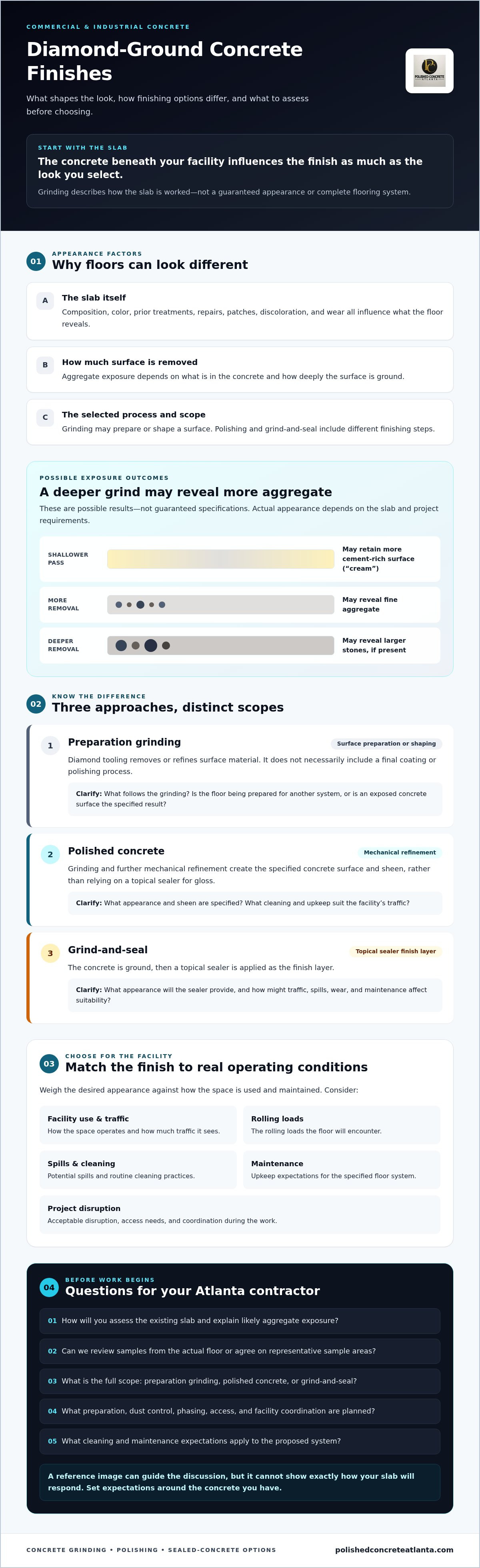
Aggregate exposure depends on what’s in the slab and how deeply its surface is ground. A shallow pass may retain more of the cement-rich surface, often described as a cream appearance. Greater removal may reveal fine aggregate or larger stones, if they’re present in the concrete. These are possible outcomes, not guaranteed specifications.
Existing repairs, patches, discoloration, and past coatings can affect color and consistency. Before committing to a look, ask the contractor to assess the slab and explain what exposure terms mean for your project. Where practical, review samples from the actual floor or agree on representative sample areas. A reference image can guide the discussion, but it can’t show exactly how your slab will respond. Set expectations based on the concrete you have.
How Do Grinding, Polishing, and Grind-and-Seal Finishes Differ?
These terms describe different scopes of work, not interchangeable names for the same floor. Diamond grinding may be preparation only, while polishing and grind-and-seal include distinct finishing steps. The right approach depends on the appearance you want, how the facility operates, and the slab’s condition. You can read more about specialized concrete polishing, floor preparation, and surface treatments to see how each method transforms a slab.
| Approach | Process and surface treatment | Appearance and maintenance questions |
|---|---|---|
| Preparation grinding | Diamond tooling removes or refines surface material to prepare or shape the concrete. This doesn’t necessarily include a final coating or polishing process. | What follows the grinding? Is the floor being prepared for another system, or is the specified result an exposed concrete surface? |
| Polished concrete | Mechanical grinding and further refinement create the specified concrete surface and sheen, rather than relying on a topical sealer for gloss. | What appearance and level of sheen are specified? What cleaning and upkeep suit the facility’s traffic? |
| Grind-and-seal | The concrete is ground, then a topical sealer is applied as the finish layer. | What appearance will the sealer provide, and how might traffic, spills, wear, and maintenance affect its suitability? |
Performance depends on the complete floor system and site conditions, including slab condition, facility use, cleaning practices, and the specified products and scope. For industry context on polished-floor specifications and related technical topics, consult the ASCC technical standards. Ask the contractor to identify the proposed system and explain its maintenance expectations.
When is a ground finish different from polished concrete?
Grinding can prepare or shape a surface without completing a polishing process. Polished concrete involves additional mechanical refinement to reach a specified finish. If you’re comparing options for an Atlanta facility, review the separate polished-concrete facility guide for broader selection considerations, and ask the contractor to define the full scope in writing.
When should a facility consider grind-and-seal?
Consider grind-and-seal when a topical sealer is part of the intended system, then assess whether its expected appearance and upkeep fit your operation. Ask how the proposed floor is expected to respond to your traffic, rolling loads, spills, and cleaning routine. For related surface-treatment questions, review guidance on sealed concrete and confirm how the proposed sealer changes the project scope.
How Can You Choose a Diamond Ground Finish for a Commercial Facility?
Choose in sequence: define how the floor must perform, assess the existing slab, select a target appearance, review a representative sample, then confirm the full scope. This keeps design preferences grounded in the concrete’s condition and the demands of daily operations. For polished-floor specifications and technical context, consult resources from the American Concrete Institute.
What should facility managers assess before selecting a finish?
Separate visual priorities from operating requirements. Decide whether you prefer a more uniform, cement-rich look or visible aggregate, then consider how the space is used. A warehouse with frequent forklift traffic has different demands from a customer-facing lobby. Discuss foot and rolling traffic, likely spills, cleaning routines, and the level of sheen or texture that suits the facility.
Why request a sample area or finish mockup?
A photograph or generic sample can’t show exactly how your slab will respond. Review a representative area under the facility’s lighting to judge aggregate exposure, color variation, and texture. Confirm that the sample uses the existing concrete and reflects the agreed preparation and finish scope.
A representative onsite sample gives you a practical reference for how the actual slab looks under your facility’s lighting before the full floor is specified. It won’t make every area identical, but it helps decision-makers compare the proposed appearance with the concrete in place. Record the accepted appearance, known slab variations, and agreed scope before work proceeds.
- Define use: Document traffic, rolling loads, spills, and cleaning routines.
- Assess conditions: Review coatings, adhesive residue, cracks, repairs, and moisture concerns.
- Select and verify: Agree on the appearance, evaluate a representative sample, and confirm the scope and operational plan.
For diamond ground concrete finishes, a site assessment and finish discussion can help clarify which approach fits the slab and facility requirements. Discuss your concrete floor requirements with a finishing contractor.
What Should Atlanta Businesses Expect From a Diamond Grinding Contractor?
A useful assessment starts with the slab, not a promise of a particular finish. For Atlanta commercial and industrial facilities, an onsite review helps connect the concrete’s current condition with the appearance and performance requirements of the space. It also gives facility teams a chance to raise operational constraints before the proposed scope is finalized.
What should an Atlanta floor assessment establish?
The contractor should document existing finishes, visible repairs, cracks, adhesive or coating residue, and moisture concerns, then discuss how the floor is used. A distribution area with rolling loads and frequent traffic may call for different priorities than a reception space. Ask what additional preparation may be needed and which conditions could affect the expected appearance.
Discuss a representative sample area, including how it will reflect the existing slab and proposed scope. Before approving work, clarify sequencing, access requirements, dust-control measures, phasing, and coordination with facility operations. Ask how the plan accounts for areas that need to remain accessible and what disruption to plan for. For more detail on preparation considerations, consult the concrete surface preparation guide.
How can Polished Concrete Atlanta help evaluate finish options?
Polished Concrete Atlanta serves commercial and industrial facilities in Atlanta and has operated since 2004. Its services include concrete grinding and polishing, sealed concrete, floor preparation, and moisture mitigation. Which options fit depends on the assessment. Discuss preparation and moisture mitigation when site conditions make them relevant, rather than assuming they are automatic parts of every project.
A useful finish discussion should clarify whether the goal is preparation grinding, polished concrete, or a ground surface with a sealer. It should also document the proposed process, appearance expectations, and maintenance considerations. Diamond ground concrete finishes reflect both the chosen scope and the existing slab. An assessment helps inform the decision, but doesn’t guarantee a uniform result.
Atlanta facility teams can discuss slab condition, finish goals, traffic demands, and access constraints with Polished Concrete Atlanta. Bring photos or maintenance concerns if useful, and ask what an onsite review can establish before you commit to a scope. First get clear answers, then decide whether the proposed approach fits your facility.
Make Your Concrete Finish Decision With Confidence
The right finish starts with a realistic view of the slab and a clear understanding of how the floor needs to perform. Diamond ground concrete finishes can vary in appearance, so define your priorities, compare the complete finishing approaches, and confirm expectations with a representative sample and a documented scope.
For Atlanta facilities, an onsite assessment can help connect the existing concrete’s condition with operational needs. Polished Concrete Atlanta provides concrete grinding, polishing, sealed concrete, and floor preparation services for commercial and industrial facilities. A direct conversation can help clarify which options may suit your project without assuming the slab will produce a particular result.
Bring your finish goals, traffic concerns, and project constraints to the discussion. Discuss your Atlanta facility’s concrete finish options with Polished Concrete Atlanta. A careful assessment and clear questions can help you choose an approach that reflects the realities of your space.
Frequently Asked Questions
What does a diamond ground concrete finish look like?
It can range from a relatively smooth, cement-rich surface to concrete with visible fine or larger aggregate. The appearance depends on the slab’s composition and how much surface material is removed. Grinding alone doesn’t determine gloss. Some diamond ground concrete finishes are further polished or sealed, which are distinct finishing choices. Existing patches, discoloration, and prior treatments can also affect the floor’s color and consistency.
Is diamond-ground concrete the same as polished concrete?
No. Diamond grinding describes mechanical work on the concrete surface, while polished concrete is a finishing approach that involves further mechanical refinement to achieve a specified appearance and sheen. Grinding may prepare a floor for another treatment without creating a polished finish. Grind-and-seal is different again: the surface is ground, then a topical sealer is applied. Ask the contractor to specify the complete process and surface treatment.
Can every existing concrete floor achieve the same diamond-ground finish?
No. Slabs vary in composition, previous coatings or adhesives, repairs, wear, and surface condition, so the same process may not produce identical results across floors or areas. The amount and type of visible aggregate also depend on what’s in the concrete and how deeply the surface can be ground. An assessment of the existing slab, followed by a review of a representative sample, helps set realistic appearance expectations before you confirm the scope.
Is diamond-ground concrete suitable for a commercial facility?
It can be, but suitability depends on the complete floor system and facility conditions, not on grinding alone. Consider foot traffic, rolling loads, spills, cleaning routines, and the appearance required in each area. Also clarify whether the project involves preparation grinding, polished concrete, or a ground-and-sealed surface. An Atlanta contractor can assess the existing concrete and discuss options in relation to operating needs and maintenance expectations.
How do you choose the right aggregate exposure for a concrete floor?
Start with the look you want, then confirm whether the existing slab can reasonably support it. A cream-style appearance exposes less aggregate, while deeper grinding may reveal fine stones or larger pieces if they’re present. Ask the contractor to define exposure terms for your project instead of relying on labels alone. Reviewing a representative sample under the facility’s lighting can help you compare texture and color variation before approving the finish.
What should Atlanta businesses ask a concrete grinding contractor?
Ask how the contractor will assess the slab, including existing coatings, glue residue, repairs, and moisture concerns, and what finish the proposed scope will deliver. Discuss sample areas, dust control, preparation, phasing, access, and coordination with facility operations. Confirm expected maintenance and how traffic or rolling loads factor into the recommendation. For an Atlanta commercial project, clear answers help align the selected finish with both the concrete’s condition and the facility’s day-to-day requirements.


