
What if the crack in your warehouse floor is a symptom, not the whole problem? Cracks, spalling, uneven areas, and worn surfaces can disrupt vehicle movement, production, cleaning, or access. The visible damage may not show what caused it. A practical plan for industrial concrete floor repair Atlanta facilities need starts with the floor’s condition and how each area is used.
Restoring dependable floor performance begins with choosing work that suits the existing concrete. A finish or surface treatment cannot address every underlying slab condition, so separate surface preparation and finishing needs from defects that require a different repair approach.
This guide covers common signs of floor damage, factors to consider when planning restoration, and how grinding, leveling, moisture mitigation, and preparation relate to polished, sealed, stained, or epoxy finishes. Use these steps to build a project plan around your Atlanta facility’s operations and the condition of its existing floor.
Key Takeaways
- Identify whether cracks, spalling, unevenness, or surface wear affect movement, cleaning, safety, or daily facility use before selecting a treatment.
- Match industrial concrete floor repair Atlanta needs to the floor’s condition: grinding prepares the surface, while leveling and moisture mitigation address different requirements.
- Compare polishing, sealing, staining, and epoxy flooring by the needs of your facility rather than treating them as interchangeable finishes.
- Map vehicle routes, pedestrian access, production zones, and storage areas to plan work around facility operations.
- Build a restoration plan around the existing concrete, thorough preparation, and a finish suited to how the floor is used.
Industrial Concrete Floor Repair in Atlanta: Identify the Damage Before Choosing a Fix
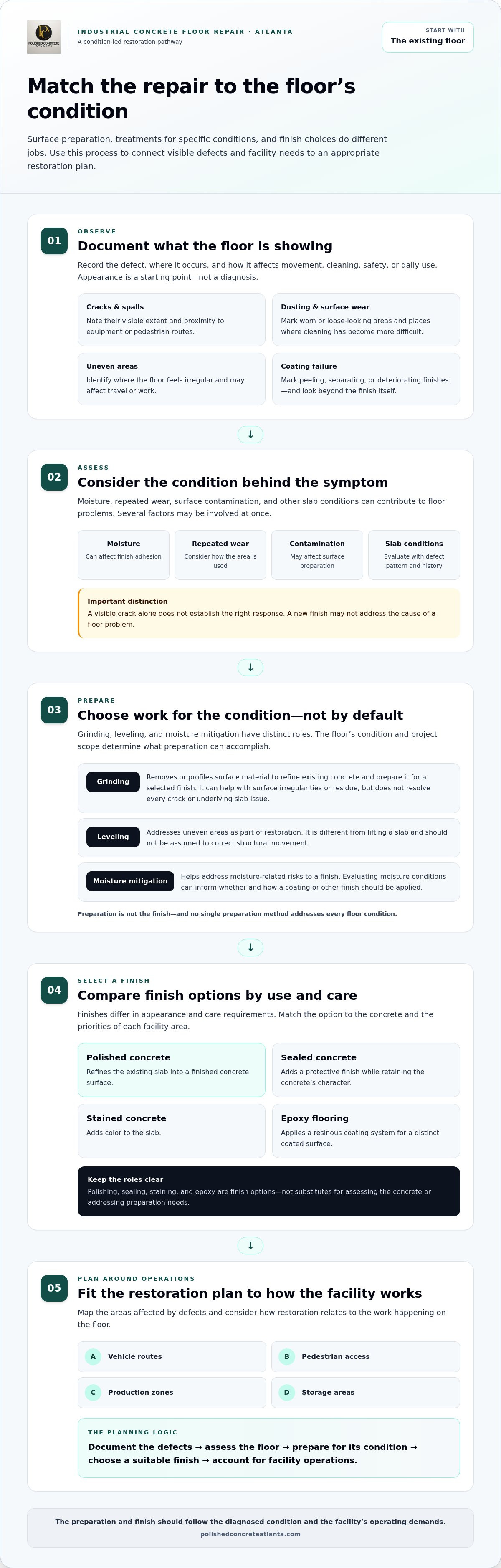
A damaged industrial floor can slow equipment, complicate cleaning, and interfere with pedestrian movement. A crack across a forklift route or spalling beside a production area can disrupt daily operations. Industrial concrete floor repair Atlanta facilities need should begin with documenting the visible condition and how it affects use. Different defects call for different responses, and a finish alone may not address the cause.
Look for cracks, spalling, worn surfaces, uneven areas, dusting, and coating failure. These signs help define the issue, but appearance alone may not reveal whether damage is limited to the surface or relates to a deeper slab condition. Record what you see before deciding on preparation or a finish.
Which concrete floor defects disrupt Atlanta facilities most?
Cracks, spalls, and broken edges can interrupt forklift, cart, and foot-traffic routes in warehouses, manufacturing spaces, and commercial facilities. Dusting and worn finishes can increase housekeeping demands. Residue or a failing coating may make cleaning more difficult or interfere with normal floor use. Note where each defect occurs and whether it affects travel paths, work zones, or storage areas.
- Cracks and spalls: Record their locations, visible extent, and proximity to equipment or pedestrian routes.
- Dusting and surface wear: Note where the surface appears worn or loose, or where cleaning has become more difficult.
- Uneven areas or coating failure: Mark where the floor feels irregular or the finish is peeling, separating, or deteriorating.
What does a floor defect reveal about its cause?
A visible symptom is a starting point, not a diagnosis. Moisture, repeated wear, surface contamination, and other slab conditions can contribute to floor problems, and several factors may be involved at once. For context on the causes of concrete degradation, concrete can be affected by chemical reactions, reinforcement corrosion, and physical damage. The relevant cause depends on the floor’s condition and history.
Recurring coating failure deserves particular attention. Peeling or separation can point to preparation or slab conditions that affect adhesion, so look beyond the finish itself. A floor defect is a symptom; the next step is to understand the condition behind it. That distinction helps prevent a new finish from being applied without addressing the factors that contributed to the problem.
How Industrial Concrete Floor Repair Methods Address Different Conditions
After documenting the floor, distinguish between surface preparation, treatments for specific conditions, and the final finish. Grinding, leveling, and moisture mitigation serve different purposes. Polishing, sealing, staining, and epoxy describe finish options, not substitutes for assessing the concrete. For industrial concrete floor repair Atlanta facilities, the right sequence depends on the slab and how the space is used.
When are grinding, leveling, or moisture mitigation relevant?
Grinding removes or profiles surface material to refine existing concrete and prepare it for a selected finish. It can help address surface irregularities or residue, but it does not resolve every crack or underlying slab issue. Leveling addresses uneven areas as part of floor restoration. It is different from lifting a slab and should not be assumed to correct structural movement. The floor’s condition and the project scope determine what the work can accomplish.
Moisture mitigation helps address moisture-related risks to a floor finish. Evaluating moisture conditions can inform whether and how a coating or other finish should be applied. If moisture affects adhesion, it can contribute to finish problems, so include moisture considerations in the preparation plan.
When should a facility consider polishing, sealing, or epoxy?
Once preparation needs are clear, choose a finish that suits both the concrete and the facility’s priorities. Polished concrete refines the existing slab into a finished concrete surface. Sealed concrete adds a protective finish while retaining the concrete’s character. Epoxy flooring applies a resinous coating system for a distinct coated surface. Stained concrete adds color to the slab. These options differ in appearance and care requirements, so compare them against how each area is used and maintained.
Concrete floors can develop cracks, but a visible crack alone does not establish the right response. The ACI Guide to Concrete Floor and Slab Construction provides industry guidance for understanding concrete floor performance. Consider the defect pattern, slab condition, and facility requirements together when planning restoration.
The preparation and finish should follow the diagnosed condition and the facility’s operating demands. This keeps the work aligned with the floor’s needs instead of relying on a one-size-fits-all approach. Polished Concrete Atlanta provides industrial concrete floor restoration using services such as grinding, preparation, moisture mitigation, and commercial floor finishes.
Plan an Atlanta Industrial Floor Repair Project Around Facility Operations
A practical project plan accounts for both the floor and the work happening on it. For industrial concrete floor repair, Atlanta facilities can organize planning around five steps: document defects, identify operational priorities, determine preparation needs, select a treatment and finish, and review the completed areas. The scope and sequence depend on site conditions, including moisture and surface preparation needs.
What should facility teams document before work begins?
Start with a floor map. Mark defect locations, approximate dimensions, nearby joints, and areas where wear repeatedly appears. Add context about vehicle and pedestrian traffic, cleaning routines, and any exposure conditions relevant to the floor. These details connect the observed condition to how each area is used and help clarify which areas need attention first.
Then note site constraints. Identify access points, production zones, storage areas, and sections that need to remain operational. Record where equipment or materials may need to move and which routes must stay clear. This article on repairing cracks and pitting in concrete also discusses why sound floor surfaces matter in settings where cleanliness and food safety are priorities.
How can an Atlanta facility limit disruption during floor work?
Divide the floor plan into practical work zones and map alternate routes around areas scheduled for treatment. For example, mark active vehicle paths separately from pedestrian access, and identify production or storage areas that need coordinated access. This makes the impact of each phase easier to anticipate. In Atlanta-area commercial and industrial facilities, site access, material movement, and the relationship between work zones and daily operations belong in the project plan.
Coordinate the sequence with facility schedules and communicate which areas are affected at each stage. Preparation needs, moisture conditions, and the selected treatment all shape the work plan, so avoid assuming that every floor or finish follows the same sequence. Clear documentation and realistic coordination can reduce avoidable surprises while helping teams plan around affected areas.
After treatment, review the completed areas against the original floor map and intended use. Check transitions, access routes, and work zones before returning those areas to normal use. Plan your Atlanta facility’s floor restoration around its existing concrete and operational needs.
Restore Existing Industrial Concrete Floors in Atlanta With a Fit-for-Purpose Finish
A useful restoration plan connects four decisions: the condition of the existing concrete, how the facility uses each area, what preparation the slab needs, and which finish suits those priorities. For industrial concrete floor repair Atlanta projects, considering these factors together helps avoid choosing a finish before the floor is ready for it.
Polished Concrete Atlanta works on existing commercial and industrial floors through concrete grinding and leveling, floor preparation, floor glue removal, and moisture mitigation. Each service addresses a different need: grinding refines or profiles the surface, leveling addresses uneven areas, glue removal clears residue from prior flooring, and moisture mitigation addresses moisture-related finish concerns. The right combination depends on the slab and the intended finish.
Which finish best fits an industrial facility’s priorities?
There is no universal best finish. Consider the appearance you want, the cleaning routine, and how each area is used:
- Polished concrete refines the existing slab into a finished concrete surface. It may suit spaces where the concrete itself is the desired finish.
- Sealed concrete adds a finish to prepared concrete while retaining its natural character.
- Stained concrete changes the slab’s appearance with color, making it an option when visual definition is part of the project.
- Epoxy flooring creates a resinous coated surface for facilities whose finish requirements call for a coating system.
The substrate matters. Surface wear, uneven areas, old adhesive, and moisture conditions can affect preparation and influence which finish makes sense. Choose a finish after considering the concrete’s condition, not instead of assessing it.
What is the next step for an Atlanta floor restoration project?
Bring together a clear record of the floor issues, the operational requirements of each area, and your project priorities. Identify the finish characteristics that matter most, including the surface appearance and how it fits your cleaning practices. Polished Concrete Atlanta tailors floor preparation and finishing to the project, aligning grinding, leveling, glue removal, and moisture mitigation with the condition of the existing slab.
With the floor’s condition and operational needs documented, define a restoration scope around your facility rather than relying on a one-size-fits-all fix. Discuss your industrial concrete floor project.
Put Your Atlanta Floor Restoration Plan Into Motion
Durable restoration starts with understanding what visible damage may indicate, then matching preparation and finish choices to the concrete and the facility’s daily demands. Cracks, wear, uneven areas, and coating failure call for careful assessment, not an automatic one-size-fits-all fix. That is the foundation of a practical plan for industrial concrete floor repair Atlanta facilities can build around their operations.
Polished Concrete Atlanta provides industrial floor preparation and finishing, including grinding, leveling, glue removal, and moisture mitigation, with polishing, sealing, staining, or epoxy flooring selected to suit the project. The restoration scope should reflect the existing floor conditions and the facility’s priorities.
Bring your floor concerns and operational needs together to plan the next step. Discuss your Atlanta industrial floor restoration project with Polished Concrete Atlanta.
Frequently Asked Questions
How do you repair a damaged industrial concrete floor?
Start by documenting the type and location of the damage, how it affects facility operations, and whether it appears limited to the surface. Cracks, spalling, wear, uneven areas, and coating failure may call for different responses. Industrial concrete floor repair Atlanta projects can include grinding to prepare the surface, leveling uneven areas, moisture mitigation, and a suitable finish such as polished, sealed, stained, or epoxy flooring. The right scope depends on the existing slab and intended use.
What causes spalling in industrial concrete floors?
Spalling occurs when the concrete surface flakes, chips, or breaks away. Potential contributors include repeated impact or abrasion, moisture-related deterioration, chemical exposure, and corrosion of reinforcement. Appearance alone cannot confirm the cause. Note where spalling occurs, whether it is recurring, and whether it is near joints, equipment routes, or areas exposed to particular conditions. Understanding the likely contributors helps guide the next steps instead of simply covering the damaged area with a finish.
Can an existing concrete floor be repaired without replacing the slab?
Some existing floors can be restored without replacing the slab, depending on the extent and nature of the damage. Work may focus on preparing the surface, addressing uneven areas, mitigating moisture concerns, and applying an appropriate finish. Polished Concrete Atlanta works with existing commercial and industrial concrete through grinding, leveling, floor preparation, and finishing. The floor’s condition and intended use help determine whether restoration is a suitable approach.
How do you fix an uneven industrial concrete floor?
Document where the floor is uneven and how the variation affects equipment, pedestrian routes, or work areas. Concrete floor leveling can address uneven areas as part of a restoration plan, but it is not the same as lifting a settled slab and should not be assumed to correct structural movement. The suitable approach depends on the existing concrete and project scope. Assessing the floor first helps define realistic expectations for the finished surface.
How long does industrial concrete floor repair take?
There is no single timeline for every industrial floor project. The work plan depends on the affected area, existing concrete conditions, preparation requirements, moisture mitigation needs, selected finish, and how the work is coordinated with facility operations. Access constraints and the finish requirements also shape the sequence. Plan around the project scope and the areas affected rather than a generic completion estimate.
What is the difference between concrete floor repair and resurfacing?
Concrete floor repair addresses a specific defect or condition, while resurfacing generally means renewing a broader floor surface with a new finish or surface treatment after preparation. The terms can overlap in restoration projects, but neither describes one universal method. Grinding, leveling, or moisture mitigation may be part of preparing existing concrete, while polishing, sealing, staining, or epoxy flooring provides a finish selected for the slab and the facility’s priorities.


