

For veterinary clinics in Atlanta, a seamless epoxy floor can make routine cleaning more manageable while standing up to water, oils, chemicals, stains, and everyday abrasion. Epoxy flooring for veterinary clinics in Atlanta gives practices a surface designed for demanding daily use. Cracks and seams can hold residue and odors, while a continuous coating gives clinic teams a more straightforward surface to clean.
Not every finish suits every room. A surface with more slip resistance can be harder to clean, so the right system balances traction with practical maintenance for the work taking place there. Choosing epoxy flooring for veterinary clinics in Atlanta means weighing each room’s needs rather than selecting one finish for the entire clinic.
This guide explains how seamless epoxy supports cleaning, what resistance to common clinic exposures means in practice, and which surface considerations matter in treatment areas, kennels, and other animal-care spaces. It also covers how preparation and finish selection shape the result, helping you make an informed decision for your Atlanta facility.
Key Takeaways
- A seamless coating helps limit liquid penetration and makes routine floor cleaning more manageable.
- Surface texture can involve a practical trade-off, as slip-resistant floors may be harder to clean.
- Choose a finish with the clinic’s daily traffic, spills, and cleaning needs in mind.
- Careful floor preparation supports a sound finish, while seams and floor-to-wall transitions deserve attention in washdown areas.
- Learn which cleaning methods suit coated floors and how consistent maintenance can help preserve the surface.
Resistance to water, oil, chemicals, stains, and abrasion
Veterinary floors face more than ordinary foot traffic. During a normal shift, water, oils, animal waste, urine, disinfectants, and cleaning products can reach treatment-room floors. Epoxy coatings provide a resistant surface that helps limit liquid penetration and staining. That matters because unprotected concrete is porous, and cracks and seams can collect residue and odors. Epoxy flooring for veterinary clinics in Atlanta should suit the substances and daily routines in each room.
Water resistance supports frequent cleaning, including washdowns and sanitizer use. A sealed coating helps prevent water and bodily fluids from seeping into the floor structure. For example, after a urine spill, staff can remove the waste and clean the surface instead of dealing with liquid absorbed into porous concrete. The coating also resists common products used for animal-waste cleanup and sanitizing. Prompt cleanup remains part of effective floor care.
Chemical resistance is useful wherever staff handle harsh cleaners, corrosive liquids, or substances used in routine clinic work. Epoxy and urethane floor-coating systems resist many chemicals used in veterinary clinics and cleaning. Their stain resistance helps limit visible marks from spills. Resistance does not mean a floor never needs attention: remove spills and follow cleaner directions to maintain the surface and support the clinic’s cleaning routine.
Constant movement adds another demand. Epoxy-coated floors are described as better able to withstand constant paw-and-claw traffic than laminate or tile. This can help maintain a consistent finish as animals move between examination, treatment, and kennel areas. Carts, equipment, staff footwear, and patient movement also contribute to wear. The coating system, floor preparation, and room use all affect performance.
Traction requires a deliberate balance. Epoxy can be designed with different surface roughness levels to meet varying slip-resistance needs for people and animals. A smoother finish is generally easier to wipe and scrub; a more textured finish can provide added grip but may trap residue. For epoxy flooring for veterinary clinics in Atlanta, choose a surface that reflects the room’s traffic, spill exposure, and cleaning method.
- Consider the task: identify where animals walk, turn, or stand during care.
- Consider cleanup: account for water, urine, waste, oils, and disinfectants used in each room.
- Balance texture: choose a surface profile that supports traction without making routine cleaning impractical.
These decisions matter throughout animal-care facilities, from examination rooms to kennels. A suitable finish combines resistance to water, chemicals, stains, and abrasion with a texture staff can clean effectively. Matching the surface to each room’s traffic and cleaning demands makes the floor more practical for daily clinic work.
Cleaning and maintenance
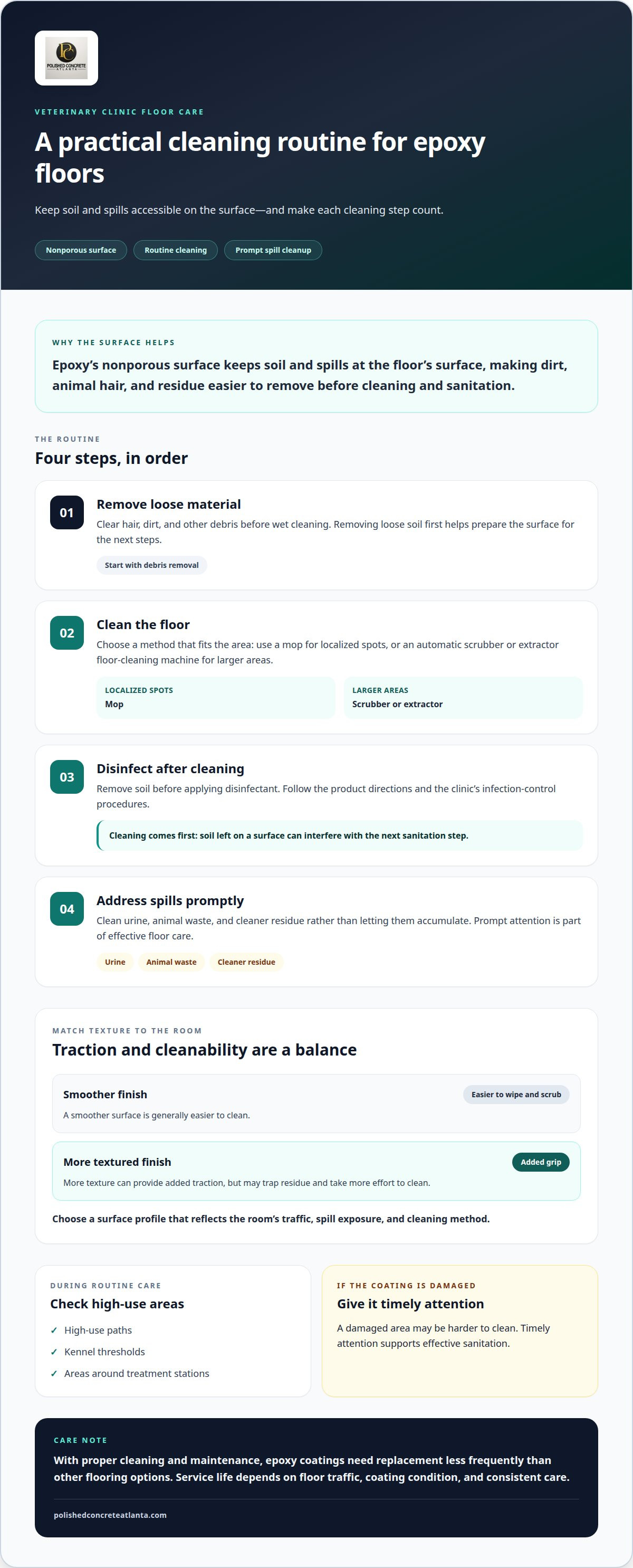
Epoxy floors simplify routine cleaning because their nonporous surface keeps soil and spills at the surface. In veterinary environments, this makes it easier to remove dirt, animal hair, and residue before cleaning and sanitation. A practical routine still matters: clear loose debris first, then wash the floor using the clinic’s established process.
Match the cleaning method to the task. A mop can handle localized spots, while automatic scrubbers and extractor floor-cleaning machines can clean larger areas. For example, a kennel aisle with tracked-in dirt may need mechanical cleaning, while a small examination room may need spot cleaning between broader cleaning cycles. Remove visible residue rather than letting it build up.
Disinfection follows cleaning. Soil left on a surface can interfere with the next sanitation step, so remove it before applying a disinfectant. Use the product according to its directions and the clinic’s infection-control procedures. Epoxy coatings can withstand deep cleaning and sanitizers because they are water-resistant, making them suitable for repeated cleaning in busy care facilities.
Nonporous resin coatings also restrict mold, bacteria, and pathogen growth to the flooring surface, where normal cleaning practices can remove them. This does not replace cleaning or disinfection. Instead, it helps avoid the challenge of porous or damaged flooring that can be difficult to clean effectively. A surface that keeps spills and residue accessible can support clinic cleaning routines.
- Remove loose material: clear hair, dirt, and other debris before wet cleaning.
- Clean the surface: use a mop for spots or a scrubber for larger floor areas.
- Disinfect after cleaning: follow product directions and clinic procedures.
- Address spills promptly: clean urine, animal waste, or cleaner residue rather than leaving it to accumulate.
How long does epoxy flooring last in a veterinary clinic, and what maintenance does it need? With proper cleaning and maintenance, epoxy coatings need replacement less frequently than other flooring options. Service life depends on floor traffic, coating condition, and consistent care, including regular cleaning and prompt attention to spills.
Inspect high-use paths, kennel thresholds, and areas around treatment stations during routine floor care. If a coating becomes damaged, that area may be harder to clean, so timely attention supports effective sanitation. Cleanability also depends on texture: heavily textured surfaces may take more effort to clear of residue than smoother finishes.
When planning a floor upgrade, include substrate preparation in the cleaning conversation. A well-prepared surface supports a sound coating system, while proper maintenance helps preserve its cleanable finish. Explore floor preparation options as part of planning a durable, easy-to-clean clinic floor.
Why Install Animal Care Facility Epoxy in Atlanta Northwest?
Animal-care floors must withstand repeated movement from patients, staff, carts, and cleaning equipment. In an Atlanta veterinary hospital, busy paths often run between reception, examination rooms, treatment areas, and kennels. A durable floor finish can help concrete surfaces handle constant traffic while supporting routine cleaning. The key is matching the coating system to each room’s use, rather than treating every area alike.
Paws and claws create a different kind of wear from shoes alone. Epoxy-coated floors are described as more resistant to constant paw-and-claw traffic than laminate or tile. This can matter where dogs turn repeatedly near kennel doors or animals walk between treatment stations. A suitable finish should also account for people pushing carts and moving equipment along the same routes.
Start by mapping the clinic’s traffic patterns. Identify entrances that collect outdoor dirt, corridors used for animal transfers, and kennel areas with frequent movement. Then consider each area’s cleaning demands and desired traction. For example, a busy corridor may need a finish that balances wear resistance with easy maintenance, while a kennel may need a surface suited to washdowns.
Which Atlanta contractors install epoxy flooring in veterinary clinics, and how do their warranties compare? Trusted professionals like Polished Concrete Atlanta install these systems, and warranty comparisons depend on each written warranty’s coverage, exclusions, and claim process. Review the terms side by side to understand what each warranty covers.
What Atlanta or Georgia health, building, and veterinary facility rules affect clinic flooring? Requirements can depend on the facility area and the work being performed, including applicable building requirements and clinic infection-control procedures. When planning flooring, consider cleanability, floor condition, and how each space is used.
What are the risks of epoxy flooring, including VOCs, curing time, and installation downtime? VOC emissions depend on the selected coating system, while installation often takes three days and curing often requires a 2-3 day period. During that work and cure, affected areas may be unavailable, so plan clinic operations around the installation sequence.
- Map traffic: note animal routes, staff corridors, and cart paths.
- Match the finish: consider cleaning demands and traction by room.
- Plan access: account for installation and curing before scheduling clinic use.
These practical steps connect durability with daily operations. In Atlanta animal-care facilities, a flooring plan should reflect actual traffic, room function, and cleaning routines. This supports hard-working surfaces while accounting for the demands of hospitals, kennels, and treatment spaces.
The American Animal Hospital Association’s Infection Control, Prevention, and Biosecurity Guidelines are dated 2018; porous or damaged surfaces are difficult or impossible to clean and disinfect effectively.
Seamless resin floors for veterinary clinics and animal hospitals
A seamless resin surface addresses a weakness of porous concrete: cracks and joints can collect residue. The right system and edge details make cleaning more straightforward throughout a veterinary facility.
Floor and Wall Cove Requirements
For a Georgia clinic, consider an integral epoxy floor-to-wall cove in kennels and other areas that receive washdowns. The curved transition reduces the hard-to-clean floor-wall corner and helps create a more seamless surface. Cove height and placement should suit the room’s cleaning method, equipment, and wall layout, especially where staff use hoses.
A cove is a practical design feature, not a substitute for reviewing applicable facility requirements. In a kennel, consider how water moves toward drains and whether the floor-wall junction remains accessible for cleaning. Treatment rooms with less frequent washdowns may need different edge details than animal-holding areas.
Installation Across Clinic Areas
Installation starts with the existing concrete, since the coating is applied directly to it. The floor’s condition and the room’s use shape preparation and system selection. Plan treatment rooms, kennels, and surgical areas separately, considering traffic, cleaning methods, transitions, and washdown needs.
During planning, identify fixed equipment, drains, door thresholds, and wall junctions. These details affect how the installer can create continuous coverage. In a kennel, coordinate the cove with washdown areas; in a treatment room, consider where staff move patients and equipment. This room-by-room approach aligns the flooring solution with actual use.
What epoxy flooring systems are best for veterinary clinics? Epoxy and urethane floor-coating systems resist many chemicals used in clinics and for cleaning and sanitizing. Choose a system according to each area’s exposure, desired traction, and cleaning routine.
Seamless coverage also matters during daily cleaning. Unprotected concrete is porous and can absorb substances, while cracks and seams may hold odors and germs. A coating helps block mold, mildew, and microbes from entering the porous concrete beneath it. Antimicrobial protection can also be incorporated into concrete coating systems for added pathogen control.
In surgical and treatment areas, match the finish to the room’s movement and cleaning needs. Kennels may call for a floor-to-wall cove and surfaces suited to washdowns, while patient-care spaces need practical routes around equipment. A carefully planned installation connects these details across the facility instead of treating the floor as a single specification.
Plan a seamless clinic flooring project around your rooms’ concrete, cleaning routines, and transitions.
Epoxy floors are described as resistant to thermal shock and able to handle hot-water washdowns in veterinary hospitals and animal-care facilities. Consider this feature when evaluating a floor system for areas where hot-water washdowns are part of the cleaning approach. The selected system should suit the room’s use and planned cleaning routine, alongside the seamless coverage and edge details under consideration.
Epoxy clinic floors can be customized in different colors and patterns. Consider visual choices alongside each room’s intended use, traffic, cleaning method, and transitions between spaces. Color and pattern can also be coordinated across treatment rooms, kennels, and other animal-care areas while keeping practical floor requirements in view.
Polished Concrete Atlanta: Epoxy Flooring
Polished Concrete Atlanta helps veterinary facilities plan epoxy flooring around room use, concrete condition, cleaning routines, and transitions. Turn to the team when weighing a seamless finish for treatment rooms, kennels, or other animal-care areas, or when existing concrete needs preparation before coating.
Floor Preparation is an important part of planning: the concrete must be addressed before the coating system is applied. Polished Concrete Atlanta also offers Polished Concrete Floors and Stained Concrete for facilities considering different concrete finishes.
For a project discussion focused on your clinic’s flooring needs, contact Polished Concrete Atlanta.
Plan the Next Step for Your Clinic Floor
Turn your flooring decision into a room-by-room plan. Identify which spaces need a new surface first, what each area must withstand, and how staff use it during a typical workday. This practical brief gives the installation team a clear basis for discussing epoxy flooring for veterinary clinics in Atlanta.
Polished Concrete Atlanta offers Epoxy Flooring, Polished Concrete Floors, and Stained Concrete. The right choice depends on your clinic’s priorities, the existing concrete, and the finish you want across patient-care and support areas. A focused project discussion can align those decisions before work begins.
Bring your facility’s goals and room needs into the conversation, then decide on a flooring direction that fits your practice. Contact Polished Concrete Atlanta to discuss the next step for your clinic.
Frequently Asked Questions
Which epoxy flooring options resist animal urine, disinfectants, and chemicals?
Epoxy and urethane floor-coating systems resist many chemicals found in veterinary clinics and cleaning routines. For an Atlanta clinic, choose the system based on the substances used in each room, such as disinfectants in treatment spaces or urine-cleanup products near kennels. Follow product directions in the cleaning plan and remove spills promptly. This aligns the floor system with daily exposure rather than relying on a generic label.
What slip-resistant epoxy flooring finishes are suitable for veterinary clinics?
Suitable finishes vary by room because traction and cleanability must be balanced. A clinic might favor a more textured surface in a kennel walkway where animals turn, while choosing a smoother finish in an examination room where staff need to wipe the floor frequently. Map the movement patterns of patients, staff, and carts, then match texture to those uses. No single finish is right for every area.


