
What if the floor that looks toughest on paper is the wrong fit for your production line? Choosing durable flooring for manufacturing plants in Georgia starts with the demands of each area: forklift and equipment traffic, process exposure, cleaning routines, and the condition of the concrete. A coating or polished finish can perform well only when the existing slab is properly assessed and prepared. Around Atlanta, humidity is also worth considering during planning, including the possibility of moisture-related slab conditions.
Look beyond appearance when comparing polished concrete, epoxy flooring, concrete staining, and urethane coating. Each option has a different role, so begin with how your plant operates and what each zone needs. This guide offers a practical way to compare systems, assess the slab, and plan a project from consultation and product selection through installation and handoff. Polished Concrete Atlanta brings decades of experience to commercial and industrial flooring projects, helping you connect the flooring decision to your facility’s requirements.
Key Takeaways
- Match the flooring system to each zone’s traffic, processes, cleaning routines, and concrete conditions.
- Compare polished concrete, epoxy, and urethane according to the demands of your facility, including exposure, maintenance, and appearance.
- Document operating conditions and assess the slab before narrowing your options.
- Plan floor preparation and moisture mitigation around the actual substrate conditions.
- Use this guide to shortlist durable flooring for manufacturing plants in Georgia and understand the consultation-to-handoff project sequence.
What makes flooring durable in a Georgia manufacturing plant?
Durability is not a finish name or a one-size-fits-all rating. It describes how well a flooring system suits a facility’s traffic, processes, cleaning routines, and existing concrete. A production line with frequent equipment movement has different demands from a storage aisle or maintenance area. Start by identifying those differences instead of assuming one system will work everywhere.
Durable flooring starts with matching the system to actual site demands. For facility teams considering options, that means reviewing how each area operates and how the concrete’s condition affects preparation and installation.
Map the demands of each manufacturing floor zone
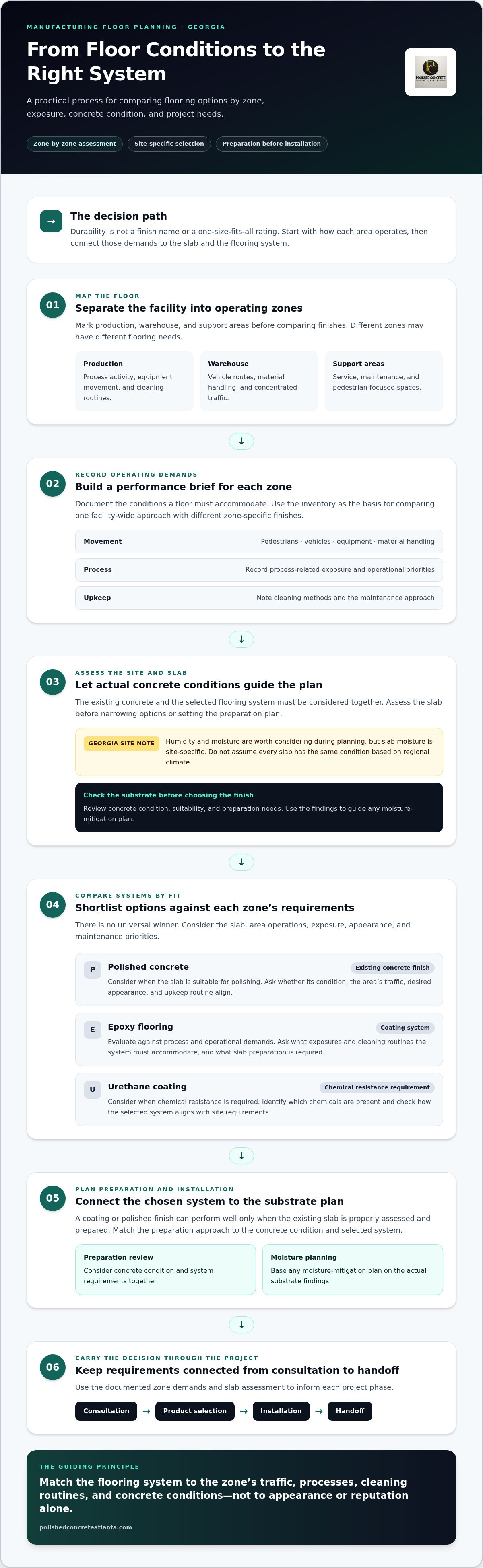
Create a zone-by-zone inventory before comparing finishes. Mark pedestrian and vehicle routes, equipment movement, and material-handling paths. For each area, record process exposures, cleaning methods, and operational priorities. This gives you a useful basis for deciding whether the whole facility needs one approach or whether different zones call for different finishes.
- Production: Record process-related exposure, equipment movement, and cleaning routines.
- Warehouse: Mark vehicle routes, material handling, and areas where traffic concentrates.
- Support areas: Note distinct requirements in service, maintenance, or pedestrian-focused spaces.
Use the inventory as a performance brief. For background on a different material category, see Linoleum as a durable flooring option. Material history alone, however, does not establish whether a floor is suitable for a particular manufacturing process.
Include Georgia site conditions in the assessment
Humidity and moisture are worth considering during planning, but Georgia’s climate does not mean every slab has the same condition. Moisture is site-specific: the building, slab, and project environment all matter. Assess the actual concrete and use the findings to guide preparation and any moisture-mitigation plan rather than relying on regional assumptions.
Surface preparation belongs in the same review. The concrete’s condition and the selected system need to be considered together. The concrete surface preparation guide explains why preparation matters when planning for adhesion. Assess the slab first, then select a system and preparation plan that fit the project.
Polished concrete, epoxy, or urethane: which fits your plant?
There is no universal winner. The right choice depends on the existing slab, how each area operates, and the facility’s finish and maintenance priorities. Use the comparison below to narrow your options, then weigh each system against the specific production or support zone.
| System | Suitable considerations | Project questions |
|---|---|---|
| Polished concrete | Existing concrete that is suitable for polishing, along with the desired appearance and maintenance approach. | What condition is the slab in? Will the finish suit the area’s traffic and upkeep routine? |
| Epoxy flooring | Areas where a coating system is being considered for process and operational demands. | What exposures and cleaning routines must the system accommodate? What preparation does the slab require? |
| Urethane coating | Projects where chemical resistance is a requirement. | Which chemicals are present, and how does the selected system align with the site’s requirements? |
For broader coating-system context, the industrial floor coatings guide can help frame the questions to resolve during project planning.
When polished concrete belongs on the shortlist
Polished concrete is a finish for existing concrete, so assess the slab’s condition and suitability first. Consider how the finish aligns with traffic, the appearance you want to maintain, and the facility’s upkeep routine. A production area with distinct process demands may call for a different system, so do not assume polished concrete is the automatic choice for every zone.
Include both appearance and maintenance priorities in the comparison. A clear view of how the floor will be used and cared for helps determine whether polished concrete belongs on the shortlist for each area.
When epoxy or urethane deserves consideration
Evaluate epoxy flooring against the area’s operational demands and the concrete preparation plan. Urethane coating is an option when chemical resistance is a project requirement. Neither system should be selected by reputation alone. Document the exposure, substrate, and project requirements, then use those details to guide product selection.
For durable flooring for manufacturing plants in Georgia, a project-specific comparison replaces assumptions with a clear rationale. Polished Concrete Atlanta provides epoxy flooring, polished concrete, and urethane coating as part of commercial and industrial flooring projects. Explore industrial flooring project options as you refine your shortlist.
How to evaluate a manufacturing floor before choosing a system
A sound flooring decision starts with a clear picture of the facility, not a product label. Use this review to organize the information that will shape system selection, preparation, and installation planning. It gives your team a practical basis for discussing durable flooring for manufacturing plants in Georgia.
- Map the zones. Mark production, warehouse, and support areas. Note pedestrian routes, vehicle traffic, equipment movement, and material-handling paths.
- Document exposures. Record production activities, substances that may contact the floor, cleaning routines, and each area’s operational priorities.
- Assess the concrete. Review the existing slab’s condition and suitability for the finish under consideration.
- Plan preparation. Identify where grinding, leveling, glue removal, or moisture mitigation may be needed based on site conditions.
- Compare systems. Match polished concrete, coatings, staining, or another finish to the documented zone requirements and project priorities.
Document operations and priorities before comparing options
A useful project scope captures more than the busiest routes. Note where production activities differ, which areas have distinct cleaning routines, and where the facility has specific appearance or maintenance priorities. Clarify the desired finish, such as polished concrete, a coating, or stained concrete. This record helps connect product selection to how each part of the plant is used.
Assess concrete condition and project preparation
The existing concrete helps determine which preparation and finish decisions make sense. Surface condition may call for grinding or leveling, while old adhesive may require floor glue removal. Moisture mitigation is also project-specific and belongs in the plan when site assessment indicates it is needed. The industrial flooring contractors guide provides additional context for organizing these decisions.
Plan around installation conditions and facility operations
Consider how the work areas relate to production priorities, access, and facility operations. Georgia humidity and other site conditions belong in installation planning, but they do not replace assessment of the concrete and project environment. Consultation and product selection should clarify the zones included, appropriate preparation, and how the selected finish aligns with documented exposures and maintenance expectations.
Checklist takeaway: Assess the slab and operating conditions before selecting a finish. For help planning a manufacturing floor project, review your facility’s flooring requirements.
Plan a durable manufacturing floor project with Polished Concrete Atlanta
A manufacturing floor project needs clear decisions from the initial review of facility needs through final handoff. Polished Concrete Atlanta serves manufacturing facilities and brings decades of experience to commercial and industrial flooring projects. Its full-service project management connects facility needs and planned floor use to consultation, product selection, installation, and handoff.
What the project-management process covers
Consultation brings the facility’s needs and project conditions into focus: how the floor will be used, which zones are included, and what is known about the existing concrete. Product selection follows that review. Polished concrete, epoxy flooring, concrete staining, and urethane coating are considered according to project requirements, including intended use and chemical-resistance needs. Installation and handoff complete the project-management sequence.
Prepare a clear project brief for your Georgia facility
A concise project brief makes consultation more productive. Include the facility location, floor zones, operating demands, cleaning routines, and known substrate concerns. Note where the scope may involve floor preparation, moisture mitigation, or a particular finish. If your organization has project documentation or certificate-of-insurance requirements, include those details. For commercial and industrial projects, Polished Concrete Atlanta can provide timely, agency-delivered certificates of insurance.
- Identify the areas included and how each is used.
- Summarize traffic, process exposures, and facility priorities.
- Share known concrete conditions and relevant project requirements.
Move from system shortlist to project consultation
Bring the shortlist together with the site assessment: the existing slab’s condition, operating demands by zone, moisture considerations, and finish priorities. Those details support a project-specific discussion instead of forcing one system onto every area. Align installation decisions with facility operations and the project schedule, then carry the plan through handoff. The result is a flooring solution selected for the work it needs to support, with a commitment to exceeding expectations.
To turn your assessment into a project plan, discuss your manufacturing floor project with Polished Concrete Atlanta.
Make your next flooring decision with confidence
A manufacturing floor is part of how your facility operates every day. Treating its renewal as a planned operational project, rather than a last-minute finish choice, gives your team a stronger basis for coordinating priorities and defining the scope. The goal is not simply to choose a surface that looks durable. It is to make a decision that reflects how the plant runs and what each space needs to support.
A site-specific plan for durable flooring for manufacturing plants in Georgia connects your facility’s priorities to a clear flooring decision. Polished Concrete Atlanta supports commercial and industrial flooring projects with decades of experience, project management from consultation through handoff, and timely, agency-delivered certificates of insurance.
Ready to put a plan in motion? Start planning your manufacturing floor project with Polished Concrete Atlanta.
Frequently Asked Questions
What is the most durable flooring for a manufacturing plant?
No single flooring system is the most durable for every manufacturing plant. Suitability depends on the facility’s processes, traffic, cleaning practices, and concrete. An area with chemical exposure has different selection priorities from one focused on equipment movement and routine cleaning. Compare systems against the demands of each zone, then align the finish and preparation plan with those conditions. That approach helps identify durable flooring for manufacturing plants in Georgia without relying on a one-size-fits-all answer.
Is polished concrete suitable for manufacturing facilities?
Polished concrete can suit a manufacturing facility when the existing concrete is appropriate for polishing and the finish fits the area’s use. Review the slab’s condition, including visible wear, patching, and previous treatments, then consider the appearance the facility wants to maintain. Include routine care in the selection discussion. Polishing is a finish for existing concrete, so suitability depends on the slab and the facility’s priorities, not simply the building’s industrial use.
Can epoxy flooring handle the demands of a Georgia manufacturing plant?
Epoxy flooring can be considered for a Georgia manufacturing plant, but selection should follow an assessment of the area and substrate. Identify the process exposures, cleaning methods, and day-to-day use the floor must accommodate, then align product selection and preparation with those requirements. For example, an area with frequent washdowns presents different planning considerations from a dry storage space. A site-specific review is more useful than assuming epoxy fits every zone.
How does Georgia humidity affect industrial floor installation?
Georgia humidity makes moisture and application conditions important planning considerations, especially around Atlanta, where moisture can contribute to condensation on cool concrete slabs. That possibility does not mean every facility has the same slab condition. Assess the concrete at the project site and use the findings to guide installation planning and any needed moisture mitigation. Planning around actual conditions is more useful than basing the flooring decision on climate assumptions alone.
What should a manufacturing facility assess before replacing its floor?
Before replacing a floor, review how it is performing and what has changed in the facility’s operations. Gather maintenance records, note recurring trouble spots, and identify areas where repairs or existing floor coverings may affect the scope. Document production priorities and access constraints that could influence project coordination. This gives consultation a more complete starting point and helps connect the flooring work to the plant’s operational needs.
How does concrete preparation affect the durability of a manufacturing floor?
Concrete preparation readies the existing surface for its selected finish, so the plan should reflect the slab’s actual condition. Depending on the project, preparation may involve grinding, leveling, or removing old floor glue. Moisture mitigation may also be appropriate when site assessment indicates a need. These steps are not interchangeable or automatic. The right preparation follows the substrate review and planned finish, making the relationship between concrete condition and flooring choice clear.


