
Why does one contractor quote you three times more than another for the exact same square footage? It's a frustrating reality for Atlanta facility managers who need predictable numbers but keep receiving wildly inconsistent bids. When you're calculating the cost to polish concrete floors Atlanta commercial spaces require, the surface-level price is rarely the final story. You're dealing with a unique local environment where high humidity and shifting clay soils demand rigorous moisture management to avoid "sweating slab" syndrome or premature finish failure. Expertly executed floors aren't a matter of luck; they're a result of disciplined engineering.
You deserve a budgeting framework that eliminates the guesswork and protects your investment from hidden post-start expenses. This 2026 guide provides the technical clarity you need to evaluate quotes with confidence and secure a floor that actually performs over the long term. We'll dissect the impact of the newly adopted 2024 International Building Codes on your project requirements. You'll discover the specific local market drivers and ROI metrics that move your facility from a "lowest bid" mentality to a high-performance strategy. Let's build a floor that works as hard as you do.
Key Takeaways
- Discover how industrial economies of scale and layout complexity dictate the baseline price for large-scale commercial projects.
- Identify the labor-intensive variables behind aggregate exposure and gloss levels to align your aesthetic vision with your budgeting goals.
- Learn why upfront investments in moisture mitigation and professional floor preparation are non-negotiable for long-term durability in Georgia's climate.
- Analyze the 10-year ROI metrics that demonstrate how polished concrete outperforms VCT and epoxy through significantly reduced maintenance cycles.
- Master the technical framework to accurately assess the cost to polish concrete floors Atlanta specialists quote, shielding your facility from hidden post-start expenses.
Primary Factors Driving the Cost of Polished Concrete in Atlanta
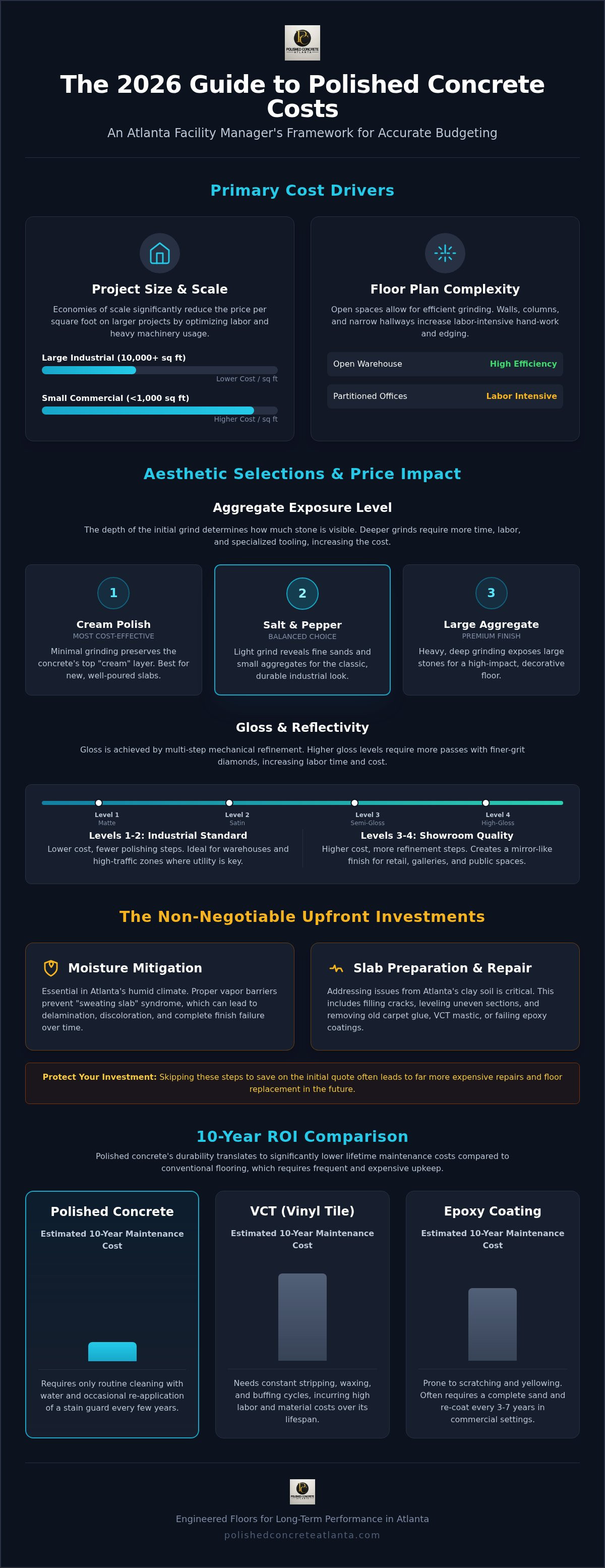
Determining the cost to polish concrete floors Atlanta projects require involves more than a simple multiplication of square footage. It's a technical assessment of site logistics, equipment mobilization, and mechanical requirements. A professional estimate accounts for the reality that no two slabs are identical. In a city where older industrial districts meet new high-rise developments, the starting condition of your concrete dictates the complexity of the entire project. We don't guess; we engineer a solution based on the physical reality of your facility.
Project Size and Economies of Scale
Scale changes the math. A 10,000 square foot warehouse allows for the deployment of heavy, planetary grinders that cover massive areas with high efficiency. Conversely, a 500 square foot retail boutique requires the same mobilization of crews and equipment but lacks the footprint to amortize those fixed costs. Industrial sites often provide the necessary 480V three-phase power for high-production machinery. Smaller commercial spaces might need portable power generation, adding another layer to the budget. Larger footprints naturally drive down the price per square foot because the "start-up" labor is spread across a broader surface.
The Complexity of the Floor Plan
Open spaces are the gold standard for efficiency. When a crew can run large-scale equipment without obstruction, the timeline stays tight and the budget stays lean. However, partitioned offices, narrow hallways, and fixed retail fixtures force a shift to hand-held grinders and edge-work specialists. Hand-grinding is labor-intensive and slow. If your floor plan is riddled with corners and tight radius turns, the labor hours per square foot will climb. To understand the mechanical process of refinement, one should look at What is polished concrete and how the multi-step grinding process requires consistent access to every inch of the slab.
Beyond the layout, the condition of the existing slab is a primary driver of the cost to polish concrete floors Atlanta businesses face. Atlanta's expansive clay soil often leads to settling and cracking, requiring technical remediation before the first polish pass. If the floor is currently buried under old carpet glue, thick epoxy, or failing sealants, the removal process adds significant time. Logistics in Metro Atlanta also play a role. Navigating tight loading docks or restricted access hours in areas like Buckhead or Midtown requires precise project management to keep the schedule on track. We manage every variable to ensure the final product meets our uncompromising standards.
Aesthetic Selections: How Gloss and Aggregate Exposure Impact Pricing
Aesthetic choices are more than visual preferences. They're direct indicators of labor intensity. When calculating the cost to polish concrete floors Atlanta facilities require, you must understand that every additional pass with a diamond-impregnated pad represents a specific investment in time and tooling. We don't just "shine" a floor; we mechanically refine it. This process follows rigorous industry standards for gloss and aggregate exposure to ensure the result is consistent, durable, and professional.
Defining Aggregate Exposure Levels
The depth of the initial grind determines how much of the internal stone is visible. A Cream Polish is the most cost-effective approach because it preserves the "skin" of the concrete. It's ideal for new, expertly finished slabs but reveals every imperfection in the pour. Salt and Pepper exposure involves grinding slightly deeper to reveal fine sands and small pebbles. This is the classic industrial look that hides wear effectively. Large Aggregate exposure is a premium decorative finish. It requires heavy grinding to expose large stones, demanding multiple coarse-grit passes before the refinement stages even begin. It's a high-impact choice that requires a higher labor investment.
Gloss Levels and Light Reflectivity
Gloss is achieved through progressive refinement, not a topical coating. Level 1 and 2 finishes provide a matte to satin look, which is perfect for high-traffic industrial environments where utility is the priority. These require fewer passes and less time. Level 3 and 4 finishes are the showroom standard. Achieving a mirror-like reflection requires stepping through higher grit counts, often up to 3,000 grit. Each step adds a full cycle of labor across the entire floor. Higher clarity demands more time. It's that simple.
High-performance floors also require chemical densifiers to harden the surface and stain guards to protect the clarity. These aren't optional extras for us; they're fundamental to the integrity of the finish. Densifiers react with the concrete to create a denser, more abrasion-resistant surface. If you're ready to define the specific requirements for your facility, our team at Polished Concrete Atlanta can help you balance aesthetic goals with functional reality. The more refined the finish, the higher the investment in labor and precision. We don't cut corners on the grit sequence because we know that clarity is earned, not applied.
The Hidden Costs of Professional Preparation and Remediation
Preparation is the foundation of performance. Many contractors skim over the preparation phase to present a lower initial bid, but this is a tactical error that leads to catastrophic floor failure. When analyzing the cost to polish concrete floors Atlanta projects demand, remember that your budget must prioritize what's happening under the shine. Professional preparation is non-negotiable. It's the difference between a surface that lasts twenty years and one that requires a full replacement in twenty months. We don't compromise on the substrate.
Industrial Floor Prep and Glue Removal
Removing multi-layered coatings, black mastic, or stubborn carpet glue requires specialized equipment and technical expertise. You can't simply polish over these contaminants. We utilize industrial-grade diamond grinding and shot blasting to reach a clean, reactive substrate. For a deeper look at the science behind this, read our technical breakdown: The Engineering of Adhesion: A Definitive Guide to Concrete Surface Preparation. This stage is critical because it ensures chemical densifiers actually penetrate the slab. Proper prep prevents the "failing floor" disaster that haunts low-bid projects.
Moisture Mitigation in the Atlanta Climate
Atlanta's humidity is a constant threat to concrete integrity. Our region's high water table and humid air often lead to "Sweating Slab Syndrome," where moisture vapor rises through the concrete and condenses on the surface. This creates dangerous slip hazards and can destroy the bond of any topical treatments. We prioritize moisture vapor emission testing for every high-risk project. It's an insurance policy for your floor investment. Remediation often involves specialized moisture-control primers that block vapor drive. It's a technical solution to a geographic problem.
Structural issues like joint spalling and deep cracking also require immediate attention. We don't ignore these defects. Professional joint filling with polyurea and technical crack injection are essential to prevent edge breakdown under heavy forklift traffic. These repairs are integrated into the grinding process to create a seamless, monolithic surface. If you need a technical partner to assess your slab's current condition and provide an accurate cost to polish concrete floors Atlanta facilities can rely on, contact Polished Concrete Atlanta for a comprehensive site evaluation. We find the problems before they become your liabilities.
Calculating the 2026 ROI: Polished Concrete vs. Alternative Flooring
The initial cost to polish concrete floors Atlanta facility managers see on a quote is only half the equation. To make a truly informed budgeting decision, you must look at the ten-year horizon. Stop thinking about flooring as a one-time installation expense. It's a lifecycle commitment. While alternative materials like VCT or standard epoxy coatings might appear cheaper on day one, they carry a heavy burden of recurring maintenance costs that quickly erode any perceived savings. We provide floors that eliminate the need for the endless cycle of stripping, waxing, and re-coating. It's a permanent solution for a high-traffic world.
Lifecycle Cost Analysis
VCT (Vinyl Composition Tile) is a legacy liability. Over a ten-year period, the labor costs associated with stripping and waxing VCT can exceed the original installation price by three or four times. Polished concrete removes this financial drain. A simple regimen of dust mopping and occasional auto-scrubbing with pH-neutral cleaners is all that's required to maintain the integrity of the surface. In heavy industrial environments, the durability of a densified slab is unmatched. We often utilize the Ashford Formula Installation to create a chemically hardened surface that actually improves with age and traffic. It doesn't just resist wear; it becomes more dust-proof and abrasion-resistant over time.
Energy efficiency is another tangible ROI driver often overlooked in 2026 budgeting. High-gloss finishes (Level 3 or 4) significantly increase light reflectivity within a facility. This allows you to reduce artificial lighting requirements or utilize lower-wattage fixtures while maintaining a safe, bright workspace. The floor essentially becomes a massive reflector, driving down utility costs month after month. It's a technical advantage that pays dividends for the life of the building.
Partnering with Polished Concrete Atlanta
Since 2004, we've set the benchmark for commercial flooring in Georgia. We don't settle for mediocrity, and neither should you. Choosing a veteran contractor means you're investing in a "no-nonsense" result backed by decades of technical mastery. We understand the specific challenges of Atlanta's climate and building codes. We don't just finish floors; we secure your facility's future. For a deeper understanding of our rigorous protocols, review our comprehensive benchmark in The Standard for Polished Concrete Floors in Atlanta.
Your 2026 facility upgrade demands a partner who prioritizes tangible results over flowery promises. We are technical consultants who happen to be elite craftsmen. If you're ready to move beyond inconsistent quotes and hidden fees, let's discuss your project. Request a professional estimate today and experience the peace of mind that comes with an uncompromising, high-end investment. We're ready to execute your vision with precision.
Securing Your Facility’s Future with Technical Precision
Budgeting for the cost to polish concrete floors Atlanta commercial spaces require is a strategic engineering decision, not just a line-item expense. You've seen how critical preparation, technical moisture mitigation, and specific gloss selections dictate the true value of your investment. A floor that fails due to poor vapor management is a liability; a floor that lasts for a 20-year lifecycle is a significant asset. We don't believe in cutting corners because we know that quality is the only way to eliminate uncertainty and protect your bottom line.
Polished Concrete Atlanta has been the local industry leader since 2004. We bring industrial-grade grinding equipment and seasoned, expert crews to every project, specializing in the complex moisture mitigation and floor preparation that low-bid contractors often ignore. Don't settle for inconsistent quotes that lead to hidden costs after the project starts. Choose a partner who prioritizes tangible results and long-term durability. If you're ready to upgrade your facility with a high-performance finish that reduces maintenance cycles, Get a Professional Quote for Your Atlanta Facility. Let’s build a surface that reflects the excellence of your organization.
Frequently Asked Questions
How much does it cost to polish concrete per square foot in Atlanta?
The cost to polish concrete floors Atlanta facility managers budget for is primarily determined by the slab's condition and the total square footage. Larger industrial footprints allow for the use of high-efficiency planetary grinders, which lowers the per-foot investment. Smaller, partitioned spaces require more labor-intensive hand-work. We provide a definitive technical assessment to ensure your quote reflects the physical reality and mechanical needs of your specific site.
Is it cheaper to polish existing concrete or install epoxy?
Polished concrete is the superior financial choice when compared to epoxy over a ten-year horizon. While some epoxy systems have a lower entry price, they are topical and prone to peeling under heavy traffic. Polished concrete is a permanent mechanical refinement of the existing slab. It eliminates the need for recurring re-coating or stripping and waxing, making it a "one-and-done" investment for high-traffic commercial environments.
What factors increase the price of concrete polishing the most?
Extensive surface preparation and high aggregate exposure are the two factors that drive the cost to polish concrete floors Atlanta projects face. If your floor requires technical moisture mitigation or heavy floor glue removal, the labor hours will increase. Likewise, grinding deep into the concrete to reveal large stones requires more time and diamond tooling than a simple cream polish. We prioritize transparency in these technical requirements.
Does the age of my Atlanta warehouse floor affect the polishing cost?
The age of your warehouse floor directly impacts the amount of remediation and repair work required before polishing begins. Older Atlanta slabs often suffer from cracks, joint spalling, or deep chemical staining from decades of industrial use. These defects must be addressed through professional joint filling and crack injection. While older floors can produce stunning results, they typically require a more disciplined preparation phase than a brand-new pour.
Can you polish concrete that has old glue or paint on it?
We can polish floors with old glue or paint, provided we perform a thorough mechanical stripping process first. You can't polish over old mastics or coatings; they must be completely removed to expose the raw concrete substrate. This allows our densifiers to penetrate and harden the surface effectively. We utilize industrial-grade grinding equipment to strip away contaminants, ensuring the final finish is both aesthetically clear and structurally sound.
How long does a professional concrete polishing project take to complete?
Most professional projects progress at a rate of 2,500 to 5,000 square feet per shift, depending on the desired gloss level. The timeline is influenced by the number of grinding passes and the complexity of the floor plan. Wide-open spaces move quickly, while areas with many corners or fixed machinery require more time for detailed edge work. We provide a precise project timeline to ensure your operations remain on schedule.


