

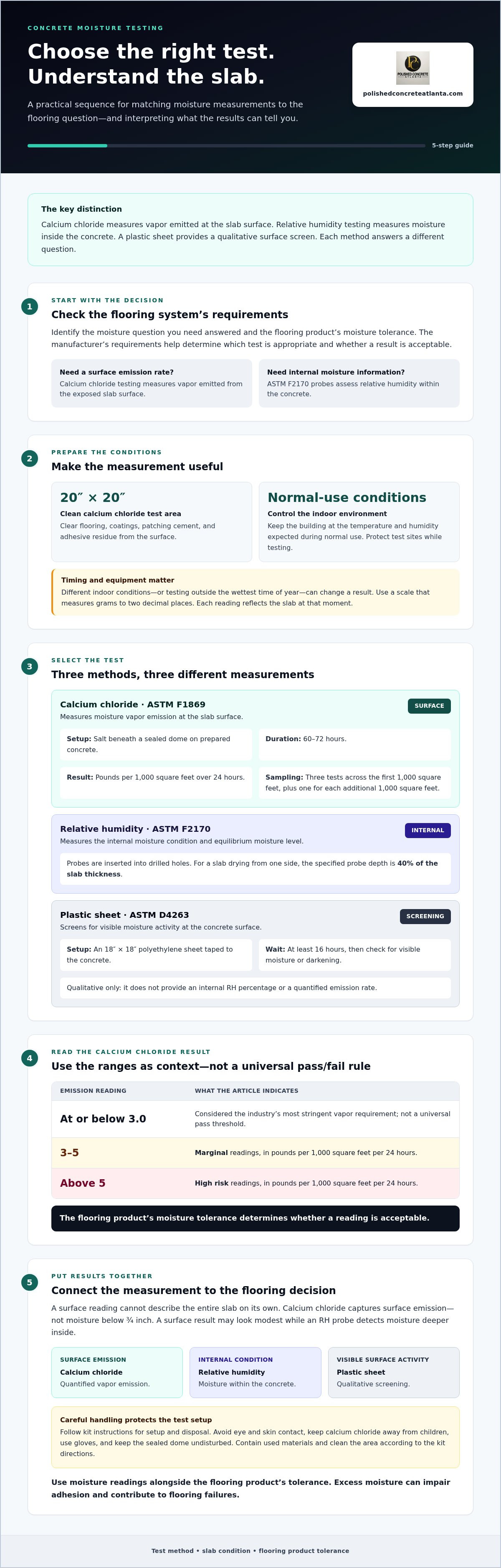
A concrete slab moisture test with calcium chloride measures moisture vapor emitted at the surface, reported in pounds per 1,000 square feet over a 24-hour period. For a better indication of how moisture may behave after a floor covering is installed, ASTM F2170 relative humidity testing places probes at 40% of the slab’s depth and measures the concrete’s equilibrium moisture level. The methods answer different questions, so the right choice depends on the flooring system and what its manufacturer requires.
One reading cannot predict on its own whether an adhesive or coating will hold. Moisture in the slab, the test method, and the flooring product’s tolerance all matter. Excess moisture can impair adhesion and contribute to flooring failures, so choosing the right test is a practical part of planning, not just a technical detail.
This guide explains what calcium chloride and other ASTM concrete moisture tests measure, how to interpret their results, and what readings can indicate about adhesive risk. It also compares the methods and helps you match a test to the question you need answered before flooring work begins.
Key Takeaways
- Choose the test based on what you need to understand about the slab and the requirements of the flooring system.
- Test conditions and preparation affect how useful calcium chloride readings are for a flooring decision.
- Use moisture readings alongside the flooring product’s tolerance to assess potential adhesive or coating problems.
- ASTM methods measure moisture in different ways, so compare what each result can reveal before selecting a test.
- When moisture concerns affect the finish you’re planning, floor preparation and polished concrete options can help guide the next step.
Calcium chloride moisture vapor emission testing
A concrete slab moisture test using calcium chloride measures vapor emitted from the slab’s surface. Its result helps compare surface emission with internal moisture readings before flooring installation.
Surface Emission Testing
The calcium chloride method places a measured amount of salt beneath a sealed dome on a clean concrete surface. After 60 to 72 hours, the test measures the absorbed moisture and reports emissions in pounds per 1,000 square feet over a 24-hour period. ASTM F1869 calls for three tests across the first 1,000 square feet, plus one for each additional 1,000 square feet.
Results from 3-5 lbs per 1,000 square feet per 24 hours are considered marginal; readings above 5 are high risk. The flooring product’s moisture tolerance determines whether a result is acceptable. A reading at or below 3.0 lbs is considered the industry’s most stringent vapor requirement, but it isn’t a universal pass threshold.
| Test option | What it measures | Where it measures | Useful distinction |
|---|---|---|---|
| Calcium chloride, ASTM F1869 | Moisture vapor emission | Slab surface | Reports pounds per area over 24 hours |
| Relative humidity, ASTM F2170 | Internal moisture condition | Probe at 40% slab depth | Indicates equilibrium moisture within concrete |
| Plastic sheet, ASTM D4263 | Visible moisture beneath plastic | Concrete surface | Qualitative screening, not an emission rate |
Choose the test that meets the flooring manufacturer’s requirements and answers the moisture question you need to resolve.
Factors Affecting Test Accuracy
Preparation and building conditions matter. The test area should be a clean 20” x 20” surface, clear of flooring, coatings, patching cement, and adhesive residue. Keep the building at the temperature and humidity expected during normal use, and protect each test site from damage throughout the 60 to 72-hour test period.
Use a scale that measures grams to two decimal places. Testing under different indoor conditions can change the result, as can testing outside the wettest time of year. Each reading reflects the slab’s condition at that moment. The method captures surface emission, not moisture below ¾ inch, so it cannot describe the entire slab on its own.
Test Kit Cost
How much does a calcium chloride concrete moisture test kit cost? The price depends on the kit’s contents and seller. Check whether it includes the components needed for the test, such as the salt, dome, and moisture measurement materials, because kits can contain different items.
A kit’s cost does not determine whether the test will answer your flooring question. The test area, timing, controlled indoor conditions, and suitable weighing equipment all affect whether the measurement is useful.
Safe Test Kit Handling
Handle calcium chloride carefully and follow the kit’s instructions for setup and disposal. Avoid contact with eyes and skin, keep the material away from children, and use gloves when handling the salt or used test materials. Keep the area orderly so the sealed dome remains undisturbed.
When setting up the test, place the dome on the prepared slab without spilling the salt. Afterward, contain the used materials and clean the area according to the kit directions. Careful handling protects the setup and prevents loose material from spreading.
Purpose of concrete moisture testing
Moisture tests help assess whether a concrete slab is suitable for a planned floor covering. When working with professional suppliers and installers like GW Flooring, assessing subfloor conditions beforehand clarifies what may happen after installation, when the covering can restrict moisture movement and change conditions near the slab surface. Calcium chloride measures surface vapor emission; relative humidity testing examines moisture inside the concrete. The methods answer different questions.
ASTM F2170 and Relative Humidity Testing
ASTM F2170 measures internal relative humidity through probes inserted into drilled holes. For a slab drying from one side, the specified probe depth is 40% of the slab thickness. That depth helps assess the moisture condition within the concrete, rather than only vapor escaping from its exposed surface.
Relative humidity describes the slab’s equilibrium moisture level, which matters because a surface reading can differ from conditions deeper inside. For example, a calcium chloride test may show modest surface emission while an RH probe detects moisture within the slab. Comparing the results gives a fuller picture of moisture distribution.
Plastic Sheet Moisture Testing
ASTM D4263 uses an 18-inch by 18-inch polyethylene sheet taped to the concrete surface. After at least 16 hours, the sheet is checked for visible moisture or darkening beneath it. The method offers a basic indication of moisture activity at the surface.
Unlike ASTM F2170, the plastic sheet test doesn’t provide an internal RH percentage. It also doesn’t report a quantified emission rate like calcium chloride testing. Treat it as a screening step, not a substitute for the measurement a flooring system requires.
Combining Moisture Testing Methods
Using more than one method can help distinguish surface emission from internal moisture. For instance, ASTM D4263 may reveal visible moisture, while ASTM F2170 shows internal RH. Calcium chloride testing adds a measurement of vapor emitted at the surface. Together, these results help explain why a slab may appear dry yet hold moisture below its surface.
Give each test a clear purpose. Match the method to the flooring product’s moisture limits and the decision at hand. A surface emission result cannot replace an internal RH measurement, and observing a plastic sheet cannot provide either numerical result.
For example, if a coating decision depends on moisture within the slab, ASTM F2170 directly measures internal RH. If the concern is visible surface moisture, ASTM D4263 offers a simple screen. When moisture conditions require remediation before a finish is installed, floor moisture mitigation addresses that project concern.
Flooring adhesive and moisture-related failures
Moisture readings matter because water vapor moving through a concrete slab can impair a floor coating’s adhesion. An adhesive or coating may not perform as intended if the slab exceeds its moisture tolerance, even when the surface looks dry. The practical question is whether the measured condition meets the flooring product’s requirements.
Read Results Against the Flooring System
A calcium chloride result reports moisture vapor emission in pounds per 1,000 square feet per 24 hours. The flooring industry’s most stringent vapor requirement is 3.0 lbs. or less, but that figure isn’t a universal acceptance limit. Product requirements differ, so interpret the reading against the specific adhesive or coating system.
Results from 3-5 lbs per 1,000 square feet per 24 hours are considered marginal. Readings above 5 are described as high risk. A result of 8-10 pounds is usually worrisome, though the concern depends on the flooring adhesive. These bands help identify potential concern; they don’t replace the product’s stated tolerance.
Use RH Readings to Assess the Slab
Relative humidity testing adds a different view by measuring moisture within the slab. Readings of 75-80% RH or less are acceptable for many epoxy and coating systems, subject to product requirements. At 80-90% RH, flooring options may narrow and moisture mitigation may be required. Readings above 90% RH are high risk and may call for specialized systems or mitigation.
Compare results carefully. A calcium chloride emission reading and an ASTM F2170 RH percentage measure different conditions, so one cannot be converted directly into the other. For example, a surface result near a product’s limit should be considered alongside the slab’s internal RH and the coating manufacturer’s requirements.
What to Do With a High or Marginal Reading
Treat a marginal or high-risk result as a decision point before installation, not a reason to guess. First, match the test type and units to the flooring system’s stated moisture tolerance. Then determine whether the proposed adhesive or coating accepts that measured condition. If the limit is exceeded, a compatible system or moisture mitigation may reduce the risk of adhesion problems.
Moisture can enter concrete through condensation, wet soil beneath the slab, leaking pipes, or surface water from leaks and flooding. A test captures conditions at the time of measurement; it does not identify every moisture source. If readings are elevated, determine whether the source is ongoing before choosing mitigation or proceeding with flooring work.
ASTM concrete moisture test methods
ASTM methods don’t all measure the same moisture condition. ASTM F1869 measures vapor emission at the slab surface, while ASTM F2170 measures internal relative humidity. ASTM D4263 offers a visual surface screen. The right method depends on the flooring decision and the measurement its product requirements call for.
ASTM F1869: Calcium Chloride Emission
The calcium chloride method originated with the US Rubber Manufactures Association in the 1950’s and was released as ASTM F1869 in late 1998. It measures moisture vapor emitted from a prepared concrete surface, reporting pounds per 1,000 square feet over a 24-hour period. This makes it useful when the flooring specification sets an emission limit.
Test conditions matter. The kit instructions call for testing at the temperature and humidity expected during normal building use. If those conditions aren’t available, ASTM F1869 allows testing at 65ºF to 75ºF and 40% to 60% relative humidity, maintained for 48 hours before and during testing. Those conditions help make the reading relevant to the building environment.
ASTM F2170: Internal Relative Humidity
ASTM F2170 uses probes inserted into the concrete to measure relative humidity within the slab. For a slab drying from one side, probes are placed at 40% depth. Unlike F1869, this method doesn’t measure vapor escaping at the surface. It assesses the slab’s internal moisture condition, which helps answer how moisture deeper in the concrete may affect a floor covering.
RH describes the equilibrium moisture level in concrete. That makes F2170 valuable when a flooring system’s requirements use internal RH limits. An emission result and an RH result use different units and represent different conditions; don’t treat them as interchangeable or convert one into the other.
ASTM D4263: Plastic Sheet Screening
ASTM D4263 uses an 18-inch by 18-inch polyethylene sheet taped to the slab, then requires at least 16 hours of waiting. Visible moisture or darkening beneath the sheet signals moisture activity at the surface. Unlike F1869 and F2170, it doesn’t produce a numerical emission rate or internal RH percentage.
Use D4263 as a simple visual screen, not as a replacement for a quantitative result required by a flooring specification. The decision guide is straightforward: choose F1869 for surface emission, F2170 for internal RH, and D4263 for a visual indication. Match the test to the floor system’s stated measurement criteria.
Once the required test identifies the slab’s moisture condition, plan flooring preparation around the result and the intended floor system.
Polished Concrete Atlanta: Polished Concrete Floors
When moisture test results shape your flooring plan, Polished Concrete Atlanta can help with the next steps. Its polished concrete floors, epoxy flooring, stained concrete, and floor preparation services address different finish and substrate needs for commercial projects in Atlanta.
Bring the test method and readings into the flooring discussion. Surface emission and internal relative humidity readings describe different conditions, which can inform preparation and finish selection. If readings raise concerns, floor preparation is an important part of planning before applying a new finish. Clear test information helps keep decisions grounded in the slab’s condition and the intended flooring system.
Contact Polished Concrete Atlanta to discuss flooring options and preparation for your project.
Turn Your Test Results Into a Flooring Plan
The next step is to relate the moisture report to the floor you want and the condition of the existing slab. A concrete slab moisture test using calcium chloride is one part of that decision, not the finish selection itself. Discuss the test method, readings, and project goals together so preparation and flooring choices follow a clear plan.
Polished Concrete Atlanta installs polished concrete floors, epoxy flooring, and stained concrete in Atlanta. Each option creates a different finish, so the intended look and use of the space should guide the selection. A well-defined scope keeps attention on the slab, the chosen system, and the preparation required.
For help connecting your flooring goals with a practical next step, contact Polished Concrete Atlanta. A thoughtful plan starts with the information you already have and moves your project forward with confidence.
Frequently Asked Questions
How Do You Know How Much Moisture Will Come Up Once You Install that Floor Covering?
Use an internal relative humidity test to assess moisture within the slab before covering it. For a slab drying from one side, ASTM F2170’s probe depth of 40% of slab thickness helps estimate the moisture condition at the surface after a floor covering is installed. For example, a surface emission test alone won’t show the moisture condition deeper in a slab.
How Do You Know What that Future Equilibrium Moisture Level Will Be?
Relative humidity testing measures the concrete’s equilibrium moisture level and helps assess moisture within the slab. The flooring assembly can change how moisture moves toward the surface, so consider the slab’s drying direction and any continuing moisture source, such as a leaking pipe or wet soil beneath the concrete. Use the result to inform the flooring-system decision, not as a standalone forecast.
What Happens If Moisture Is Too High?
Excess moisture can weaken a coating’s bond with concrete and increase the risk of adhesion failure. For example, a coating with a low moisture tolerance may not suit a slab with readings above its limit. Compare the result with the specific system’s requirements before proceeding. If the slab exceeds those limits, moisture mitigation or a compatible flooring system may be needed.
Which Test Should You Use?
Choose the method that measures the condition relevant to your flooring decision. Use ASTM F1869 when the specification calls for surface vapor emission, ASTM F2170 for internal relative humidity, and ASTM D4263 for a visual moisture screen. For an Atlanta commercial floor, start with the flooring system’s stated test method and acceptance criteria. The tests use different units and aren’t interchangeable.
What is the calcium chloride test for concrete slab moisture?
A concrete slab moisture test using calcium chloride measures vapor emitted from the slab’s exposed surface. The measured result is expressed as pounds per 1,000 square feet over a 24-hour period. It can help assess whether surface emission fits a flooring product’s tolerance. It does not measure internal relative humidity, so it answers a different question than an ASTM F2170 probe.
How does the calcium chloride moisture test work, step by step?
The test measures moisture absorbed by calcium chloride beneath a sealed dome on prepared concrete, then converts the change into an emission reading. Follow the kit instructions and maintain appropriate building conditions throughout the test.
- Prepare a clean 20” x 20” concrete area.
- Weigh the calcium chloride using a scale accurate to two decimal places.
- Place and seal the kit according to its instructions.
- Protect the test site for 60 to 72 hours.
- Reweigh the material and calculate the reported emission rate.


