
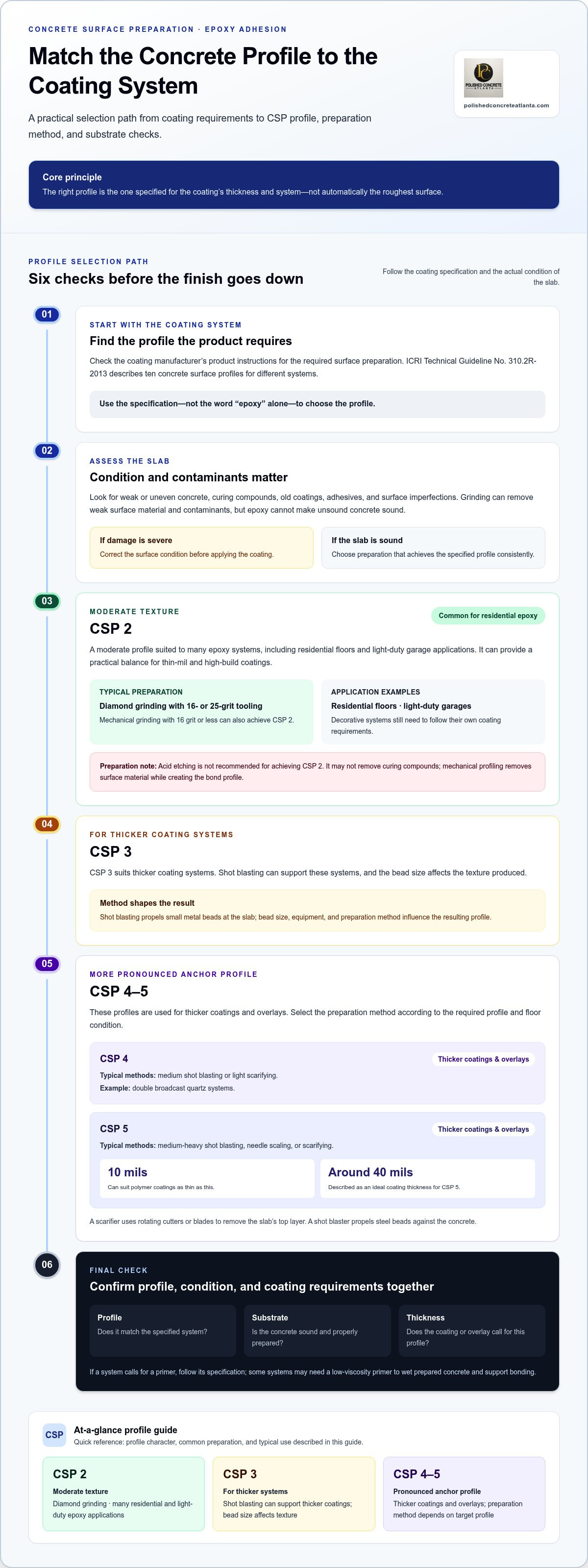
The right concrete surface profile can make or break epoxy adhesion. Concrete surface profiling for epoxy means matching the concrete’s texture to the coating system: CSP 2 is typical of diamond grinding, CSP 3 suits thicker coating systems, and CSP 4-5 are used for thicker coatings and overlays. The goal is a profile that gives the epoxy a suitable surface to bond to.
Roughening concrete is an essential preparation step, but a rougher surface is not always better. The coating’s thickness and intended use determine whether grinding, shot blasting, or a deeper profile is appropriate. The wrong profile can weaken the bond or leave the floor unnecessarily rough.
This guide explains how CSP 2, CSP 3, and CSP 4-5 relate to adhesion, which preparation methods create those profiles, and why coating thickness matters. You’ll see how the profile choice changes for thinner epoxy systems, thicker coatings, and overlays, so you can understand what the floor needs before the finish goes down.
Key Takeaways
- Match the concrete profile to the coating system; a rougher surface isn’t automatically better for adhesion.
- Diamond grinding with 16- or 25-grit tooling typically creates CSP 2 for suitable epoxy applications.
- CSP 3 and shot blasting can support thicker coating systems, while the right shot size affects the resulting texture.
- CSP 4-5 profiles are commonly used for thicker coatings and overlays, with preparation method chosen to suit the system.
- Look beyond profile alone: concrete condition, contaminants, and coating thickness all influence surface preparation.
CSP 2 grinding and coating applications
CSP 2 is a moderate concrete texture commonly created by diamond grinding with 16- or 25-grit tooling. It suits many epoxy systems, including residential floors and light-duty garage applications.
Diamond Grinding and Shot Blasting
Diamond grinding removes concrete surface material and can create CSP 2, while shot blasting propels small metal beads at the slab. For a residential epoxy floor, grinding with 16- to 25-grit tooling can create a uniform CSP 2 profile. Shot-blasting bead size affects the texture, so the method and equipment influence the resulting profile. The distinction matters: each surface needs to match its coating system.
Floor Grinders and Diamond Tooling
A floor grinder fitted with diamond tooling removes curing compounds, existing coatings, adhesives, and surface imperfections. Different diamond grits remove material at different rates and help create different bond profiles. For CSP 2, 16- or 25-grit tooling is a common choice; mechanical grinding with 16 grit or less can also achieve this profile. Uniform passes help prepare the substrate consistently across the flooring area.
When the Concrete Is Severely Damaged
Deep damage changes the preparation decision. Severely damaged concrete can contribute to epoxy installation failure, and grinding may be necessary before applying a coating. A grinder can remove weak or uneven surface material, but the existing slab condition still matters: epoxy cannot make unsound concrete sound. For example, a damaged garage floor may need its surface corrected before a CSP 2 profile can support the planned system.
CSP 2 provides a practical balance of surface texture for thin-mil and high-build coatings. Some systems may require a low-viscosity primer to wet the prepared concrete and support bonding. The coating specification should guide the profile and primer choice, rather than the word “epoxy” alone.
- Residential epoxy: CSP 2 created by diamond grinding is a standard profile for residential floors.
- Light-duty garages: CSP 2 may suit a light-duty garage floor’s epoxy system.
- Decorative flooring: Match the profile to the decorative coating’s requirements, not appearance alone.
Acid etching is not recommended for achieving CSP 2. Mechanical profiling removes curing compounds while creating a bond profile, whereas etching may not remove those compounds. A durable finish starts with a prepared substrate that fits the selected coatings. When severe damage, old adhesive, or uneven concrete complicates grinding, floor preparation and concrete floor grinding address the conditions that determine whether CSP 2 is appropriate.
CSP 4-5 preparation for thicker coatings and overlays
CSP 4-5 creates a more pronounced anchor profile for thicker coatings and overlays. ICRI Technical Guideline No. 310.2R-2013 describes ten concrete surface profiles for different systems; the coating manufacturer’s requirements help identify the suitable profile.
Preparation for Epoxy Adhesion
Surface preparation creates texture and removes weak surface material so epoxy can bond to concrete. CSP 4 is typical of medium shot blasting or light scarifying, while CSP 5 is typical of medium-heavy shot blasting, needle scaling, or scarifying. Both profiles can suit thicker coatings and overlays.
Preparation also affects the risk of coating failure. If the texture is unsuitable or the concrete substrate is compromised, the coating may not achieve its intended bond. Match the surface profile to the coating’s thickness and system requirements instead of automatically choosing the roughest option.
Tools and Equipment for Surface Preparation
Shot blasters, scarifiers, and needle scalers create different textures through distinct mechanical actions. A shot blaster propels small steel beads against the concrete; bead size influences the resulting profile. A scarifier uses rotating cutters or blades to remove the slab’s top layer. Medium shot blasting or light scarifying typically produces CSP 4, while medium-heavy shot blasting, needle scaling, or scarifying typically produces CSP 5.
Equipment selection should follow the target profile and floor condition. For example, a warehouse coating may need CSP 4 or higher, making the preparation method a system requirement, not a cosmetic preference.
Manufacturer and Industry Preparation Standards
ICRI Technical Guideline No. 310.2R-2013 describes ten profiles for systems applied to concrete. The coating manufacturer’s product instructions establish the preparation requirements for its specific epoxy coatings. Use both references to connect the specified material with the required profile, rather than assuming every epoxy floor needs CSP 4 or CSP 5.
This distinction protects the substrate and the finished system. A double broadcast quartz coating, for example, is among the thicker systems suited to CSP 4; CSP 5 is also used for thicker coatings and overlays.
CSP 5 concrete can suit polymer coatings as thin as 10 mils and is ideally used for coatings around 40 mils thick. CSP 4 is appropriate for thicker coatings and overlays, including double broadcast quartz systems. These examples show why the specified coating thickness and product requirements should guide preparation.
CSP 1 serves a different purpose. It is associated with acid etching, low-pressure water cleaning, or grinding with tooling of 40 grit or higher, and suits acrylic or other low-solids sealers. Acid-etched surfaces are described as suitable for thin sealers under 3 mils, but acid etching may not remove curing agents. A profile label alone does not establish that a preparation method is suitable for epoxy.
For a floor where the specified profile, existing condition, or coating thickness calls for professional preparation, concrete floor preparation helps align the surface with the intended system.
CSP 3 shot blasting and thick coatings
CSP 3 provides a rough concrete texture for demanding coating systems. It’s suitable for high-performance epoxy in industrial and commercial settings, where the coating must bond to a prepared substrate. Coating thickness helps determine whether this profile fits. CSP 3 is appropriate for coatings with more than 60 mils of dry film thickness. It’s also identified as the minimum roughness for thicker coatings from 10 to 40 mils.
Those thickness ranges make the product specification essential. A thin coating from 4 to 10 mils has a different profile limit: CSP 3 is the maximum roughness recommended for that range. So CSP 3 doesn’t simply mean “more adhesion” for every finish. Compare the required dry film thickness with the coating system’s specified profile before selecting a preparation method.
Shot blasting creates CSP 3 by propelling small metal beads against concrete, then reclaiming them through a high-powered vacuum system. The process roughens the surface while collecting the spent shot. Different bead sizes can create different profiles, so the equipment setup affects the texture. For an industrial epoxy application, this makes shot blasting a method for producing a controlled mechanical profile, not just removing visible surface material.
A scarifier uses rotating cutters or blades to remove the top layer of concrete. That differs from shot blasting, which impacts the surface with steel shot. Both methods can create concrete texture, but their action and resulting profile differ. The target remains CSP 3 when the selected coating calls for it. On a slab with damaged areas, repair and surface condition also matter before applying the finish.
- For 4 to 10 mils: CSP 3 is the maximum roughness recommended for thin concrete coatings.
- For 10 to 40 mils: CSP 3 is the minimum roughness recommended for thicker coatings.
- Above 60 mils: CSP 3 is appropriate for coatings with this dry film thickness.
- For decorative metallic systems: CSP 3 is identified as the best-performing profile.
These examples show why “thicker” needs a precise meaning: dry film thickness and the coating system guide the profile decision. A polymer coating or overlay may have different preparation requirements than industrial epoxy. Shot-blasting bead size, scarifying action, concrete condition, and the intended finish all shape the result. Match the preparation method to the specified CSP 3 profile, then assess the prepared surface before coating. That keeps the texture aligned with the system rather than relying on appearance alone.
How concrete surface profile affects epoxy adhesion
Concrete roughness gives epoxy a mechanical surface to bond with. The right profile depends on coating thickness, slab condition, and the system’s requirements.
Choosing a Concrete Profiling Method
The best method is the one that creates the profile required by the specific epoxy system. Mechanical profiling is the most effective way to remove curing agents while forming a bond profile. Diamond grinding commonly creates CSP 2 for residential epoxy; CSP 3 and CSP 4-5 suit systems requiring a more textured surface. Match profile depth to coating thickness, not to a general preference for roughness.
There is no single CSP required for every epoxy coating. CSP 2 suits many epoxy coatings, while thicker systems may call for CSP 3 or CSP 4-5; the coating specification determines the target.
Profiling cost per square foot depends on the floor area, concrete condition, existing coatings or adhesives, and preparation method. The price is provided after a quote request, with those project factors shaping the scope.
Acid Etching and Mechanical Profiling Risks
Acid etching textures concrete through a chemical reaction, while mechanical profiling removes material from the surface. Acid etching, light sanding, and power washing generally do not remove curing agents, which can interfere with epoxy adhesion. Mechanical methods can remove these agents while creating texture, but the method still needs to suit the concrete and coating.
Mechanical profiling can also reveal weak or damaged concrete that needs attention before coating. If cracks or deteriorated areas appear, repair them before applying epoxy. A simple water-drop check can offer a basic indication of surface readiness. Absorption indicates that curing-agent surface tension has been removed.
Measuring Concrete Surface Profile
A profilometer uses a sensor to measure surface irregularities; laser-based scanners can create a three-dimensional surface image. These tools provide more detailed measurements than visual inspection alone, which contractors commonly use but which is less accurate. For quantitative analysis, the research guidance recommends at least 15 depth readings per square foot.
Concrete surface profiling for epoxy should assess more than appearance. Compare measured texture with the coating system’s required CSP, and inspect for uneven areas, residue, or damage. ICRI Technical Guideline No. 310.2R-2013 describes profiles for different concrete-applied systems, giving teams a framework for matching texture to application. Consistent readings help reveal whether the prepared floor changes across the area.
For help aligning floor condition and preparation with an epoxy system, request professional floor preparation.
Polished Concrete Atlanta: Polished Concrete Floors
Polished Concrete Atlanta provides floor preparation and epoxy flooring for projects that need a properly prepared concrete surface. The right profile depends on the coating system, slab condition, and desired finish, so preparation should follow the project specifications rather than a one-size-fits-all approach.
If epoxy is not the finish you want, Polished Concrete Floors and Stained Concrete offer other ways to finish a concrete floor. The right choice depends on the look and use you have in mind. Start by assessing the concrete and defining the result you want.
For guidance on floor preparation or concrete flooring options in Atlanta, contact Polished Concrete Atlanta.
Plan the Floor Around Its Finished Use
Next, consider how the finished floor needs to perform in its space. Weigh traffic, appearance, maintenance expectations, and the concrete’s condition together. Treat concrete surface profiling for epoxy as part of the overall flooring plan, not as an isolated preparation step. Clear priorities help align the surface work with the finish you want.
Polished Concrete Atlanta offers Epoxy Flooring, Polished Concrete Floors, and Stained Concrete. Each creates a different look, so choose based on the space’s practical demands and the appearance you want. A focused conversation about the floor can help clarify the right direction.
Contact Polished Concrete Atlanta to discuss your concrete flooring project and next steps. With the priorities defined, you can move forward with a clear plan for the finished space.
Frequently Asked Questions
How do you prepare concrete for epoxy coating using grinding, shot blasting, or acid etching?
Choose a preparation method that suits the epoxy system and the concrete’s condition. Diamond-tool grinding can remove existing coatings, adhesives, and surface imperfections. Shot blasting creates texture by propelling steel shot and collecting it with a vacuum system. Acid etching is not a recommended substitute for mechanical profiling because it may leave curing compounds behind. After profiling, remove dust and residue before applying the coating.
What equipment is needed to profile concrete for epoxy?
The right equipment depends on the desired texture and the floor’s condition. A diamond-tool floor grinder can remove old coatings or adhesives and create a selected profile. A shot blaster propels steel shot and recovers it with a vacuum, while a scarifier uses rotating cutters or blades to remove the concrete’s surface layer. A profilometer measures surface irregularities; laser scanners can create a three-dimensional image.
How do moisture, oil, curing compounds, and existing coatings affect epoxy adhesion?
Moisture and contaminants can interfere with coating adhesion, so assess the slab before application. Oil can leave residue that degreasers or concrete cleaners help remove. Curing compounds can inhibit adhesion if they remain on the surface; mechanical profiling helps remove them. Existing coatings can also obstruct bonding, so grinding can remove them and expose the concrete. Moisture mitigation may be part of floor preparation for Atlanta facilities.
How do you test concrete cleanliness and tensile strength before epoxy application?
Inspect the prepared concrete for visible oil, dust, loose material, and remaining coatings, then use a water-drop check as a basic field indicator. Observe the droplets for a few minutes: absorption indicates that curing-agent surface tension has been removed. A separate pull-off test on the concrete or prepared coating system measures tensile strength. Compare the result with the epoxy manufacturer’s acceptance criteria, since the required threshold depends on the system.


