

Uneven concrete can disrupt a facility long before the floor looks severely damaged. Concrete floor leveling services in Atlanta may be relevant when a slab slopes, separates at joints, or holds standing water. These changes can indicate settlement, but an inspection is needed to identify the cause and determine the right response.
Look beyond appearance: an uneven slab can affect how a space functions and whether its surface is ready for a new finish. The appropriate work depends on the concrete’s condition and how the facility uses the floor.
This guide explains the signs that may indicate a leveling need, how professional leveling can restore a more even surface, and what to consider when planning the work. It also covers service coverage around Atlanta, so you can understand where support is available and how floor preparation or finishing may fit into the project. Clear criteria. A practical next step.
Key Takeaways
- Learn how to distinguish surface wear from signs that a concrete slab may have settled.
- Understand when lifting and leveling may be an alternative to replacing a concrete surface.
- See how site conditions and the floor’s intended use shape the work and preparation needed.
- Explore how to assess service coverage for facilities around Atlanta.
- Find out how leveling can fit into a broader plan for industrial flooring, epoxy, or polished concrete.
What are the signs I need Concrete Leveling and Raising repair or service?
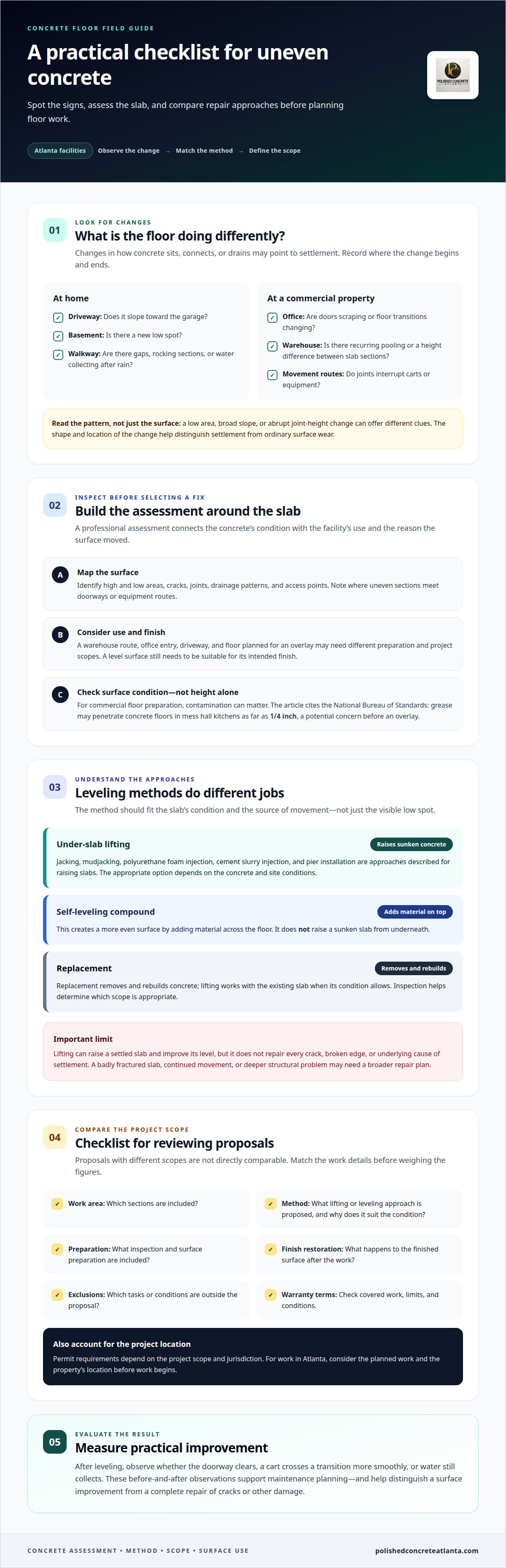
Look for changes in how a concrete surface sits, connects, or drains. A driveway that slopes toward a garage, a basement floor with a new low spot, or warehouse joints that interrupt cart movement can signal uneven concrete. In Atlanta, slabs may settle when poured on wet, weak, or poorly compacted soil. The shape and location of the change help distinguish settlement from ordinary surface wear.
Residential and commercial properties show different practical clues. At home, inspect the driveway, basement, and walkway for gaps, rocking sections, or water that collects after rain. For routine home maintenance and minor fixes surrounding these areas, homeowners often turn to American Handyman to keep residential spaces in good order. In an office, scraping doors or a changed floor transition can affect daily use. In a warehouse, note recurring pooling or height differences between slab sections where carts and equipment travel.
Concrete raising methods include jacking, mudjacking, and polyurethane foam injection. These approaches lift sunken slabs, but the appropriate method depends on the slab’s condition and the source of movement. A lift does not repair every crack, broken edge, or cause of settlement. Concrete floor leveling services in Atlanta should begin with an assessment that distinguishes a low slab from damage requiring a broader repair plan.
Surface preparation also matters before a commercial floor receives an overlay. According to the National Bureau of Standards, grease may penetrate concrete floors in mess hall kitchens as far as 1/4 inch, a potential concern when preparing a floor for an overlay. This illustrates why inspection should consider contamination as well as height. A level surface still needs suitable preparation for its intended finish.
Before leveling, contractors inspect high and low areas, cracks, joints, drainage, and the floor’s intended use. They can map uneven sections, identify access points, and assess surface conditions before selecting a method. For an office or warehouse, the plan should account for doorways, equipment routes, and the intended finish. These observations help define a project scope around facility operations.
When reviewing proposals, compare the work area, preparation, method, finish restoration, and exclusions. Read any warranty terms for covered work, limits, and conditions. Proposals with different scopes are not directly comparable, so match the tasks before weighing the figures.
Permit requirements depend on the project scope and jurisdiction. For a concrete project in Atlanta, account for the planned work and the property’s location before work begins.
Leveling may not suit a slab that is badly fractured, continues to move, or has a deeper structural problem. Raising the slab does not correct an underlying cause by itself. An inspection should distinguish a settled section from damage needing a broader repair plan, whether the surface is a residential driveway or a commercial floor.
What are the benefits of hiring professional concrete leveling services?
For an Atlanta facility, lifting a settled slab can restore a usable surface without removing the entire section, when the slab’s condition allows. That can matter at a warehouse threshold, office entry, or sidewalk where a height change interrupts movement. Replacement removes and rebuilds concrete; lifting works with the existing slab. The first step is matching the plan to the actual condition.
Methods differ. Self-leveling compounds add material across a floor to create a more even surface; they do not raise a sunken slab from underneath. Mudjacking and polyurethane foam injection place material beneath concrete to lift it. Cement slurry is another injection material, and pier installation is a further slab-raising method. Each approach suits different conditions, so a proposal should identify the method and scope.
Professional concrete lifting can help facilities plan around floor use. A level subfloor may support later installation of hardwood or appliances, while correcting a low area can help water run away rather than pool. In a warehouse, a smoother transition can reduce disruption at a slab joint. Results depend on matching the work to the surface, its intended use, and the reason it settled.
Assess the work against practical outcomes. A facility manager can record whether a doorway clears, whether a cart crosses a transition more smoothly, or whether water still collects after leveling. Before-and-after observations support maintenance planning and help distinguish a surface improvement from a complete repair of cracks or other damage.
For a useful estimate, compare the same details across proposals: areas included, lifting method, preparation, finish restoration, and exclusions. Ask why the proposed method suits the condition, rather than focusing only on the final figure. A sidewalk and a warehouse floor may need different scopes. Clear documentation makes those differences visible and supports a sound facilities decision.
Can lifting permanently fix cracks, sinking slabs, and uneven floors? It can raise a settled slab and improve its level, but lifting alone does not repair every crack or stop the cause of settlement. If the soil or another underlying condition continues to change, the surface may move again.
Concrete leveling works best when inspection connects the slab’s condition with the facility’s needs. For a project-specific next step, explore Atlanta concrete floor assessment options and define the area, surface use, and desired outcome.
Signs that concrete may need leveling
At Atlanta facilities, changes in floor height, drainage, or slab alignment can indicate settlement. The pattern across the surface helps distinguish a low area from broader movement.
Sunken or Uneven Concrete
A sunken section sits lower than adjoining concrete, while unevenness may appear as a ridge, slope, or abrupt change at a joint. In Atlanta, note where the difference begins and ends, such as a warehouse aisle that dips beside a loading area. A consistent slope across one area differs from a sharp edge between panels. That distinction helps define the affected surface.
One Atlanta homeowner reported an 8-foot-by-12-foot driveway slab that had settled approximately 1 inch at one end, with settlement uniform across its 8-foot width. This example shows why both the depth and spread of a low area matter. A polyurethane lifting approach may suit some settled slabs, but it does not address every form of cracking or damage.
Slab Settlement
Settlement may show through a widening gap where a slab meets a wall, step, or neighboring panel. In Atlanta, slabs can settle when poured on wet, weak, or poorly compacted soil. Look for related changes, such as a threshold that no longer aligns or water collecting in a spot that previously drained. Record the location and pattern for an inspection.
Distinguish movement from ordinary surface wear. A worn finish can look rough while the slab remains level; settlement changes the slab’s position. At an office entrance, compare the concrete edge with the adjoining floor transition. In a warehouse, note whether a joint has developed a height difference that equipment crosses unevenly. These observations help identify where closer assessment is useful.
Use a simple observation sequence during routine facility checks:
- Mark each low spot, raised edge, and visible gap on a floor plan.
- Note whether water pools or flows toward a building after rain.
- Record changes at doors, wall edges, and slab joints.
- Compare the same locations during later inspections.
Keeping a record can show whether a floor condition is stable or changing. A growing gap or recurring pool deserves attention alongside cracks, because surface appearance alone cannot explain the cause. If the slab continues to shift, lifting may restore alignment without resolving the underlying soil condition. A sound repair plan starts by identifying what moved and where.
For a commercial floor, include operational impact in the assessment. A raised seam that interrupts cart movement or a low point that collects wash water affects more than appearance. Concrete floor grinding addresses surface high spots, while lifting targets a sunken slab. The observed condition determines which work is appropriate.
Concrete leveling service areas around Atlanta
For an Atlanta project, identify the property’s location and the concrete area involved. State whether the site is in Atlanta or the surrounding area, then describe the affected surface, such as an interior warehouse floor, office entrance, or outdoor loading area. These details clarify the location and project scope from the outset.
Concrete floor work serves different needs in homes and commercial properties across the Atlanta area. A homeowner may need to address a garage slab or driveway, while a facility manager may be focused on a commercial floor used by staff and equipment. Discuss the property location, surface type, and how the area functions day to day.
For a commercial site, the location within the property matters as much as the address. A warehouse project may involve a slab near an operating aisle, while an office project may center on an entrance or floor transition. Describe affected areas separately so the scope reflects the actual site rather than the entire building.
Prepare these details for a focused project discussion:
- Share the property address and identify the building or outdoor area.
- Name the surface, such as a warehouse floor, office entrance, driveway, or garage slab.
- Describe visible settlement, cracks, water pooling, and transitions between concrete sections.
- Note access routes and facility operations around the work area.
These details connect an Atlanta project’s location with its technical needs. A settled slab and surface cracks describe different conditions, even when they occur in the same area. A clearer scope starts by identifying the affected section and its intended use together.
Residential and commercial properties also require different descriptions of impact. A homeowner can explain how a garage or driveway is used, while a facility manager can note whether the area carries carts, staff traffic, or equipment. A simple floor plan or location notes can identify the work zone in a larger building without assuming every slab section needs attention.
The practical takeaway is to identify the Atlanta-area property, the exact concrete surface, and the way that surface supports daily use. That gives the service-area conversation a clear focus and helps define a useful project scope. Discuss concrete leveling for your Atlanta facility with the location and affected areas in mind.
Polished Concrete Atlanta: Epoxy Flooring
Polished Concrete Atlanta helps facility managers plan concrete floor leveling and choose a suitable finish for commercial spaces. The team can address an uneven floor before a finishing project or treat an existing concrete surface. The work has distinct stages: leveling addresses surface irregularities, while epoxy flooring provides a separate finish option.
For facilities considering Polished Concrete Floors or Epoxy Flooring, the existing slab’s condition and intended use shape the plan. Industrial Floor Services also support flooring needs in operational environments. Details about the affected area, current floor condition, and desired finish help define the project.
Contact Polished Concrete Atlanta to discuss your facility’s concrete floor needs.
Set a Clear Direction for Your Facility Floor
A floor project is easier to manage when its purpose is defined before work begins. Decide whether the priority is a more even concrete surface, a refreshed finish, or a coordinated plan for both. That distinction helps connect facility needs with concrete floor leveling services in Atlanta and the finish that follows.
Polished Concrete Atlanta provides concrete floor leveling alongside Polished Concrete Floors, Epoxy Flooring, and Stained Concrete. Discuss the surface condition, facility use, and finish you’re considering to define a practical scope. For floors that support daily operations, a clear plan is a strong starting point.
Contact Polished Concrete Atlanta to discuss your facility’s flooring needs. Take the next step with a defined objective and move your project forward with confidence.
Frequently Asked Questions
Can I get a free estimate?
Contact Polished Concrete Atlanta to discuss an estimate for your floor. Describe the Atlanta facility site, surface type, affected area, and intended finish, such as epoxy or polished concrete. These details help define the scope. Review the estimate terms so you understand what the work covers before deciding how to proceed.
Can concrete leveling help with water drainage issues?
Leveling can help correct a low area where water collects by restoring a flatter surface that allows water to run away. The direction of drainage matters: water should move away from the area you want to keep dry. Identify whether pooling occurs near an entrance or across a facility slab, and include that location in the project discussion. In cases where drainage problems or washouts stem from damaged underground pipes, professional sewer specialists such as A&V Drain Corp. illustrate how comprehensive drain inspections and line repairs can resolve subsurface water issues at the source.
Do I need to vacate my property during the concrete leveling process?
People do not need to vacate a property during concrete leveling. Keep people and vehicles off the repaired area while it dries. At a facility, plan routes around the work zone and keep access to unaffected areas clear. A warehouse can direct carts through another aisle, while a commercial space can use a different entrance until the repaired section is ready.
Do you provide services in my area?
Service coverage is focused exclusively on Atlanta and the immediate metro area. For a commercial property, share its specific Atlanta location and the concrete area involved, such as a warehouse floor, office space, or garage. This establishes whether the location falls within the service region and gives the discussion a practical starting point.
What causes uneven floors in a commercial space?
Uneven floors can result from settlement, foundation damage, or years of wear. In Atlanta, a slab may settle when poured over wet, weak, or poorly compacted soil. At a facility, a change in floor height near a doorway or a newly sloping section can signal movement. Track where the unevenness appears and whether it changes over time.
Why Does Concrete Sink?
Concrete can sink when wet, weak, or poorly compacted soil beneath a slab no longer supports it evenly. Water pooling beside a foundation or changes in the soil can accompany movement. A sunken section may create a noticeable height difference at a joint or edge. The location and pattern of settlement help guide an assessment for professional concrete floor leveling services Atlanta.


