
A concrete floor can look dry while moisture continues moving up through the slab. A commercial floor moisture remediation system helps limit that vapor movement, often with an epoxy or resin coating applied as a barrier before the finish. Moisture may be retained in the concrete or rise as vapor from the ground below.
Hidden moisture can undermine adhesives and contribute to blistering, peeling, discoloration, or coating bond failure. Surface appearance alone cannot reveal the full picture, so assess conditions within the slab before selecting a flooring system.
This article covers common sources of commercial floor moisture, how relative humidity and moisture emission are assessed, and how test results inform mitigation choices. It also explains where epoxy-based options fit, why surface preparation matters, and what to consider when selecting a durable floor system for your facility.
Key Takeaways
- A slab can appear dry while moisture vapor continues moving upward, so assess the concrete before choosing a finish.
- Relative humidity and moisture emission tests measure different aspects of slab moisture; results help guide flooring and mitigation choices.
- Mitigation options include vapor barriers and epoxy or resin coatings, selected to suit the slab and flooring system.
- Blistering, peeling, discoloration, or efflorescence can signal moisture concerns that warrant a closer assessment.
- Compare system types by how they manage vapor and support the intended floor finish, rather than relying on appearance alone.
What is a Moisture Mitigation System?
A moisture mitigation system limits vapor moving through a concrete slab into the flooring assembly. A commercial floor moisture remediation system may use an epoxy or resin coating as a surface barrier before the finish is installed. It does not remove every source of water. Instead, it controls transmission at the slab surface to help protect adhesives and finishes.
Concrete retains moisture after placement and releases it as the slab cures. Vapor may continue migrating upward even when the surface looks dry. If it reaches flooring adhesive, wood, laminate, or a coating, it can contribute to bond loss, blistering, delamination, discoloration, or other failures. Testing helps determine whether the slab’s moisture condition is suitable for the specified flooring system.
Drying time matters, but appearance alone cannot establish readiness. A widely used rule of thumb is approximately 28 days of drying per inch of slab thickness. A standard four-inch slab may take four months or more. These are general estimates, not substitutes for moisture testing, since slab conditions and site factors affect drying. Wood flooring also needs time to acclimate before installation, allowing its moisture condition to align with the material’s requirements.
A mitigation coating can also be applied to existing concrete. First assess and prepare the surface, then test for compatibility and vapor control. Preparation may include mechanical grinding, cleaning, contaminant removal, crack treatment, or correcting uneven areas. Skipping these steps can weaken coating adhesion, even when the system is suitable for the slab’s moisture condition.
Plan moisture management early, while selecting the floor assembly and finish. This gives the project team time to test the slab, account for drying, and choose compatible mitigation and flooring systems. If slab moisture cannot be controlled, the National Institute for Occupational Safety and Health (NIOSH) advises considering breathable floor coatings or a moisture vapor suppression system. Early planning can reduce the risk of avoidable floor failures.
How do you choose a moisture remediation contractor and get a warranty? Evaluate the contractor’s qualifications, training, experience, and references, as advised by the U.S. Environmental Protection Agency. A written warranty should specify its coverage, preparation requirements, exclusions, and the remedy for a covered failure.
Are there local building codes or regulations for commercial floor moisture remediation in the United States? Coordinate the work with applicable local building requirements and the selected flooring system’s installation instructions. The project location, floor assembly, and specified materials determine which requirements apply.
How long does floor moisture remediation take, including curing time? Timing depends on slab drying, testing, surface preparation, the selected coating, and its required cure time. A four-inch slab may take four months or more to dry, while coating and curing schedules depend on the product’s installation requirements.
Relative humidity and moisture emission levels
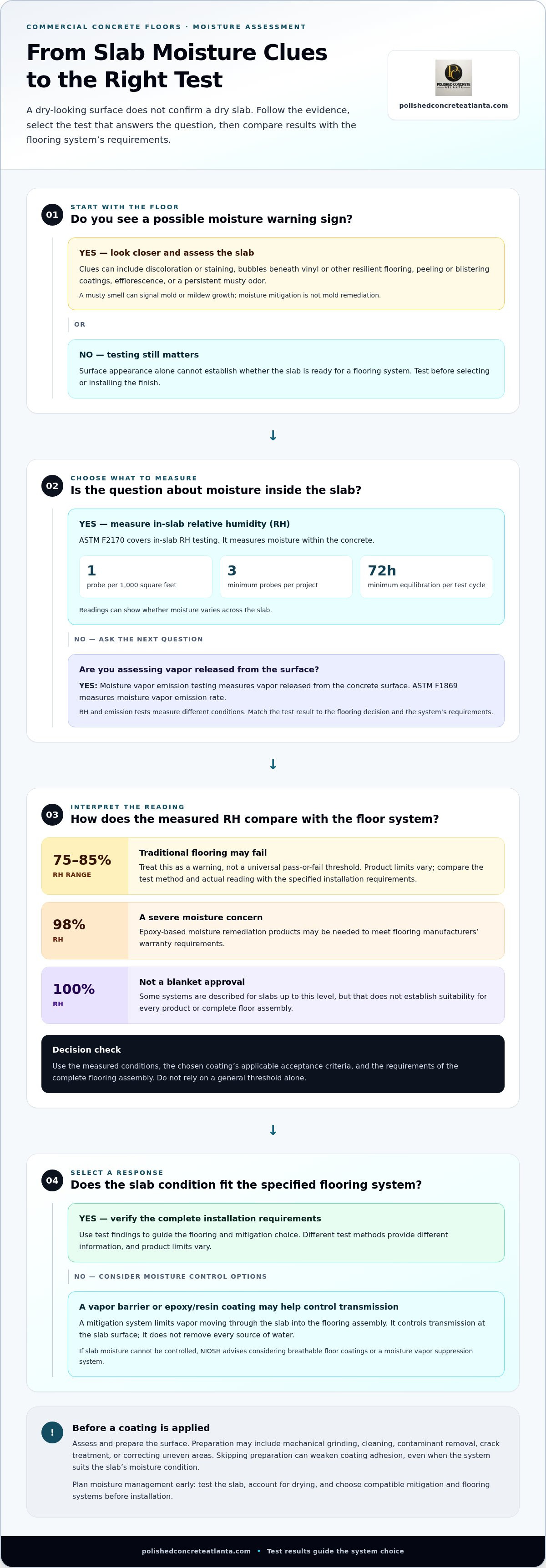
Concrete moisture tests measure different conditions, so the result must match the flooring decision. Relative humidity (RH) testing measures moisture within the slab. Moisture vapor emission testing measures vapor released from its surface. ASTM F2170 covers in-slab RH testing, while ASTM F1869 measures moisture vapor emission rate. Neither a dry-looking surface nor one isolated reading describes every area of a commercial floor.
For RH testing, the stated sampling plan is one probe per 1,000 square feet, with at least three probes per project. Each test cycle requires a minimum 72-hour equilibration period. Those readings help show whether moisture varies across the slab and whether the planned installation fits its conditions. Emission results provide another measure, especially when comparing flooring applications or assessing a coating system’s requirements.
Check for physical clues alongside test results. Discoloration or staining can indicate moisture moving through the flooring assembly. Bubbles beneath vinyl or other resilient flooring may point to trapped moisture. Peeling or blistering coating, efflorescence, and a persistent musty odor also warrant attention. A musty smell can signal mold or mildew growth, but moisture mitigation flooring is not mold remediation.
Traditional flooring may fail when concrete moisture exceeds 75-85% relative humidity. That range is a warning, not a universal pass-or-fail threshold for every material. Product limits vary, so compare the test method and actual readings with the requirements for the specified installation. At 98% relative humidity, moisture is a severe concern, and epoxy-based moisture remediation products may be needed to meet flooring manufacturers’ warranty requirements.
For MVS 601 suitability, base the decision on measured RH and the system’s applicable acceptance criteria. Don’t treat a general threshold for traditional flooring as proof that MVS 601 is suitable, or unsuitable. Moisture conditions, the chosen coating, and the complete floor assembly all matter. A result of 100% RH is not a blanket approval for every moisture-tolerant flooring system, even though some systems are described for slabs up to that level.
Moisture-related coating damage often starts when vapor pressure undermines adhesion. Blisters can form, coatings may peel, and the bond can fail across affected areas. Early testing can guide product selection before installation and help identify where further assessment is needed. For a floor affected by moisture, floor moisture mitigation can be considered alongside the test findings and intended finish.
Moisture mitigation system benefits and floor options
Moisture mitigation limits vapor transmission through concrete floors, helping protect the bond between the slab, adhesive, and finish. That matters because excessive moisture can cause blistering, delamination, discoloration, and surface deterioration. The goal is not simply a dry-looking floor, but an assembly suited to measured slab conditions and the demands of its intended use.
Epoxy-based mitigation applies a resinous barrier over prepared concrete to reduce moisture vapor transfer at the surface. When compatible products are installed according to their manufacturers’ instructions, the epoxy layer supports the selected flooring system. This can be useful before commercial epoxy flooring, particularly when moisture conditions threaten long-term adhesion. The coating controls transmission, but does not replace slab assessment or surface preparation.
Epoxy terrazzo requires the same careful coordination. The mitigation layer, terrazzo materials, substrate condition, and installation requirements must work together as one assembly. If moisture pressure weakens the bond beneath the terrazzo, the finish can blister or separate. Testing and proper surface preparation help determine whether the slab is ready for the specified system. The terrazzo manufacturer’s requirements guide product compatibility and installation.
Other options depend on moisture severity and the finish. Lower emission levels may be addressed with moisture-friendly adhesives, while an epoxy or resinous coating can provide a vapor-control barrier. Some moisture-tolerant flooring systems are designed for concrete slabs with relative humidity up to 100%, but that figure doesn’t make every product suitable for every floor. Match the test results to the chosen system’s stated limits.
Moisture mitigation can reduce moisture accumulation at the floor surface, which may limit conditions that support mold or mildew. It is not mold remediation and will not resolve mold growth elsewhere in a building. Treat a persistent musty odor beneath commercial flooring as a warning sign that requires appropriate investigation, not as proof that a coating alone will solve the problem.
Failure costs vary with the severity of the damage. These figures describe potential failure costs, not mitigation installation prices. Early testing and a compatible system can help reduce the risk of avoidable damage.
How do moisture remediation systems compare by performance and application? Vapor barriers and epoxy or resin coatings reduce moisture transmission at the slab, while moisture-friendly adhesives address lower emission levels. Compare each option with measured moisture conditions, substrate preparation needs, the selected floor finish, and manufacturers’ requirements.
What are the types of commercial floor moisture mitigation systems?
Commercial moisture control options depend on when the slab is built, where the barrier sits, and which finish follows. An under-slab vapor retarder is placed between the subgrade and poured concrete. It helps limit moisture rising from the ground, so it must be planned during construction rather than added later as a surface finish.
Another approach places a vapor retarder above the slab and beneath absorbent flooring, such as wood or laminate. This separates the floor covering from moisture moving through the concrete. Placement matters: the barrier must work with the selected flooring assembly, and the slab must be suitable for installation. This differs from coating exposed concrete.
Topical epoxy or resin moisture-mitigation coatings form a barrier over concrete floors. The slab is assessed and prepared before a compatible coating is applied and the finish installed. Preparation can include mechanical grinding, cleaning, and contaminant removal. These coatings can also be applied over existing concrete when the surface is prepared and tested for compatibility and vapor control.
For lower moisture emission levels, moisture-friendly adhesives may be suitable within the flooring system. Another option is a moisture-tolerant floor covering designed for concrete with relative humidity up to 100%. That stated capacity applies to the relevant product system, not every flooring material. Match the measured slab condition with the manufacturer’s requirements before selecting either approach.
Breathable floor coatings offer another option when moisture cannot be controlled at the slab. The National Institute for Occupational Safety and Health (NIOSH) identifies breathable coatings or a moisture vapor suppression system as options in that situation. Because these approaches manage vapor differently, consider the slab, expected use, chosen finish, and product instructions together.
- Under-slab retarder: placed between subgrade and poured concrete during construction.
- Above-slab retarder: positioned beneath absorbent coverings such as wood or laminate.
- Epoxy or resin coating: applied to prepared concrete as a surface vapor barrier.
- Moisture-tolerant flooring or adhesive: selected to suit the measured slab conditions and flooring requirements.
- Breathable coating: considered when the slab’s moisture cannot be controlled through other means.
For an existing commercial slab, compare test results, surface condition, and the intended finish before settling on a system. Plan moisture mitigation for your concrete floor with the slab and final flooring system in view.
Polished Concrete Atlanta: Polished Concrete Floors
Polished Concrete Atlanta helps turn moisture test results into a practical plan for floor preparation and finish selection. Its floor moisture mitigation and preparation services address the concrete substrate before finishing, aligning the work with the slab’s measured condition.
For commercial spaces, the right finish depends on the project’s needs and the condition of the concrete. Options include polished concrete floors, epoxy flooring, and stained concrete. Consider the test findings alongside the space’s intended use to shape a practical flooring plan.
Set the Floor Up for the Right Finish
Turn the slab assessment into a clear flooring plan by bringing together moisture test findings, the concrete’s condition, and the demands of the space. This gives the project team a practical basis for coordinating preparation, mitigation, and finish selection rather than treating them as separate decisions.
A commercial floor moisture remediation system should support the chosen finish and account for conditions beneath it. Polished Concrete Atlanta offers Polished Concrete Floors, Epoxy Flooring, and Stained Concrete, giving commercial projects finish options to consider alongside floor moisture mitigation and preparation.
Share your project goals and flooring concerns with Polished Concrete Atlanta to discuss a suitable path forward. A well-planned floor starts with decisions grounded in the slab and the intended use. Make the next choice with clarity, and move toward a finish built around your facility’s needs.
Frequently Asked Questions
What Causes Moisture Issues?
Moisture issues often start below the floor, but building conditions can add to the problem. High groundwater, poor drainage, or a missing barrier beneath the slab can allow moisture to rise through concrete. Water used excessively during cleaning can also contribute. For example, repeated wet cleaning may leave moisture at floor joints or beneath resilient flooring, where it can affect adhesives and finishes.
How can someone prevent vapor transmissions?
Preventing vapor transmission starts with managing moisture before it reaches the finished floor. In new construction, a vapor retarder can be placed below the slab. Drainage matters too: downspouts discharging beside a foundation and ground sloping toward a building can contribute to moisture below concrete. For an existing floor, test the slab and select a compatible mitigation layer before installing the finish.
How do I know if my floor has a moisture problem?
Look for changes across the floor, not just isolated wet patches. Blistering, peeling, staining, or loose flooring can point to moisture-related damage; white mineral deposits may indicate efflorescence. A musty odor beneath flooring is another warning sign. These symptoms do not identify the moisture source by themselves. Compare affected areas with nearby flooring and investigate with concrete moisture testing.
What is a commercial floor moisture remediation system?
A commercial floor moisture remediation system combines materials and preparation steps to manage moisture moving through a concrete slab before or beneath a floor finish. Depending on the site, it may involve a vapor retarder, a surface-applied epoxy or resin barrier, or moisture-tolerant flooring materials. For Atlanta facilities, the right approach depends on slab readings, substrate condition, and the intended floor assembly.
What causes moisture problems in commercial concrete floors?
Commercial concrete floors can take on moisture from the ground, especially where groundwater is high or site drainage directs water toward the building. An absent under-slab barrier can also allow vapor to pass through. Building ventilation conditions and excessive water during floor cleaning may contribute. Identify the source as well as the visible damage: treating a coating symptom alone will not address water entering from elsewhere.
How do you test concrete floor moisture before installing flooring?
Testing commonly measures in-slab relative humidity or surface moisture vapor emission. ASTM F2170 applies to in-slab relative humidity, while ASTM F1869 measures emission rate. The test method should suit the flooring system’s requirements. Before installation, record results alongside the slab locations tested and any visible floor conditions. This makes it easier to compare readings with product requirements and determine whether mitigation is appropriate.


