
What if the right moisture vapor barrier isn’t the one with the boldest performance claim, but the one that fits your slab data and planned finish? Choosing a moisture vapor barrier for concrete slab Atlanta projects starts with evidence, not assumptions. Moisture moving through a slab can interfere with a coating or other floor finish, putting the investment and schedule at risk.
Before committing to epoxy, polished concrete, stained concrete, or another finish, bring together the slab’s condition, relevant moisture test results, surface preparation needs, and the finish system’s documented requirements. A barrier or mitigation approach chosen without that context can leave important project conditions unaddressed.
This guide explains how slab moisture affects commercial floors, what testing can tell you, and how to compare mitigation approaches with the needs of your facility. Use it to plan a coordinated sequence from assessment through preparation and finishing. Measure first, then match the solution to the slab and the finish.
Key Takeaways
- Assess the existing slab before committing to a commercial floor finish. Moisture conditions can influence how the finish system performs.
- Use moisture test results as evidence for a project decision, not as a standalone endorsement of a particular mitigation product.
- Choose a moisture vapor barrier for concrete slab Atlanta projects by considering the slab, intended finish, test evidence, and system compatibility together.
- Compare mitigation requirements with the needs of epoxy, sealed, stained, or polished concrete to shape a finish plan around the actual project.
- Coordinate slab assessment, floor preparation, moisture mitigation, and finish installation as a connected sequence.
Why Atlanta Commercial Concrete Slabs Need Moisture Assessment Before Flooring
Assess the existing slab before committing to a commercial floor finish. Moisture moving through concrete can affect how a coating, adhesive, or other finish system performs, so appearance alone is not enough to make a sound flooring decision. Consider the slab’s condition and intended use before specifying epoxy, sealed concrete, stained concrete, or polished concrete for an Atlanta facility.
For a moisture vapor barrier for concrete slab Atlanta projects, the practical question is what the existing slab and planned finish require. That is more useful than choosing a mitigation approach based on a generic symptom or product claim. Treat moisture mitigation as part of a coordinated preparation and finishing plan.
How moisture vapor can affect a finished concrete floor
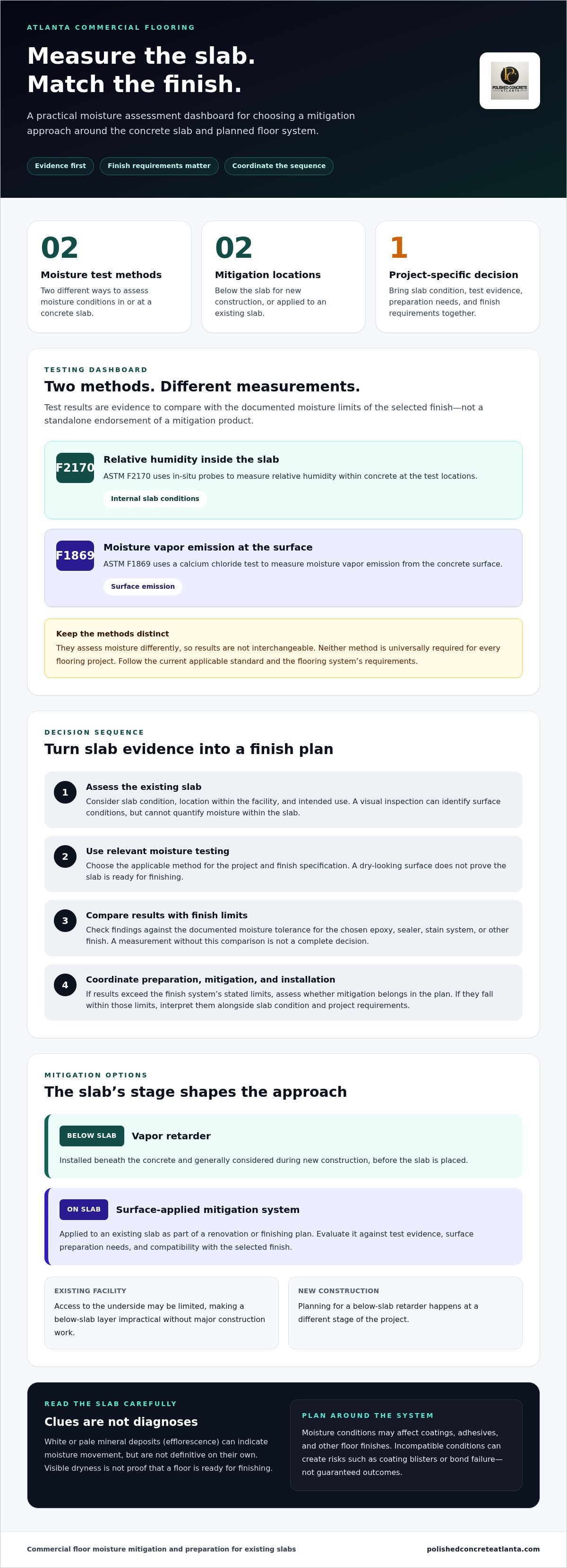
Concrete can transmit moisture vapor from within the slab toward its surface. This movement differs from a visible spill: the floor may look dry while moisture is still moving through the concrete. If conditions are incompatible with the selected finish system, problems such as coating blisters or bond failure may occur. These are risks to assess, not guaranteed outcomes.
White or pale mineral deposits on concrete, often called efflorescence, can be a clue that moisture has moved through the slab and carried soluble materials to the surface. It is not a definitive moisture diagnosis by itself. This overview of damp proofing and vapor barriers in construction explains how barriers are used to limit moisture passage. A commercial flooring decision still needs to account for the specific slab and finish.
Why a dry-looking slab is not a moisture assessment
A visual inspection can identify surface conditions, but it can’t quantify moisture within the slab. A surface that appears clean and dry does not establish whether moisture conditions are suitable for a planned coating or adhesive. Visible dryness alone is not proof that the floor is ready for finishing.
Project context matters. The slab’s location within the facility, its current condition, and the intended finish all shape what assessment information is relevant. Use the finish system’s documented moisture requirements to interpret results. Don’t base a mitigation decision on a single visual sign.
For an Atlanta commercial project, this evidence-led approach gives the team a clearer basis for planning preparation and moisture mitigation before installation. It keeps the decision tied to the actual facility rather than assumptions drawn from a different slab or flooring system.
How Moisture Testing Guides a Vapor Barrier Decision in Atlanta
Moisture testing gives a commercial flooring team evidence to compare with the requirements of the planned finish. It doesn’t endorse a particular product or, by itself, determine that mitigation is necessary. For a moisture vapor barrier for concrete slab Atlanta projects, compare test findings with the finish system’s documented moisture limits to assess whether mitigation belongs in the plan.
What ASTM F2170 and ASTM F1869 measure
ASTM F2170 measures relative humidity inside a concrete slab using in-situ probes. It provides information about internal slab conditions at the test locations. ASTM F1869 measures moisture vapor emission from the concrete surface using a calcium chloride test. The methods assess moisture differently, so their results aren’t interchangeable. Neither method should be treated as universally required for every flooring project. For an overview of industry standards and methods for concrete moisture testing, AMPP discusses these approaches and their considerations.
Test setup, execution, and interpretation should follow the current applicable standard and the flooring system’s requirements. Confirm current technical details before relying on a procedure or threshold. The appropriate method depends on the project and finish specification.
From test results to a mitigation approach
Results matter in context. Compare them with the documented moisture tolerance for the selected epoxy, sealer, stain system, or other finish. A test result without that comparison is only a measurement, not a complete decision. If results exceed the finish system’s stated limits, use them to assess whether mitigation should be part of the project plan. If they fall within those limits, interpret them alongside the slab’s condition and the project requirements.
Also distinguish between two different points in the slab-to-finish sequence:
- A vapor retarder beneath a slab is installed below the concrete and is generally considered during new construction, before the slab is placed.
- A surface-applied moisture mitigation system is applied to an existing slab as part of a floor renovation or finishing plan.
In an existing commercial facility, access to the underside of the slab may be limited, making a below-slab layer impractical to add without major construction work. A surface-applied approach can be evaluated against test evidence, surface preparation needs, and finish compatibility. In new construction, planning for a below-slab retarder happens at a different stage. Timing and access shape the options.
Polished Concrete Atlanta provides commercial floor moisture mitigation and preparation for existing slabs, coordinated with the intended finish and project requirements.
How to Choose a Concrete Slab Vapor Mitigation System for Your Finish
Select mitigation by working from the slab and finish requirements, not from a product label. A moisture vapor barrier for concrete slab Atlanta projects should fit the existing concrete, test evidence, preparation needs, and intended commercial floor as one coordinated system. Use this sequence to structure the decision:
- Identify the slab. Record its condition, location within the facility, and visible issues such as existing coatings, adhesive residue, or surface damage.
- Define the finish. Specify whether the project calls for epoxy, sealed concrete, stained concrete, or polished concrete. Each finish has its own installation requirements.
- Review test evidence. Compare the findings with the selected finish system’s documented moisture limits. Don’t rely on a test result without the relevant finish requirements.
- Confirm compatibility. Evaluate whether the proposed mitigation approach suits the slab condition, preparation plan, and finish that will follow.
Match mitigation to epoxy, polished, or sealed concrete
Epoxy, sealed, and stained concrete systems can have different moisture tolerances and application requirements. Treat compatibility as a system-level decision: consider the mitigation layer, prepared concrete, and finish together. Polished concrete requires separate consideration because the concrete itself remains the visible floor surface. The plan should account for how preparation and any mitigation work relate to the intended appearance and floor performance.
Account for slab preparation and project conditions
Existing coatings or floor adhesive can affect the preparation sequence. Concrete grinding and floor glue removal may be part of preparing an existing commercial slab, depending on its condition and the selected system’s requirements. Preparation comes before mitigation, and mitigation must suit the planned finish. Specify each step in relation to the others rather than in isolation.
A simple decision matrix can keep project discussions focused:
- Test findings: What did the assessment show, and how does it compare with the finish system’s documented limits?
- Finish type: What requirements apply to epoxy, sealed, stained, or polished concrete?
- Slab conditions: What existing adhesive, coatings, or surface conditions shape preparation?
- System fit: Does the proposed sequence account for preparation, mitigation, and the intended finish?
This framework helps commercial teams evaluate options without defaulting to a universal product or unsupported performance promise. Polished Concrete Atlanta coordinates commercial floor moisture mitigation with floor preparation and the planned finish.
Atlanta Moisture Mitigation: Plan the Slab-to-Finish Project
A durable commercial floor plan connects every stage, from the condition of the existing slab to the finish specified for the facility. For a moisture vapor barrier for concrete slab Atlanta project, treat moisture assessment, floor preparation, mitigation, and finish installation as one sequence. Polished Concrete Atlanta provides floor moisture mitigation and preparation for commercial and industrial environments, with the plan shaped around the existing concrete and intended finish.
Coordinate mitigation with the planned floor finish
Set the finish requirements early. Epoxy, stained concrete, and polished concrete involve different materials and installation considerations, so don’t assume one mitigation approach fits every finish. Account for the slab, the finish requirements, and how the layers or prepared surface work together.
A practical project sequence keeps decisions clear:
- Assess the slab. Record its condition and gather available moisture test results.
- Establish finish requirements. Define whether the project calls for epoxy, stained concrete, polished concrete, or another planned finish.
- Prepare the surface. Address existing coatings, adhesive, and other conditions as part of the preparation plan.
- Mitigate as specified. Select an approach based on project evidence and compatibility with the planned finish.
- Install the finish. Proceed according to the requirements for the selected flooring system.
Preparation isn’t an afterthought. Grinding or floor glue removal may be relevant on an existing slab, and those conditions can influence how mitigation fits into the work. Let project-specific requirements guide the sequence rather than assuming product selection or timing in advance.
Set clear next steps for an Atlanta facility
Before planning the work, gather four essentials: slab details, intended finish, available test results, and known surface conditions. These give the project team a practical basis for assessment instead of a one-size-fits-all product decision. They also help align concrete preparation with the flooring specification from the outset.
For additional planning context, review guidance on concrete surface preparation and industrial floor coatings in Atlanta alongside the finish requirements for your facility. Polished Concrete Atlanta coordinates commercial floor preparation and moisture mitigation around the existing slab and planned finish.
Plan your Atlanta concrete floor moisture mitigation project.
Move Your Commercial Floor Project Forward With Clarity
Turn information about your slab and intended finish into a practical project plan. That gives your facility team a clearer basis for scheduling work, aligning flooring requirements, and deciding how moisture mitigation fits before the finish is installed. For a moisture vapor barrier for concrete slab Atlanta project, tie the decision to the actual facility rather than relying on a generic specification.
Polished Concrete Atlanta provides commercial and industrial concrete floor preparation and moisture mitigation. The work connects the existing slab to the floor your operation needs, without treating any one system as a universal answer.
Bring your project into focus with a plan built around your facility’s requirements. Plan your Atlanta concrete floor moisture mitigation project.
Frequently Asked Questions
Is a moisture vapor barrier needed for every concrete slab in Atlanta?
No, a barrier isn’t automatically needed for every Atlanta slab. A warehouse changing from bare concrete to a coating has a different decision to make than a facility keeping an existing polished floor. Consider the specific slab, available test evidence, and documented requirements for the planned finish. A dry surface alone doesn’t establish readiness, and the slab’s presence alone doesn’t prove mitigation is necessary.
How much moisture is too much for a concrete slab?
There’s no single moisture limit that applies to every concrete floor system. The relevant limit comes from the selected finish’s documentation and must be considered alongside the test method and project conditions. Don’t treat a result as a pass or fail without knowing which finish specification it’s being compared against. For a moisture vapor barrier for concrete slab Atlanta project, use documented, project-specific requirements rather than a generic online threshold.
Does a dry-looking slab mean it is ready for epoxy flooring?
No. A visually clean slab doesn’t show whether its moisture condition aligns with the selected epoxy system’s requirements. Before planning a coating over an existing warehouse or commercial work area, organize available test information alongside details about previous finishes, adhesive, or other surface conditions. This helps determine whether preparation or mitigation belongs in the scope before epoxy installation is scheduled.
Can concrete moisture mitigation work with polished concrete?
It may, depending on the slab, moisture findings, and intended floor system. Polished concrete and applied coatings create different finished surfaces, so don’t assume a mitigation approach designed around a coating will suit a polished floor. For a commercial space where the concrete itself is meant to remain visible, include the desired appearance and finishing approach in the project discussion, along with the slab’s condition.
Does Atlanta humidity alone mean a concrete slab needs a vapor barrier?
No. Humidity in Atlanta doesn’t, by itself, diagnose the moisture condition of a particular commercial slab. Two facilities can face different project decisions because their slabs, site conditions, existing floor layers, and intended finishes differ. Use information from the actual facility rather than treating local weather as a pass-or-fail test. This keeps mitigation decisions tied to project evidence and the floor system planned for the space.
How long should a mitigation system cure before a floor coating is installed?
There’s no universal cure interval for every mitigation system or coating project. The required interval depends on the system instructions, site conditions, and requirements of the finish layer that follows. A project schedule should account for documented readiness criteria rather than assume a surface is ready based on appearance or elapsed time alone. Coordinate the sequence before scheduling coating installation.


