

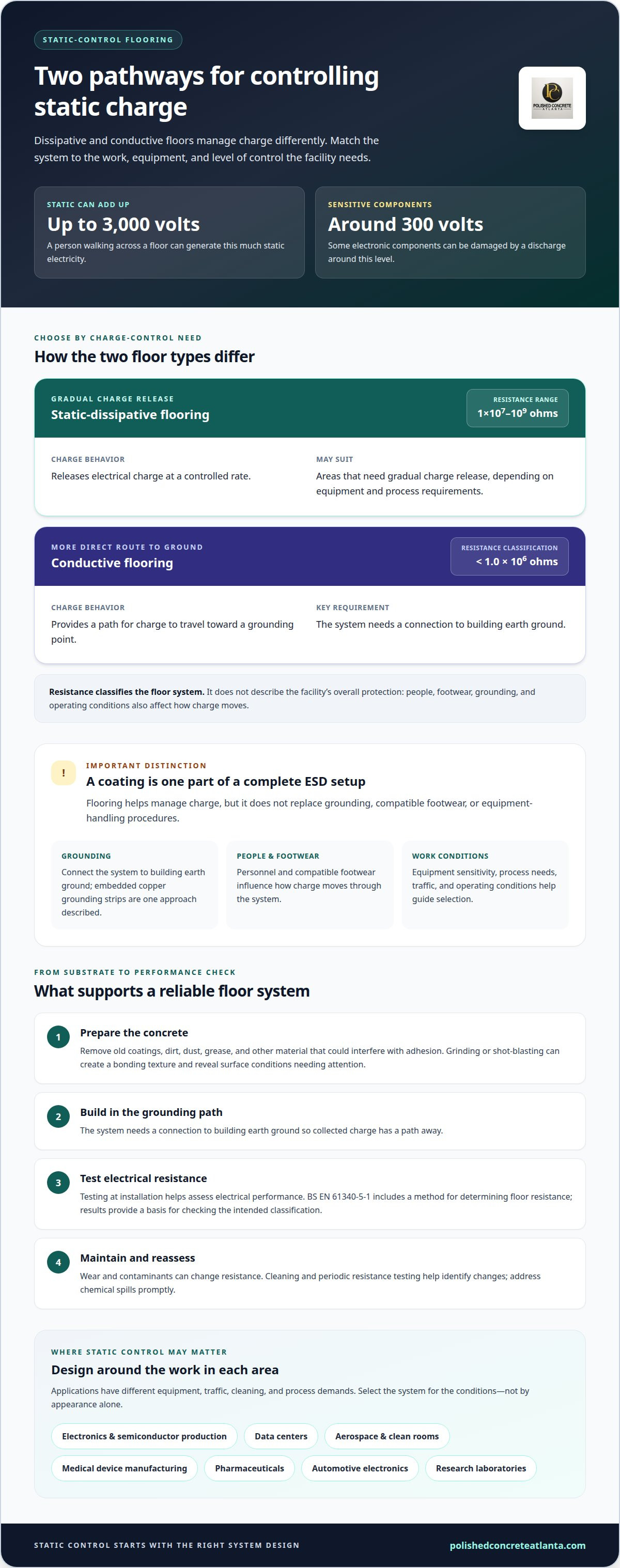
Static control is a facility requirement, not a cosmetic upgrade. For facilities considering anti-static epoxy flooring in Atlanta, GA, the key choice is between dissipative flooring, which directs charge away at a controlled rate, and conductive flooring, which provides a path to ground. A floor is classified as conductive when its resistance is less than 1.0 × 10⁶ ohms.
That distinction matters wherever an electrostatic discharge could disrupt operations or damage sensitive components. A person walking across a floor can generate up to 3,000 volts of static electricity, while some electronic components can be damaged by a discharge around 300 volts. The right system depends on the level of charge control the work area needs.
This guide explains how anti-static flooring manages electrical charge, how dissipative and conductive systems differ, and which environments commonly use each. You’ll learn why grounding, floor preparation, and system testing matter, with examples from electronics and semiconductor production to data centers, medical device manufacturing, pharmaceuticals, automotive electronics, and research laboratories. Clear guidance supports better flooring decisions.
Key Takeaways
- Compare dissipative and conductive resistance ranges to understand which level of static control suits your facility.
- Match the flooring system to the work being done, since sensitive processes can have different charge-control needs.
- Grounding and compatible footwear are part of a functioning ESD floor system, not optional finishing details.
- Surface preparation and testing at installation stages help support adhesion and assess electrical performance.
- Explore how professional floor preparation and epoxy flooring can support a facility’s static-control requirements.
What Is an Anti-Static Floor?
An anti-static floor controls electrical charge rather than allowing it to accumulate on a standard epoxy surface. Its resistance helps determine whether charge moves away gradually or travels toward a grounding point.
Static-Dissipative and Conductive Resistance
Static-dissipative floors release electrical charge at a controlled rate, while conductive floors provide a more direct route to ground. The distinction matters because sensitive equipment and work processes need different levels of charge control. Static-dissipative flooring is commonly specified in the 1×10⁷-109 ohm range; conductive flooring has resistance below 1.0 × 10⁶ ohms.
A resistance reading describes the floor system, not the facility’s overall protection. People, footwear, grounding, and operating conditions also affect how charge moves. A dissipative coating may suit an area that needs gradual charge release, while a conductive system directs charge toward an earth-ground connection.
Electrical Resistance Classifications
Electrical resistance, measured in ohms, is used to classify how a floor handles static charge. Standard epoxy flooring is normally non-conductive, so charge may build up rather than dissipate through the surface. Resistance testing helps determine whether an installed coating falls within its intended classification.
BS EN 61340-5-1 includes a method for determining floor resistance. Testing uses equipment that measures conductivity or electrical resistance in ohms. The result gives facility teams a concrete basis for assessing the floor system, rather than relying on the coating’s appearance or product description alone.
Customizable Floor Conductivity
Flooring formulations can use resins, carbon-based additives, or metallic compounds to adjust conductivity. These materials influence resistance, helping tailor the system to an environment’s static-control needs. Equipment sensitivity and process requirements guide the selection.
A custom formulation does not remove the need for grounding. ESD flooring needs a connection to building earth ground, often through embedded copper grounding strips, to give collected charge a path away. Resistance testing after installation assesses the completed system’s performance.
Installation and access: Installation duration depends on substrate preparation, system layers, and curing conditions. The floor is ready for use when the coating reaches the required cure stage, according to the system’s specified schedule.
Durability and maintenance: Epoxy coatings create a continuous surface, but resistance can change as the floor wears or contaminants build up. Cleaning and periodic resistance testing help identify changes. Concrete floors with epoxy flooring will likely need recoating every couple of years. Chemical exposure matters too: spills can affect the coating, so facility maintenance should address them promptly.
Warranties and performance guarantees: Atlanta contractors’ warranty terms depend on the written agreement. It should state what coating or resistance performance is covered, the maintenance conditions, and any exclusions. These terms are separate from the floor’s classification and test readings.
Antistatic flooring applications and case studies
Anti-static flooring is relevant wherever a small electrical discharge could interrupt work or harm sensitive equipment. The right system depends on the facility’s processes, equipment, and operating conditions.
Concrete preparation lays the groundwork for a successful coating. Professionals remove old coatings, dirt, dust, grease, and other material that could interfere with adhesion. Grinding or shot-blasting can create a bonding texture and expose surface conditions that need attention before installation. A seamless finish starts with a properly prepared substrate.
An electronics manufacturing area, for example, may handle circuit boards and components vulnerable to electrostatic discharge. A static-control floor helps manage charge across the work zone, while the complete system must account for grounding and how personnel move through the facility. Flooring is one part of a coordinated setup, not a substitute for equipment-handling procedures.
Aerospace work can involve sensitive electronics, testing equipment, and controlled work areas. In a clean room, the floor surface also needs to suit cleaning routines and movement patterns. A seamless coating avoids joints that can collect dirt, while an appropriate static-control design helps manage charge. The specific system depends on the work performed in each room.
Data centers are another example. Technicians move through equipment aisles, handle components, and maintain systems where an electrostatic event can create operational risk. A static-control floor can help manage charge, but performance depends on grounding, footwear, and ongoing testing. Layout matters too: traffic routes and equipment locations influence where charge-control measures are needed.
Are permits or local code requirements relevant to epoxy flooring installation in Atlanta? Requirements depend on the project scope and facility. A coating-only project differs from work that changes building systems or affects other regulated features, so review the scope against applicable local requirements before work begins.
Every application needs its own preparation and performance plan. An electronics production line, an aerospace test room, and a data center have different equipment, traffic, and cleaning demands. A professional assessment links those conditions to concrete preparation, coating selection, grounding, and post-installation testing. This helps avoid treating every facility as if it had the same flooring requirements.
For an existing concrete slab, preparation may also involve evaluating old coatings and surface contaminants before installation. Removing material that could weaken adhesion is a practical first step. A facility planning an upgrade can make concrete floor preparation part of its installation scope, so the substrate and intended flooring system are considered together.
ESD dissipative and ESD conductive flooring
Both systems manage electrostatic charge, but they control its movement differently. The right choice depends on the sensitivity of the work area and how the floor connects with personnel and grounding.
ESD Dissipative Flooring
ESD dissipative flooring moves charge away at a controlled rate instead of releasing it abruptly. That gradual path can suit work areas where sensitive electronics need charge control without direct, rapid conduction. Performance depends on the complete floor-and-footwear system, not just the coating. For personnel grounding, the stated performance limit is under 100 volts of body voltage.
Electrostatic dissipative shoes help connect a person to the floor’s charge-control path. Without compatible footwear, the floor alone cannot reliably ground personnel. This is important in production areas where staff walk between workstations and handle components. A coordinated system supports the intended dissipative function.
ESD Conductive Flooring
ESD conductive flooring provides a direct route for collected charge to reach earth ground. The floor needs an earth connection because charge transferred into an ungrounded surface can accumulate there. Embedded copper grounding strips or copper tape can provide a conductive pathway. The grounding design needs to match the facility and its electrical requirements.
During installation, copper tape is commonly arranged in 3 m² grids. One earthing point per 200 m² may be sufficient in most cases, subject to an electrical engineer specifying the requirements. These details affect the system’s charge path, so the layout is planned as part of the flooring assembly rather than treated as a final accessory.
Both types require assessment of the intended resistance and a complete grounding plan. The stated upper resistance limit for an ESD floor is under 1×10⁹ ohms. Resistance testing with suitable equipment helps assess whether the installed system meets its intended electrical performance. A durable surface still needs testing; visual condition cannot show electrical resistance.
Testing at different installation stages can reveal issues before later layers conceal the grounding layout. Testing after the copper grid and primer, in particular, helps assess the developing system. Further checks after completion provide readings for the finished floor. This staged approach links installation quality to measurable electrical performance.
System performance also depends on daily use. Personnel walking on an anti-static floor should wear electrostatic dissipative shoes so static charge can be reliably grounded. Facility procedures should address footwear, grounding connections, and floor condition together. A conductive or dissipative coating cannot compensate for a broken earth path or incompatible footwear.
Material selection follows the same principle. Vinyl, rubber, and carpet tiles can also be made anti-static with conductive features, but an epoxy system is selected for the facility’s surface and operational requirements. The functional difference is that dissipative floors control charge gradually, while conductive floors direct it toward grounding. Both need planned installation and electrical testing.
Industries that use anti-static epoxy flooring
Anti-static flooring is most relevant where a discharge could damage sensitive equipment or interrupt controlled work. Electronics manufacturing, semiconductor production, data centers, pharmaceuticals, medical device manufacturing, automotive electronics, and research laboratories all have distinct operating demands. For facilities planning anti-static epoxy flooring in Atlanta, GA, start with the process being protected, not the industry label alone.
In electronics manufacturing, teams may handle components at several workstations. A flooring plan should connect charge control to handling areas, staff routes, and equipment locations. Mapping component assembly and testing areas, for example, helps distinguish spaces that need static control from nearby rooms with different functions. The floor specification can then reflect actual workflow instead of assuming the whole facility has identical needs.
Semiconductor production and research laboratories may have specialized equipment and different activities in adjoining rooms. Identify where sensitive materials are handled and how people or carts move between spaces. This map helps define controlled-area boundaries and transitions, giving facility teams a clearer basis for coordinating floor performance with operating procedures.
Data centers bring technicians into equipment aisles and service areas for ongoing work. The project scope should account for access routes, maintenance activities, and locations where equipment is handled. Because a room’s use can change, plan the flooring for intended operations, not just the current layout. This matters when one installation must serve both equipment zones and working paths.
Pharmaceutical and medical device manufacturing facilities may need static control alongside cleaning and material-handling routines. Automotive electronics work adds assembly and testing areas where components are handled. Aerospace and clean-room environments also involve controlled operations, but their precise flooring needs depend on the work performed. In every facility, the practical question is how the floor supports its process without treating every room identically.
To plan anti-static epoxy flooring in Atlanta, GA, connect each work area’s purpose with its traffic, equipment, and operational boundaries. Then align the floor plan, grounding design, and testing approach with those needs. This creates a more useful project brief than specifying an ESD floor by industry name alone and gives facility stakeholders a shared reference for installation and ongoing use.
For an Atlanta facility, the takeaway is straightforward: define the work to protect, then plan the flooring around that work. Plan your facility’s epoxy flooring around its processes, traffic, and static-control requirements.
Polished Concrete Atlanta: Epoxy Flooring
Polished Concrete Atlanta can help when your facility is assessing epoxy flooring and concrete preparation for a static-control project. A sound floor plan starts with the substrate and the work performed in each area. Floor preparation addresses existing surface conditions before a coating is applied, while the intended use guides the flooring decision.
Bring your facility’s operating needs into the project discussion, including sensitive work areas, traffic patterns, and cleaning demands. Polished Concrete Atlanta also offers polished concrete floors and stained concrete when another concrete finish better suits the space. A clear scope helps match the flooring choice to the facility’s actual requirements.
Contact Polished Concrete Atlanta to discuss your flooring project.
Plan a Floor That Fits the Work
Planning anti-static epoxy flooring in Atlanta, GA, gives you an opportunity to define what the facility needs from its floors over time. Consider how the space is used, what the existing concrete requires, and how the flooring choice fits the broader facility plan. A clear scope provides a practical starting point.
Polished Concrete Atlanta offers Epoxy Flooring, Polished Concrete Floors, and Stained Concrete. The right option depends on the space and its intended use. Discussing those needs helps shape a flooring plan based on the facility’s day-to-day operations rather than assumptions.
Contact Polished Concrete Atlanta to discuss your flooring project and the needs of your facility. A well-considered next step can make the path forward clearer.
Frequently Asked Questions
Does installing a conductive epoxy floor make my facility ANSI/ESD S20.20 compliant?
No. A conductive floor by itself doesn’t establish facility-wide ANSI/ESD S20.20 compliance. The floor is one element of an ESD control arrangement, alongside personnel grounding, footwear, and the facility’s procedures. For example, a conductive surface without a functioning earth connection can’t provide the intended route for charge. Treat the flooring as one part of the system, not proof that every compliance requirement has been met.
Does epoxy flooring scratch easily?
Epoxy flooring can scratch or gouge under enough force, especially when heavy equipment or objects are dragged across it. Moving a loaded machine without protecting its contact points, for example, can damage the coating. Padding beneath heavy-object legs helps reduce that risk during movement. Floor condition also affects performance over time, so address visible damage as part of regular facility maintenance.
How can a contractor spec an ESD floor for your Atlanta facility?
A flooring specification should reflect the facility’s processes, sensitive equipment, personnel movement, and charge-control needs. For an Atlanta electronics work area, identify where components are handled and how the floor connects to earth ground. The specification should also account for substrate condition, installation preparation, compatible footwear, and electrical testing. Together, these details connect the floor design to the work performed.
What are the different types of epoxy floor coatings?
For static control, the key distinction is between standard epoxy and ESD epoxy systems. Standard epoxy is normally non-conductive, while anti-static formulations use materials that help manage charge. Within ESD systems, dissipative coatings release charge gradually, and conductive coatings provide a more direct route to ground. The work area and its charge-control needs determine the appropriate type.
Why does ESD floor resistance change over time?
Resistance readings can change as a floor wears or contaminants affect its surface. A heavily used aisle, for example, may show different conditions from a protected area near equipment. Periodic testing helps identify where readings have shifted, while maintenance keeps the surface in usable condition. Concrete floors with epoxy flooring will likely need recoating every couple of years, so retesting can help inform planning for that work.
Why does an ESD floor need copper grounding strips?
Copper grounding strips connect an ESD floor to building earth ground, creating a path for collected charge to leave the surface. Without an earth connection, charge transferred into the floor can accumulate instead of being conducted away. Strip placement is part of the electrical design, not just a coating detail. Grounding requirements should align with the facility layout and electrical engineer’s specifications.


