

Moisture vapor transmission is managed by identifying the source of excess moisture, testing the concrete, and matching a mitigation system to the slab before installing a floor finish. Warehouse concrete floor moisture solutions are most effective when they address the cause, not just a damp surface. Leaks, condensation, and moisture moving through concrete can all contribute to floor failures.
A wet-looking slab doesn’t always show what is happening beneath it. Water can move through concrete’s microscopic channels, while poor ventilation and temperature changes can cause condensation on the floor. The right response depends on what is causing the moisture and how it affects the planned coating or floor system.
This article explains common causes of excess moisture in Atlanta warehouses, how testing helps identify the issue, and how vapor-mitigation systems reduce moisture movement through concrete. You’ll also learn how moisture barriers and epoxy coatings differ, and when professional mitigation can help protect a new floor from bubbling, softening, or losing adhesion. Diagnosis comes first. Then the system can be selected for the slab and its intended use.
Key Takeaways
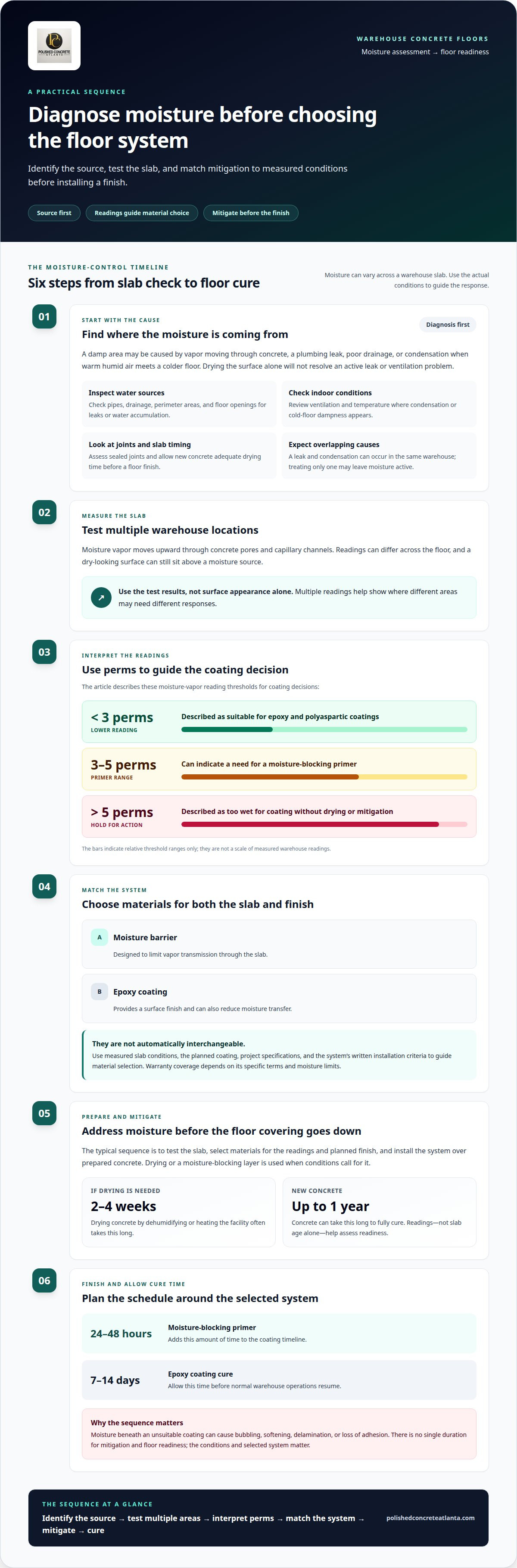
- Use moisture readings to guide coating decisions: concrete below 3 perms is described as suitable for epoxy and polyaspartic coatings, while higher readings may call for additional mitigation.
- Test multiple areas of a warehouse slab because moisture levels can vary across the floor.
- Account for ventilation, drainage, water pipes, and sealed joints when assessing moisture risks in an industrial space.
- Allow new concrete adequate drying time before installing a floor system; it can take up to a year to fully cure.
- Understand how a vapor barrier differs from an epoxy coating so the selected system addresses the slab’s moisture conditions and intended finish.
What is a Moisture Mitigation System?
A moisture mitigation system limits vapor moving through a concrete slab before it damages a floor covering. Readings of 3 to 5 perms can indicate a need for a moisture-blocking primer.
Moisture Vapor Movement Through Concrete
Moisture vapor transmission is the upward movement of moisture through concrete’s pores and capillary channels. As vapor travels, it can carry the concrete’s inherent alkalinity toward the slab surface. A dry-looking surface can still sit above a moisture source. In a warehouse, uneven readings across the slab may mean different areas need different responses.
Effects on Floor Coverings
Moisture vapor can interfere with the bond between concrete and its floor covering. When vapor condenses at the slab surface, coatings such as epoxy may bubble, soften, delaminate, or lose adhesion. A coating may look intact at first, then separate where moisture collects beneath it. These failures can disrupt warehouse operations and require repairs or renewed floor preparation.
Concrete Moisture Vapor Testing
Moisture vapor testing measures conditions in the concrete to help identify the risk to a planned floor system. Testing multiple warehouse locations matters because moisture distribution can vary across a slab. A reading of 3 to 5 perms is described as requiring a moisture-blocking primer, while readings above 5 perms are described as too wet for coating without drying or mitigation. Results guide material selection.
Barriers and Epoxy Coatings
A moisture barrier is designed to limit vapor transmission through the slab, while an epoxy coating provides a surface finish that can also reduce moisture transfer. They are not automatically interchangeable. The right system depends on measured slab conditions and the coating’s requirements. An unsuitable coating can blister or peel, so test results should guide material selection before installation.
For a U.S. warehouse, project specifications and the selected system’s written installation criteria guide the work. Warranty coverage depends on the specific terms and moisture limits. Don’t assume a coating warranty covers every slab condition.
There’s no single duration for moisture mitigation and floor readiness. Drying concrete by dehumidifying or heating a facility often takes 2 to 4 weeks. A moisture-blocking primer adds 24 to 48 hours to the coating timeline, while epoxy coatings take 7 to 14 days to cure before normal warehouse operations resume.
A typical mitigation process starts with slab testing, then matches materials to the readings and planned finish. The system is installed over prepared concrete, with drying or a moisture-blocking layer used when conditions call for it. This sequence addresses vapor transmission before the new floor covering goes down.
What causes moisture problems in industrial floors?
Moisture in an industrial slab can come from below the floor, enter through a leak, or form as condensation. Effective warehouse concrete floor moisture solutions start by identifying the active source. Drying the surface alone won’t fix a pipe leak or ventilation problem. For example, a damp patch near a damaged water line points to a different cause than condensation across a cold floor.
Concrete contains microscopic cavities and capillary channels that allow water to enter and move through the slab. When moisture reacts with soluble compounds in concrete, it can reduce the hardness of the concrete mass. That can weaken the floor itself, not just affect a later coating. A localized soft or damp area calls for investigating both the surface and the conditions supplying water.
Leaks from damaged water pipes and poor drainage can create concentrated wet areas. A leaking pipe may affect the slab along its route, while inadequate drainage can leave water near the building perimeter or floor openings. Sealing the floor without addressing the water source leaves the cause in place; in situations where chronic moisture causes environmental issues or mold growth, property restoration teams such as Coastline Environmental Solutions, Inc. can remediate the space before flooring work resumes. A useful assessment considers pipes and drainage as well as the concrete’s moisture condition.
Ventilation problems and temperature changes can also produce moisture indoors. Condensation forms when warm, humid air meets a colder surface, such as a concrete floor above cold ground. Moisture can appear without a plumbing leak. Changes in ventilation or indoor temperatures can therefore contribute to wet areas in an industrial building, even when water isn’t visibly entering through the slab.
Slab design and construction timing also affect moisture conditions. Continuous, jointless floors can contribute to saturation of the floor’s moisture content. New concrete may take up to a year to fully cure, so installing a floor finish before the slab has dried sufficiently can trap moisture beneath the surface. The slab’s age alone doesn’t show whether it is ready; its condition and moisture readings matter.
Prevention starts by matching the response to the cause. An assessment can include these checks:
- Inspect drainage and water pipes for leaks or water accumulation near affected areas.
- Review ventilation and temperature conditions where condensation appears.
- Assess whether joints are sealed, reducing spaces where moisture can penetrate.
- Allow the slab adequate drying time before installing a floor finish.
These factors can overlap. A warehouse may have a slow pipe leak and condensation on a cold section of concrete. Treating only one condition can leave the other active. Choosing warehouse concrete floor moisture solutions requires distinguishing between water entry, condensation, and moisture retained in the slab. That diagnosis helps determine whether the response involves drainage or pipe repairs, ventilation adjustments, joint sealing, drying, or moisture control before a new floor system is applied.
Causes of excess moisture in industrial concrete floors
Moisture in an industrial slab can come from below the floor, enter through a leak, or form as condensation. Identifying the source matters because drying the surface alone won’t fix an active pipe leak or ventilation problem. A damp patch near a damaged water line points to a different cause than condensation across a cold floor.
Concrete contains microscopic cavities and capillary channels that allow water to enter and move through the slab. When moisture reaches soluble compounds in concrete, the reaction can reduce the hardness of the concrete mass. That can weaken the floor itself, not just affect a later coating. A localized soft or damp area calls for investigating both the surface and the conditions supplying water.
Leaks from damaged water pipes and poor drainage can create concentrated wet areas. A leaking pipe may affect the slab along its route, while inadequate drainage can leave water near the building perimeter or floor openings. Sealing the floor without addressing the water source leaves the cause in place. In cases of severe plumbing failures or flooding, calling in water damage specialists such as Droplet Restoration ensures the area is properly dried and remediated before flooring repairs begin. A useful assessment considers pipes and drainage as well as the concrete’s moisture condition.
Ventilation problems and temperature changes can also produce moisture indoors. Condensation forms when warm, humid air meets a colder surface, such as a concrete floor above cold ground. Moisture can appear without a plumbing leak. In an industrial building, changes in ventilation or air conditions can therefore contribute to wet areas even when water isn’t visibly entering through the slab.
Slab design and construction timing also affect moisture conditions. Continuous, jointless floors can contribute to saturation of the floor’s moisture content. New concrete may take up to a year to fully cure, so installing a floor finish before the slab has dried sufficiently can trap moisture beneath the surface. The slab’s age alone doesn’t show whether it is ready; its condition and moisture readings matter.
Prevention starts by matching the response to the cause. A facility assessment can include the following checks:
- Inspect drainage and water pipes for leaks or water accumulation near affected areas.
- Review ventilation and temperature conditions where condensation appears.
- Assess whether joints are sealed, reducing spaces where moisture can penetrate.
- Allow the slab adequate drying time before installing a floor finish.
These factors can overlap. For example, a warehouse may have a slow pipe leak and condensation on a cold section of concrete. Treating only one condition can leave the other active. Identifying the source first helps determine whether the response involves drainage or pipe repairs, ventilation adjustments, joint sealing, slab drying, or moisture control before a new floor system is applied.
How do concrete moisture vapor barriers and epoxy coatings compare?
A concrete moisture vapor barrier and an epoxy coating address moisture at different points in the floor assembly. A barrier can be installed beneath a slab before concrete is poured; a resinous coating is applied to the slab surface. That distinction matters in Atlanta warehouses: one is planned during construction, while the other can be part of a flooring decision for an existing slab.
When soil is relatively damp, a moisture vapor barrier should be installed before the concrete pour. Positioned beneath the slab, it helps limit moisture movement from the ground into the concrete. This is a construction-stage measure, not a surface treatment for an existing warehouse floor. Existing facilities need their slab conditions assessed and a surface system selected accordingly.
Epoxy coatings work at the concrete surface. They create a waterproof layer that can prevent water absorption in high-humidity environments and reduce moisture vapor transfer. This differs from an under-slab barrier: epoxy also serves as the floor coating, while the barrier sits below the concrete. A coating can’t fix a leaking pipe or poor drainage, so the moisture source still matters.
The choice depends on the slab, moisture readings, and intended floor finish. A moisture-control coating that doesn’t suit the concrete can blister or peel. For instance, a warehouse slab with elevated readings may need moisture mitigation before the finish coat is applied. Choosing a system by its label alone, without accounting for measured conditions, can leave vapor movement unresolved beneath the finished surface.
Other surface treatments have different characteristics. Polyurethane coatings can adhere to concrete pores and seal cavities against moisture penetration. Lithium treatment seals and hardens concrete while increasing impermeability without affecting its breathability. Methyl methacrylate can be applied to concrete with moisture vapor transmission readings up to 7 to 8 perms. These are distinct approaches, not interchangeable names for a single barrier or epoxy coating.
For a new warehouse, under-slab protection is a decision made before the pour. In an existing facility, testing and slab conditions guide whether drying, a moisture-control layer, or a coating system is appropriate. The key difference is placement and purpose: a below-slab barrier limits ground moisture, while a surface-applied coating manages the concrete interface and provides the chosen finish.
Have the slab assessed before choosing between surface protection and a coating. Arrange warehouse floor moisture mitigation to align the system with the concrete’s measured condition.
Polished Concrete Atlanta: Epoxy Flooring
Polished Concrete Atlanta provides floor moisture mitigation and epoxy flooring for warehouse concrete floors affected by moisture. When testing identifies vapor transmission, addressing the slab before selecting a finish helps match the floor system to its conditions.
The next step is a project assessment that considers the moisture findings and intended use of the space. Epoxy flooring may suit a warehouse’s needs, while polished concrete floors or stained concrete provide other finish options. The right choice starts with the floor, not a generic coating recommendation.
If moisture readings are complicating your flooring plans, contact Polished Concrete Atlanta to discuss your warehouse floor.
Make Moisture Control Part of Your Flooring Plan
A warehouse floor is part of a larger operating environment. Consider moisture control early in renovation planning, alongside traffic patterns, facility use, and the desired finish. This gives flooring a clear role in the project, rather than treating moisture as a surface issue after installation begins. A considered approach to warehouse concrete floor moisture solutions keeps slab conditions central to the decision.
Polished Concrete Atlanta offers Polished Concrete Floors, Epoxy Flooring, and Stained Concrete. The right finish depends on the project’s goals and the concrete’s condition. Share your plans for the space and what the floor needs to support, then discuss a suitable direction with the team.
Contact Polished Concrete Atlanta to discuss your warehouse flooring project. A clear plan is a strong start.
Frequently Asked Questions
How can someone prevent vapor transmissions?
Preventing vapor transmission starts with limiting moisture sources and choosing floor protection suited to the slab’s conditions. For a new warehouse, install an appropriate vapor barrier beneath the concrete before the pour when soil is relatively damp. In an existing facility, address leaks or drainage problems, manage condensation, and assess moisture before choosing a coating. Properly sealed concrete joints can also reduce pathways for moisture. These steps help prevent avoidable coating failures.
What causes moisture in warehouse concrete floors?
Warehouse floor moisture can come from groundwater moving through concrete, pipe leaks, poor drainage, or condensation. A wet area near a water line, for example, may indicate a localized leak, while moisture on a cold floor during warm, humid conditions may point to condensation. New concrete also needs time to dry. Identifying the conditions at play helps determine whether to address water entry, building conditions, or the slab.
How can you test a concrete floor for moisture or vapor emission?
A professional moisture test measures slab conditions and helps guide flooring decisions. Testing several locations is useful because moisture may not be evenly distributed across a warehouse. Readings from a dry-looking aisle, for example, may differ from those near an exterior wall or suspected leak. Consider test results alongside visible dampness, the slab’s condition, and the planned floor finish. This gives a clearer picture than surface appearance alone.
What moisture levels are acceptable for warehouse concrete floors and flooring systems?
For epoxy and polyaspartic coatings, concrete below 3 perms is described as suitable. Readings from 3 to 5 perms call for a moisture-blocking primer, while readings above 5 perms are too wet for coating without drying or mitigation. These are practical thresholds, not a substitute for matching materials to the project. A warehouse with uneven readings may need different preparation decisions across the slab before its flooring system is installed.
What are the best solutions for excessive moisture in concrete floors?
The right solution depends on what is supplying the moisture and the floor system planned for the warehouse. Repairing a pipe leak or correcting drainage addresses an active water source; ventilation adjustments can help address condensation. Once the cause is addressed, slab testing guides whether drying, a moisture-control layer, or another floor coating is appropriate. Polished Concrete Atlanta provides floor moisture mitigation and epoxy flooring for industrial and commercial concrete projects.
What does warehouse concrete floor moisture mitigation cost per square foot?
Warehouse concrete floor moisture mitigation pricing depends on the specific project and is provided after a quote request. Relevant factors include the slab’s moisture readings, the area requiring treatment, concrete condition, preparation needs, and selected system. A warehouse with localized moisture and limited preparation may involve different work from a floor requiring broader treatment. Per-square-foot pricing alone can’t reflect those differences, so the project scope determines the quote.


