

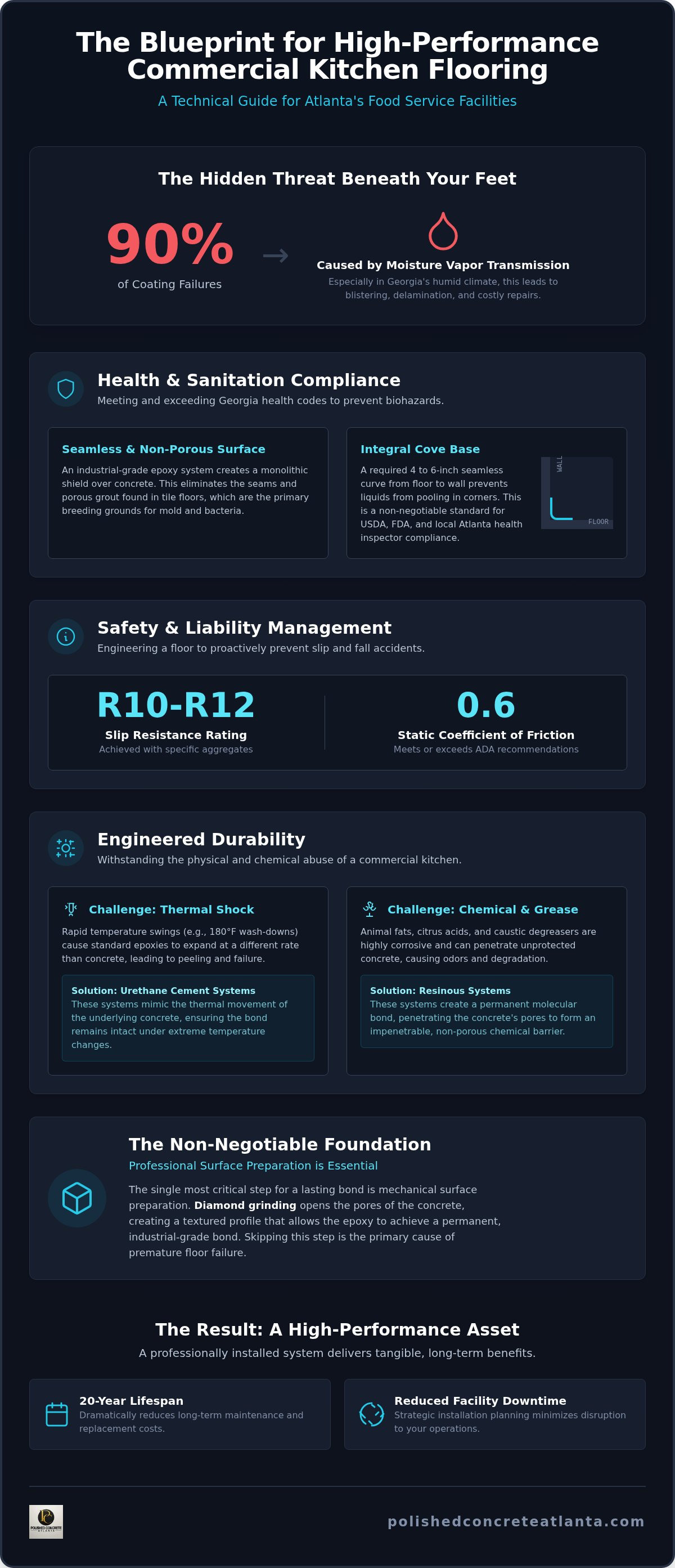
Your kitchen floor isn't just a surface; it's a high-performance piece of equipment that either supports your operation or threatens to shut it down. In a high-volume environment, the margin for error is zero. When searching for epoxy flooring for commercial kitchens Atlanta facility managers often prioritize aesthetics, but the real battle is won in the prep work. Nearly 90% of coating failures in the humid Southeast are caused by moisture vapor transmission through the concrete slab. Without strategic moisture mitigation, even the most expensive topcoat will blister and delaminate under the pressure of a Georgia summer.
You understand that a peeling floor is a direct invitation for health code violations and a massive liability for slip and fall accidents. We agree that your facility deserves a foundation that works as hard as your staff does. This guide will show you how high-performance epoxy systems protect your kitchen from thermal shock and hot grease while meeting strict Georgia safety standards. You'll discover the technical requirements for R10 slip resistance, the necessity of 4 to 6-inch coved bases, and how professional mechanical preparation ensures a floor that lasts up to 20 years.
Key Takeaways
- Identify the technical benchmarks for seamless, non-porous surfaces that satisfy Georgia health codes and eliminate bacterial breeding grounds.
- Learn how to engineer your floor for thermal shock resistance to prevent cracking during high-temperature wash-downs and heavy grease exposure.
- Understand the critical role of moisture mitigation in ensuring epoxy flooring for commercial kitchens Atlanta stays bonded despite the region's high humidity.
- Recognize why mechanical surface preparation via diamond grinding is a non-negotiable step for achieving a permanent industrial-grade bond.
- Develop a strategic installation plan that prioritizes facility uptime and establishes long-term maintenance protocols for a 20-year lifespan.
The Standards for Commercial Kitchen Epoxy Flooring in Atlanta
Commercial kitchen flooring is a specialized resinous barrier, not a simple coat of paint. In the demanding environment of Atlanta food service, standard residential products fail because they lack the cross-linking density required to withstand constant traffic and caustic cleaners. High-performance epoxy flooring for commercial kitchens Atlanta relies on industrial-grade epoxy resins that create a monolithic, non-porous shield over the concrete. This isn't just about looks. It's about preventing organic matter from seeping into the slab and creating a permanent biohazard. Residential kits can't handle the heat. Professional systems can.
Sanitation and Health Code Compliance
Pathogens thrive in the porous gaps of tile grout. By eliminating these seams, you remove the primary breeding ground for mold and bacteria. Georgia health department standards mandate floors that are smooth and easily cleanable. To meet local Atlanta inspector requirements, an integrated cove base is essential. This creates a seamless transition where the floor curves 4 to 6 inches up the wall, preventing liquids from pooling in the corners. It's a non-negotiable standard for USDA and FDA compliance. If your floor doesn't have a cove base, it isn't finished.
Safety and Liability Management
A kitchen is a high-risk zone. Water, grease, and rapid movement create a perfect storm for accidents. Professional-grade epoxy flooring for commercial kitchens Atlanta is engineered with specific aggregates to achieve a slip resistance rating of R10 to R12. This meets the ADA recommendation of a 0.6 static coefficient of friction. Superior traction isn't a luxury; it's a strategic move to reduce worker compensation claims. We also use color-coding to define work zones, improving visibility and workflow in high-traffic areas. This level of precision transforms a liability into a controlled asset. Don't leave safety to chance.
Engineering Durability: Resistance to Grease and Thermal Shock
A commercial kitchen is a high-stress environment where physics and chemistry constantly challenge your floor's integrity. Heavy cookware drops, industrial equipment rolls, and constant foot traffic demand extreme impact resistance. While many providers offer basic coatings, epoxy flooring for commercial kitchens Atlanta must be engineered to withstand structural abuse without chipping or cracking. This isn't just a cosmetic layer. It's a strategic defense for your concrete slab.
Thermal Shock and Temperature Fluctuations
Thermal shock is the leading cause of floor failure in professional culinary spaces. When you blast a floor with 180-degree water for a nightly wash-down near a walk-in freezer, the temperature differential is massive. Standard epoxy has a different coefficient of thermal expansion than concrete. It expands and contracts at a different rate, leading to the "peeling" effect common in low-grade installations. Urethane cement systems are often the superior choice here. They mimic the thermal movement of the concrete itself, ensuring the bond remains unbroken even during rapid temperature shifts. If you are managing a high-output facility, consult with a specialist in industrial floors to determine which resinous system fits your thermal profile.
Grease and Chemical Exposure
Animal fats, citrus juices, and caustic degreasers are surprisingly corrosive to unprotected concrete. Over time, these substances penetrate the slab, causing internal degradation and foul odors that no amount of scrubbing can fix. Resinous systems create a permanent molecular bond with the concrete substrate by penetrating the surface pores during the curing process. This molecular integration ensures the moisture barrier remains intact under heavy chemical stress. Maintaining these high standards is critical for meeting FDA flooring requirements and passing local health inspections. We don't settle for surface-level protection. We engineer for total containment.
Choosing between traditional epoxy and urethane cement depends on your specific workflow. High-heat zones near ovens require different specifications than dry storage areas. We provide the technical clarity needed to make that distinction. You get a floor that doesn't just look professional but performs under the most grueling conditions Atlanta's food industry can deliver.
The Foundation of Success: Prep and Moisture Mitigation
A high-performance topcoat is only as reliable as the concrete beneath it. In the humid Southeast, 90% of kitchen floor failures start with poor surface preparation. It's a staggering statistic that most contractors ignore in favor of speed. When we engineer epoxy flooring for commercial kitchens Atlanta, we don't just "clean" the floor. We transform the substrate. Without professional floor glue removal and the elimination of legacy contaminants like deep-seated grease, the bond will inevitably fail. We prioritize the engineering of adhesion over the convenience of a quick turnaround.
Mechanical Surface Preparation
Mechanical bonding is the only way to ensure a permanent industrial-grade link between the resin and the slab. We utilize professional-grade diamond grinding to strip away weak concrete and old adhesives. This process creates a Concrete Surface Profile (CSP) level 3 or higher, providing the necessary "teeth" for the resin to bite into. While some competitors rely on chemical etching or shot blasting, diamond grinding offers the precision required to remove grease-soaked layers without damaging the structural integrity of the slab. We don't settle for "good enough" prep. We demand a perfect profile.
Advanced Moisture Mitigation
Atlanta’s climate creates a specific threat known as "Sweating Slab Syndrome." Moisture vapor travels through the concrete and becomes trapped under the non-porous epoxy, leading to osmotic blistering and catastrophic delamination. This is why epoxy flooring for commercial kitchens Atlanta requires more than just a standard primer. We perform rigorous testing for Moisture Vapor Emission Rate (MVER) before any coating is applied. If the data shows high vapor pressure, we install specialized moisture barriers to neutralize the threat. You can explore the technical details in our guide to moisture mitigation concrete floors.
Do not let a rushed timeline compromise your facility's safety and longevity. If you are dealing with a problematic slab, it's time to invest in professional floor moisture mitigation that addresses the root cause of failure. We provide the technical expertise to ensure your floor stays bonded for its entire 20-year lifespan. Quality prep isn't an option. It's the foundation of your success.
Implementing Your Facility’s High-Performance Floor Strategy
Executing a successful installation of epoxy flooring for commercial kitchens Atlanta requires a project management mindset. Technical skill is only half the battle. You can't afford to halt production for weeks due to poor planning. We understand the high-stakes logistics of food service. Our approach focuses on minimizing disruption while maximizing the long-term value of your facility's asset. From the initial site assessment to the final verification of slip-resistance profiles, every step is choreographed for efficiency and total compliance. Mediocrity isn't an option when your reputation is on the line.
Strategic Installation Planning
We coordinate directly with your other trades and local health inspectors to ensure the schedule remains on track. For 24/7 facilities, we implement phased installations. This allows you to maintain service in one zone while we secure the next. Curing times are non-negotiable for achieving full chemical and thermal resistance, but we utilize rapid-cure systems where possible to get you back to heavy service faster. We don't guess; we provide a clear timeline so you can manage your staff and inventory with confidence.
Durability doesn't end with the final coat. Long-term performance depends on established maintenance protocols for industrial-grade kitchen floors. We provide your team with specific cleaning guidelines that avoid abrasive tools which can degrade the non-porous topcoat. A professional floor is a 20-year investment. It requires a commitment to proper care to maintain its R10 slip-resistance rating and bacterial defense.
The Polished Concrete Atlanta Advantage
We take a no-nonsense approach to industrial flooring durability. We aren't just installers; we're strategic partners for facility managers who demand excellence. We prioritize transparency and rigorous standards because we've seen the consequences of cut corners. Our team brings the gravitas of a veteran who has mastered the craft of resinous systems. Consult with our experts on your Atlanta commercial kitchen project today to secure a floor that finally meets the professional standard. We're ready to execute your vision with precision.
Secure Your Facility's Future with Industrial-Grade Flooring
Your kitchen floor is a critical asset that demands more than a superficial coating. It requires a system engineered to withstand thermal shock, corrosive grease, and the high humidity of the Georgia climate. Success is found in the technical details: mechanical preparation, rigorous moisture testing, and strategic installation. Settling for anything less than industrial-grade epoxy flooring for commercial kitchens Atlanta is a direct risk to your health code compliance and staff safety. Don't leave your facility's integrity to chance.
Polished Concrete Atlanta has been privately owned and operated since 2004. We're technical experts in the engineering of adhesion and specialists in industrial moisture mitigation. We eliminate the uncertainty that leads to floor failure by focusing on high-end craftsmanship and no-nonsense results. It's time to invest in a floor that finally works as hard as your culinary team. Get a Professional Quote for Your Atlanta Kitchen Floor and secure a foundation built for long-term durability. Your operation deserves the professional standard.
Frequently Asked Questions
How long does epoxy flooring last in a busy commercial kitchen?
A professionally installed system lasts between 10 and 20 years, depending on the intensity of your operation. We've seen high-traffic environments maintain their integrity for two decades when the substrate is properly prepared. Longevity isn't a guess; it's a result of mechanical bonding. Cheap epoxy flooring for commercial kitchens Atlanta fails in months, but our industrial-grade solutions are built for long-term asset protection and total peace of mind.
Is epoxy flooring slip-resistant when wet or greasy?
Yes, we engineer specific slip-resistance profiles into every installation to ensure worker safety. For commercial kitchens, we target an R10 to R12 rating to provide traction in wet and greasy conditions. We use specialized aggregates that enhance grip without compromising the floor's cleanability. This meets the ADA recommendation of a 0.6 static coefficient of friction. Your floor becomes a safety tool that actively reduces the risk of liability claims.
Can epoxy flooring be installed over existing tile in a kitchen?
We don't install resinous systems over existing tile because grout lines are notorious for trapping moisture and bacteria. This hidden contamination compromises the bond of the new coating and leads to failure. Our process involves professional floor preparation and diamond grinding to reach the raw concrete substrate. We remove legacy adhesives to ensure a permanent molecular bond. Removing the tile is the only way to guarantee a seamless surface that won't delaminate.
What is the difference between standard epoxy and urethane cement for kitchens?
Standard epoxy is a durable resin, but urethane cement is specifically engineered for extreme thermal shock. In kitchens with hot water wash-downs and heavy ovens, urethane cement expands and contracts at a rate similar to the concrete slab. This prevents the peeling seen in lower-grade epoxy flooring for commercial kitchens Atlanta. Urethane cement also offers superior resistance to organic acids and fats, making it the definitive choice for high-volume culinary production zones.
How long do we need to close our kitchen for an epoxy installation?
Most installations require a downtime of 72 to 120 hours, including preparation, application, and full curing. While we utilize rapid-cure systems to accelerate the process, we never compromise on the time needed for the resin to achieve its chemical-resistant properties. We offer phased installations for 24/7 facilities to keep your operation running. We provide a definitive schedule upfront so you can manage your staff and inventory without the uncertainty of a lingering project timeline.
Does epoxy flooring meet Atlanta health department requirements?
Our systems are designed to exceed Atlanta health department standards and USDA/FDA guidelines. We create a non-porous, monolithic surface that eliminates the grout lines where pathogens thrive. By integrating a 4 to 6-inch coved base, we ensure your kitchen meets local requirements for easy sanitation and wash-downs. This isn't just about passing an inspection; it's about maintaining a professional environment that prioritizes food safety and total operational hygiene.


