
For grocery and big-box stores in Atlanta, polished concrete and epoxy flooring are practical options. The right system depends on the slab, traffic, cleaning demands, and desired appearance. Polished concrete uses the existing slab as the finished surface, with no wax to strip, tile to replace, or grout to scrub. Older slabs with adhesive residue can also be prepared for polishing when their condition supports that finish.
That distinction matters in a busy store, where floor care needs to be manageable without sacrificing a clean, professional look. Polished concrete turns the slab into a durable finished surface, while epoxy creates a coating suited to commercial spaces. Neither option eliminates routine cleaning, but matching the system to the floor and store operations can make upkeep more straightforward.
This guide compares polished concrete and epoxy for retail floors, including what to consider when appearance and heavy cart traffic matter and how residue on an older slab affects preparation. It also explains why the floor’s history and condition help determine the right finish for the space.
Key Takeaways
- Match the flooring system to the slab’s age, history, store use, and appearance requirements before choosing a finish.
- Consider how overhead lighting interacts with a polished surface, especially when selecting a gloss level for sales areas.
- Plan for high-traffic lanes: dulled polished sections can be refreshed through burnishing without removing the floor.
- For older floors, the condition of the concrete and the type of residue help determine the preparation needed before polishing.
- Compare the maintenance demands of a finished concrete surface with the protective role a coating can play across retail areas.
Low-maintenance commercial flooring
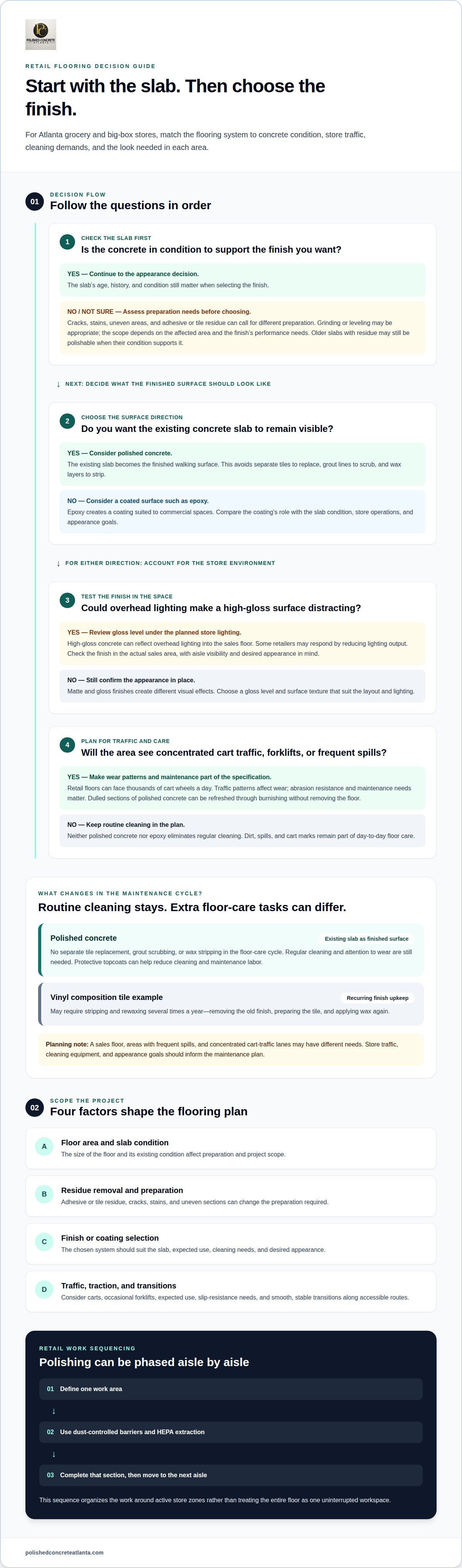
In a grocery store, floor care affects daily routines and long-term upkeep. Vinyl composition tile may require stripping and rewaxing several times a year. That cycle involves removing the old finish, preparing the tile, and applying wax again. Big-box retail concrete flooring takes a different approach: the slab itself becomes the walking surface, without separate tiles to replace, grout lines to scrub, or wax layers to strip.
Concrete still needs regular cleaning. Dirt, spills, and cart marks remain part of a store’s daily floor-care needs. The comparison is not cleaning versus no cleaning, but routine cleaning versus routine cleaning plus periodic stripping and rewaxing. This distinction helps facilities teams assess the work required across a large sales floor.
Protective topcoats can help reduce cleaning and maintenance labor. They protect the surface, while regular cleaning removes everyday soil. Consider the topcoat alongside store traffic, cleaning equipment, and appearance goals. A sales floor may have different needs from areas exposed to frequent spills or concentrated cart traffic, so one maintenance plan may not suit every zone.
Situation: A big-box sales floor needs regular cleaning, while its existing tile finish requires recurring upkeep. Action: The flooring plan uses the concrete slab as the finished surface and considers polishing with an appropriate protective treatment. Result: The store avoids tile replacement, grout scrubbing, and wax stripping as part of its floor-care cycle. Routine cleaning and attention to wear remain necessary.
Equipment can shape that routine. Some newer big-box floors are maintained with Diamabrush polishing heads fitted to Tennant scrubber machines. This example shows how machine-based care can fit retail cleaning operations. Big-box retail concrete flooring still needs maintenance suited to its surface condition and selected system.
Scheduling also affects how floor work fits store operations. Retail polishing can be phased overnight, aisle by aisle, using dust-controlled barriers and HEPA extraction. The work sequence defines an area, controls dust, completes that section, and moves to the next aisle. This organizes the project around active store zones rather than treating the entire floor as one uninterrupted workspace.
A practical plan links the chosen surface with cleaning methods and work sequencing. For example, a store considering a polished slab can evaluate its existing floor-care equipment and plan how aisles will be handled during the work. Big-box retail concrete flooring is easier to manage when maintenance expectations are part of finish planning from the start.
Floor choices for grocery stores and big-box retailers
Polished concrete and epoxy are two options for large retail floors. The choice depends on the slab’s condition, traffic, cleaning needs, and desired appearance. Polished concrete keeps the concrete visible, while epoxy creates a coated surface. Stores should also consider how handcarts, shopping carts, and occasional forklifts move through aisles and receiving areas. In Atlanta, those operating demands should guide the finish decision.
What slip-resistance and accessibility requirements apply to retail concrete floors? Specify traction and smooth, stable transitions along accessible routes, and consider how the selected finish performs under expected use. Gloss level and surface texture should suit the store’s layout and lighting.
What factors affect concrete flooring cost for a big-box store? The price depends on floor area, slab condition, residue removal, preparation, and the selected finish or coating. Project pricing follows a quote request, with the scope shaped by those conditions and performance needs.
How durable is concrete flooring under carts, forklifts, and heavy foot traffic? Retail floors can face thousands of cart wheels a day, so abrasion resistance and maintenance needs matter. Densified concrete resists abrasion better than resilient flooring and can last for decades, though traffic patterns affect how the surface wears.
Situation: An Atlanta big-box store needs a consistent finished surface across its sales floor. Action: The flooring plan weighs a concrete-look finish against a coating, based on the slab, store lighting, and intended use. Result: The selected system supports the facility’s appearance and operating needs without assuming one finish suits every area.
High-gloss concrete can reflect overhead lighting into the sales floor. Some retailers may respond by reducing lighting output, so gloss belongs in the design discussion alongside aisle visibility and the store’s preferred appearance. A matte finish creates a different visual effect. Evaluate the finish under the lighting planned for the actual sales area, not only in a sample viewed elsewhere.
How can a store address cracks, stains, or damaged concrete flooring? Start by assessing the affected area, then prepare the surface through appropriate grinding or leveling before applying a compatible finish. Stains may call for a different approach from cracks or uneven sections. The scope depends on the damage and how the finished floor needs to perform.
For store planning, connect slab preparation, traffic demands, and finish selection in one scope. Explore commercial concrete flooring options as part of that decision.
Polishing older slabs with glue or tile residue
Removing old flooring can expose a concrete slab that looks uneven, stained, or coated with adhesive. Polishing may still be possible, but assess residue before grinding begins. The glue’s type, thickness, and coverage affect preparation, as do cracks, patches, and prior repairs. An industrial or retail floor needs a plan based on the actual slab, not the appearance of one small test area.
Preparation starts by identifying residue and mapping the floor’s condition. Crews then determine how much adhesive to remove and whether damaged areas need leveling or repair. Grinding exposes the concrete and prepares it for progressive refinement. Dust control and clear work zones matter across occupied stores, especially when the project moves aisle by aisle. Each step helps establish whether the slab can produce a consistent polished appearance.
Adhesive can affect the finish if it remains on the surface. Residue may conceal the concrete’s color and texture, while grinding can reveal patches or differences between areas. Preparation needs to account for the final appearance, not just visible glue removal. If tile removal leaves old patching compound or uneven spots, address those conditions as part of floor preparation before polishing continues.
Situation: A store removes tile and finds adhesive across the exposed slab. Action: The floor is assessed, residue is removed through appropriate preparation, and the concrete is ground and refined in stages. Result: The remaining slab can be evaluated as a potential polished surface, with the finish shaped by its condition and the desired appearance. A representative test area can clarify how the existing concrete responds.
How long does it take to install or polish concrete flooring in a retail store? The schedule depends on floor area, adhesive coverage, slab condition, preparation required, and how the work is phased. A clean, accessible section may progress differently from an aisle with extensive residue or repairs. Sequencing the work around store operations also affects the timeline.
After residue removal, the exposed surface guides the remaining work. Grinding removes imperfections and prepares the slab for polishing; progressive refinement develops the selected sheen. If the surface reveals uneven sections, leveling may be needed for a consistent appearance. If patches differ in color, the finished floor may retain visible variation. Set clear expectations: polishing reveals the character of existing concrete rather than replacing it with a uniform new slab.
For an older retail floor, the decision rests on three practical steps: assess the slab, prepare it for the intended finish, then refine the concrete to the selected appearance. Adhesive removal is part of that sequence, not a shortcut around it. The result depends on how the existing slab responds to preparation and polishing.
What concrete finish and coating work best for high-traffic retail floors?
The right finish depends on slab history, store use, and performance goals. Polished concrete keeps the slab visible, while epoxy forms a coating over prepared concrete. For big-box retail concrete flooring, compare the intended appearance with traffic, cleaning routines, and exposure to substances that may affect the surface. A sales aisle and a receiving area can have different demands, so the finish decision should reflect how each area operates.
Polished concrete may suit a sales floor where the existing slab can serve as the finished surface. Densified concrete resists abrasion better than resilient flooring and can last for decades. However, polished concrete is not very resistant to chemicals or fuel. If a retail area encounters those substances, include that exposure when evaluating finishes rather than assuming one system fits every zone.
Epoxy offers a coated alternative for large grocery and big-box areas. A 100% solids epoxy remains as coating film because water or solvent does not evaporate during cure. Resin and epoxy products can cover retail areas seamlessly. That makes a coating system relevant when the facility wants a continuous surface and its requirements favor a coating over exposed concrete.
Situation: A grocery store needs a continuous surface across its retail area and a system suited to its use. Action: The flooring plan compares epoxy with polished concrete, weighing slab condition, exposure, maintenance expectations, and appearance. Result: The selected finish reflects the facility’s needs rather than applying a one-size-fits-all answer. That comparison is central to a durable plan for big-box retail concrete flooring.
Lighting changes how a finish looks. High-gloss polished concrete can reflect overhead lighting into the sales floor, affecting the appearance of aisles and displays. A lower-sheen finish creates a different visual effect. Evaluate samples under the store’s planned lighting and across areas where customers will see the floor. The comparison should account for both the concrete surface and the surrounding fixtures.
Traffic lanes also need a maintenance plan. If polished concrete dulls in busy sections, burnishing can restore those areas without demolition. This allows localized attention instead of removing the whole floor. For a coating system, consider planned cleaning and resurfacing needs during selection. The chosen finish should support the store’s upkeep approach as well as its immediate appearance.
Set the decision around slab condition, traffic, exposure, and visual goals. For a project-specific assessment of retail concrete and finish options, discuss your flooring needs.
Polished Concrete Atlanta: Epoxy Flooring
Polished Concrete Atlanta helps grocery and big-box retailers match floor preparation and finish selection to their slab and operating needs. Its epoxy flooring suits facilities seeking a coated surface, while polished concrete floors keep the slab itself as the finished surface. Stained concrete offers another option when appearance is a priority.
Turn to the team when an older floor has adhesive residue, when the slab needs preparation before finishing, or when you’re weighing epoxy against polishing for a retail area. The right scope starts with the floor’s condition, traffic, and performance goals, then aligns preparation with the selected finish. Clear decisions up front support a cohesive flooring project.
Contact Polished Concrete Atlanta to discuss your store’s concrete flooring needs.
Plan the next phase of your retail floor
Use your flooring decision to set a clear direction for the space: define the appearance you want, the demands each area faces, and how the finished surface should fit store operations. That gives your project a practical starting point, whether the priority is a polished slab, a coated finish, or a more decorative look. Big-box retail concrete flooring works best as a considered project, not a finish chosen in isolation.
Polished Concrete Atlanta offers Polished Concrete Floors, Epoxy Flooring, and Stained Concrete. Discuss the store’s slab, intended use, and finish goals with the team to shape the flooring scope around the facility’s needs.
Contact Polished Concrete Atlanta to discuss your retail flooring project. A clear plan can move your store toward a finish that suits its needs.
Frequently Asked Questions
What flooring is used in big-box retail stores?
Big-box stores use several flooring systems, including polished or sealed concrete, epoxy coatings, and resilient flooring such as vinyl composition tile. The choice can vary by zone within one location. A sales floor may prioritize appearance and cart traffic, while a stockroom or receiving area may need a different surface for its work demands. Existing slab condition and the desired cleaning routine also shape the selection.
What are the pros and cons of concrete floors in big-box stores?
Concrete can provide a durable finished surface without separate tile or grout, and densified concrete resists abrasion better than resilient flooring. Its limitations matter too: polished concrete is not very resistant to chemicals or fuel, and overhead lights can reflect off a high-gloss finish. A store handling chemical products should consider exposure areas separately, while sales-floor lighting should inform the chosen sheen.
How does polished concrete compare with epoxy and other retail flooring?
Polished concrete leaves the slab visible, while epoxy adds a coating over the prepared surface. Epoxy systems can provide chemical resistance, making them relevant where exposure is part of the operating environment. Resilient floors offer a different surface but may require periodic finish maintenance. For an Atlanta store, compare how each option aligns with slab condition, expected use, visual goals, and upkeep.
What maintenance and cleaning do polished concrete retail floors require?
Polished concrete retail floors need regular cleaning to remove everyday soil and spills, plus attention to wear in busy lanes. A practical routine includes removing loose debris before machine cleaning, since grit can be tracked through aisles by cart wheels. Keep cleaning methods consistent with the floor’s finish. If traffic lanes lose their sheen, burnishing can refresh dulled areas without replacing the entire floor.


